
A drawer is the most-used moving part in a kitchen and the least examined. People compare door fronts and worktops, then accept whatever runner the cabinet came with. That is backwards: the runner decides how the drawer feels in year one and whether it still closes in year seven. This guide breaks a drawer into five parts, gives the numbers that separate a good one from a cheap one, and ends with a test you can run in a showroom without tools.
1. Five parts, one job each
A drawer is a box (sides, base, back), a front, a pair of runners, and a fixing system that attaches the runner to the cabinet. Each part fails differently. The box warps, the base sags, the front pulls away, the runner loses its balls or wheels, and the fixing strips its screws. Knowing which part is under load tells you what to look at when a drawer starts to stick.
2. The three runner types
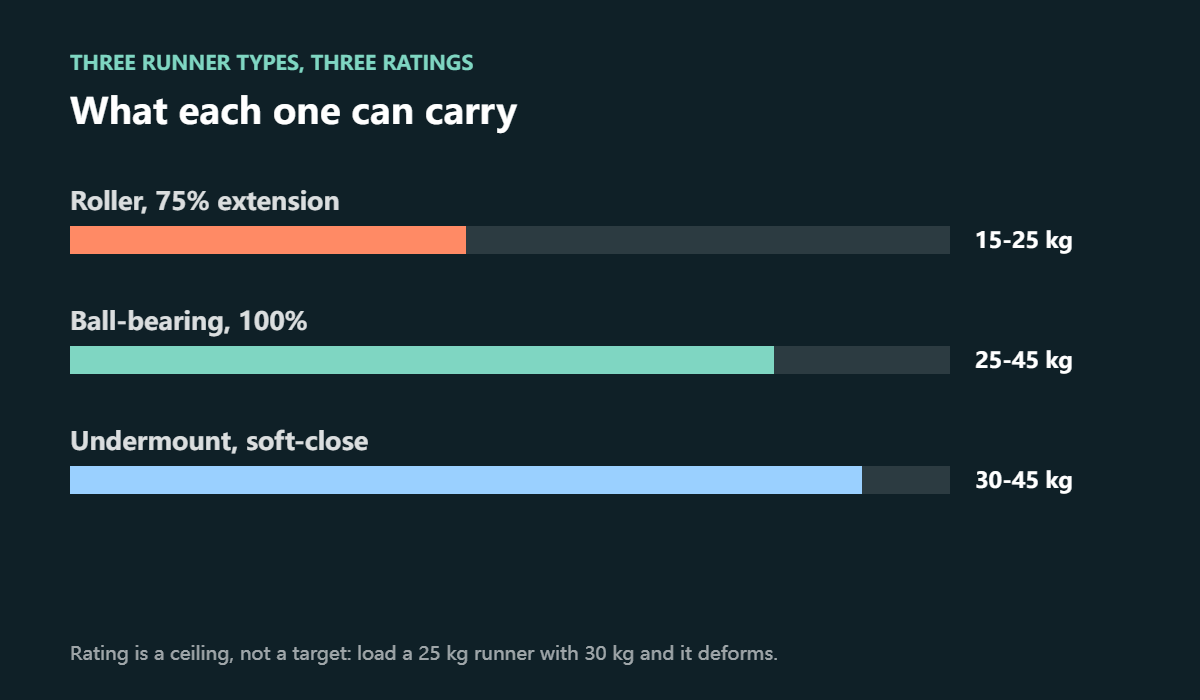
Roller runners are the cheapest: two wheels on a steel channel, usually rated 15-25 kg, with a partial extension of about 75%. They work, they are noisy, and they wear at the wheel axle. Ball-bearing runners use steel balls in a cage and are rated 25-45 kg with full extension, which means you can reach the back of the drawer. Undermount runners hide beneath the base, run on concealed rollers, and give a soft-close action; they are the quietest and the most expensive.
The rating matters more than the type. A 25 kg runner loaded with 30 kg of tins will still open – for a while – and then the cage deforms and the drawer drops. Always compare the runner rating with what you actually store.
3. Extension: the number nobody quotes
Partial extension of 75% on a 50 cm drawer leaves 12.5 cm of the drawer inside the cabinet. That is exactly where the things you never use end up, because you cannot see or reach them. Full extension (100%) pulls the whole box out, and it is the single upgrade with the biggest day-to-day effect.
4. Sag: why 16 mm and 18 mm are not the same
| Part | Cheap version | Better version | What it changes |
|---|---|---|---|
| Base panel | 3 mm hardboard, stapled | 5-6 mm board, grooved into sides | Whether the base bows under 10 kg |
| Side panel | 12-15 mm particleboard | 16-18 mm, dowelled or cam-locked | Racking and screw holding |
| Runner | Roller, 75% extension | Ball-bearing, full extension | Access to the back, smoothness |
| Load rating | 15-25 kg | 25-45 kg | Whether tins are safe |
| Fixing | Two screws per side | Four screws, or a metal bracket | Whether the front pulls away |
5. The 25 kg question
Twenty-five kilograms is the line where most domestic drawers either work properly or start to complain. A drawer full of tins and jars reaches 20-25 kg easily; a cutlery drawer rarely passes 8 kg. If you are planning a drawer for heavy items, buy a runner rated at least 1.5 times the expected load – so 35-40 kg for a pantry drawer – and fix it with four screws per side, not two.
6. Alignment and the 2 mm rule
Drawer fronts should sit within 2 mm of each other and of the cabinet edge. More than that and the eye reads the whole kitchen as crooked, even when the boxes are perfect. The fix is at installation: fit the runners to the cabinet first, then the box, then the front last, adjusting the front with its own screws. Trying to align a front before the runner is square is the most common DIY mistake.