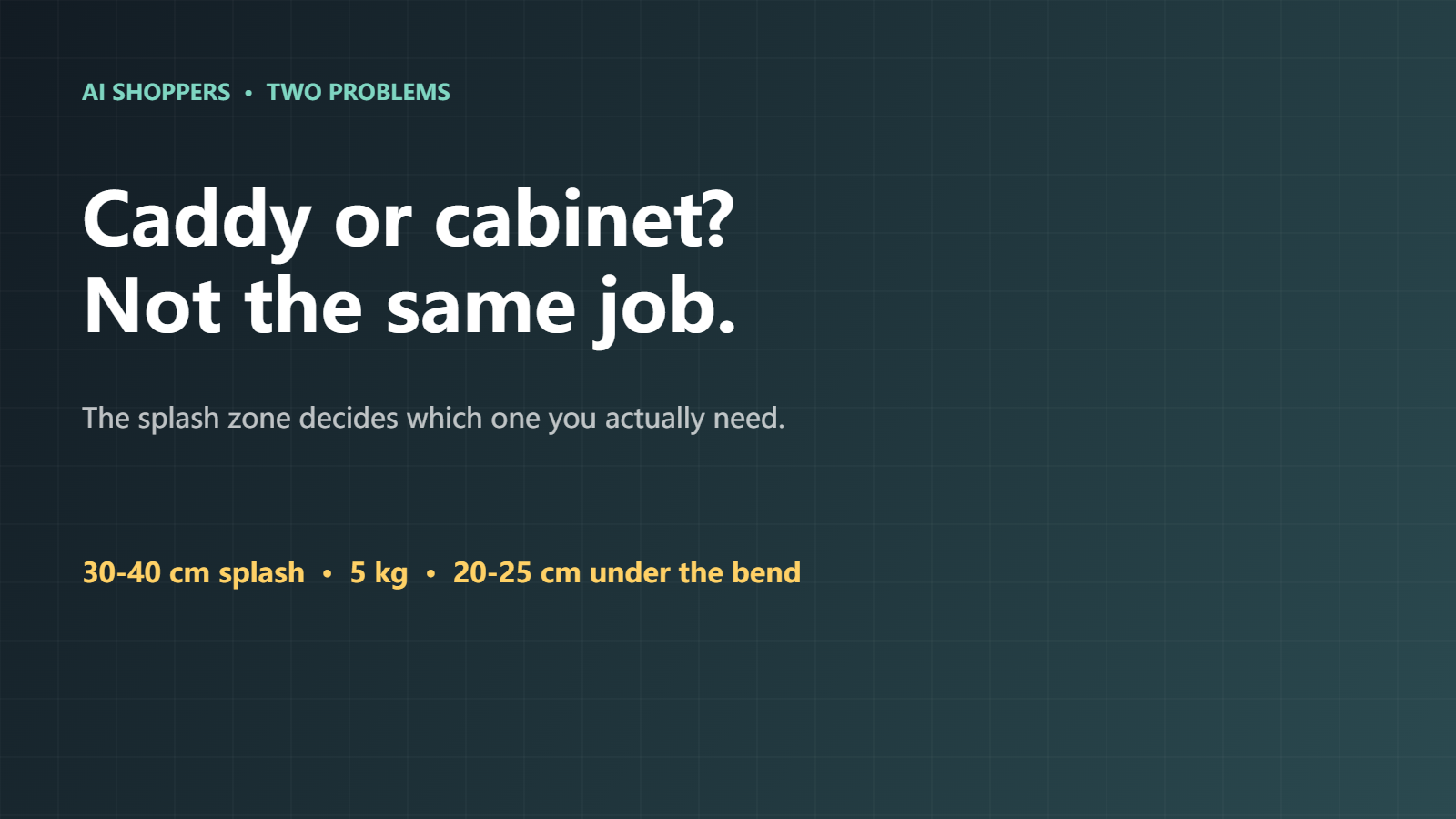
These two products get filed under the same heading and solve opposite problems. A sink caddy handles what you use every day and want within reach of wet hands. An under-sink organizer handles what you want out of sight and away from the splash zone. Buying one when you need the other is the most common storage mistake in a kitchen – and it is easy to avoid once you know which problem you actually have.
1. The splash zone is the dividing line
A tap running at normal pressure throws water roughly 30-40 cm sideways, and a hand-held spray can reach further. That defines a wet band around the basin where anything stored will be damp most of the day. A caddy lives inside that band by design: it is meant to hold wet sponges and dripping bottles. An under-sink organizer lives below and behind it, where the only water is a slow leak you have not noticed yet.
2. What a caddy is actually good at
A hanging or counter caddy holds the six to eight things you touch while washing up: sponge, brush, washing-up liquid, steel wool, a scraper, a cloth. Capacity matters less than drainage. A flat tray holds a 2-3 mm film of water around every base, and that film turns into the pink-orange biofilm people blame on hard water. Slotted or wire bottoms drain in minutes and stay clean with a weekly rinse.
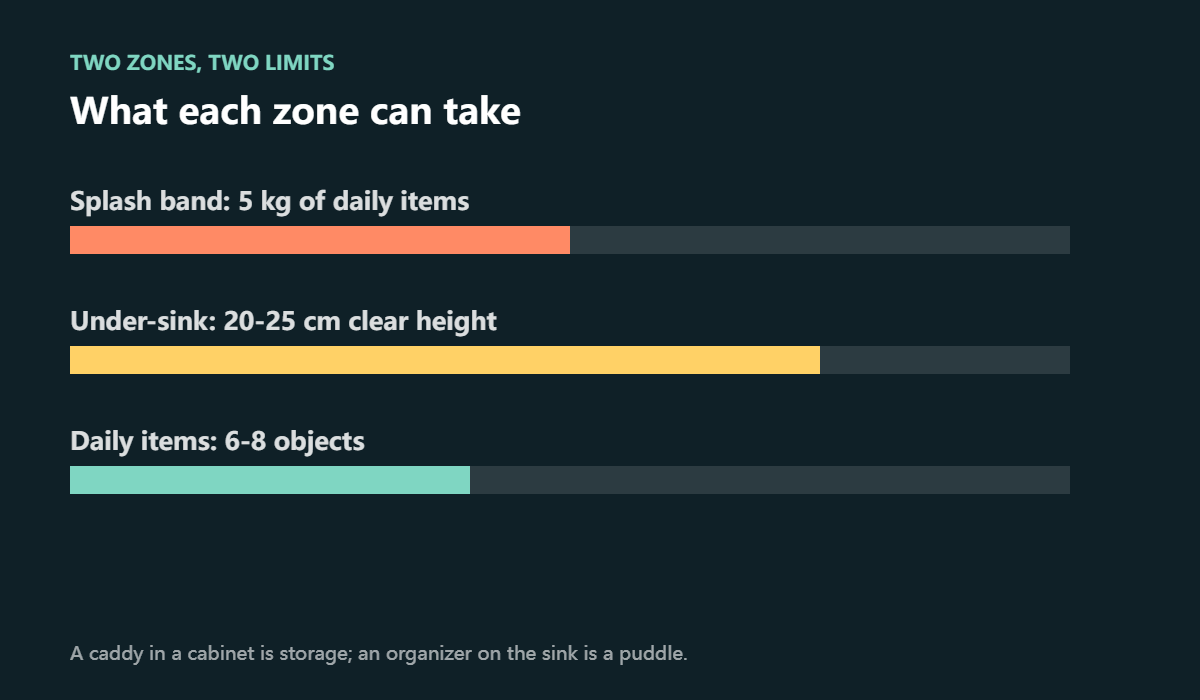
Two numbers decide whether it works: the distance from the tap to the wall (usually 20-30 cm, which is all the shelf depth you get) and the weight it must hold when every bottle is full – a litre of washing-up liquid is about 1.05 kg, and six items easily reach 5 kg.
3. What an under-sink organizer is actually good at
Under the sink is the awkward volume of a kitchen: 60 cm deep, 70-80 cm high, interrupted by a U-bend and a water valve. The usable space is the two flanks and the low shelf, not the middle. A pull-out or two-tier organizer recovers that volume by splitting it horizontally, so cleaning products sit in front of the pipe rather than behind it.
The constraint here is height, not weight. A 30 cm tall caddy will not fit under a 25 cm pipe bend, and a shelf that clears the bend leaves only 20-25 cm above it. Measure from the cabinet floor to the lowest point of the plumbing before buying anything.
4. Side by side
| Sink caddy | Under-sink organizer | |
|---|---|---|
| Job | Daily items within reach | Bulk and refills out of sight |
| Location | Inside the 30-40 cm splash band | Below the basin, behind the cabinet door |
| Key dimension | Wall-to-tap depth, 20-30 cm | Cabinet floor to pipe bend |
| Key limit | 5 kg when full | Height under the U-bend |
| Failure mode | Standing water, biofilm | Leaks and rust at the base |
| Ventilation | Needs slots or wire | Needs an occasional airing out |
5. The 5 kg rule for anything hanging
Adhesive mounts hold 3-5 kg on smooth, clean, dry surfaces and less on textured tiles. A caddy loaded with six full bottles is right at that limit, and the failure happens at the far edge, where the leverage is greatest. If the caddy hangs from a screen or a tap rather than a wall, the limit is the frame, not the adhesive – but the same rule applies: heavy bottles nearest the support, light items on the outside.
6. Leaks you will only find later
Under-sink storage has one quiet failure: a slow drip that soaks the back of the cabinet for months. Anything stored there should be in a tray or on a raised shelf, and the base should be visible – not packed to the back. Once a month, empty the front row and run a hand along the cabinet floor. Damp particleboard swells and never returns to shape, and that repair costs more than the organizer.
7. Which one to buy first
If your counter has three bottles, two sponges and a brush permanently on it, buy the caddy first: it removes visual clutter from the most visible 60 cm in the kitchen, at the lowest cost. If your counter is clear but the cabinet under the sink is a pile of half-empty bottles you cannot reach, buy the organizer. If both are true, buy both – they do not overlap, which is the point.
8. Materials that survive a wet band
Inside the splash zone, plastic and aluminium are the safe choices; coated steel survives only if the coating is intact at the welds, which is where it fails first. Below the sink, the risk is chemical rather than wet: bleach and descaler corrode cheap chrome and eat through thin coatings. Stainless steel or plastic trays last; wire racks rust at the joints within a year in a damp cabinet.
9. A ten-minute setup that stays tidy
- Empty the counter and the cabinet completely, then wipe both dry.
- Measure wall-to-tap depth and the height under the pipe bend.
- Put the eight daily items in the caddy, and nothing else.
- Group under-sink products by job: washing, cleaning, refills.
- Leave the back 10 cm of the cabinet empty so a leak is visible.
10. The one item people forget
Both setups fail for the same missing piece: a place for the thing that is wet right now. A caddy with no drip tray soaks the counter; an under-sink cabinet with no tray soaks the board. A cheap plastic tray – 2 cm deep, slightly wider than the caddy – solves both, and it is the difference between wiping a surface once a week and replacing swollen chipboard after a year.
Put the tray under the caddy, not beside it, and empty it when you rinse the sponges. That single habit removes most of the smell complaints associated with sink storage.
11. When neither is the answer
If the counter is short and the cabinet is full, the constraint is not organization but volume. In that case the answer is a wall-mounted rail above the sink – a 60 cm rail with four hooks holds the same eight items, uses zero counter space, and drains by hanging rather than sitting. It costs less than either product and solves the space problem instead of rearranging it.
Frequently asked questions
Can a caddy replace an under-sink organizer?
No. A caddy holds daily items in the splash zone; an organizer recovers the awkward volume below the basin. They solve different problems and usually coexist.
How much weight can an adhesive caddy hold?
Typically 3-5 kg on smooth, clean, dry tiles, and less on textured surfaces. Keep full bottles near the support and light items at the outer edge.
Why does my caddy go pink?
Biofilm in standing water. A slotted or wire base drains in minutes; a flat tray holds a 2-3 mm film. Rinse weekly either way.
What height do I need under the sink?
Measure from the cabinet floor to the lowest point of the U-bend – often only 20-25 cm. Two shallow tiers usually beat one tall box.
Does an under-sink organizer need to be pulled out?
Not necessarily, but a pull-out makes the back reachable. If you keep a fixed shelf, leave the rear 10 cm empty so leaks stay visible.
Honest disclosure: dimensions and weights are typical ranges for domestic kitchens, not a specification for your cabinet.
Gear referenced in this guide
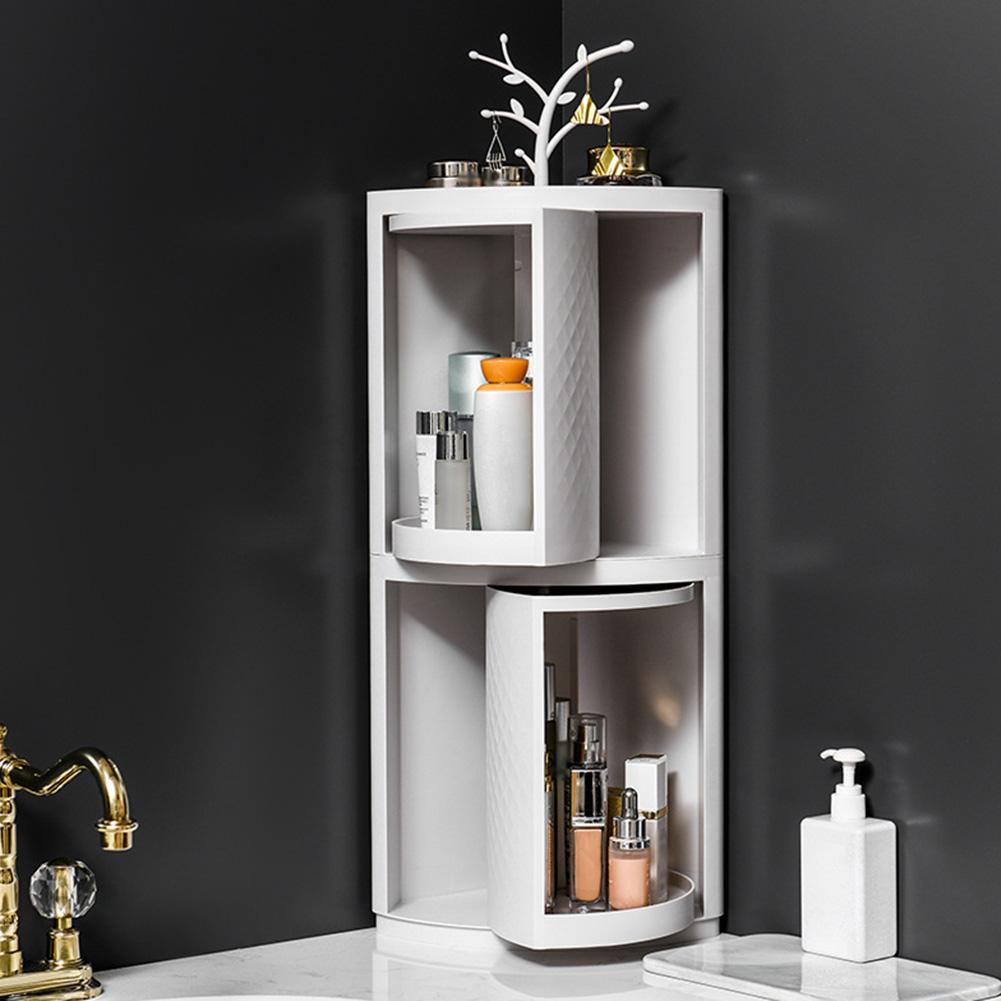
Rotatable Corner Bathroom Organizer, Wall-Mounted
For the corner that a caddy cannot use and a cabinet shelf cannot reach.
$54.99
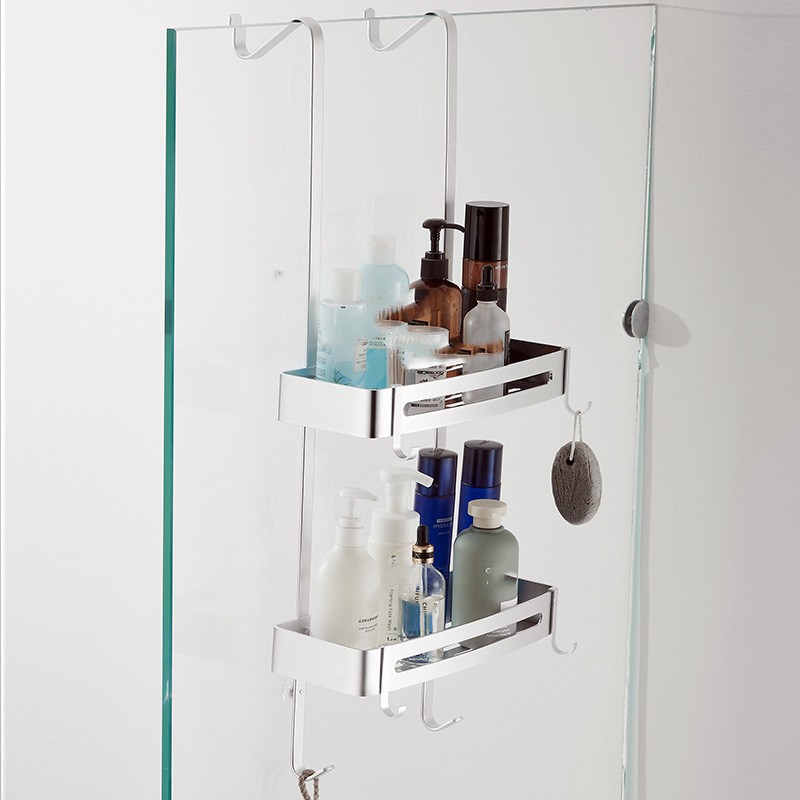
Aluminium Hanging Shower Caddy, Double Basket
Slot drainage and a hollow frame: the wet-band version of the caddy described above.
$63.99
Compare on Amazon — this category usually has more brands, sizes and price points there.
Check current prices on Amazon →
As an Amazon Associate we earn from qualifying purchases. The price you pay is unchanged. Disclosure