Bathroom Storage for Two: Dividing 60 Centimetres Without a Fight

Sixty centimetres, two people: how to split a bathroom so nobody negotiates daily.

Bathroom storage for two
Sixty centimetres, two people, one set of rules.

Sharing a bathroom is not a storage problem until two people put their things in the same 60 centimetres. Then it becomes a negotiation with no referee: whose bottle goes at the front, whose razor falls off the edge, whose towel ends up on the floor. The fix is not more shelves – it is a division of space that both people can follow without discussion.

1. Start with the counter, not the cabinet

A typical basin counter is 100-120 cm wide and 50-60 cm deep. Two people need roughly 30 cm of personal width each, plus a shared middle for soap and a hand towel. That leaves the counter effectively full before anything is stored, which is why the cabinet and the walls have to carry the load. Measure your counter, subtract 20 cm for the tap zone, and divide the rest by two – that number is your personal width, and it is usually smaller than people expect.

2. The 90-150 cm band belongs to both of you

The band between 90 and 150 cm above the floor is the only zone reached without bending or climbing, and it is the fairest space in the room: both people can use it. Put shared items there – toothpaste, hand wash, the daily moisturiser – and put personal items above or below. A shelf at 110 cm serves two people; a shelf at 170 cm serves whoever is tallest.

3. Two caddies beat one big shelf

The single most effective change is giving each person their own container. Two hanging caddies, one per side of the shower, end the “where is my razor” problem permanently and cost no floor space. A double-basket aluminium caddy holds about 5 kg when full, drains through slots instead of holding a 2-3 mm film of water, and can be lifted off in one movement – which is also what makes cleaning the screen a two-minute job.

4. Split the cabinet by height, not by side

Splitting a cabinet into left and right halves sounds fair and works badly: the left half is usually nearer the door, so it gets used more. Split by shelf instead. The top shelf holds shared bulk (spare towels, refills), the middle two are one each, the bottom holds heavy items – 5 kg per shelf is the practical limit for a 16 mm shelf, and a large shampoo bottle is 1.05 kg. Two people, four shelves, no overlap.

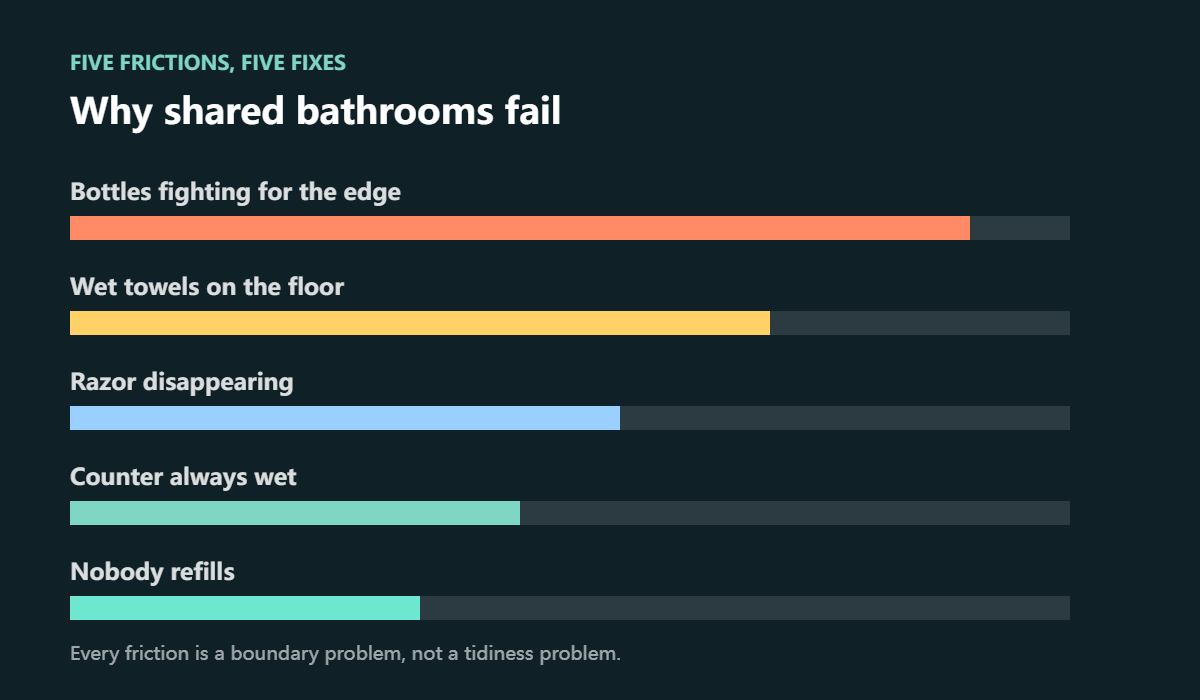
5. The five things that cause 90% of the friction

Friction Cause Fix Number
Bottles fighting for the edge One shared shelf, no boundary One tray per person 30 cm each
Wet towels on the floor One hook, two towels Two hooks, 60 cm apart 5 kg each
Razor disappearing Shared caddy Personal caddy 2 units
Counter always wet No drainage Slotted holder 2-3 mm film gone
Nobody refills Shared stock, no owner Alternate months 12 refills/yr
Five frictions and fixes
Why shared bathrooms fail: five boundaries, not five habits.

6. Hooks: the cheapest fix in the room

Two hooks on the back of the door solve the towel problem for about the price of a coffee. Space them 60 cm apart so two towels can dry without touching – towels that touch stay damp in the middle and smell within a day. Adhesive hooks hold 3-5 kg on smooth, dry paint; if the door is textured or the bathroom steams heavily, use over-door hooks rated 5-10 kg instead.

7. The shower: one wall, two zones

A 75-90 cm wide shower has two usable walls. Give each person half of one wall rather than one wall each – that keeps both caddies inside the 1.0-1.3 m splash band where they dry fastest, and leaves the other wall free for the shower head and controls. Height: mount the bottom edge at 110-120 cm, so the lowest bottles clear the spray at hip height while staying reachable with a wet hand.

8. The corner nobody uses

A 90-degree corner with 40 cm of wall on each side encloses about 0.08 square metres – enough for the things that clutter the counter but not enough for a shelf you can reach. A rotating corner unit turns that dead triangle into a usable surface and swings 20-30 cm out so the back is reachable. It is the only storage in the room that adds capacity without taking floor or counter space from either person.

9. Cleaning is a storage decision

The bathroom that takes ten minutes to clean is the one where nothing has to be lifted twice. Two caddies lift off in one hand; two trays lift off in one hand; the bottles on the counter, one at a time, do not. If you want to spend less time cleaning, reduce the number of separate objects on any horizontal surface to two per person – and give everything else a hook, a basket or a corner unit.

10. The one-page agreement

Write it down, because verbal divisions drift within a week: who owns which shelf, which caddy, which hook; what is shared and restocked alternately; and the rule that nothing lives on the counter except the two daily items. Four lines, stuck inside the cabinet door. It sounds excessive for a bathroom; it is the difference between a room that stays usable and one that reverts to a pile every fortnight.

11. The two-item rule on the counter

Two people, two items each: that is the entire counter allocation. Not two categories, not two shelves – two objects, per person, on the counter, daily. Everything else lives on a wall, in a caddy or in the cabinet. Applied honestly, this single rule removes the wet counter, the bottle shuffle and the “whose is this” question in one move, and it costs nothing to implement.

If two per person feels severe, start with three and count what accumulates after a week. Almost always the third item is something used twice a week – a hair oil, a night cream – and it belongs in a drawer, not on the surface you both wipe down.

12. When one of you travels

Shared bathrooms reset badly when one person is away: the absent person’s caddy stays up, the toiletries go stale, and the returning traveller finds everything where they left it but no space to unpack. The fifty-fifty split has a simple fix – a travel kit that lives in the cabinet, so the returning person uses it for the first week while the main caddy is washed and refilled. It is a ten-minute habit that prevents the usual fortnight of clutter on the counter.

Frequently asked questions

How much counter space does each person need?

About 30 cm of personal width, with a 20 cm tap zone left shared in the middle. On a 100-120 cm counter that leaves very little, which is why wall storage matters.

How much weight can a shower caddy hold?

Roughly 5 kg when full, and adhesive mounts are rated 3-5 kg on smooth dry surfaces. Keep heavy bottles near the support.

Where should a shared shelf go?

Between 90 and 150 cm above the floor – the band both people reach without bending or climbing.

Do two caddies really beat one shelf?

For two people, yes: they remove the shared-boundary problem and cost no floor space. One caddy shared by two people is the single most common source of daily friction.

How do I stop towels smelling?

Space hooks 60 cm apart so towels dry without touching, and wash the hook area monthly. Towels that stay folded together stay damp in the middle.

Honest disclosure: dimensions and weights are typical ranges for domestic bathrooms, not a specification for yours.

Gear referenced in this guide

Aluminium hanging shower caddy

Aluminium Hanging Shower Caddy, Double Basket

Two baskets, one per person, draining through slots instead of pooling water.

$63.99

Rotatable corner bathroom organizer

Rotatable Corner Bathroom Organizer, Wall-Mounted

The 0.08 m2 corner that adds capacity without taking counter from either person.

$54.99

Compare on Amazon — this category usually has more brands, sizes and price points there.

Check current prices on Amazon →

As an Amazon Associate we earn from qualifying purchases. The price you pay is unchanged. Disclosure

Structured guide fields (summary, verdict, best for, criteria, pros and cons) appear here once content is added.
0 0 votes
文章评分
Subscribe
Notify of
guest
0 评论
Oldest
Newest Most Voted