
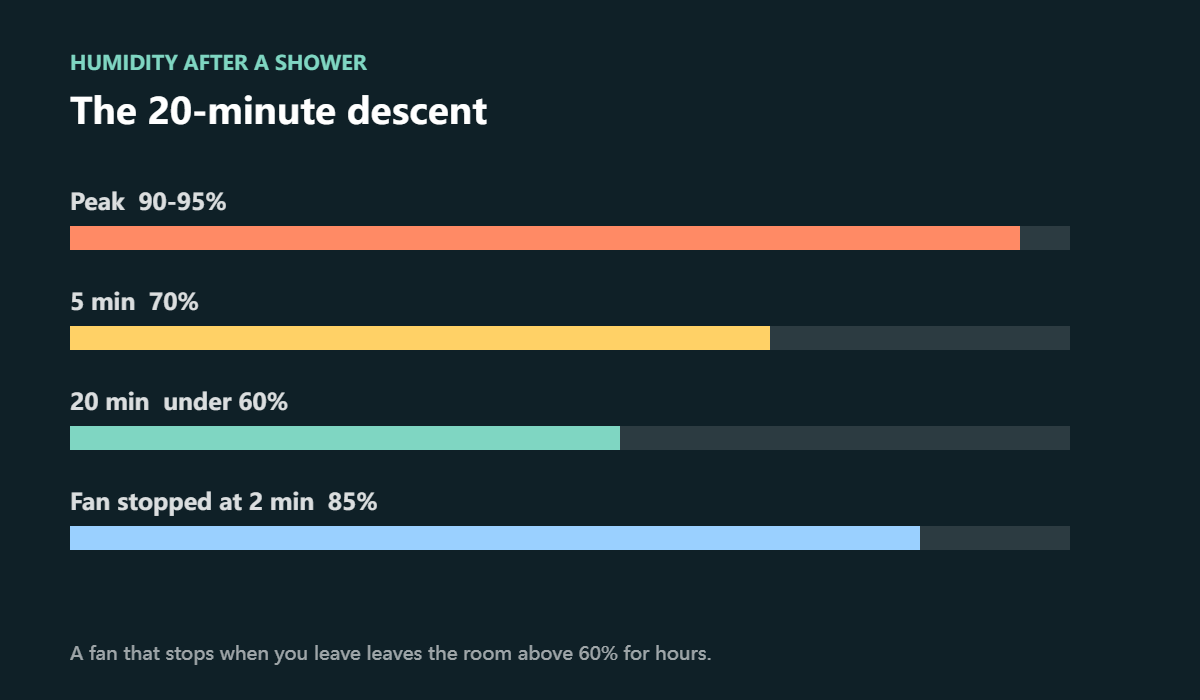
Mould behind a shelf is not a cleaning problem; it is a ventilation problem with a measurable cause. A shower pushes a small bathroom past 90% relative humidity in minutes, and it takes 20-40 minutes with an extractor to fall back under 60% – the level below which mould stops growing on cold surfaces. Everything else – the paint, the grout, the shelf you mounted at 110 cm – is downstream of that number.
1. What a shower actually does to the air
A ten-minute shower at 38 C releases roughly 0.5-1 litre of water into the air as vapour, plus splashes that evaporate later. In a 4 square metre bathroom with a 2.4 m ceiling – about 9.6 cubic metres of air – that is enough to push relative humidity from 50% to 90%+ within a few minutes. Warm air holds more moisture, so the problem peaks just after the shower, not during it.
2. The 60% line
Mould germinates above roughly 60-70% relative humidity on a cold surface, which is why the same bathroom grows black spots behind the toilet but not on the mirror. The target is not “dry”, it is **under 60% within 20 minutes** of the shower ending. A cheap hygrometer costs less than a tube of silicone and turns this from guesswork into a number.
3. Fan sizing: cubic metres per hour
| Bathroom volume | Minimum extract rate | Typical fan | Noise |
|---|---|---|---|
| 6 m3 (small, 2.5 m2) | 54 m3/h | 60-70 m3/h | 25-30 dB |
| 10 m3 (typical) | 90 m3/h | 90-100 m3/h | 30-35 dB |
| 14 m3 (large) | 126 m3/h | 130-150 m3/h | 35-40 dB |
| No window, internal room | +20% | 110-180 m3/h | In-line fan |
The rule of thumb is nine air changes per hour: multiply the room volume in cubic metres by 9 and you have the minimum extract rate. An inline fan in the loft usually beats a wall fan of the same rating, because the motor is not fighting the grille.
4. The eight-minute rule
A fan on a light switch stops when you leave – usually 2-3 minutes after the shower, when the air is still at its wettest. That is the single most common mistake. Set the overrun timer to **8-10 minutes** after the light goes off; the last of the moisture leaves during that window, not during the shower. Timers with a humidity sensor do this automatically and are worth the extra cost in a windowless bathroom.
5. Why the door matters more than the window
Opening a window for two minutes in winter feels effective and is mostly theatre: cold air holds little moisture, and the warm humid air condenses on the first cold surface it meets – usually the wall behind the towel rail. A fan that runs for eight minutes moves the whole air volume; a window open for two exchanges a fraction of it. If you have both, run the fan and leave the window on the latch.
6. Where the water ends up
Moisture does not disappear – it condenses. The coldest surfaces in a bathroom are usually the external wall, the window reveal, the underside of a shelf and the grout lines. That is why mould appears in horizontal lines at shelf height: the shelf is a cold bridge that holds a film of water. Mounting a shelf with a 5 mm air gap behind it costs nothing and removes the bridge.
[…] the same measured approach: how humidity behaves in a bathroom and when a fan actually clears it (the eight-minute ventilation rule), and why wet floors fail long before the surface wears out (the four materials that stop […]