The Pet Feeding Station: Bowl Height, Fifteen Degrees and the Splash Zone

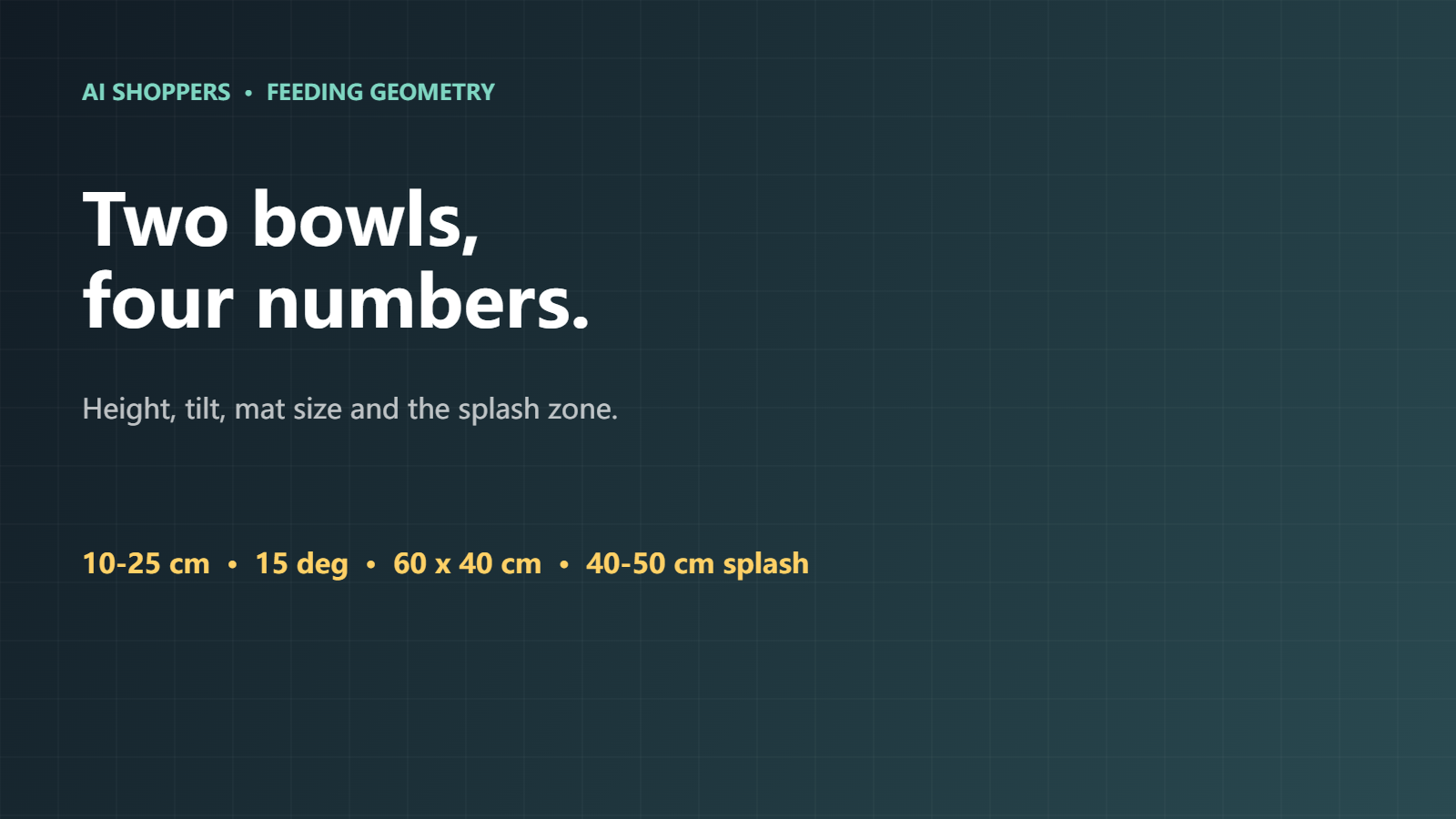
Bowl height, a 15-degree tilt and a 60 x 40 cm mat: the numbers behind a feeding station that stays clean.

Pet feeding station
Height, tilt, mat size and splash zone.

A feeding station looks like the simplest thing in the house – two bowls on a mat – and it is the one that decides how much kibble ends up on the floor, how often you wash the mat, and whether an older dog eats in comfort. The numbers are small: 10-15 cm of bowl height, a 15-degree tilt, a mat of 60 x 40 cm, and a 40-50 cm splash radius. Get them right and feeding stops being a daily cleaning job.

1. Bowl height is a joint decision

A cat eats comfortably with the bowl at floor level; a large dog does not. The rule of thumb relates bowl rim height to the dog’s shoulder: roughly one third of shoulder height for a raised feeder. A 60 cm beagle does well at 15-20 cm; a 70 cm Labrador at 20-25 cm. Below that, the neck angles down and the front legs splay; above it, the dog has to reach and swallows air.

2. The fifteen-degree tilt

A bowl tilted 15 degrees toward the animal reduces neck flexion without raising the rim. It matters most for flat-faced breeds and for older animals with arthritis, where a shallow angle is the difference between finishing a meal and leaving half of it. Tilted bowls also slow fast eaters slightly, because the food gathers at the low edge.

3. Why the mat is 60 x 40 cm

Item Typical size Why Watch out
Food bowl 16-20 cm diameter Fits a 10 kg bag portion Too deep = whisker fatigue in cats
Water bowl 18-22 cm Holds 500-800 ml Refill twice daily
Mat 60 x 40 cm Catches the 40-50 cm splash Needs a raised lip
Raised rim 1.5-2 cm Stops water running off Flat mats fail in a week
Stand height 10-25 cm One third of shoulder height Adjustable is better

4. The splash zone is 40-50 cm

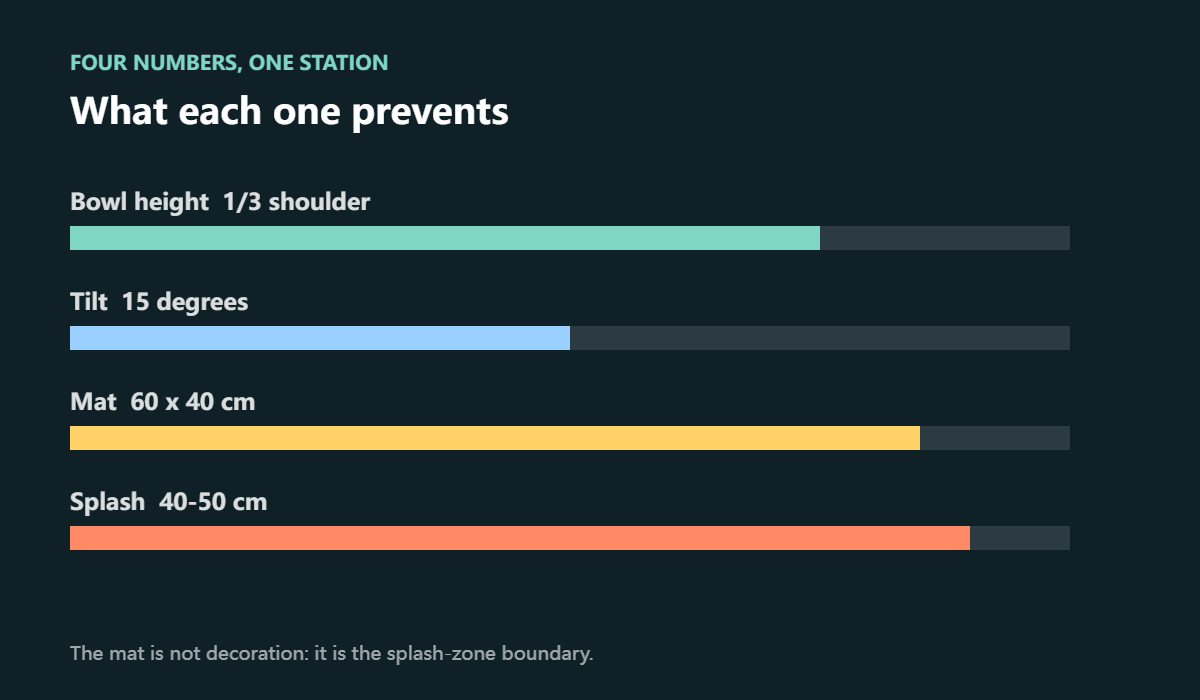
A dog drinking from a 20 cm bowl flicks water roughly 40-50 cm in front of and beside the bowl; a cat flicks less but drinks more often. That is why the mat has to be wider than the bowls by at least 15 cm on each side – not for aesthetics, but because water lands there. A mat narrower than the splash zone simply moves the puddle onto the floor.
Four feeding numbers
Four numbers, one station.

5. Material: what survives daily washing

Silicone mats tolerate hot water and dishwasher cycles and lie flat; TPR mats grip better but warp above 90 C; fabric mats with a waterproof backing look better and need machine washing twice a week. The number that matters is wash frequency: a mat that takes 30 seconds to wipe gets cleaned; one that needs a machine cycle gets left until it smells.

6. The 2 x 4 rule for cats

Cats prefer shallow, wide bowls – roughly 2 cm deep and 14-16 cm wide – because their whiskers touch the sides of narrow bowls. Two bowls side by side, 4 cm apart, separated from the water by at least 20 cm, matches most cats’ preference for not drinking where they eat. That last detail is the one most feeding stations get wrong.

7. Food storage beside the station

A 10 kg bag of kibble goes stale in 4-6 weeks once opened, so the station needs a sealed bin of 15-20 litres holding about 8 kg. Keep it below 25 C and away from the radiator; a bin next to a warm wall is the fastest way to rancid fat. The scoop lives in the bin, not in the bag, because a scoop buried in kibble is a scoop you stop using.

8. Water: 50 ml per kilogram per day

A 10 kg dog drinks roughly 500 ml a day, a 30 kg dog about 1.5 litres. A 500 ml bowl therefore needs refilling twice for a medium dog, which is why the bowl size matters more than the stand. In summer, add 20-30%; in winter, a dog eating wet food may drink less and still be fine.

9. The 5 kg question for raised stands

A raised stand with two bowls and a full water bowl weighs 3-5 kg, and a dog leaning on it adds another 5-10 kg of lateral force. That is why plastic stands with thin legs tip, and why a 3-4 kg base or a wall-adjacent position matters. If the stand is on tile, rubber feet are not optional.

10. Cleaning routine that takes two minutes

  1. Shake the mat into the bin, not the sink – kibble blocks drains.
  2. Wipe with hot water; use a pet-safe cleaner weekly.
  3. Wash bowls daily in hot water, or every second day if dry food only.
  4. Check the bin seal monthly; replace if it no longer snaps.
  5. Rinse the water bowl twice daily in summer.

11. Placement: the three no-go zones

Not next to a radiator (food goes rancid, water evaporates), not in a walkway (bowls get kicked), and not beside a litter tray (most animals refuse to eat there). The best spot is a corner with a wall on two sides, which also stops the bowl sliding – a corner does the job of a non-slip mat.

12. What to buy, in order

First a mat with a raised lip, 60 x 40 cm. Second, a stand at one third of shoulder height, adjustable if the animal is still growing. Third, a sealed 15-20 litre food bin. Fourth, two bowls of different heights for a multi-pet house. Everything else – slow feeders, puzzle bowls, decorative ceramic – is a behaviour tool, not a feeding station.

13. Multi-pet households

Two animals mean two stations, not one bigger one: a shared bowl creates guarding behaviour within days, and the faster eater finishes both portions. Separate them by at least a metre, in sight of each other but not within reach – that keeps the social structure intact without the resource competition. If one animal is on a prescription diet, the separation is not optional.

Water is the exception: one large bowl of 1-1.5 litres is usually better than two small ones, because a shared water source does not trigger guarding the way food does. Wash it twice daily and refill rather than top up – stale water is the reason cats start drinking from the tap.

14. Travel: the station that folds

For a weekend away, the station has to collapse to under 5 cm: a silicone mat that rolls, two collapsible bowls of 500 ml, and a 2-litre water bottle. That kit weighs about 400 g and lives in the car boot next to the food bin, which is the only way it is still there when you need it. Bowls that stay at home get left at home.

Frequently asked questions

How high should a dog’s bowl be?

Roughly one third of shoulder height: 15-20 cm for a beagle-sized dog, 20-25 cm for a Labrador. Too high and the dog reaches and swallows air.

Does a tilted bowl help?

Yes for flat-faced breeds and older animals – a 15-degree tilt reduces neck flexion without raising the rim.

How big should the mat be?

60 x 40 cm with a 1.5-2 cm raised lip. The splash zone is 40-50 cm, so the mat must be wider than the bowls by 15 cm each side.

Should food and water be separated?

For cats, yes – at least 20 cm, ideally in different spots. Many cats prefer not to drink where they eat.

How much water does a dog need?

About 50 ml per kilogram per day: 500 ml for a 10 kg dog. Add 20-30% in summer.

Honest disclosure: dimensions and volumes are typical ranges for domestic pets and standard bowls, not veterinary advice.

Gear referenced in this guide

Corner organizer

Rotatable Corner Bathroom Organizer, Wall-Mounted

Keeps scoop, wipes and spare kibble off the floor beside the bowls.

$54.99

Folding trunk organizer

Folding Car Trunk Organizer Storage Box, 70 L Oxford

For travel days: bowls, food and towel in one liftable box.

$65.99

Compare on Amazon — this category usually has more brands, sizes and price points there.

Check current prices on Amazon →

As an Amazon Associate we earn from qualifying purchases. The price you pay is unchanged. Disclosure

Structured guide fields (summary, verdict, best for, criteria, pros and cons) appear here once content is added.
0 0 votes
文章评分
Subscribe
Notify of
guest
0 评论
Oldest
Newest Most Voted