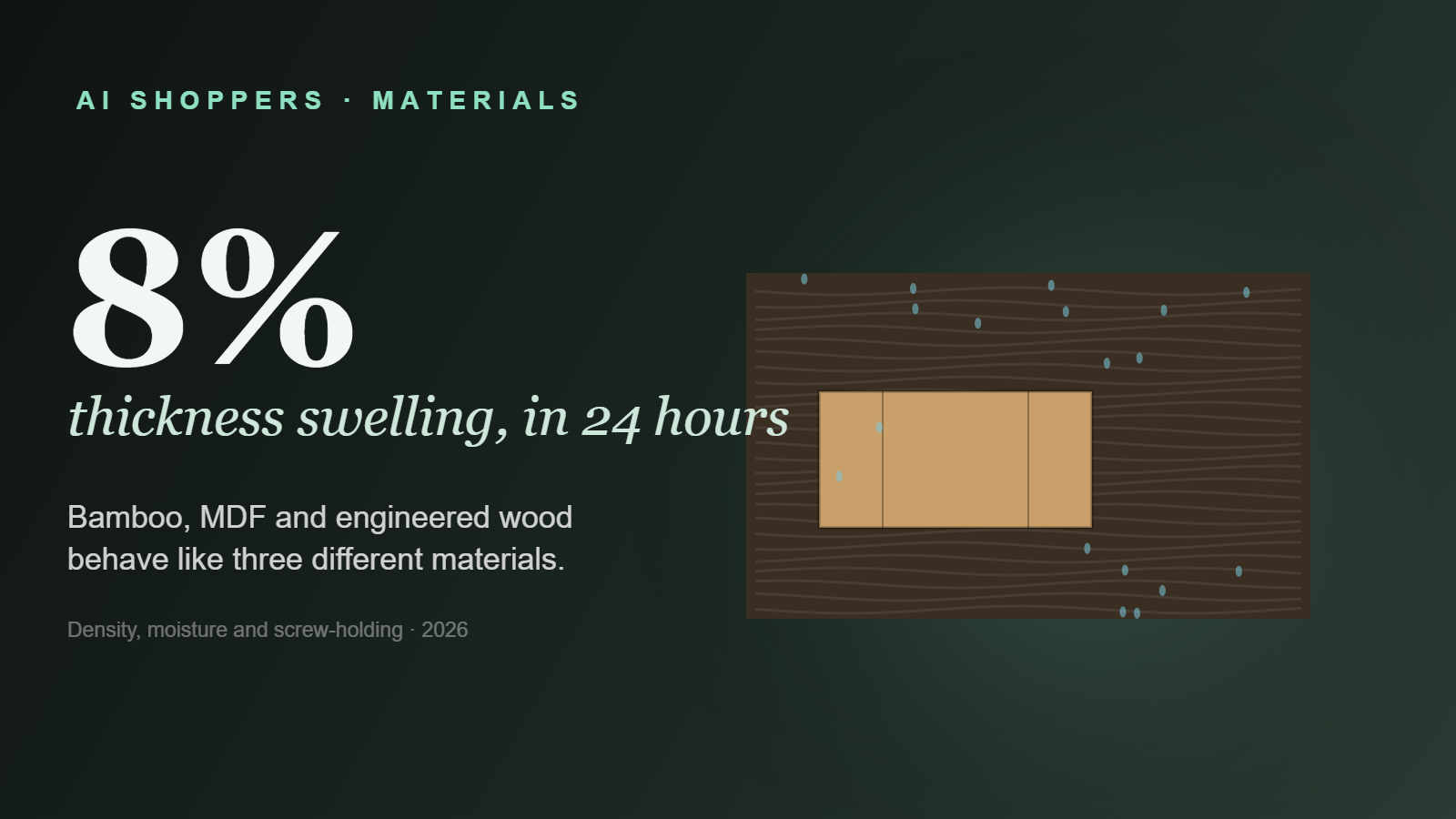
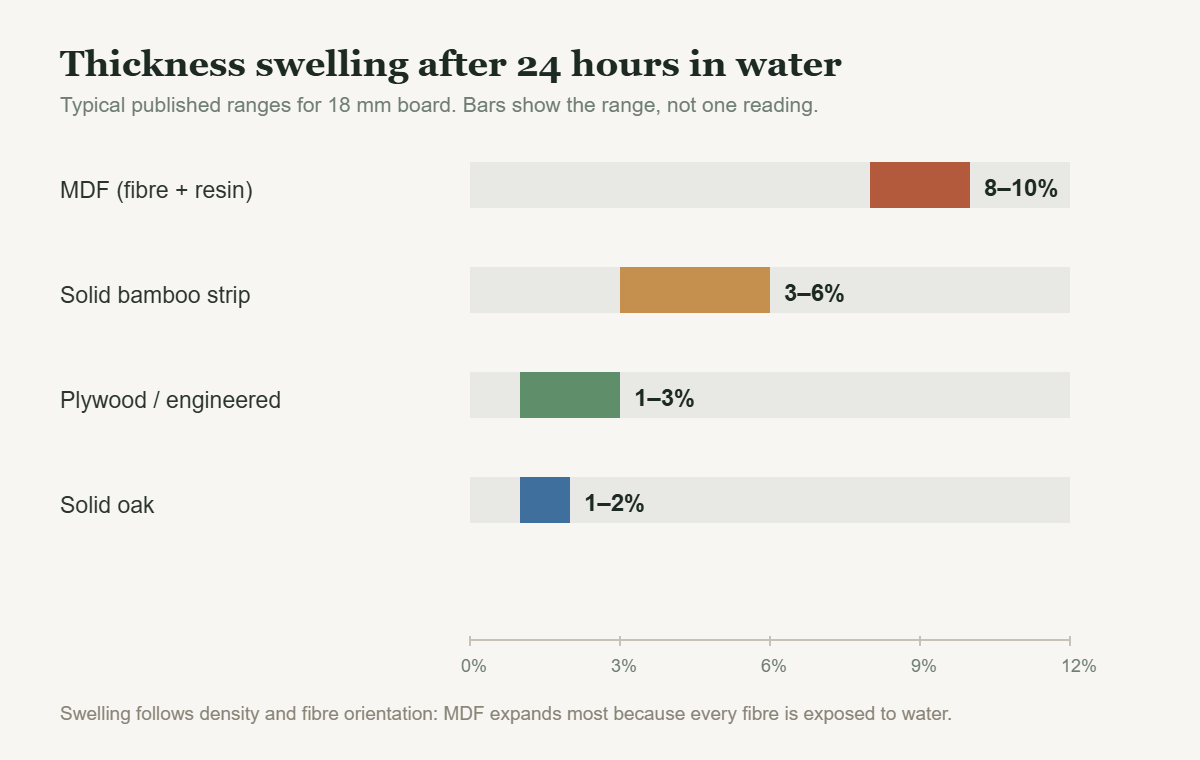
“Wood” on a product page covers at least four different materials, and they disagree about water by a factor of five. A solid bamboo drawer box swells roughly 3–6 percent in thickness after a day in water. An MDF box swells 8–10 percent. Plywood sits at 1–3 percent, and solid oak at 1–2. Put any of them next to a kitchen sink for two years and the difference stops being academic: the MDF version swells at the cut edges, the laminate lifts, and the joint that held the screw opens by a millimetre or two.
None of that is a manufacturing defect. It is a material used where its weakest property is constantly tested. What follows is what each material actually is, the numbers that predict failure, and the four checks that separate a drawer insert that lasts from one that delaminates by the second summer.
1. Three materials wearing one word
Solid bamboo is a grass, cut into strips and laminated under pressure. Strand-woven bamboo goes further: the strips are crushed into fibres and rebonded with resin, which raises density and hardness but adds a resin fraction of roughly 10–15 percent by weight. MDF is wood fibre glued with urea- or melamine-formaldehyde resin and pressed into a uniform board. Plywood and “engineered wood” are veneers stacked at 90 degrees, which is why they resist warping far better than a single slab.
The construction matters more than the label. A bamboo box made of edge-glued strips behaves like a hardwood; a strand-woven panel behaves more like a dense composite; an MDF box with a paper-thin melamine skin is a sponge with a raincoat.
2. Density decides weight, screws and silence
Typical densities: MDF 700–800 kg/m³, solid bamboo 600–700, plywood 500–600, pine 450–500. Heavier is not automatically better, but density predicts two things buyers notice. First, screw holding: a No. 8 screw into MDF face grain holds roughly 300–400 N, into plywood edge roughly 500–700 N, and into solid bamboo closer to 700–900 N. Second, resonance: a dense drawer insert does not rattle when the drawer closes.
The catch is that MDF holds screws well the first time and poorly the second. Once a screw strips, the hole is dust; in bamboo or plywood you can move 20 mm along the grain and start again.
3. Moisture content is a moving target
Wood is never dry. At 20 °C and 50 percent relative humidity, most boards settle at 8–12 percent moisture content. In a kitchen at 60–80 percent RH in summer, that equilibrium rises by two to four points, and the board expands. A 30 cm bamboo strip moving from 9 to 12 percent moisture grows about 0.9 mm along the grain and 2–3 mm across it. That is why a drawer box that fits perfectly in February can jam in July — and why manufacturers leave 2–3 mm of clearance.
4. Where the failures actually start
Water reaches a board through its edges and through screw holes, not through the face. That single fact explains most failures. A sealed face with an unsealed edge — the cut end of a drawer divider, the underside of a shelf — absorbs water like a wick, swells, and pushes the laminate off from the inside. This is why cheap MDF fails at the corners first and looks fine in the middle.
Three concrete places to check before buying: are the edges painted, waxed or edge-banded; are the screw holes pre-drilled and sealed; and does the base sit on feet or flat on the counter. A 3 mm foot that keeps the bottom out of standing water buys years.
5. The numbers, side by side
| Material | Density | 24 h thickness swelling | Screw holding (face) | Best use |
|---|---|---|---|---|
| MDF + melamine | 700–800 kg/m³ | 8–10% | 300–400 N | Dry interiors, flat panels |
| Solid bamboo strip | 600–700 kg/m³ | 3–6% | 700–900 N | Drawer inserts, boards near water |
| Plywood / engineered | 500–600 kg/m³ | 1–3% | 500–700 N | Structural shelves, humidity |
| Solid oak | 700–750 kg/m³ | 1–2% | 800–1,000 N | Long-life surfaces |
Read the table as risk, not ranking. MDF is the flattest and cheapest way to make a straight panel, and it is excellent in a dry cupboard. It is the wrong material 60 cm from a sink. Bamboo and plywood trade a little flatness for a lot of water tolerance.
6. Resin and the indoor-air question
MDF and engineered boards contain formaldehyde-based resin. The relevant thresholds are E1 at 0.124 ppm and E0 at 0.05 ppm in chamber tests; most export-grade kitchen products now claim E0 or “no added formaldehyde”. Bamboo lamination uses similar adhesives, so the “natural” label does not automatically mean lower emissions — ask for the test level, not the material name.
Practically, emissions fall sharply in the first weeks and are dominated by edge exposure. Sealed edges and a few days of airing before use matter more than the headline claim.
7. Four checks before you buy
One: the edge. Edge-banded or painted edges mean the maker thought about water. Two: grain direction. In a drawer box, grain should run the long way, which limits seasonal movement across the width. Three: the stated moisture or indoor-use rating — “for dry interiors only” is a warning, not a category. Four: weight relative to size. A 30 × 10 × 7.6 cm bamboo box weighing noticeably less than similar boxes is probably hollow-core or thin-walled.
Cleaning follows from the same logic: wipe, do not soak; dry the edges; keep the box out of the direct splash zone; and never put a laminated board in a dishwasher, whatever the listing implies.
8. Five years, twenty cycles
Seasonal movement is not a one-off event. A kitchen board in a temperate climate goes through roughly four humidity cycles a year — a 20-point swing between winter heating and summer air — so five years is about twenty expansions and contractions. Each cycle leaves a little permanent deformation in MDF: the classic figure is 1–2 percent irreversible thickness growth per wetting cycle at the exposed edges, which compounds into the 2–3 mm lip you can feel with a fingernail after a few summers.
Bamboo and plywood creep too, but more slowly and mostly along one axis. That is why long-lived bamboo boards tend to cup slightly rather than swell uniformly, and why a drawer divider that started at 30.0 cm measures 30.3 cm three years later. The practical response is the same as at purchase: leave 2–3 mm clearance, seal the cut edges, and keep standing water off the base.
Frequently asked questions
Is bamboo actually more waterproof than MDF?
Yes, by roughly a factor of two to three on thickness swelling, but neither is waterproof. Bamboo is water-resistant when sealed; unsealed end grain still absorbs quickly.
Why did my MDF drawer insert swell only at the corners?
Because water entered through cut edges that were never sealed. The face laminate resisted, the exposed core did not, so the swelling concentrated where the board was open.
Does “engineered wood” mean plywood?
Usually, but the term also covers particleboard and fibreboard. Ask for the core: plywood has visible layers, particleboard has chips, MDF has uniform fibre.
How much clearance should a wooden drawer insert have?
Two to three millimetres per side. Below 1 mm, seasonal swelling will jam it; above 5 mm it slides and rattles.
Are E0 boards safe in a kitchen?
E0 is the stricter of the two common chamber ratings and is generally considered low-emission. Ventilation in the first weeks matters more than the label afterwards.
Honest disclosure: the ranges above are typical published values for these material classes, not tests of the specific products shown. Board quality varies by mill; check the spec sheet for the actual swelling figure if a product will sit near water.
Gear referenced in this guide
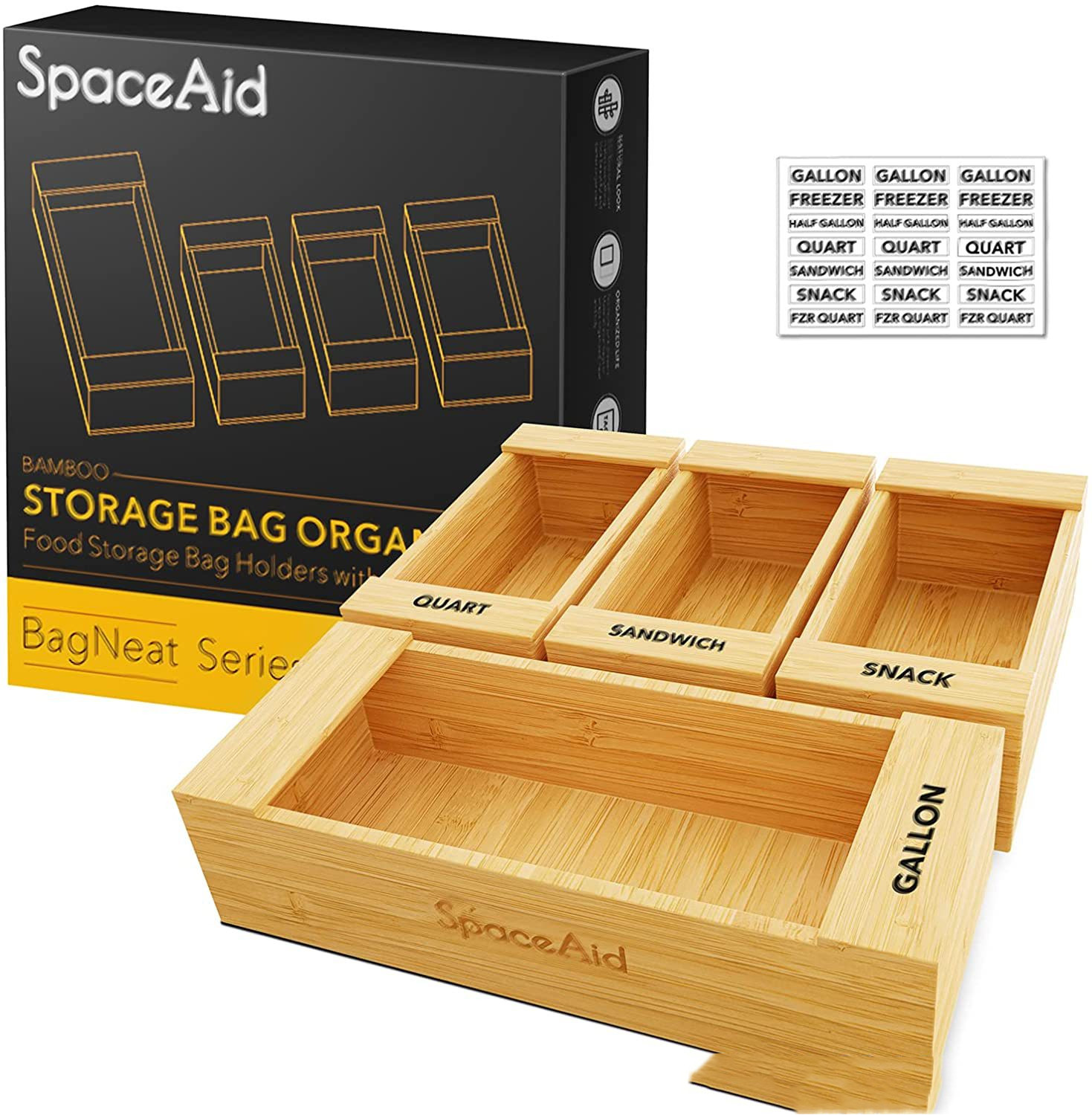
Bamboo Kitchen Drawer Organizer Box, 30.5 x 10.2 x 7.6 cm
Solid bamboo with the grain running lengthwise: the format that handles a humid kitchen best.
$53.99
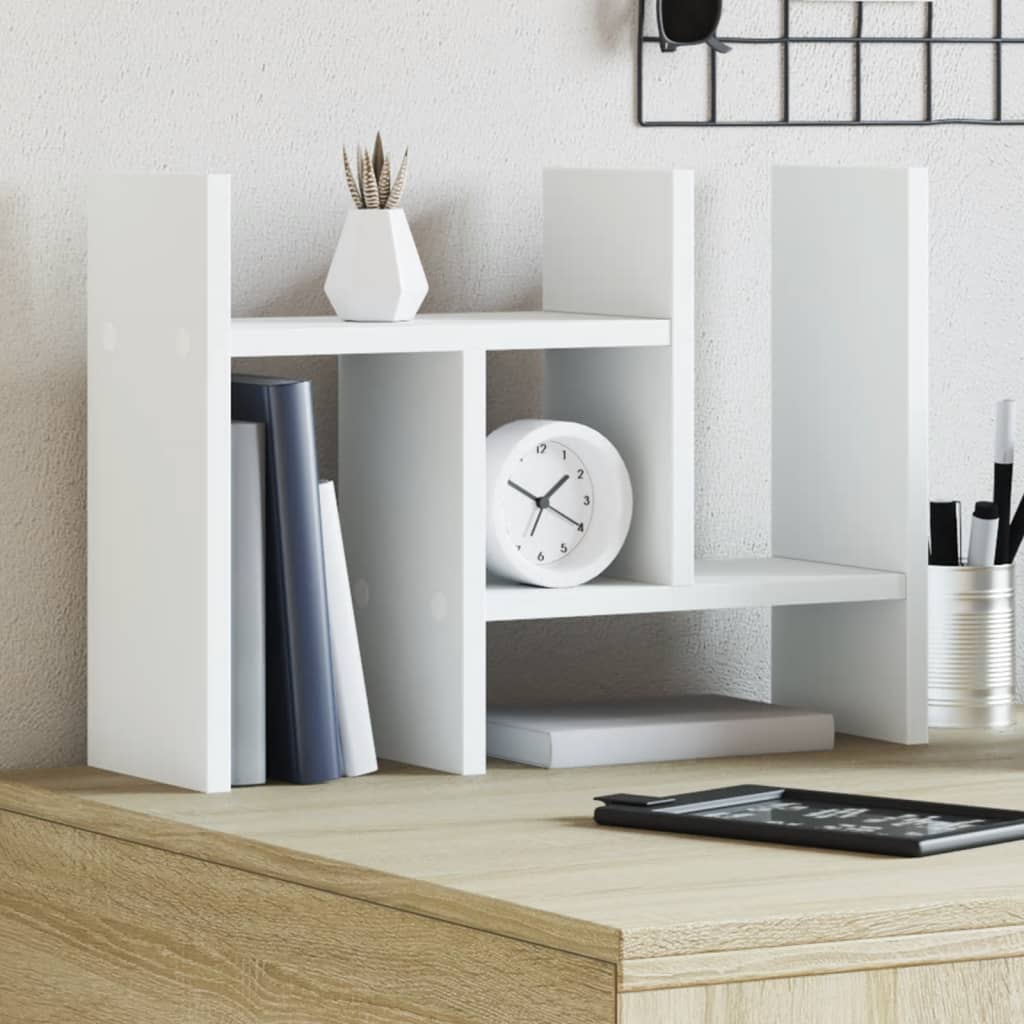
Engineered Wood Desk Organizer Shelf, 34.5 x 15.5 x 35.5 cm
Engineered board at 34.5 × 15.5 × 35.5 cm — stable in a dry room, and honest about it.
$67.99
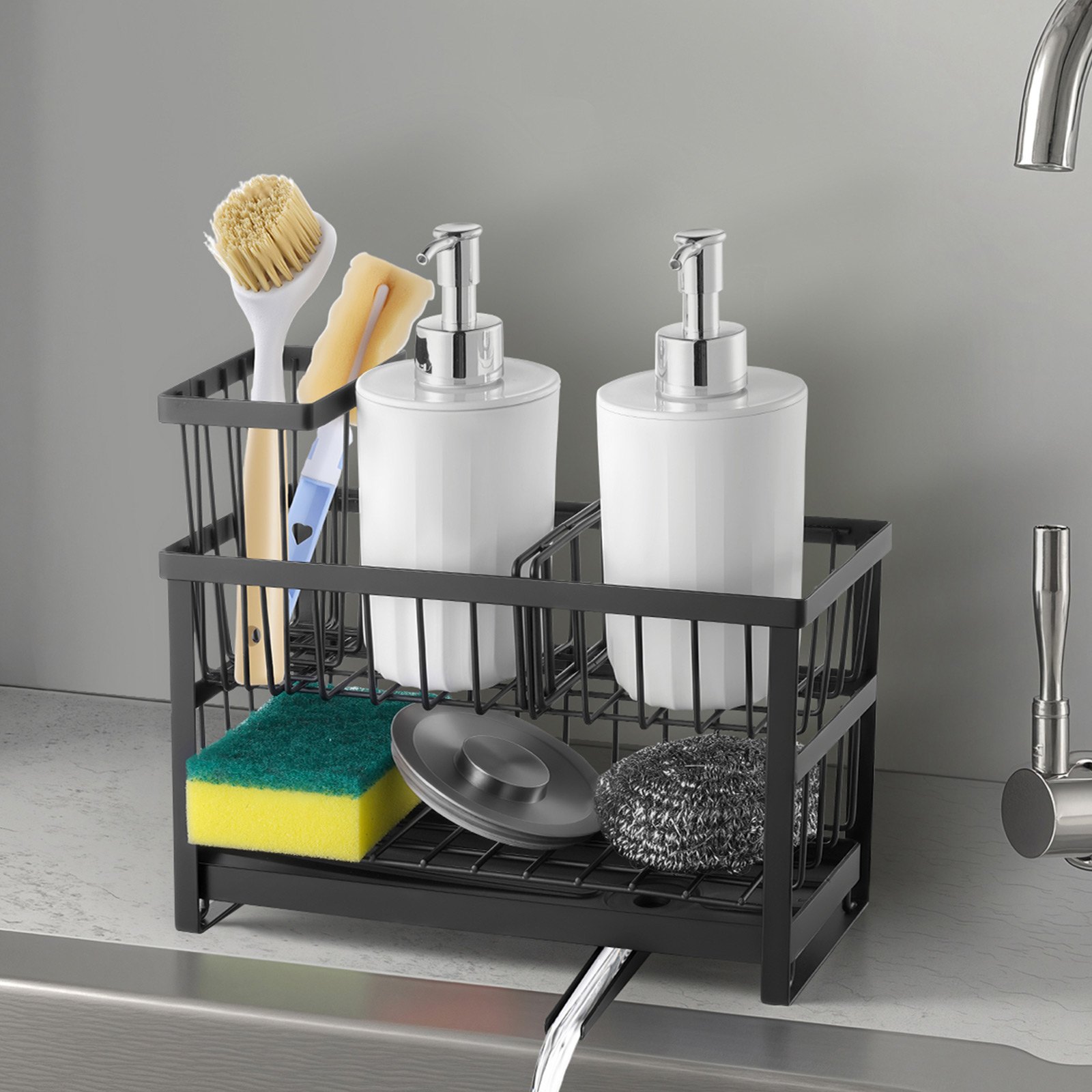
Kitchen Sink Caddy Organizer, Sponge and Brush Holder
The splash zone itself: whatever you put here should tolerate standing water, not just humidity.
$65.99
Compare on Amazon — this category usually has more brands, sizes and price points there.
Check current prices on Amazon →
As an Amazon Associate we earn from qualifying purchases. The price you pay is unchanged. Disclosure