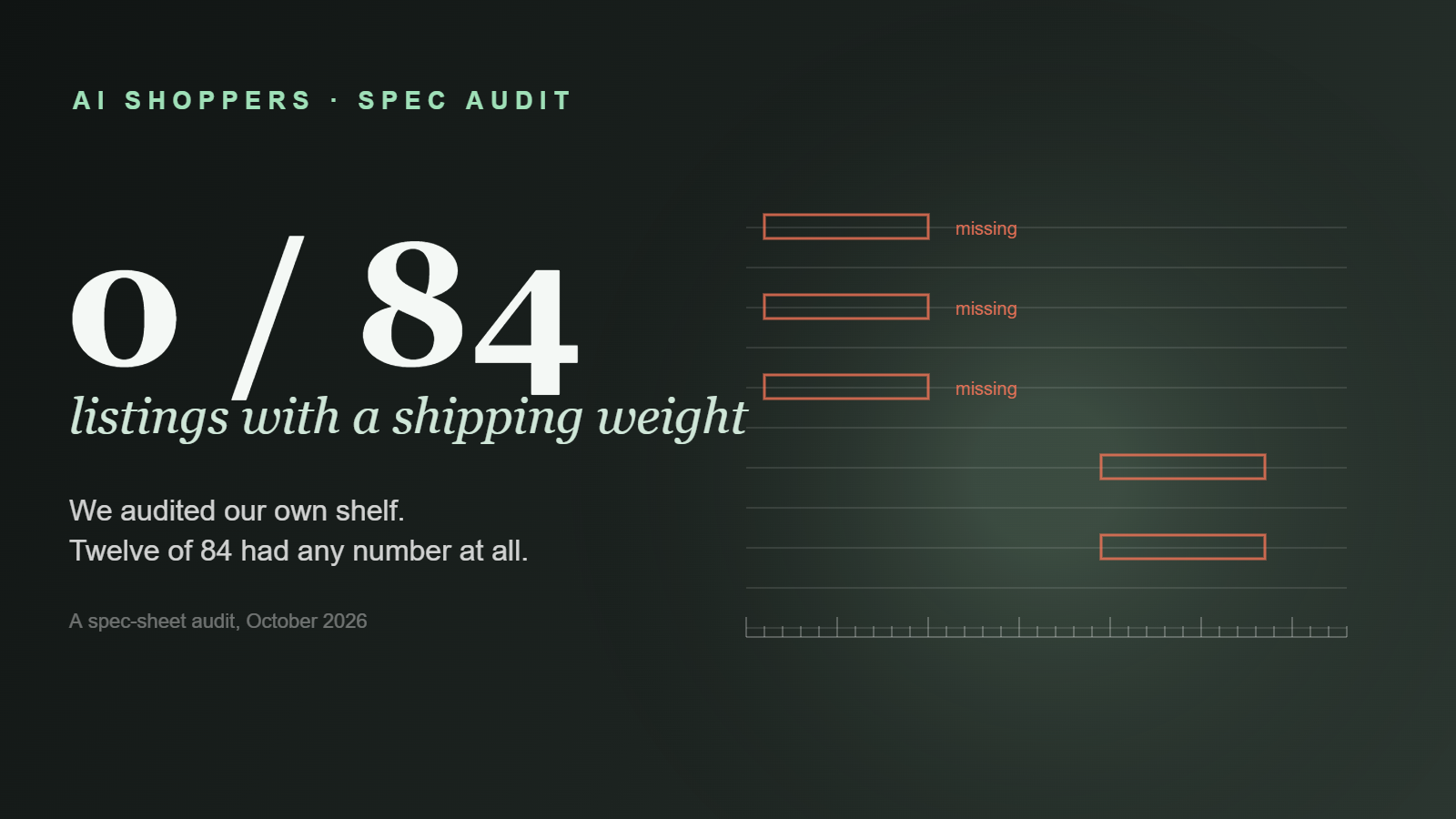
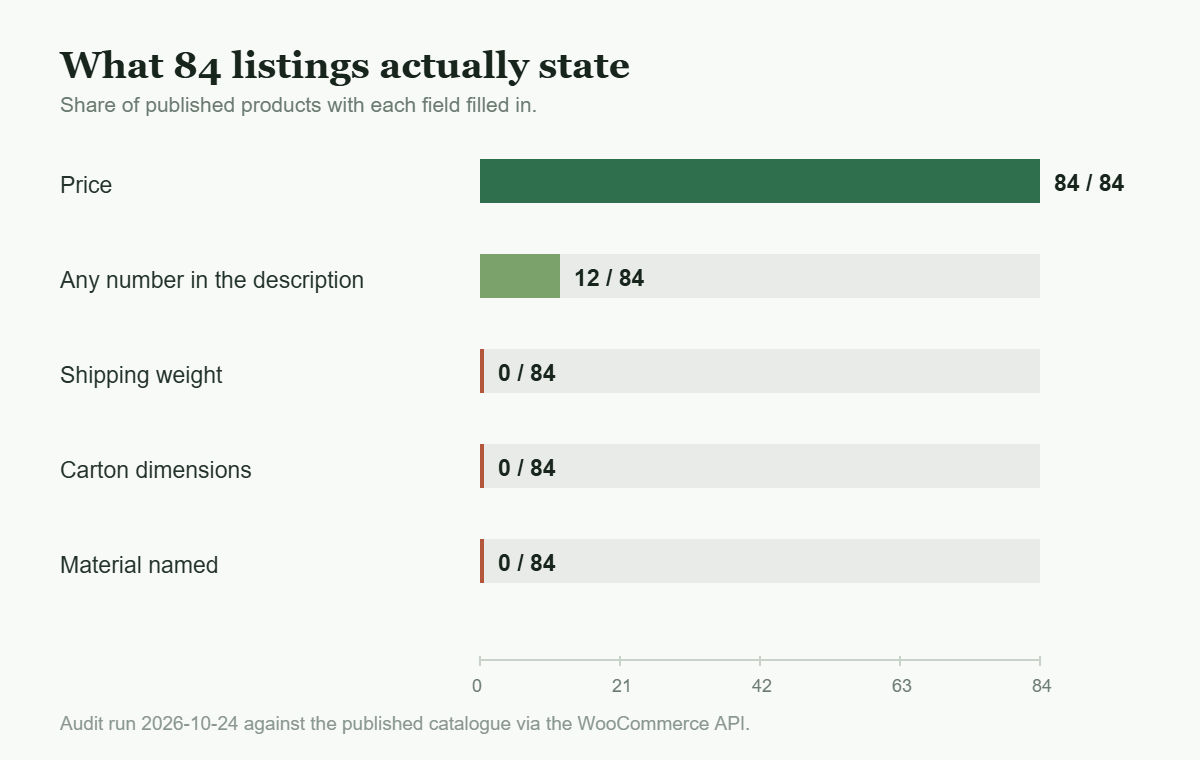
We audited our own catalogue this week: every published product, checked for four things a buyer actually needs — price, shipping weight, carton dimensions and a named material. The result was blunt. All 84 listings had a price. Twelve carried any number at all in the description. Zero listed a shipping weight. Zero listed carton dimensions.
That is not a confession so much as a map of where online shopping goes wrong. When a listing omits weight and volume, the buyer cannot calculate delivery cost, cannot judge whether a shelf will hold, and cannot tell whether “solid wood” means 12 mm board or 18 mm. What follows is the audit, the arithmetic that fills the gaps, and the five fields worth demanding before you pay.
1. What we measured, and how
The audit ran through the store’s own API, pulling every product with status “published”: 84 items across 10 categories. For each we checked four fields — price, weight, dimensions, and whether the short description contained any measurement (a number followed by cm, mm, g, kg, litre, inch or pieces). No sampling, no estimation: this is a full count.
Two numbers stand out. Price: 84 of 84. Measurements: 12 of 84, or 14 percent. Weight and carton size: 0 of 84. The pattern is common well beyond one store — marketplaces reward photography and punish specification work, because a photo sells in the feed and a spec sheet does not.
2. Why shipping weight is the field that matters most
Weight and volume set the cost of getting an object to you, and they also predict how it behaves in your home. A carton of 60 × 35 × 35 cm occupies 0.0735 m³. Under the volumetric rule used by air freight and most couriers — cubic centimetres divided by 6,000 — that carton is charged as 12.3 kg even if the product inside weighs 1.8 kg. The difference between 1.8 and 12.3 is the entire reason a light, bulky item can cost more to ship than a heavy, compact one.
The formula is worth writing down: chargeable kg = (L × W × H in cm) ÷ 6,000. Equivalently, 167 kg per cubic metre. Sea freight uses a similar idea with a different ratio (roughly 1 m³ to 1,000 kg), which is why the same product can be cheap to import in bulk and expensive to send as a single parcel.
3. The five fields a spec sheet needs
| Field | Why it decides the purchase | What “missing” usually means |
|---|---|---|
| Product weight | Postage tier, wall-anchor choice, whether a shelf sags | Seller has not weighed it, or it varies by batch |
| Carton dimensions | Volumetric shipping cost and storage before use | Only the assembled size is known |
| Material, named | Durability, water tolerance, formaldehyde class | “Premium” or “natural” used instead of a material |
| Load rating | Whether it holds 5 kg or 25 kg | No test was done; the number would be a guess |
| Assembly state | Time, tools, and whether joints survive moving | Flat-packed items often omit the fixings list |
Four of those five are absent from most listings and all five are cheap to produce: a kitchen scale, a tape measure and one sentence. The reason they are missing is not cost — it is that nobody asks.
4. How to estimate the missing numbers yourself
Weight: a 30.5 × 10.2 × 7.6 cm bamboo box with 8 mm walls weighs roughly 400–500 g; the same volume in MDF runs 15–20 percent heavier because the density is higher. Dimensions: assume the carton adds 10–15 mm on each side and 20–30 mm in height for padding. Load: for a shelf, divide the stated capacity by three — the safety factor most furniture testing uses — to get a number you can trust with books rather than a single ornament.
These are estimates, and they should be labelled as such. But an estimate with a stated assumption is worth more than a blank field, because it tells you what to verify with the seller.
5. What to ask before you pay
One: the packaged weight and carton size. Two: the material, named precisely — “bamboo strip”, “MDF with melamine”, “PP board”. Three: the load rating and how it was tested. Four: whether the item arrives assembled or flat-packed, and what tools are needed. Five: the return window for a bulky item, since return shipping on a 0.07 m³ parcel can exceed the product price.
A seller who answers all five in one message is worth the extra few percent. A seller who answers none has told you something too.
6. Why this matters more for small goods
Small home goods sit in an awkward band: too cheap for a dedicated spec sheet, too bulky for a letter rate, too varied for a standard size. The result is that the buyer absorbs the uncertainty — through returns, through wall anchors that fail, through a “storage box” that turns out to hold 62 litres rather than the 70 on the label.
There is a straightforward fix on both sides. Sellers who publish the five fields get fewer returns and fewer one-star reviews about size. Buyers who ask for them stop guessing. Neither requires new equipment; both require the habit of measuring before listing and before buying.
7. The return arithmetic
Missing specifications do not only cost the buyer a bad guess; they cost the seller a return. Take a 0.0735 m³ carton that cubes to 12.3 chargeable kilograms. At $5 per chargeable kilogram — a mid-range courier rate — sending it back costs about $61. If the product sold for $54, the return costs more than the item, so the buyer keeps it, writes a review about the size, and never buys from that listing again.
That is the hidden ledger behind a blank spec sheet: the seller saves twenty minutes of measuring and pays for it in returns, refunds and reviews. Publishing weight and carton size is not marketing polish. It is the cheapest return-reduction tool available, and it is the first thing a careful buyer should ask for.
Frequently asked questions
Is a missing weight a red flag?
Not on its own — most listings omit it. But it does mean you cannot calculate shipping or compare two products on cost per kilogram, so ask before buying anything bulky.
How accurate is the ÷6,000 volumetric rule?
It is the common industry divisor for air and courier freight. Some carriers use 5,000 or 4,000, which makes bulky items even more expensive; check the carrier’s own divisor.
Why do listings give assembled size but not carton size?
Because assembled size is what the photographer measures. Carton size is known to the warehouse, not the marketing team, and rarely makes it onto the page.
Does a load rating have a standard safety factor?
Furniture testing commonly uses a multiple of the intended load — often three times for static loads. A shelf rated 15 kg is usually tested well above that, but the test method should be stated.
What is the single most useful field to ask for?
Packaged weight. It converts directly into shipping cost, anchor choice and whether the thing can be carried up stairs — three decisions in one number.
Honest disclosure: the audit figures are from our own published catalogue on 2026-10-24, counted through the store API. The estimates in section 4 are stated as ranges from material density and typical packaging allowances, not measurements of specific products.
Gear referenced in this guide
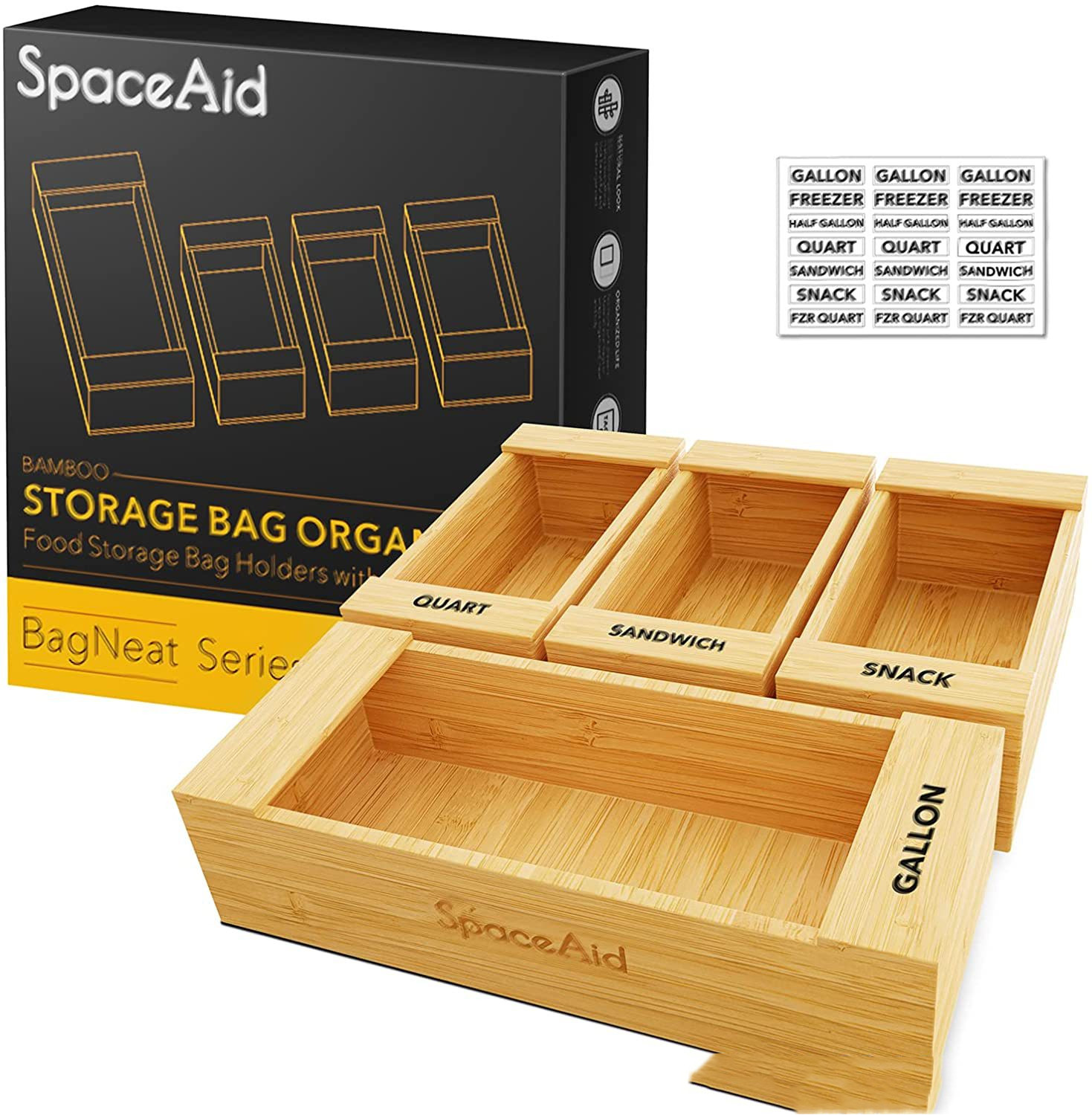
Bamboo Kitchen Drawer Organizer Box, 30.5 x 10.2 x 7.6 cm
Full dimensions in the title: 30.5 × 10.2 × 7.6 cm — the format that makes fit checkable.
$53.99

Engineered Wood Desk Organizer Shelf, 34.5 x 15.5 x 35.5 cm
34.5 × 15.5 × 35.5 cm of engineered board — a shelf where the footprint is stated up front.
$67.99

Wooden Post Nail Insulators, 25-Piece Nylon Set
8.5 × 4 × 3.2 cm at 18 g each — a listing where per-unit weight is the selling point.
$24.99

Stainless Steel Kitchen Scale with Tempered Glass Platform
1 g resolution: the tool that lets a seller produce the spec sheet in the first place.
$72.99
Compare on Amazon — this category usually has more brands, sizes and price points there.
Check current prices on Amazon →
As an Amazon Associate we earn from qualifying purchases. The price you pay is unchanged. Disclosure