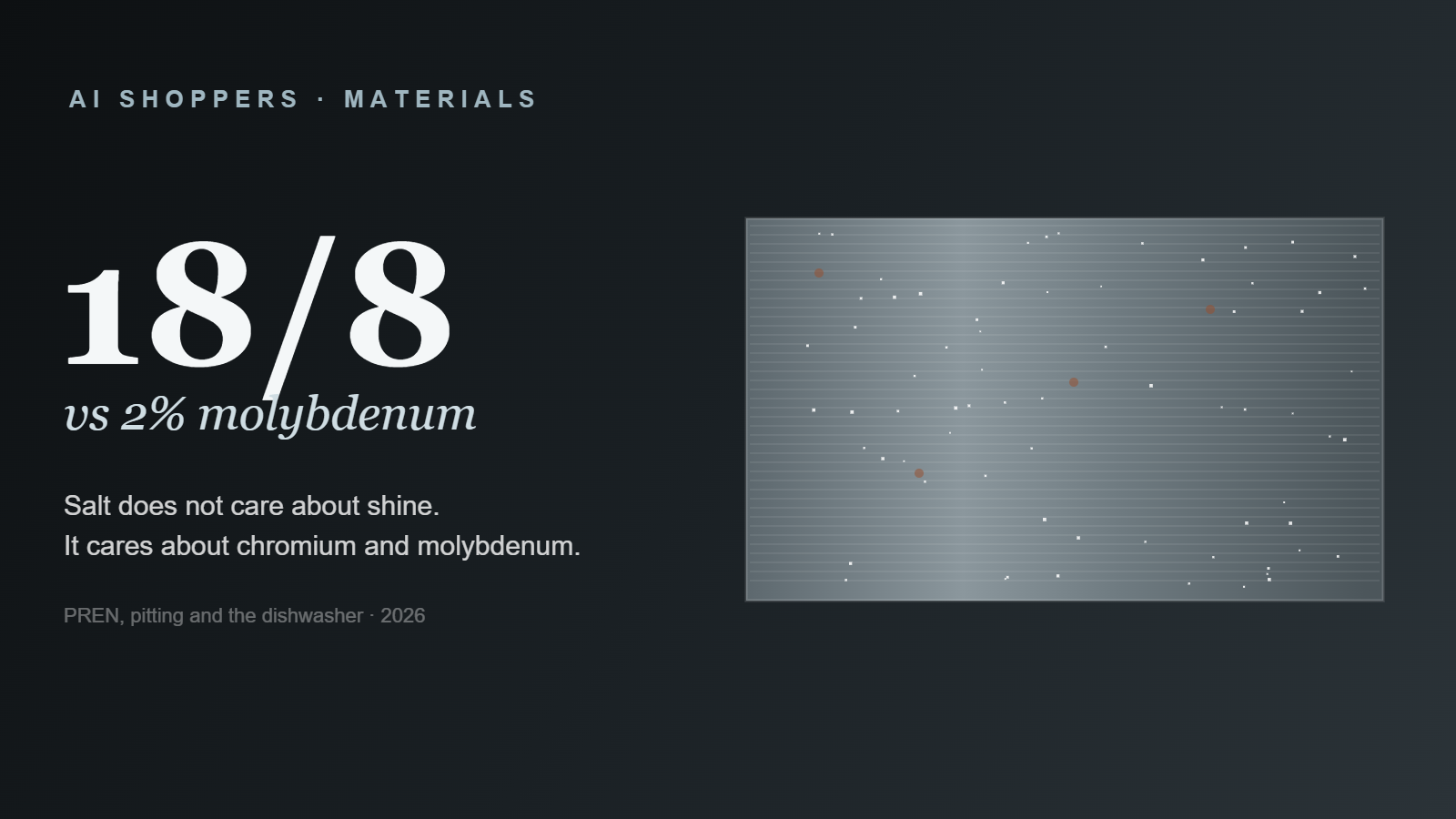
Stainless steel is not a metal; it is a family. The two grades sold most often into kitchens are 304 and 316, and the difference between them is one element: molybdenum, about 2 percent by weight in 316 and zero in 304. That 2 percent decides whether a sink caddy shows brown pits after two years of dish soap and salty pasta water, or after ten.
You cannot see the difference, feel it, or test it with a magnet. You can only read the grade — and most listings do not print one. Here is what the numbers actually mean.
1. What “18/8” actually says
304 is the grade most people mean by “stainless”: roughly 18 percent chromium and 8 percent nickel, hence the old shorthand 18/8. Chromium is the active ingredient — it forms a passive oxide layer a few nanometres thick that seals the surface and re-forms within seconds when scratched, as long as oxygen is present.
316 keeps about 16 percent chromium, raises nickel to 10 percent, and adds 2 percent molybdenum. The chromium still does the sealing; the molybdenum specifically improves resistance to chlorides — salt. That is the whole story, and it is why marine hardware is 316 and kitchen trolleys are 304.
2. PREN: one number that predicts pitting
Metallurgists compare grades with the pitting resistance equivalent number: PREN = Cr + 3.3 × Mo + 16 × N. For 304 that lands around 19. For 316, the molybdenum term adds roughly 6.6 points, putting it near 26 — about a third more resistance to chloride pitting.
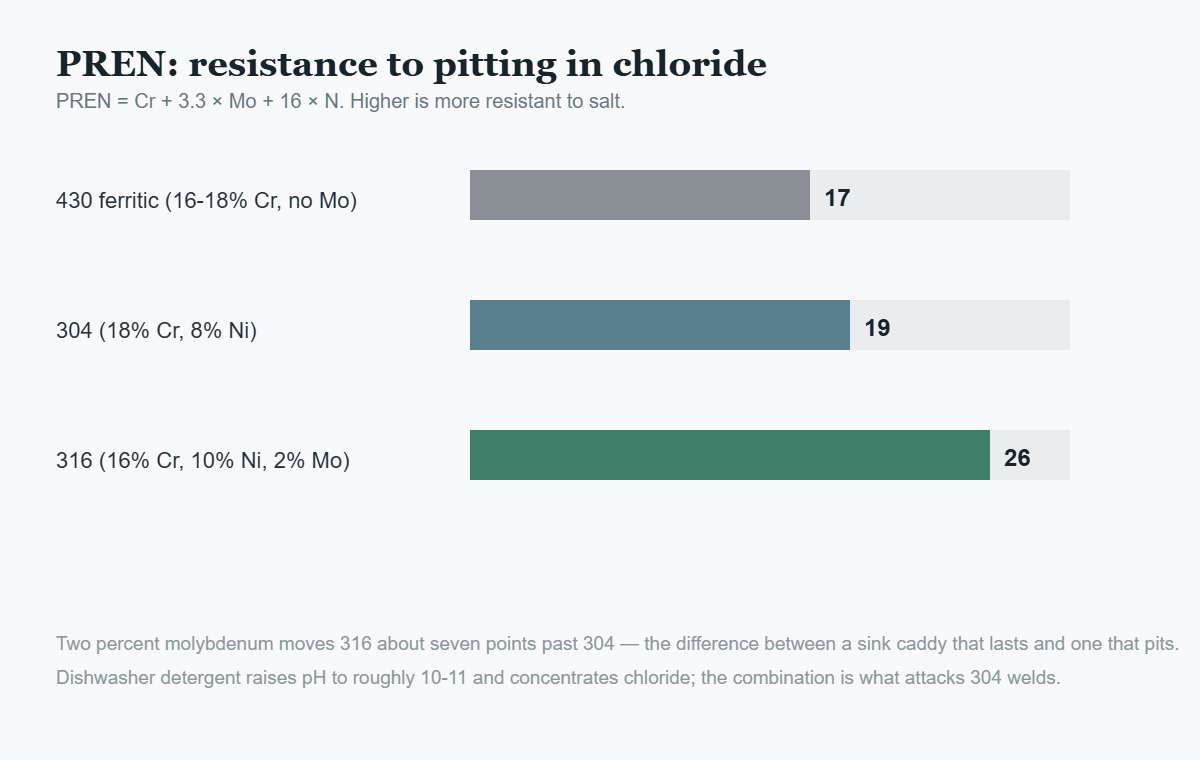
PREN is a ranking, not a guarantee. A 304 part with a rough weld and trapped salt can pit before a well-finished 316 part sees any damage — surface finish and cleaning matter as much as the grade.
3. Where a kitchen actually attacks steel
Three mechanisms do the damage. Chlorides (salt, some detergents, bleach) break down the passive layer locally and start a pit. Acids (tomato, vinegar, citrus) attack it uniformly if left for hours. And heat plus detergent in a dishwasher raises the stakes: dishwasher detergent runs at roughly pH 10–11 and often contains chloride, while the drying cycle concentrates whatever is left on the surface.
Welds are the weak point. Welding burns out chromium near the seam and leaves a rougher microstructure; if that area is not passivated — cleaned with citric or nitric acid to restore the oxide layer — it will be the first place to rust even on 316.
4. The table
| Grade | Chromium / nickel | Molybdenum | PREN | Where it belongs |
|---|---|---|---|---|
| 430 ferritic | 16–18% / 0% | none | ~17 | Appliance panels, dry interiors; magnetic |
| 304 | ~18% / ~8% | none | ~19 | General kitchen tools kept dry |
| 316 | ~16% / ~10% | ~2% | ~26 | Sink area, salt water, marine hardware |
A magnet is a rough grade test: 430 is strongly magnetic, 304 is essentially non-magnetic, 316 is non-magnetic. It will not tell 304 from 316 — for that you need the stamp or the spec sheet.
5. What this means for buying
Match the grade to the wetness, not the price. A sink caddy that sits in a puddle every day is the hardest job in the kitchen; if the listing says only “stainless steel”, assume 304 and expect to dry it. A colander or a bowl that is rinsed and dried can be 304 for a decade without a mark. A knife is different again — cutlery steels trade corrosion resistance for edge retention.
Rough rule: if the item will hold standing water or salt, pay for 316 or accept a shorter life. If it only touches water briefly, 304 is enough. Never pay 316 prices for a part that is stamped 18/8 — that is 304.
6. Care that actually prevents pitting
Dry the item rather than letting it air-dry in a puddle; rinse salt off within the hour; skip bleach-based cleaners on steel; and use a citric-acid passivation wipe on any weld or scratch once a year. Avoid steel wool, which embeds free iron that then rusts on its own.
None of this is exotic. The reason stainless fails is almost always the same: chloride plus time plus a wet contact surface.
7. Why the L matters
You will see 316L more often than 316 on anything welded. The L means low carbon — capped at about 0.03 percent instead of 0.08. Carbon is what combines with chromium at weld seams to form chromium carbide, pulling chromium out of the passive layer exactly where the metal was hottest. Lower carbon leaves more chromium available, so a welded 316L joint resists pitting where a standard 316 weld might not.
For a sink caddy or a rack made from bent wire, this matters: every bend and weld is a place where the oxide layer has to rebuild. If a listing says “316” without the L on a welded product, ask which one — the difference shows up in year three, at the joint, not on the flat surface.
8. Reading the listing
Three phrases are worth translating. “18/10” means roughly 18 percent chromium and 10 percent nickel — usually a 304-family grade upgraded for shine, not a 316. “Surgical steel” has no legal definition and is marketing. “Food grade” describes a finish and a test, not a grade: 304 and 316 can both be food grade, and 430 can be too for dry contact.
The only reliable markers are the grade number (304, 316, 316L, 430) and, for welded parts, a passivation statement. Anything else is a description of appearance, and appearance is exactly what salt ignores.
9. Salt spray, and why the hours confuse people
Spec sheets often quote salt spray hours from ASTM B117: 24, 72, 200, 500. The number is not a lifetime — it is the time to first visible corrosion in a 5 percent salt fog at 35 °C. A 304 part might show first rust between roughly 24 and 72 hours depending on finish; a well-passivated 316 part commonly reaches several hundred. Compare only within the same test and the same finish, and treat the number as a ranking, not a warranty.
Frequently asked questions
Is 304 worse than 316?
For salt and chlorides, yes — roughly a third lower pitting resistance by PREN. For dry general use, the difference rarely shows within a decade.
Why did my “stainless” caddy rust in a year?
Usually chloride pitting at a weld or under a rubber foot where water sits. Grade and passivation both matter; trapped moisture is the accelerant.
Can I use a dishwasher for stainless?
Generally yes, but repeated cycles with high-chloride detergent are the hardest environment in a home. Hand-drying extends life noticeably.
Does a magnet tell me the grade?
Only broadly. 430 is magnetic; 304 and 316 are not. A magnet will not separate 304 from 316.
What is passivation?
A cleaning step — citric or nitric acid — that removes free iron from a surface and lets the chromium oxide layer rebuild. It is standard after welding.
Honest disclosure: the composition and PREN figures are standard published values for these grades; actual performance depends on surface finish, welding, passivation and the specific chloride exposure. Nothing here is a lab test of the products shown.
Gear referenced in this guide
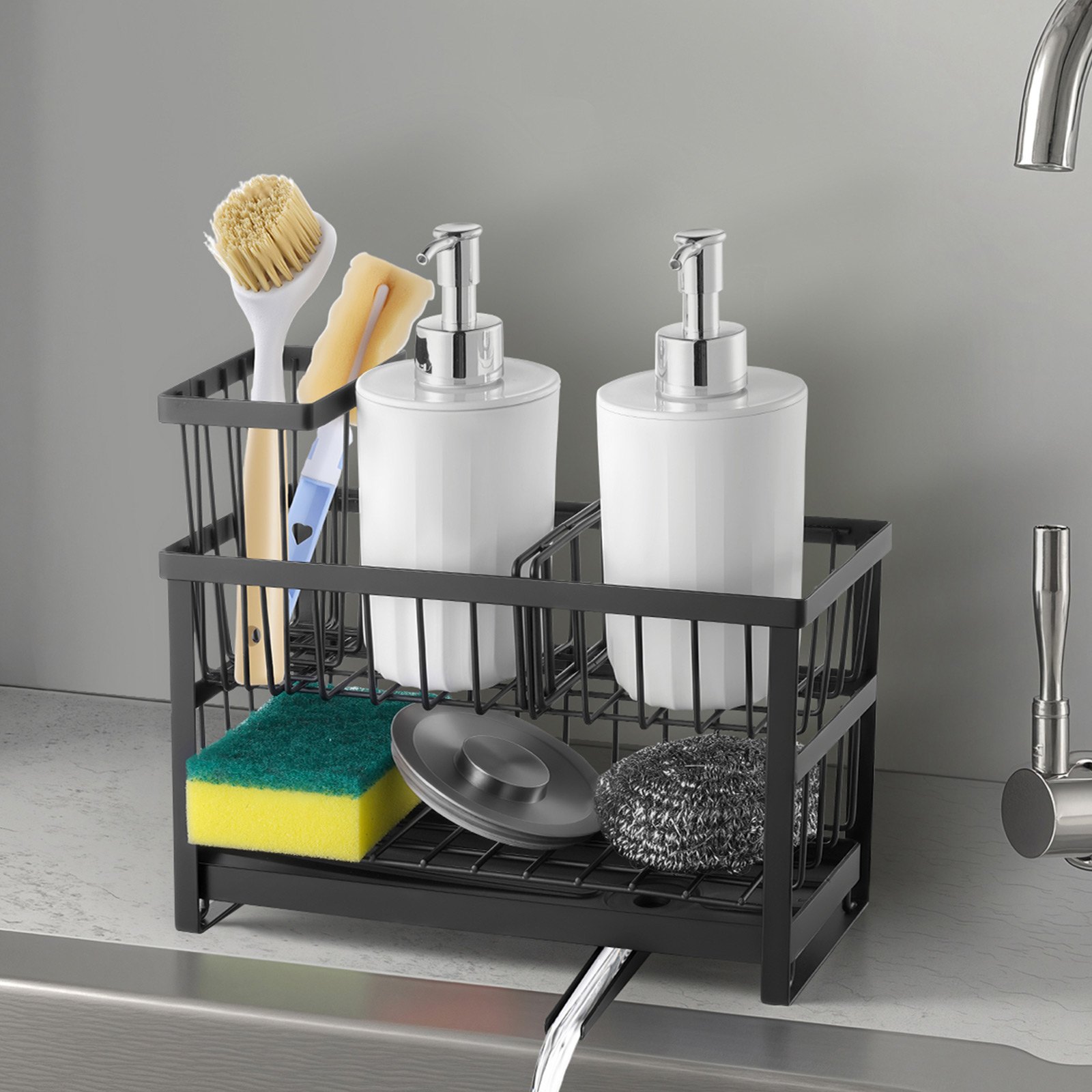
Kitchen Sink Caddy Organizer, Sponge and Brush Holder
The wettest spot in the kitchen: check the grade before you buy, and dry it after use.
$65.99
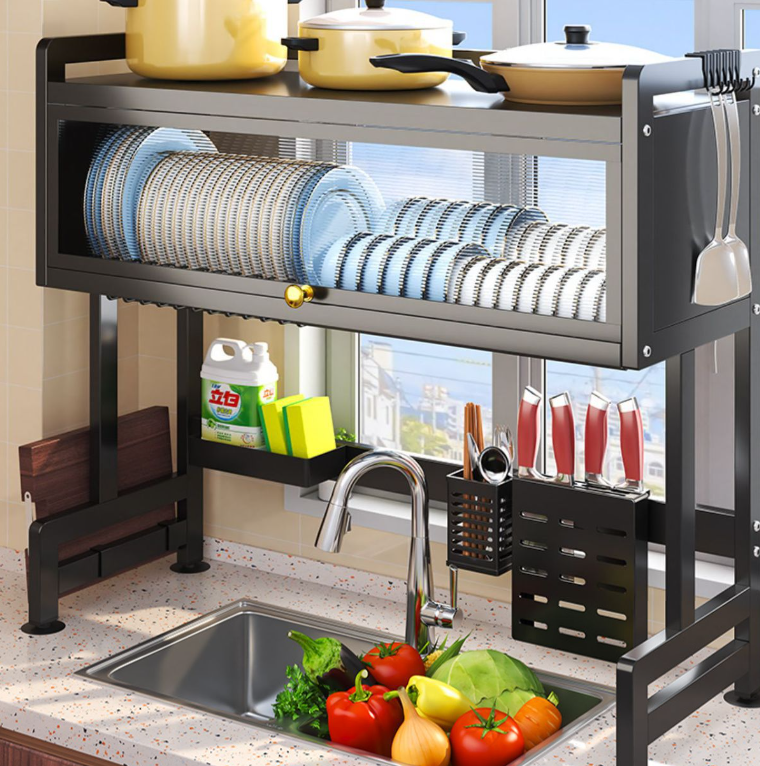
Kitchen Sink Storage Rack, Over-Basin Bowl and Sponge Drainer
Keeps bowls and sponges draining instead of standing in water — the cheapest anti-pitting measure.
$65.99
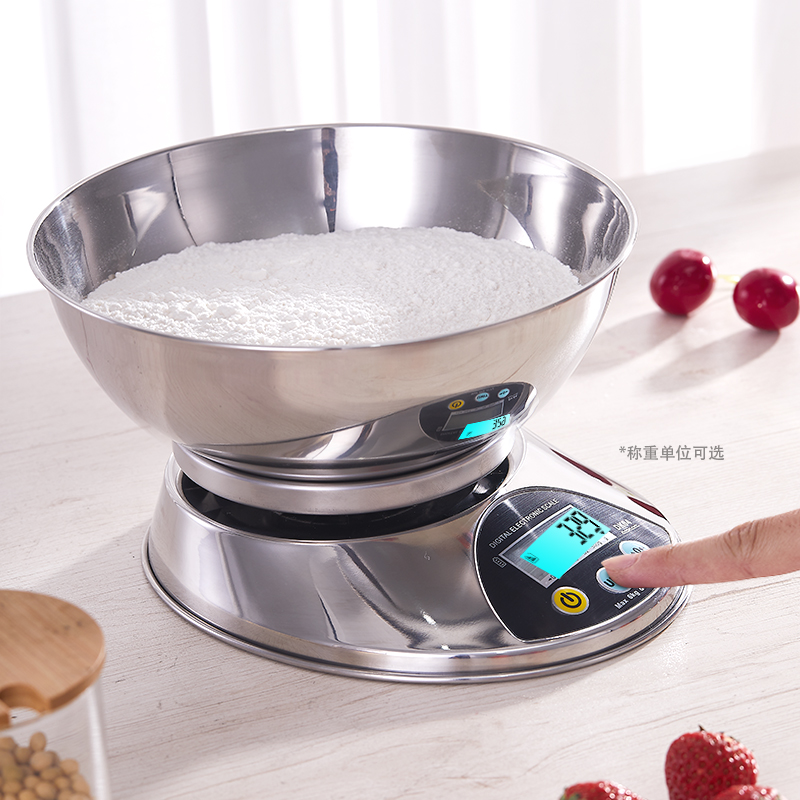
Stainless Steel Kitchen Scale with Tempered Glass Platform
Stainless platform, dry use: exactly the case where 304 is entirely sufficient.
$72.99
Compare on Amazon — this category usually has more brands, sizes and price points there.
Check current prices on Amazon →
As an Amazon Associate we earn from qualifying purchases. The price you pay is unchanged. Disclosure