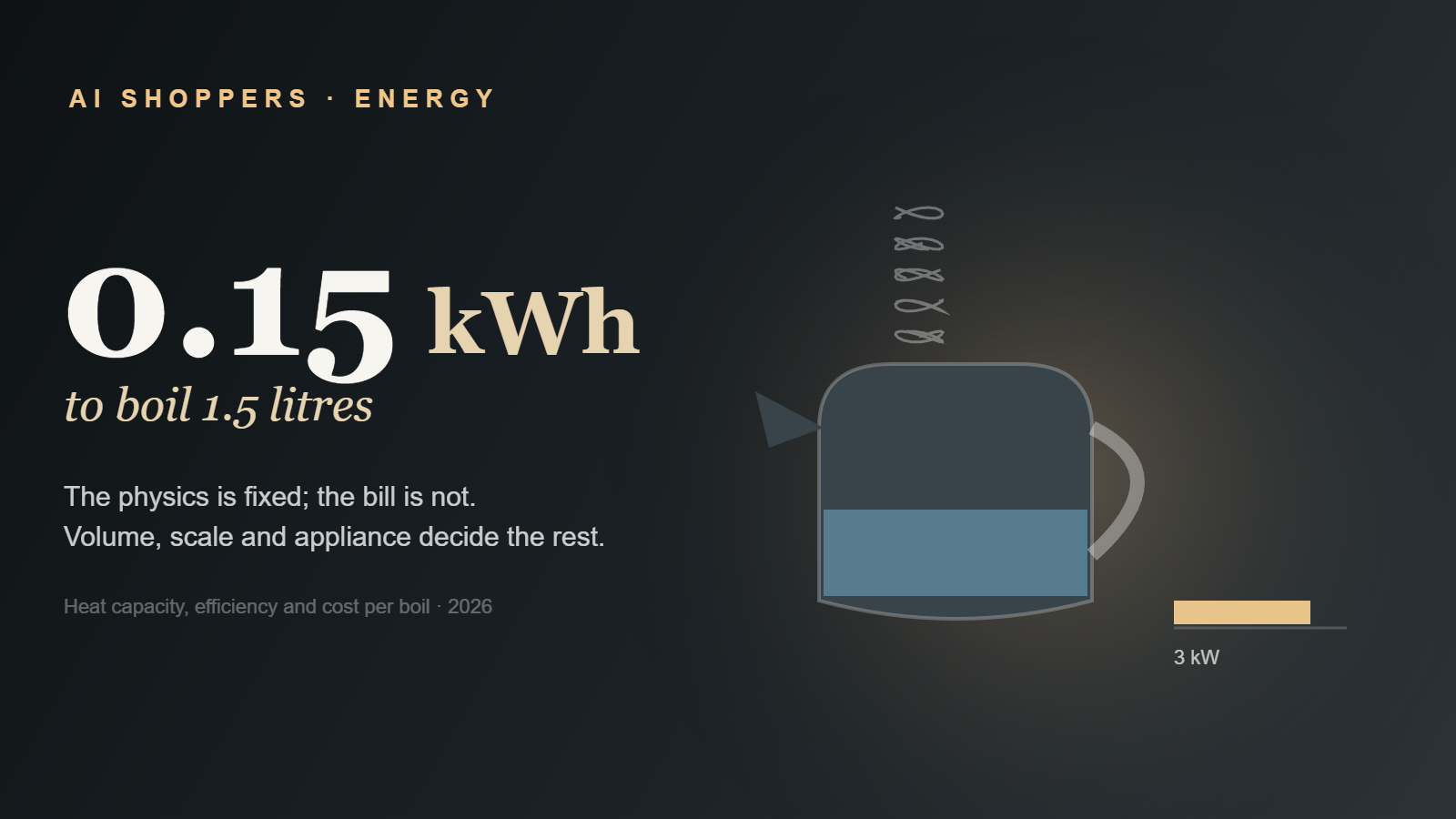
Boiling water is the most repeated energy task in a kitchen, and the least examined. A kettle is a resistor with a thermostat: it converts electricity to heat at close to 100 percent, pours most of that heat into water, and loses the rest to the air and the scale on its element. The arithmetic is short enough to do on paper, and it explains why two households with the same electricity tariff can differ by a factor of three on the same job.
Here is the number to keep: 1.5 litres from 15 °C to 100 °C requires about 0.148 kWh of heat. With real-world losses, the meter sees roughly 0.19 kWh. Everything else — kettle design, hob type, how much you fill — moves that figure by tens of percent, not by a factor of ten.
1. The formula, and the four numbers in it
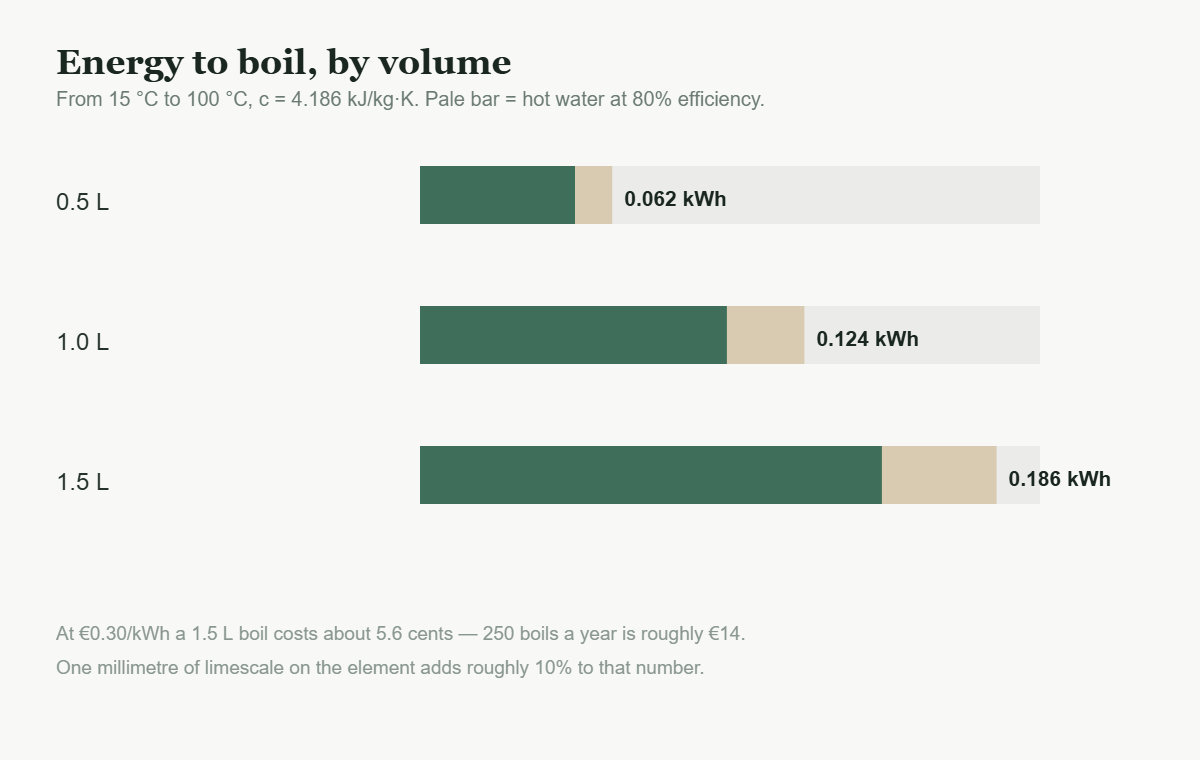
The energy is Q = m × c × ΔT, where m is mass in kilograms, c is the specific heat of water at 4.186 kJ/(kg·K), and ΔT is the temperature rise. For 1.5 kg and 85 K that is 533.7 kJ, or 0.148 kWh once you divide by 3,600.
Four numbers decide the result: the volume you actually fill, the starting temperature, the efficiency of the appliance, and the condition of the heating surface. Nothing else has more than a few percent of influence — including the shape of the kettle.
2. Volume is the only variable you control for free
Boiling a full 1.5-litre kettle for one cup wastes roughly two-thirds of the energy. Half a litre takes 0.05 kWh of heat instead of 0.15 — a third of the cost for the same tea. If a household boils a full kettle four times a day out of habit, the difference is around 140 kWh a year, which at €0.30/kWh is about €42.
Weighing water is more precise than eyeballing the window: 1 litre is 1 kg, so a kitchen scale with a 1 g step resolves the fill to a millilitre. It sounds fussy until you see how far off the “minimum” line most kettles actually are.
3. Appliance efficiency: 80 versus 45 percent
A modern electric kettle delivers roughly 80 percent of its input to the water; the rest heats the body and escapes as steam. An induction hob with a matched pan reaches about 85 percent. A gas hob is the outlier at roughly 40–50 percent, because most of the flame heats the air around the pot. A microwave is efficient at heating a single cup but poor at a full litre.
4. The table
| Method | Efficiency | Energy for 1.5 L | Time | Cost at €0.30/kWh |
|---|---|---|---|---|
| Electric kettle, 3 kW | ~80% | 0.19 kWh | ~3 min | €0.056 |
| Induction hob, covered pan | ~85% | 0.17 kWh | 5–6 min | €0.052 |
| Gas hob, covered pan | ~45% | 0.33 kWh | 6–8 min | €0.099 |
| Microwave, 1 L max | ~60% | 0.17 kWh per litre | 8–10 min | €0.050 |
The table explains a common surprise: on a gas hob, the electric kettle is not just faster, it is roughly half the energy. That is a statement about the appliance, not about electricity being cleaner.
5. Scale is the silent tax
Limescale is a thermal insulator. A millimetre of scale on an element can add around 10 percent to the energy needed and shorten the element’s life; two millimetres is worse. In hard-water areas this is the single biggest efficiency variable in the whole calculation, and it is fixable with a descaling cycle every few months — citric acid, twenty minutes, no special tools.
You can measure the effect: fill the same volume twice, once before descaling and once after, and compare the time to boil. The thermostat cuts off at the same temperature, so a longer boil is energy going somewhere other than the water.
6. The cost side, done properly
At €0.30/kWh, a 1.5-litre boil costs about 5.6 cents. At four boils a day, that is roughly €82 a year; halving the volume brings it to about €28. The order of magnitude matters more than the cent: boiling water is not a major household cost, but it is a daily one, which makes habits worth more than hardware.
One caveat: electricity tariffs vary by a factor of three across Europe and more across regions, so plug your own rate into the formula rather than trusting any published figure, including this one.
7. What this means for equipment
Buy a kettle with a marked minimum fill and a flat element, and descale it. Buy a scale if you want to hit that minimum precisely. If you cook on gas, the kettle genuinely is the more efficient way to boil water — and a covered pan matters more than the burner setting. None of that requires a smart appliance; it requires knowing which number you are optimising.
Honest disclosure: the figures above come from standard thermodynamics (c = 4.186 kJ/kg·K) and typical appliance efficiency ranges, not from laboratory tests of the products shown. Your tariff, starting water temperature and scale thickness will move the result.
8. Starting temperature, and the keep-warm trap
Tap water arrives at roughly 10–15 °C in winter and 18–22 °C in summer. Starting at 50 °C instead of 15 °C cuts ΔT from 85 K to 50 K — about 41 percent less energy for the same final boil. Filling from the hot tap is not a good way to get there: hot-water tanks and long pipe runs are a source of stagnation and metal pick-up, which is why drinking-water guidance says draw cold and heat it yourself.
Keep-warm functions are the other hidden cost. Holding a litre at 90 °C takes roughly 0.02–0.05 kWh per hour depending on insulation — small per hour, but it runs all day. A kettle that keeps warm for eight hours can spend more energy holding temperature than it used to boil.
Frequently asked questions
Does a higher-wattage kettle use more energy?
No — it uses the same energy, faster. A 3 kW kettle boils in about three minutes; a 1.5 kW kettle takes twice as long for the same kWh, though it loses slightly more heat to the surroundings.
Is it cheaper to boil water in a microwave?
For a single cup, often yes because there is less wasted heat mass. For a litre or more, a kettle wins on both time and total energy.
Does the kettle’s shape matter?
Only marginally. A taller, narrower body reduces surface area, but the difference is a few percent — far smaller than fill volume or scale.
How often should I descale?
In hard water, every two to three months; in soft water, twice a year. If the boil takes noticeably longer than it used to, descale now.
Do I need to measure water with a scale?
Not strictly. But 1 litre is 1 kg, and a 1 g scale resolves the fill precisely, which is the only free variable in the calculation.
Further reading
Related: what a 1 g scale can and cannot measure, and why 60 percent humidity is the number that matters indoors.
Gear referenced in this guide
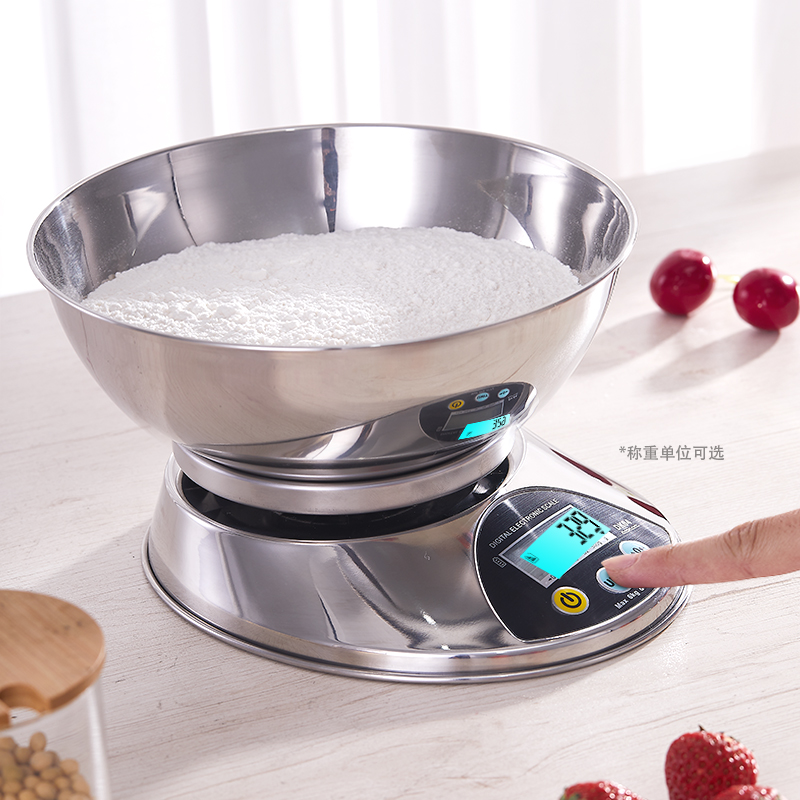
Stainless Steel Kitchen Scale with Tempered Glass Platform
1 g steps, 5 kg capacity: weigh the water instead of guessing the line.
$72.99
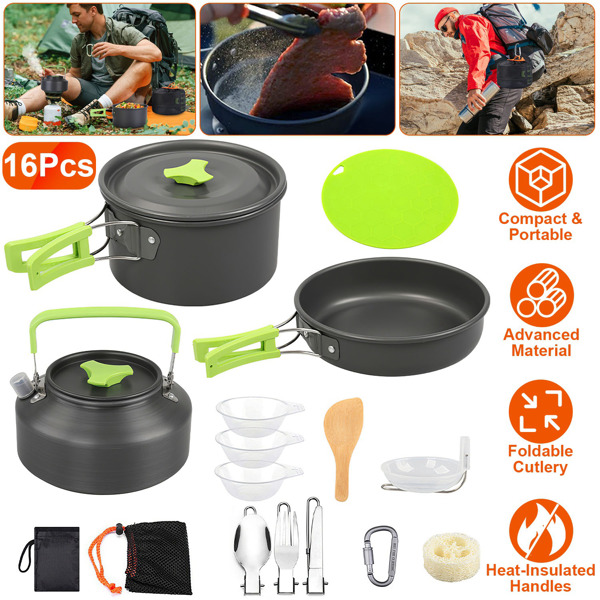
16 Piece Camping Cookware Set, Outdoor Cooking Kit
For stovetop boiling, a lid does more for efficiency than a bigger burner.
$93.99
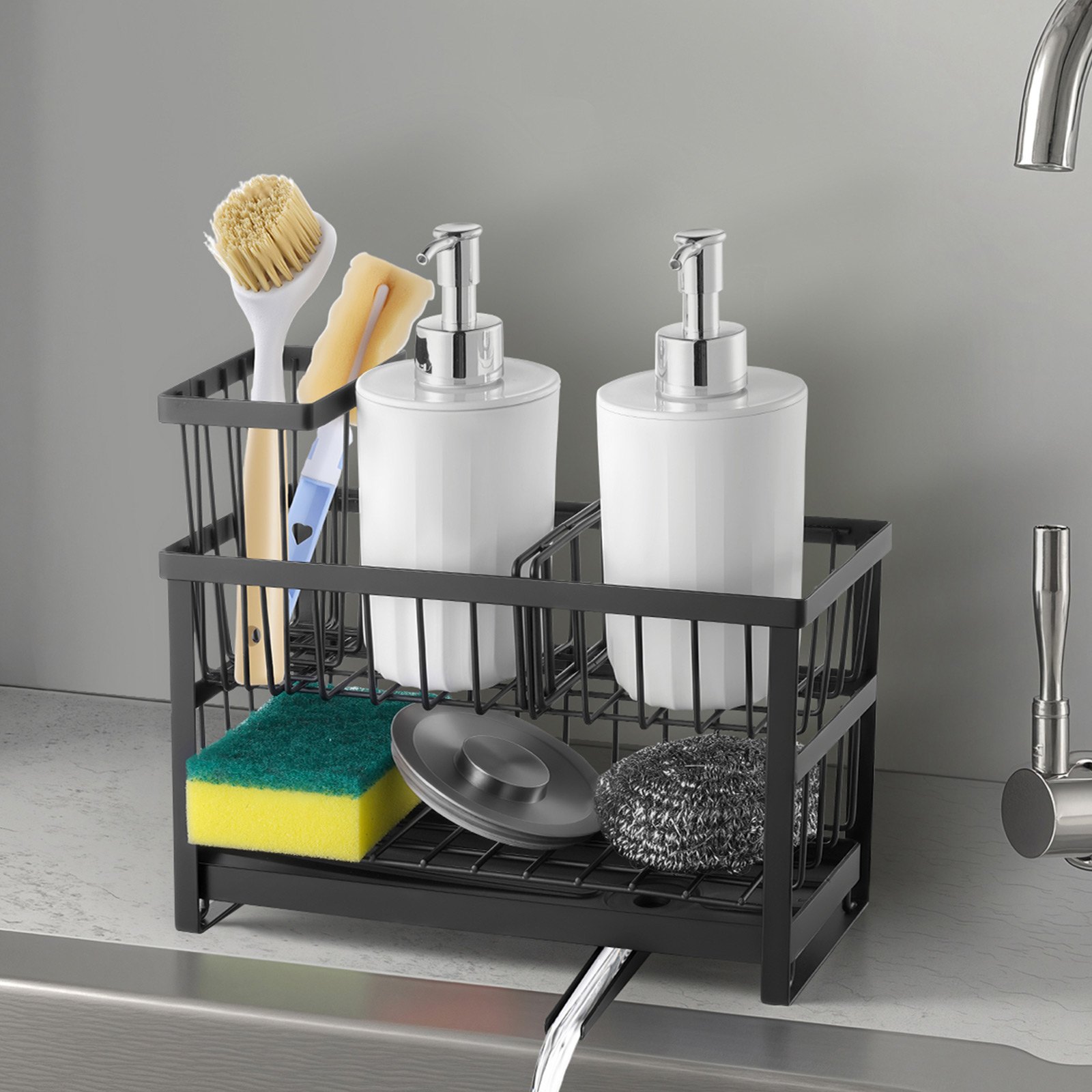
Kitchen Sink Caddy Organizer, Sponge and Brush Holder
Keeps the counter dry — the unglamorous half of kitchen efficiency.
$65.99
Compare on Amazon — this category usually has more brands, sizes and price points there.
Check current prices on Amazon →
As an Amazon Associate we earn from qualifying purchases. The price you pay is unchanged. Disclosure