A shower head does not add pressure. It only decides how the water you already have leaves the face — fast and narrow, or slow and wide. Almost every complaint about a “weak” shower traces back to that one sentence, and almost every product claiming to “boost” pressure is selling a change in nozzle geometry, not a change in supply.
This piece is about the numbers behind that: flow rate, total hole area, and exit speed. Once you can compute those three, the marketing language stops mattering.
The word “pressure” is doing two jobs
Plumbers mean supply pressure: the static pressure in the pipe behind the wall, usually quoted in bar or psi. Shower-feel is something else entirely — the speed and concentration of the jets where they hit your shoulder. You can have high supply pressure and a weak-feeling shower (a wide face with many large holes), or low supply pressure and a sharp-feeling one (few small holes at the same flow).
The link between them is one equation: velocity = flow ÷ area. Flow is set by your plumbing and by the flow restrictor in the head. Area is set by the holes. Change the holes and you change the feel without touching the water supply at all.
The arithmetic: hole area decides exit speed
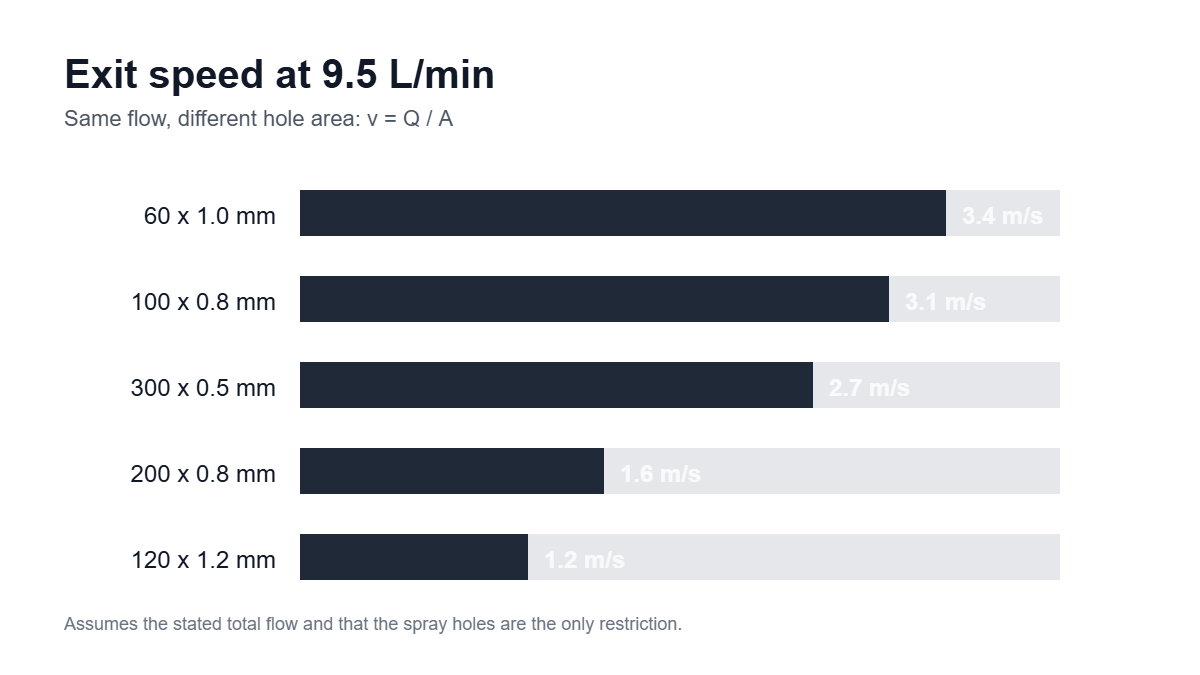
Take a US-spec head delivering 2.5 gallons per minute, about 9.5 litres per minute. That is 158,000 cubic millimetres per second. Divide by the total hole area and you get the exit speed in metres per second:
| Hole pattern | Total hole area | Exit speed at 9.5 L/min | How it feels |
|---|---|---|---|
| 60 holes × 1.0 mm | 47 mm² | 3.4 m/s | Sharp, narrow, handful of strong jets |
| 100 holes × 0.8 mm | 50 mm² | 3.1 m/s | The usual “strong” shower head |
| 300 holes × 0.5 mm | 59 mm² | 2.7 m/s | Fine mist, feels warm and soft |
| 200 holes × 0.8 mm | 101 mm² | 1.6 m/s | Wide and gentle, rinses slowly |
| 120 holes × 1.2 mm | 136 mm² | 1.2 m/s | Rainfall feel, no bite at all |
Two consequences follow. First, a head with more holes is not automatically stronger — if the extra holes are the same size, the same water is spread thinner and every jet gets slower. Second, the popular “anti-clog” heads with hundreds of sub-millimetre holes feel soft for exactly this reason, at any supply pressure.
The 2.5 gpm ceiling, and why removing the restrictor is not the fix
In the United States, shower heads have been capped at 2.5 gallons per minute at 80 psi since the 1992 energy legislation; that is the 9.5 L/min used above. Heads sold with the restrictor removed, or with a removable one sold as a “feature”, are not a legitimate upgrade route — the flow limit is a legal requirement, not a manufacturer preference, and a head that exceeds it is being sold outside the rule.
It also does not solve the problem it claims to. On a fixed supply, the gain from removing a restrictor is modest because the pipe and valve upstream become the limit. If your shower is genuinely weak, the numbers to check are pipe bore, valve type and the length of run — not the plastic insert in the head.
Measure your own supply in three minutes
Unscrew the head, hold a 10-litre bucket under the arm and time how long it takes to fill. Flow in litres per minute is 10 divided by the time in minutes. Forty seconds gives 10 ÷ 0.67 = about 15 L/min. Thirty seconds gives 20 L/min. If the bucket takes more than a minute and a half, you are under 7 L/min at that pressure and no head will manufacture the difference.
That single number tells you which half of the market to shop in. Above roughly 12 L/min, a low-flow head costs you nothing in feel. Below 8 L/min, prioritise hole area over hole count — you want fewer, larger holes, not a fine mist.
Buying rules that follow from the numbers
- Find the rated flow. gpm or L/min should be printed on the listing or the box. A head with no stated flow is a head whose geometry nobody measured.
- Read hole count together with face diameter. A 100 mm face with 300 holes means 0.5 mm holes. A 200 mm face with 100 holes means something very different.
- Body material. Brass threads survive being unscrewed and re-tightened; ABS is lighter and cheaper but the thread is the part that fails first.
- Silicone nozzles in hard water. Small holes scale up first. Rubber nozzles can be rubbed clean with a thumb; brass ones need descaling.
- Treat “boost” and “turbo” as geometry claims. Ask what changed: hole size, hole count, or an air-injection venturi. Those are the only three mechanisms that exist.
Four mistakes
- Buying by hole count. More holes with the same flow means slower water, every time.
- Assuming a bigger face gives more water. It spreads the same flow over more skin, which reads as weaker.
- Blaming the head for supply problems. A 1.5 bar supply through a long 12 mm run cannot be rescued at the nozzle.
- Ignoring scale. In hard water, a 0.5 mm hole can lose a third of its area in a year. That is a slow, invisible loss of pressure.
FAQ
Will a low-flow head feel weaker?
Not necessarily. Feel tracks exit speed, which is flow divided by hole area. A 7 L/min head with 40 mm² of holes is faster than a 9.5 L/min head with 100 mm².
Does a rainfall head use more water?
No. It uses the same flow and spreads it wider, so each jet is slower and the water cools on the way down. That is why large faces usually feel lukewarm.
Can a shower head increase pressure?
It can increase velocity by restricting area. Pressure in the pipe is set upstream by supply, pipe bore and valves. No head adds water.
What does the pause button do?
It closes a valve at the head. It is a shut-off, not a pressure device, and it is the reason some heads drip for a minute after you press it.
All exit speeds above assume the stated total flow and that the holes are the only restriction. Your supply will differ; the bucket test is the number that matters.
Related reading on this site
Two companion pieces use the same measured approach: how humidity behaves in a bathroom and when a fan actually clears it (the eight-minute ventilation rule), and why wet floors fail long before the surface wears out (the four materials that stop slipping).
Compare on Amazon — this category usually has more brands, sizes and price points there.
Check current prices on Amazon →
As an Amazon Associate we earn from qualifying purchases. The price you pay is unchanged. Disclosure