Non-stick is not one product. The word covers at least three different coatings with different temperature limits, different failure modes and different price points — and the listing copy rarely says which one you are buying.
What the coating actually is
PTFE (polytetrafluoroethylene) is a fluoropolymer applied as a water-based dispersion, sprayed on and baked. It is chemically inert, has one of the lowest friction coefficients of any solid, and is applied in layers: a primer that bonds to the metal, a mid-coat for build, and a topcoat for release. A one-layer pan is a cost decision, not a technology.
Sol-gel ceramic coatings are silica-based films cured at lower temperature. They release well when new and are marketed as “PTFE-free”, but they are thinner and lose release faster under abrasion. There is no ceramic coating on the market that keeps its non-stick performance as long as a well-applied PTFE system.
“Marble” and “stone” finishes are almost always a PTFE or hybrid base with mineral filler for appearance. The speckles are pigment, not reinforcement.
The temperature line: 260 °C
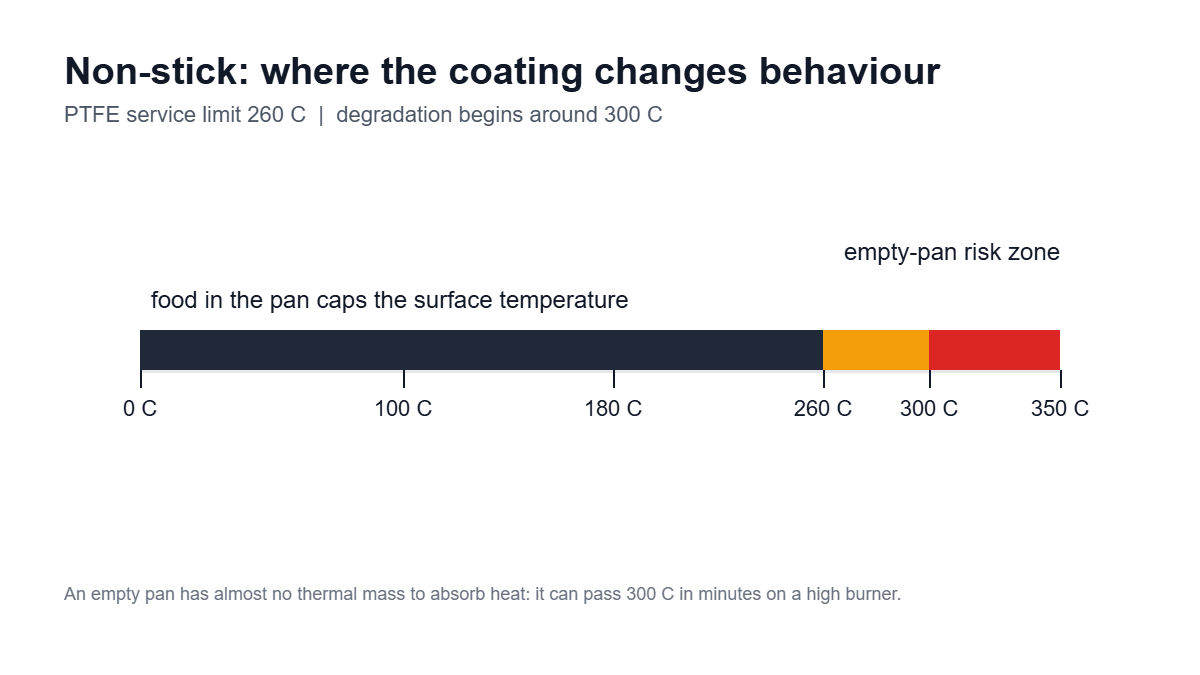
PTFE is rated for continuous service up to about 260 °C (500 °F). Above roughly 300 °C it begins to degrade, and the degradation products are the reason pans carry a “do not preheat empty” warning. A dry non-stick pan on a high burner reaches 300 °C in a couple of minutes — faster than most people expect, because an empty pan has almost no thermal mass to absorb the heat.
This is a use rule, not a product flaw. Oil, water or food in the pan caps the surface temperature near the boiling point of what is in it. An empty pan has no such cap.
Why the rim fails first
Most worn-out non-stick pans fail at the rim, not the centre. Three reasons: the rim is where the coating is thinnest after spraying, it is the part that takes the most mechanical contact (stacking, spatulas, the sink), and it cycles through the widest temperature swing because it is furthest from the food. If you are judging a used pan, look at the rim before the cooking surface.
“PFOA-free” is not “PFAS-free”
PFOA was a processing aid used in making some fluoropolymers and has been phased out of PTFE manufacturing. A “PFOA-free” claim therefore tells you something about the process, not about the chemistry of the finished coating — PTFE is itself a fluoropolymer. If a listing uses “PFOA-free” to imply “contains no fluorochemicals”, that implication is wrong. The honest claims are the specific ones: which coating, how many layers, what total thickness.
What the listing numbers mean
| Spec on the listing | Typical range | What it tells you |
|---|---|---|
| Coating thickness | 20–40 µm per layer; 60–90 µm for a 3-coat system | Thicker builds last longer; the number is rarely printed, which is itself information |
| Number of coats | 2 or 3 | 3-coat means primer plus build plus topcoat; 2-coat skips the build layer |
| Body gauge | 2.0–3.0 mm aluminium; 0.6–1.0 mm steel | Thin bodies deflect and flex, which cracks coating at the rim |
| Induction compatible | yes/no | Requires a magnetic base layer; usually means a different, harder substrate |
Use rules that measurably extend life
- Never preheat empty on high. Medium heat with oil already in the pan.
- No metal utensils and no stacking. Most coating loss is mechanical, not thermal.
- Hand wash, or accept a shorter life. Dishwasher detergent and the drying cycle both attack the coating edge.
- Replace at the first flaking. Once the coating is breached, the exposed substrate and the loose film are the problem.
FAQ
Is ceramic coating safer than PTFE?
Both are inert in normal cooking. Ceramic has a lower practical temperature ceiling for release performance and wears faster; PTFE releases better for longer but must not be overheated empty.
Can I re-coat a pan at home?
No. Factory coatings are baked at temperatures a domestic oven cannot reach, and a sprayed film will not bond to a used surface.
Do I need to season a non-stick pan?
Not in the cast-iron sense. A thin film of oil before first use helps release, but it does not build a seasoning layer on PTFE.
Temperature figures are the standard service limits for PTFE coatings; layer and gauge ranges are typical industry values, not a claim about any single product.
Compare on Amazon — this category usually has more brands, sizes and price points there.
Check current prices on Amazon →
As an Amazon Associate we earn from qualifying purchases. The price you pay is unchanged. Disclosure