A bathroom that smells faintly of drains is usually not dirty. It is dry. The smell comes through the floor drain, and the thing that is supposed to stop it is a shallow pool of water sitting in a bend of pipe under the floor. When that pool is gone, the pipe is an open chimney into the sewer line.
What the water seal actually is
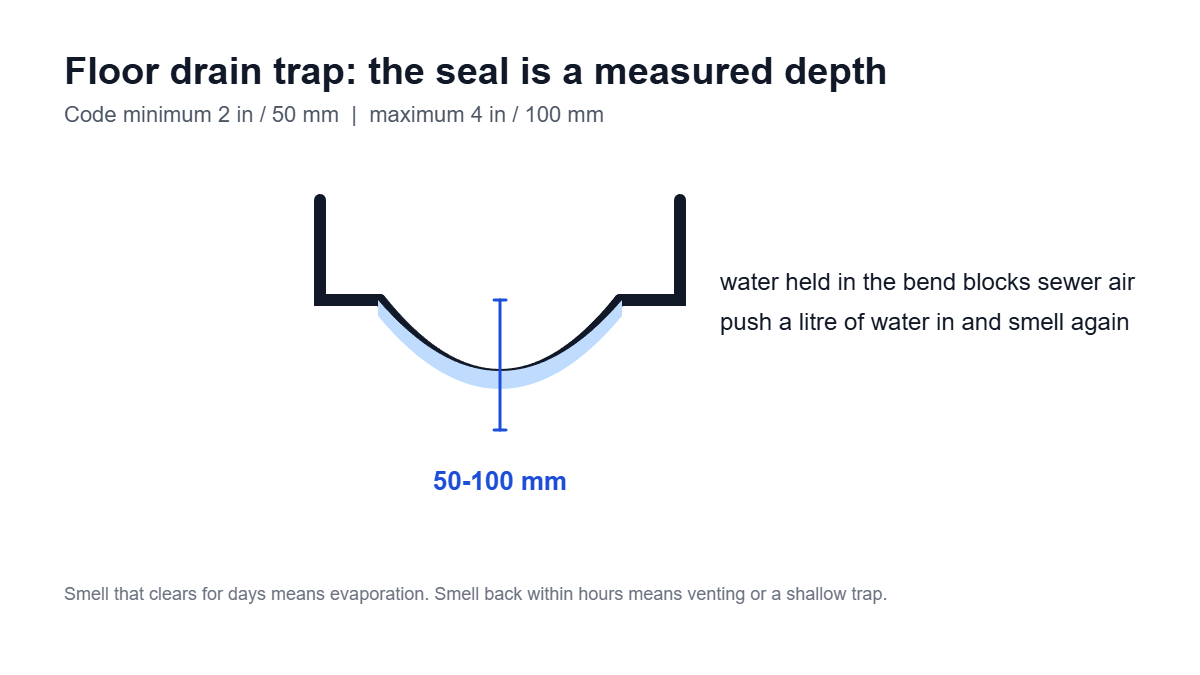
The trap under a floor drain holds water in a U-shaped body. The depth of that water column — from the weir to the dip — is the seal. Plumbing codes require a seal depth of between 2 and 4 inches (50–100 mm) for floor drains. Below 2 inches, the seal is thin enough that normal air movement over the drain can disturb it; the code minimum exists because below it the trap stops being a trap.
Three ways the seal disappears
- Evaporation. A drain that never gets water — a guest bathroom, a laundry floor drain, a basement — loses its seal to dry room air. How fast depends on temperature, humidity and the exposed surface area, which is why the same drain is fine in a humid climate and smells in a heated flat in winter.
- Self-siphonage. A slug of water falling down a nearby stack can pull the seal out behind it if the venting is wrong. The seal refills on the next use, so the smell comes and goes.
- Back pressure. A blockage downstream pushes air and water back through the lowest drain in the building. This is the one that leaves debris on the grate and should be treated as a real plumbing fault, not a maintenance item.
The two-minute diagnosis
Pour about a litre of water slowly into the drain and smell again after ten minutes. If the smell goes and stays away for days, you have evaporation and the fix is hydration, not chemicals. If it returns within hours, suspect the seal itself: either the trap is a shallow one-piece type with too little depth, or the drain has a mechanical flap that is stuck open.
Look down the drain with a torch. A proper trap shows standing water. A dry trap shows a dark throat and, often, a ring of dried biofilm at the water line.
What actually fixes it
- Hydrate unused drains. A cup of water every two to three weeks keeps a seal alive. This is the whole fix for seasonal rooms.
- Use a sealing insert for genuinely unused drains. A silicone one-way membrane sits in the drain and passes water while blocking air. It is a substitute for the seal, not a cleaner.
- Do not use drain cleaner for a smell. Caustic products do not refill a seal, and pouring them into a chemically dry trap adds residue to a problem that is about water.
- Check the venting if the smell returns within hours. Repeating self-siphonage is a venting defect; no grate or insert will fix the cause.
What to look for when buying a drain or insert
| Spec | What matters |
|---|---|
| Trap seal depth | 2 in / 50 mm minimum; deeper holds longer between uses |
| Body material | ABS or PVC welded to the pipe; stainless only as a strainer, not a seal |
| Grate free area | Too fine clogs with hair; too coarse passes it downstream |
| Insert type | Silicone membrane for odour; mechanical flap for backflow. They solve different problems |
FAQ
Why does the smell only appear in winter?
Heating lowers indoor humidity and increases air movement across the grate, both of which speed evaporation from an unused trap.
Will bleach fix it?
It will mask it for a day. If the seal is missing, the path from the sewer is still open.
Can I just cover the drain?
A tight cover works for a drain you never use, but it also hides the early warning of a real blockage.
Code figures refer to the 2–4 inch trap seal requirement for floor drains in US plumbing codes; check your local code for the exact edition in force.
Compare on Amazon — this category usually has more brands, sizes and price points there.
Check current prices on Amazon →
As an Amazon Associate we earn from qualifying purchases. The price you pay is unchanged. Disclosure