Every cutting board argument eventually becomes a hygiene argument, and most of those arguments are about the wrong variable. The material matters less than how long the surface stays wet — and that is measurable.
Three materials, three failure modes
Bamboo is a grass, laminated into boards with adhesive under heat and pressure. It is dense and dimensionally stable, and the lamination lines are the weak point: water that gets into an end or a lifted edge travels along the glue line, not through the fibre.
Hardwood (maple is the standard) is cut either edge-grain or end-grain. End-grain boards present the open ends of the fibres upward, so a knife parts the fibres instead of severing them. That is why end-grain boards show fewer scars — and why they hold more water if they are not dried.
Plastic (HDPE) does not absorb water at all, which is its real advantage. Its weakness is the opposite: every knife pass leaves a scored groove, and those grooves are where residue sits. A plastic board that looks clean can be heavily scored.
The measurement that decides it
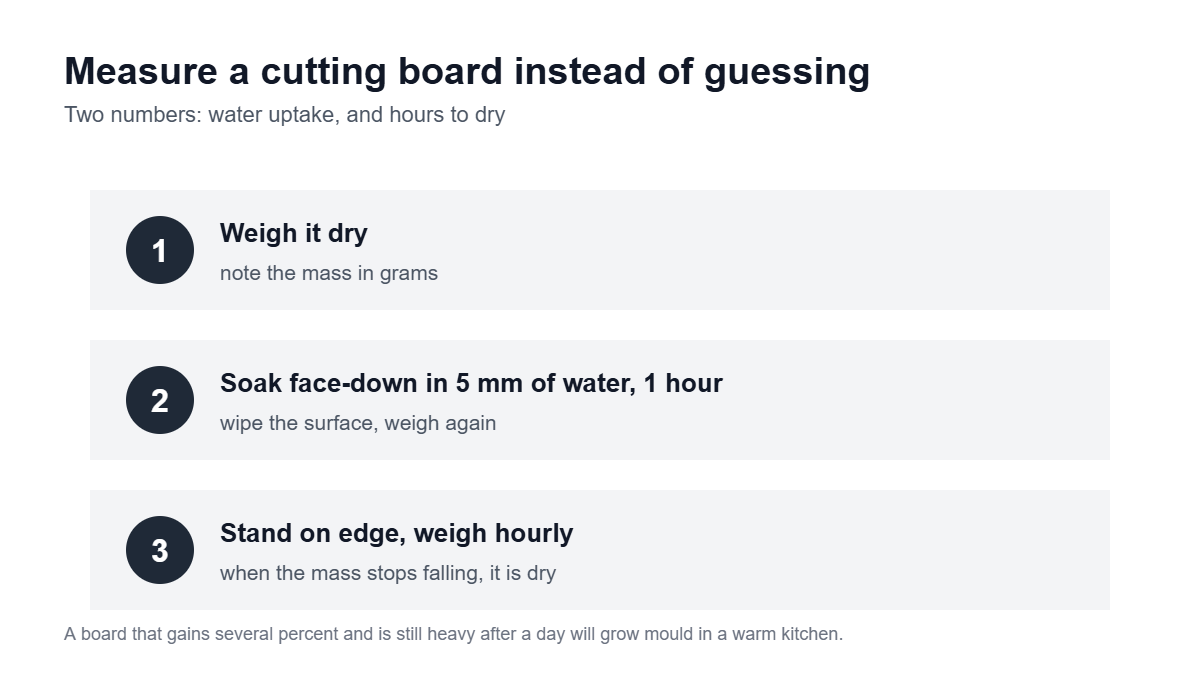
Weigh the board dry, soak it face-down in 5 mm of water for an hour, dry the surface with a cloth and weigh it again. The gain as a percentage of dry mass is the water the board took up. Then leave it standing on edge and weigh it hourly until the mass stops falling; that is the drying curve.
The two numbers together tell you what kind of board you have bought. A board that takes up little water and dries in two hours is a low-risk board. A board that takes up several percent and is still heavy after a day will grow mould in a warm kitchen regardless of what the listing says about antibacterial properties.
About the antibacterial claims
Wood has been reported to reduce surface bacterial counts in some studies, and other studies have not reproduced the effect. The honest summary is that the evidence is mixed and the effect, if real, is small compared with the effect of drying. A wet board of any material is a better growth surface than a dry one. Treat “antibacterial” as marketing until it comes with a test method and a number.
Choosing by kitchen, not by material
| Situation | Reasonable choice | Why |
|---|---|---|
| Raw meat daily | Thin plastic board, dedicated, dishwasher-safe | You want it cleanable at temperature, not pretty |
| Vegetables and bread | Edge-grain hardwood | Low scarring, kind to knives |
| Small kitchen, one board | Bamboo, thin, with a hanging hole | Dries fast on edge, stores vertically |
| Heavy knife work | End-grain, thick, oiled | Fibres part rather than cut; needs more drying care |
Five rules that outrank material choice
- Dry on edge, never flat on a counter. Contact with a wet surface is what keeps the underside damp.
- Oil hardwood monthly for the first year; oil does not make it waterproof, it slows uptake.
- Never soak any board. Water is the variable you are trying to control.
- Replace a board with deep grooves or a split lamination. A split is a channel, not a surface.
- One board per raw-meat job, or wash at temperature between jobs.
FAQ
Is bamboo more hygienic than wood?
Not inherently. Bamboo is denser and takes up less water at the surface, but the glue lines are a failure path that solid hardwood does not have.
Does vinegar sanitise a board?
It reduces surface counts modestly. Hot water and detergent plus thorough drying does more.
Can a warped board be flattened?
Sometimes, by dampening the concave face and clamping flat to dry. A board that has delaminated cannot be repaired reliably.
The soak-and-weigh test is a comparative measurement, not a lab method. Its value is that it compares your boards against each other under your own kitchen conditions.
Compare on Amazon — this category usually has more brands, sizes and price points there.
Check current prices on Amazon →
As an Amazon Associate we earn from qualifying purchases. The price you pay is unchanged. Disclosure