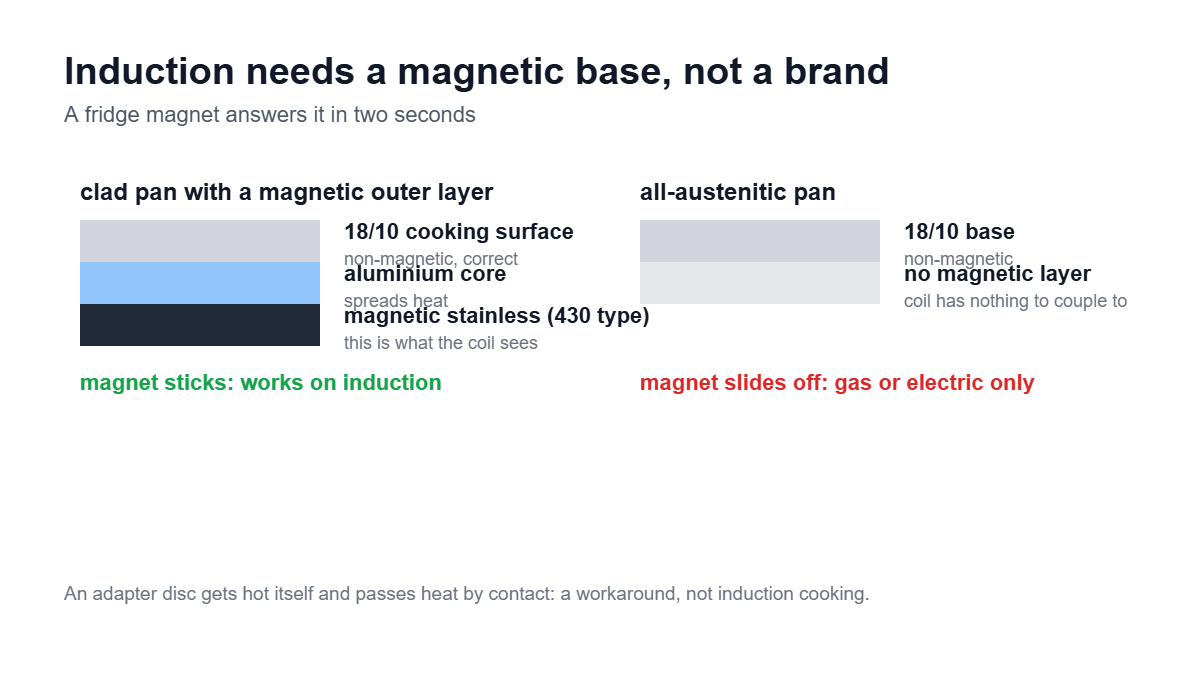
Induction is the only common hob technology that asks a question about the pan rather than the cook. It does not heat the pan with a flame or a coil; it induces currents in the pan’s base, and it can only do that if the base is magnetic. Everything else about induction cooking follows from that single requirement.
Why some stainless pans work and some do not
Most stainless cookware surfaces are austenitic steel — 18/8 or 18/10. Austenitic steel is essentially non-magnetic, which makes it a good cooking surface (stable, corrosion resistant) and a useless induction base. Manufacturers solve this in one of two ways: a magnetic steel layer bonded into the base, or a full clad construction where the outer layer is a ferritic stainless such as a 430-type.
That is why two pans that look identical behave differently on the same hob. The difference is inside the base, not on the label.
The magnet test is the whole test
Put a fridge magnet on the base, inside and out. If it sticks firmly, the pan will work on induction. If it slides off, it will not, and no adapter disc changes that reliably — an adapter works by getting hot itself and passing heat to the pan, which is a conduction workaround, not induction cooking.
Test the cooking surface too, not just the outside. On a disc-bottom pan, only the outside plate is magnetic. On a clad pan, the cooking surface is still non-magnetic, which is normal and correct.
What induction changes about performance
- Heat arrives in the base only. The walls heat by conduction from the base. A clad pan with an aluminium core spreads that heat upward; a thin disc-bottom pan leaves the walls cool and the base ring-shaped.
- Flatness matters more than on gas. Induction relies on close magnetic coupling. A base that has bowed away from the surface loses efficiency exactly where it has lifted.
- Base size versus hob ring. A base much smaller than the marked ring wastes the outer coil; a base much larger concentrates heat in the centre of the pan.
- It responds fast, then overshoots. Induction delivers heat almost instantly, so a pan taken off the hob keeps cooking. Expect to move food sooner than on gas.
What to check in a listing
| Claim | What it should say |
|---|---|
| “Induction compatible” | Which layer is magnetic, and whether it is the base plate or the full outer shell |
| “Tri-ply” | Three layers bonded across the base, or across the whole pan. Not the same product |
| “Works on all hobs” | Usually true for clad; check the base diameter against your largest ring |
| Base thickness | Thicker bases resist the bowing that costs coupling |
FAQ
Will an induction disc let me use any pan?
It transfers heat by contact and works, badly. The hob heats the disc, the disc heats the pan. You lose the efficiency and the control that made induction worth having.
Why does my induction hob hum?
The coil and the pan base vibrate slightly at the switching frequency. Thin or loose bases hum louder.
Can a warped pan be used on induction?
It will run, but the lifted area loses coupling and the pan heats unevenly. Flatness is a functional requirement here, not cosmetic.
Magnetism is a material property, not a quality grade; a magnetic base says nothing about how well the pan conducts heat.
Compare on Amazon — this category usually has more brands, sizes and price points there.
Check current prices on Amazon →
As an Amazon Associate we earn from qualifying purchases. The price you pay is unchanged. Disclosure