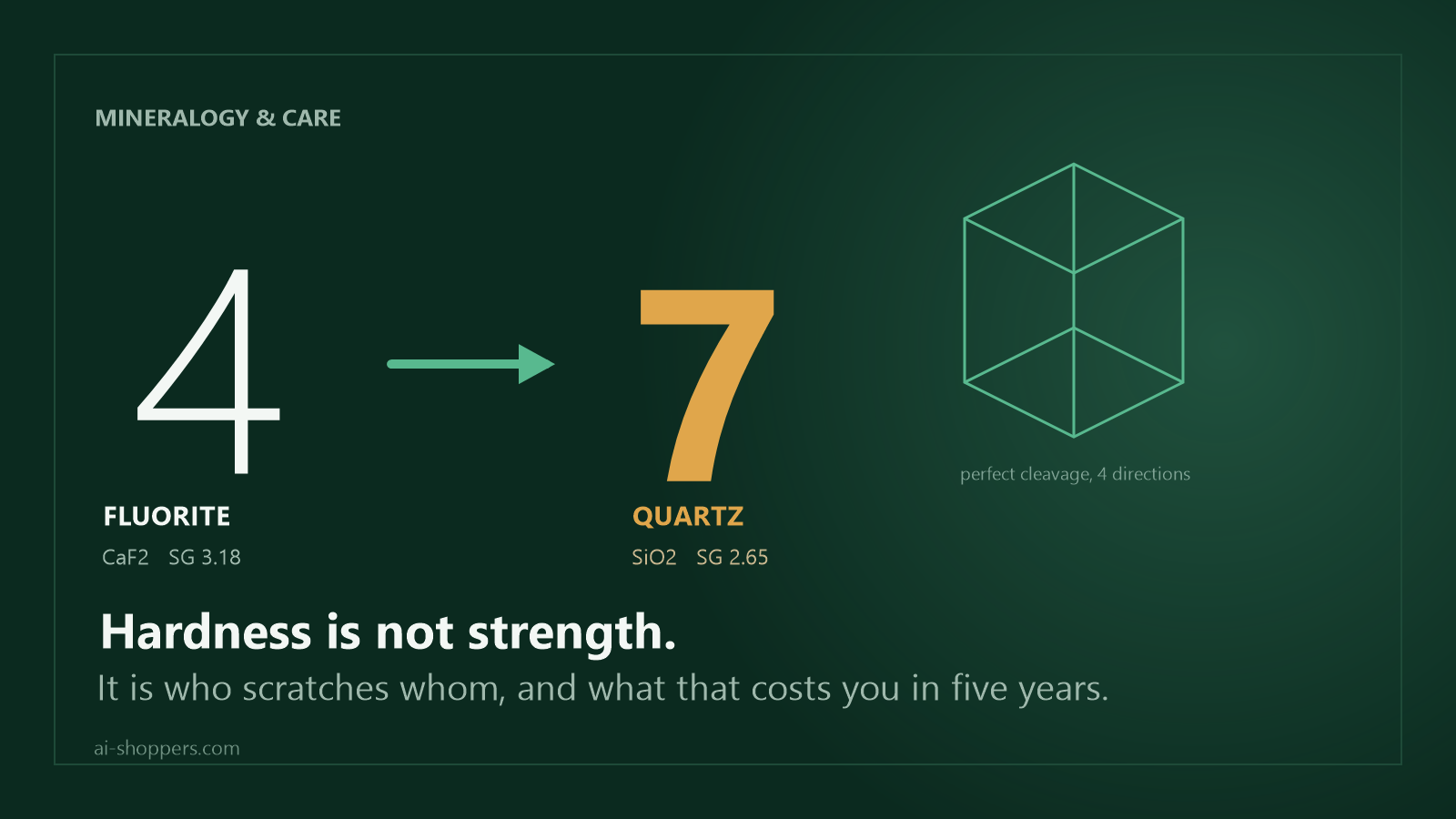
A crystal set is sold on colour and mood. The two properties that decide whether it still looks the same in three years, hardness and cleavage, are almost never printed on the box. Both are measurable at home, and once you know them the care instructions stop being vague advice and become arithmetic.
1. Hardness measures one thing: who scratches whom
Mohs hardness, published by Friedrich Mohs in 1812, is a scratch ranking. A mineral with a higher number scratches one with a lower number, and the reverse never happens. That is the whole test. It says nothing about toughness, and nothing about how a stone behaves when it is dropped, heated or left in a window.
Three reference points cover most of what a household set contains. A fingernail sits at about 2.5. A steel nail or a pair of scissors is roughly 5.5, and so is ordinary window glass. Quartz is 7. Those three numbers let you sort almost any stone on a shelf: if a steel nail leaves a bright line, the mineral is below 5.5; if it skates, it is above.
Fluorite is 4. It is scratched by steel, by glass and by the quartz dust that settles on every open shelf. Quartz, including amethyst, is 7: it scratches glass, and glass does not scratch it. This is why a $6 glass vase and a $38 fluorite specimen cannot share a display shelf without one of them losing.
2. The scale is a ranking, not a measurement
The gap between 9 and 10 is not the same size as the gap between 1 and 2. Measured by abrasion resistance on the Rosiwal scale, which sets talc at 1, fluorite sits around 21 and quartz at 100. The five-number gap on the label is a five-fold difference in how fast the surface wears. Diamond, at the top, is roughly 1,400 on the same table.
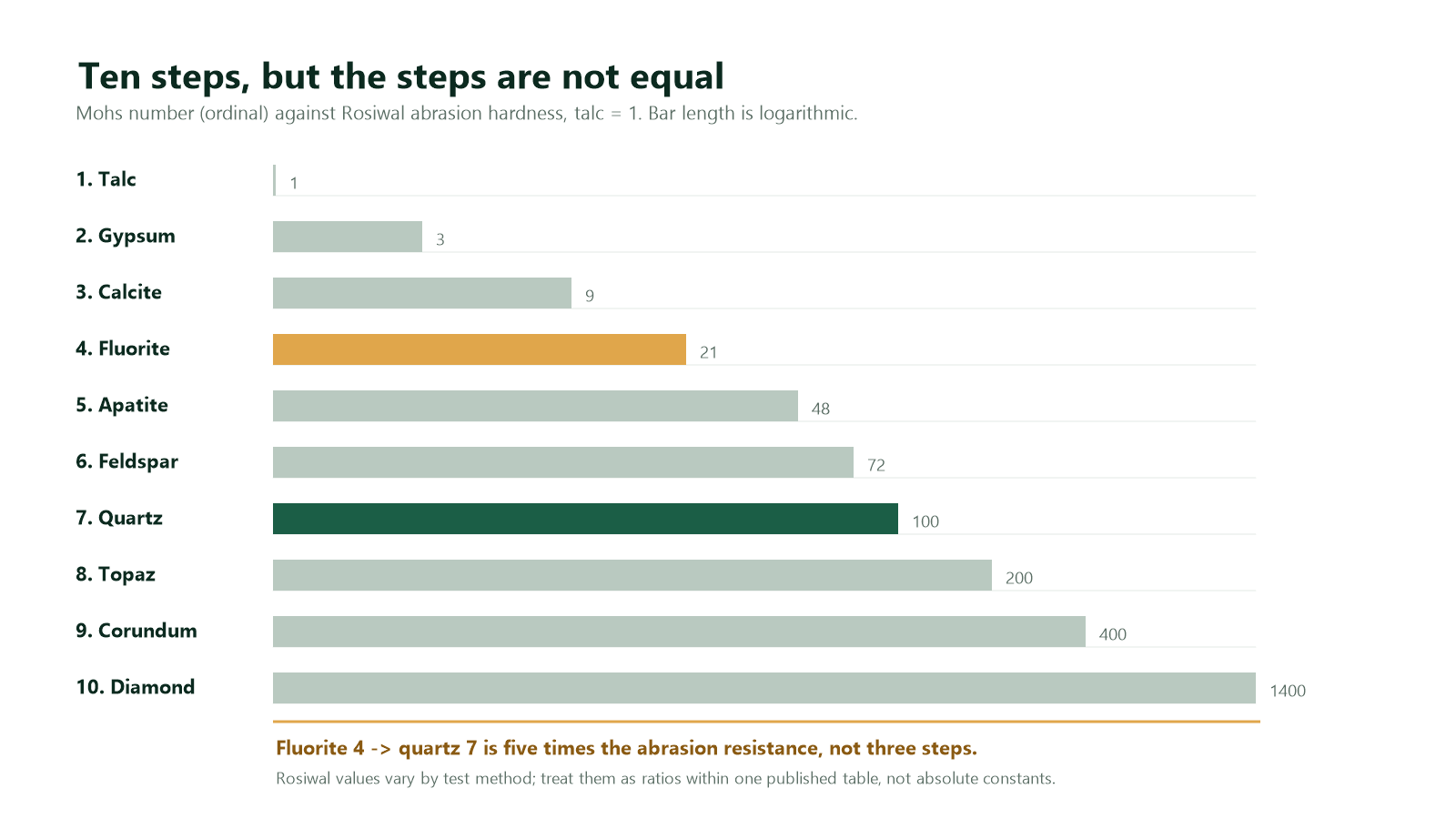
That matters for expectations rather than for chemistry. A fluorite tower that gets handled weekly will dull along its edges within a year or two, because the material is being abraded by things softer than quartz but harder than fluorite: steel, glass, ceramic glaze, most dust. A quartz point handled the same way keeps its polish, because almost nothing in a living room except corundum abrasives is harder than 7.
3. Dust is the part nobody warns you about
Household dust is largely silica, and silica is quartz at Mohs 7. A dry cloth dragged across a fluorite specimen is a fine abrasive slurry being pushed over a Mohs 4 surface at hand speed. Do it weekly for two years and the matte patches on the flat faces are not a manufacturing defect; they are the result of a 3-point hardness difference applied a hundred times.
The fix costs nothing. Rinse the piece under running water, blot it with a soft cloth, and let it dry before it goes back on the shelf. Never dry-wipe an unpolished mineral. For quartz and amethyst the same rule is optional, because dust cannot scratch them; for fluorite and calcite it is the difference between a clear face and a scuffed one.
A two-second field test. Turn the stone over and try to scratch an inconspicuous corner with the tip of a steel nail. A white line that rubs away is soft material being crushed; a bright groove that stays is a scratch. Fluorite and calcite mark. Quartz and amethyst do not.
4. Three stones, side by side
Most decorative sets mix minerals without saying which is which, so the table below is the one worth keeping. Specific gravity (SG) is density relative to water; refractive index (RI) is how strongly the material bends light, and it is why polished quartz and polished glass look different under a lamp.
| Property | Fluorite (CaF2) | Calcite (CaCO3) | Quartz / amethyst (SiO2) | What it changes at home |
|---|---|---|---|---|
| Mohs hardness | 4 | 3 | 7 | Whether dust, glass and steel can scratch it |
| Specific gravity | 3.18 | 2.71 | 2.65 | Weight in the hand; usable as an ID test |
| Refractive index | 1.434 | 1.486–1.658 | 1.544–1.553 | How much a polished face sparkles |
| Cleavage | Perfect, 4 directions | Perfect, 3 directions | None; conchoidal fracture | Whether a knock chips a corner or splits the piece |
| Dilute acid | Slow attack | Dissolves with fizzing | Unaffected | Whether vinegar or lemon juice is safe nearby |
| Prolonged light | Colour can fade | Stable | Amethyst fades slowly | Whether a sunny windowsill is a display or a slow erase |
| Cleaning | Water, blot, no heat | Water only, no acid | Water, mild soap | Which of the three survives a rinse |
5. The 27-gram test
Hardness tells you how a stone wears; density tells you what it is. A 3 cm cube has a volume of 27 cm³, so its mass is simply 27 times its specific gravity. Fluorite comes out at 85.9 g, calcite at 73.2 g, quartz at 71.6 g. The spread between fluorite and quartz is 14.3 g, which is far wider than the drift of an inexpensive kitchen scale.
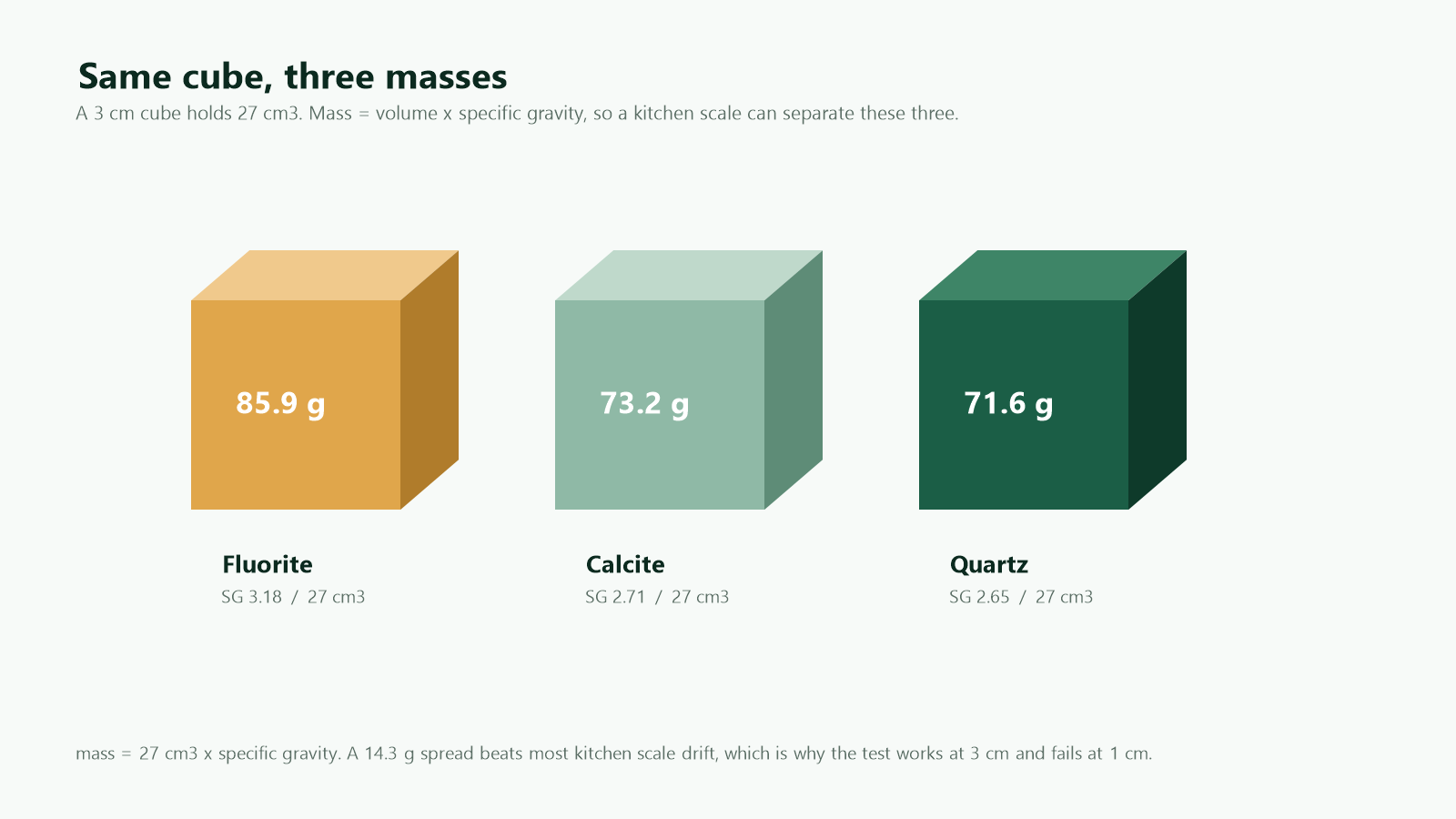
Tumbled stones are not cubes, so measure the volume instead of assuming it. Weigh the piece dry, then weigh it again suspended in water on a thin thread, or use a marked jug and read the displacement. Divide the dry mass in grams by the displaced volume in millilitres and you have specific gravity directly. Quartz lands near 2.65, fluorite near 3.18, and glass near 2.5 — which is how a glass “quartz” point gives itself away on a scale long before anyone looks at it under a loupe.
The test only works at size. At 1 cm the fluorite-quartz difference is about 1.4 g, inside the error of a cheap scale and inside the natural variation between specimens. At 3 cm and above it is decisive.
6. Water, acid and ultrasound
Water is safe for quartz, amethyst and most untreated silicates. It is not automatically safe for everything else. Calcite is calcium carbonate: dilute acetic acid, the kind in household vinegar at roughly pH 2.4, dissolves it and leaves an etched, chalky surface that cannot be polished back at home. A lemon wedge on the same shelf does the same job more slowly.
Fluorite tolerates water but not heat. It has perfect cleavage in four directions, meaning it separates along flat planes when stressed, and a sudden temperature change is stress. Hot water, a radiator, a dishwasher, a windowsill in direct summer sun: each is a way to turn a corner chip into a split. Room-temperature water and a blot is the whole safe procedure.
Ultrasonic cleaners are the third trap. They work by cavitation, and they are excellent on metal and on untreated quartz. On resin-stabilised turquoise, dyed howlite or any stone with a filled surface, the same vibration can drive cleaning fluid into the treatment and lift it. If you would not put the piece in a glass of water for an hour, do not put it in an ultrasonic bath for three minutes.
7. Colour is a process, not a property
Amethyst is quartz coloured by iron-related colour centres, and those centres are not permanent under heat. Sustained heating to roughly 400–450 °C turns amethyst yellow, which is why most commercial citrine is heat-treated amethyst rather than a separate mineral. The same centres respond to light over years: an amethyst left in a bright window fades toward pale lilac, slowly enough that owners blame their memory rather than the sun.
Fluorite behaves similarly for a different reason. Its colour comes from structural defects and trace elements, and prolonged ultraviolet exposure can bleach it. It also fluoresces under UV, which is where the mineral’s name comes from — a useful parlor trick and a reminder that the material is chemically active in light.
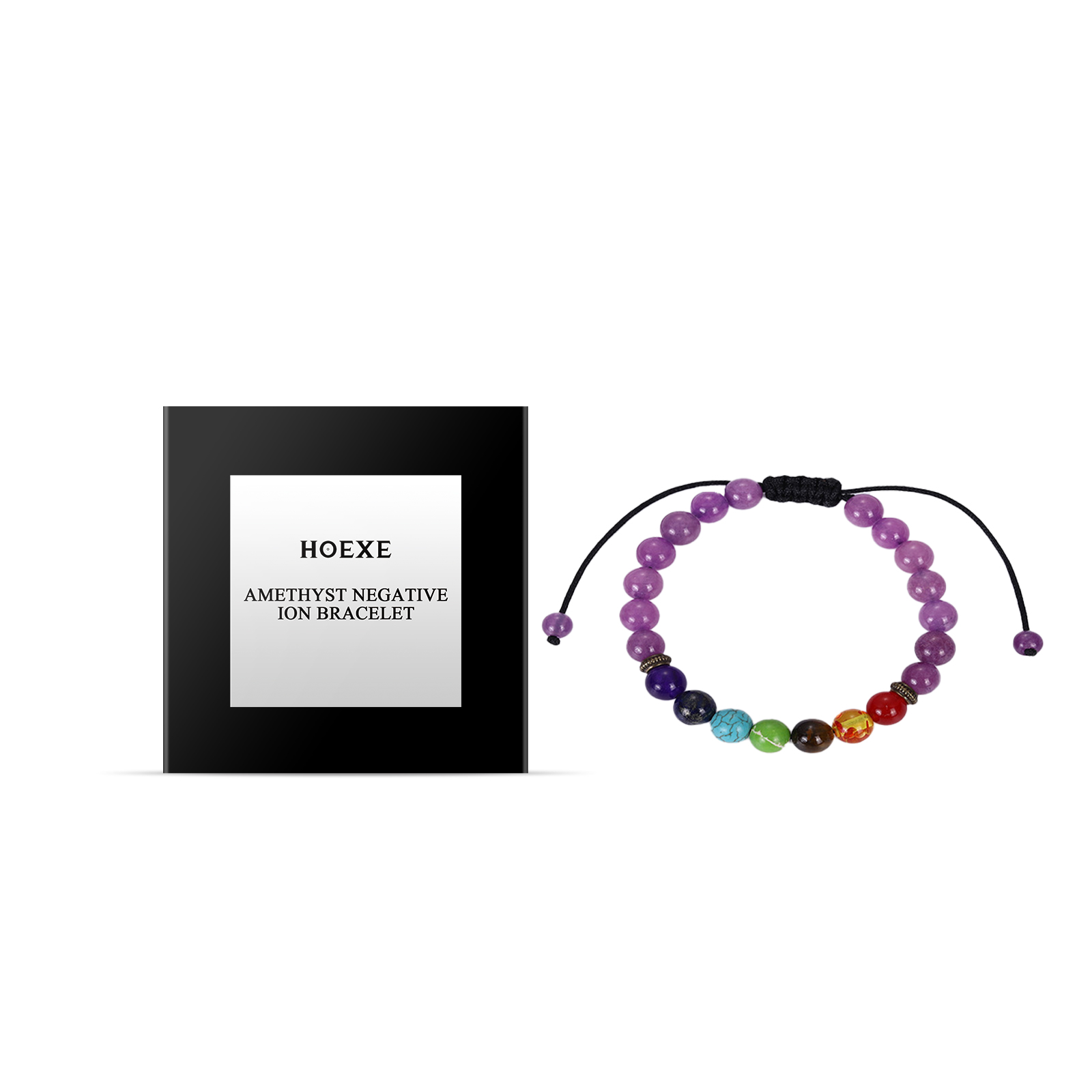
Turquoise is the opposite case. It is a porous hydrated copper aluminium phosphate at Mohs 5–6, and most of what reaches a jewellery bench has been stabilised with resin to stop it absorbing skin oils and darkening. That is a legitimate treatment, not a fake. The fake is dyed howlite, a much softer mineral at about Mohs 3.5, which takes dye well and scratches with a fingernail far more readily than turquoise should. On a bracelet, the turquoise accent and the amethyst beads therefore need different handling: no alcohol, no ultrasonic, no long soaking for the turquoise side.
8. What the price actually covers
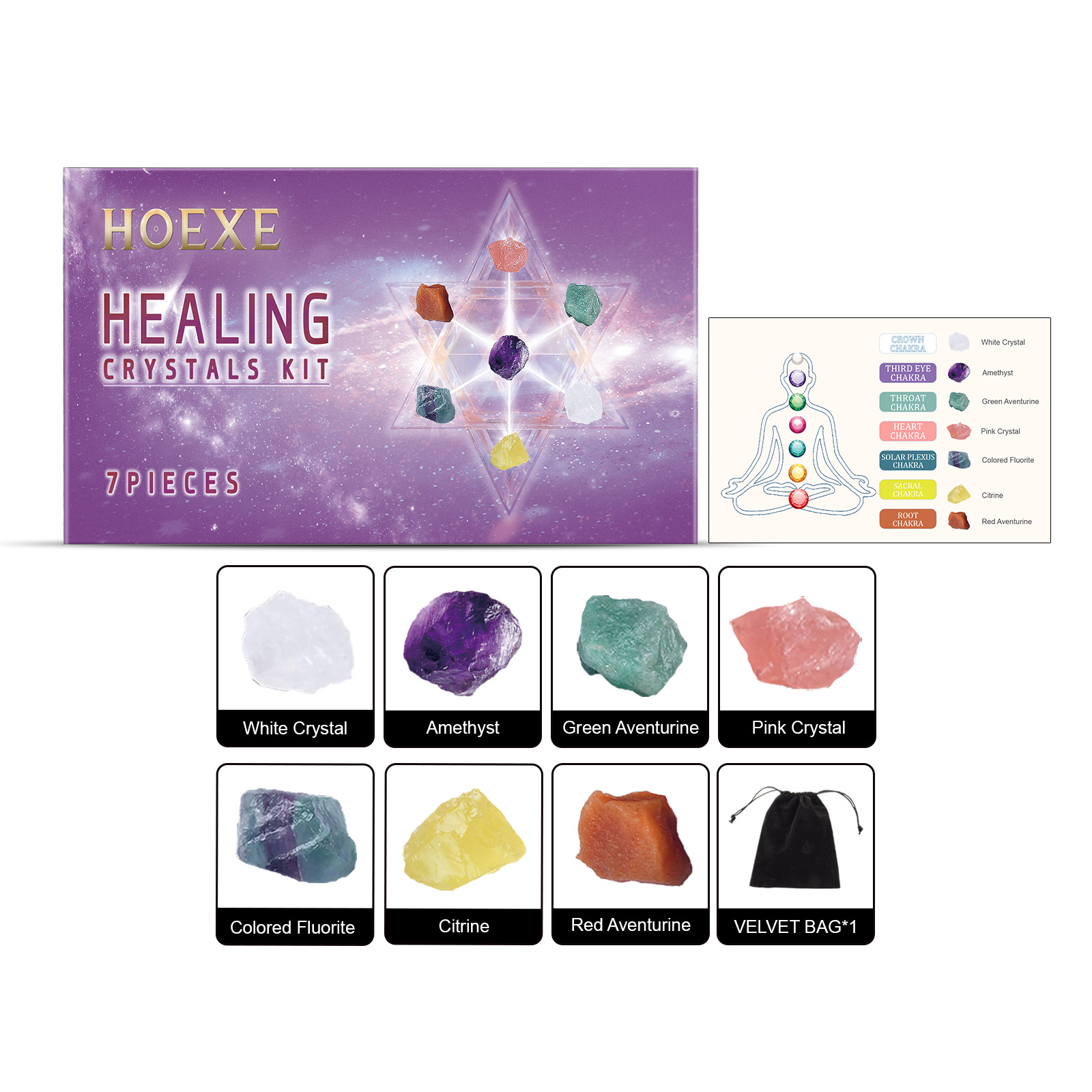
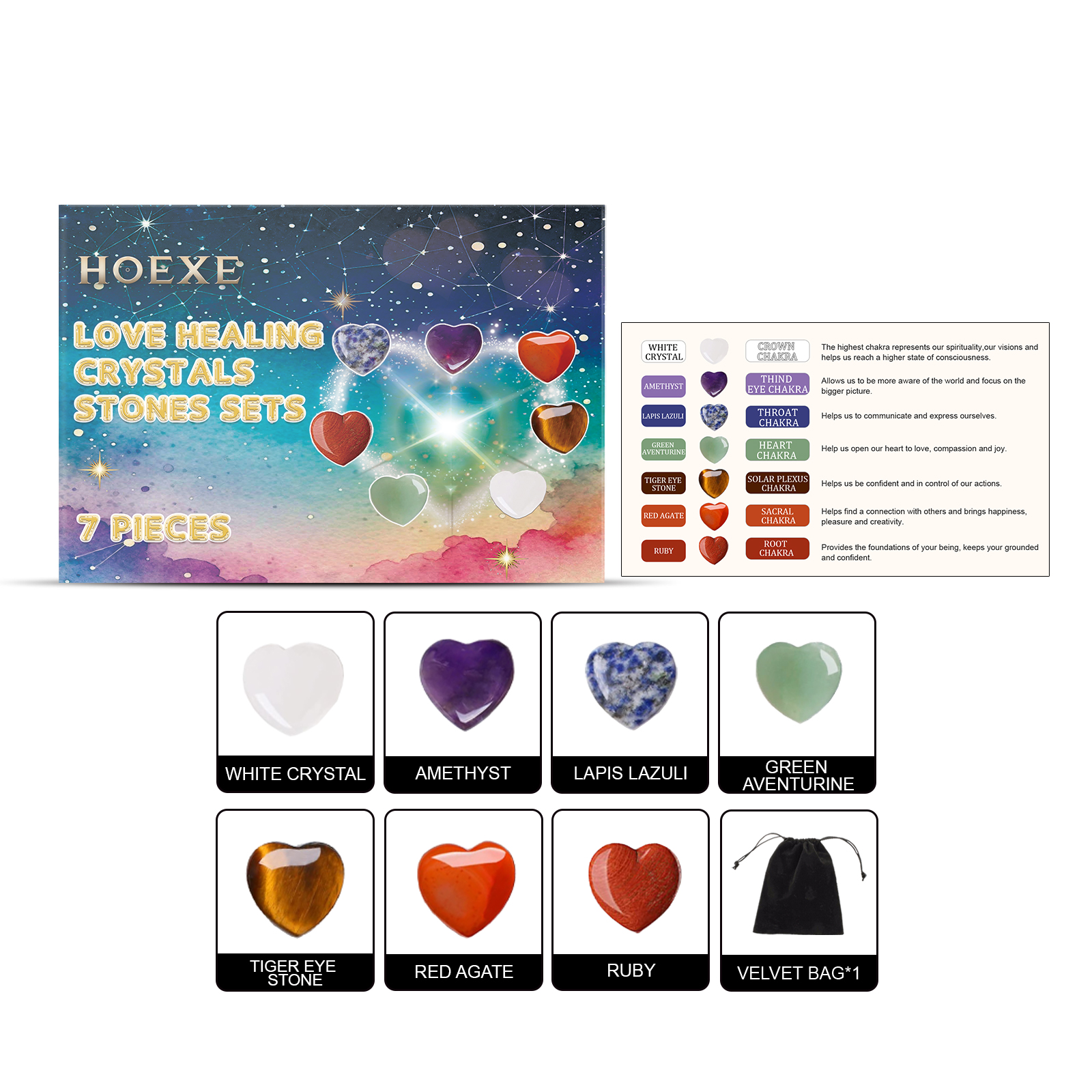
In this catalogue the fluorite set with a display base is $37.99, the chakra assortment is $35.99, the love-collection stone set is $35.99 and the amethyst-and-turquoise bracelet is $29.99, all shipped from a US warehouse with delivery quoted at 2–6 business days after dispatch. Within that band, price tracks three things: the size of the largest piece, how well the set is matched in colour and shape, and whether a base or box is included.
It does not track hardness. A soft fluorite specimen can cost more than a hard quartz one because it is larger, clearer or better matched, and that is a reasonable thing to pay for as long as you know what you are buying. What is not reasonable is expecting the soft piece to survive the same handling as the hard one.
Honest disclosure: the hardness, density and refractive values above are published mineralogical constants for the mineral species, not measurements taken on the specific items in this catalogue. Individual specimens vary, and treated or synthetic material can differ from the species values. Nothing here is a health claim; the article is about wear, cleaning and identification only.
Frequently asked questions
Can I identify a stone with my fingernail?
Only at the soft end. A fingernail is about Mohs 2.5, so it can test talc, gypsum and very soft decorative material, and nothing else in a typical set. For fluorite, calcite and quartz you need a steel nail at roughly 5.5 or a piece of glass.
Will my amethyst fade in a window?
It can, over months to years of direct sun. Amethyst colour comes from colour centres that respond to heat and light, which is the same mechanism the trade uses deliberately when heating amethyst to make citrine. A shelf away from direct sun costs nothing and removes the variable.
Is it safe to rinse crystals in water?
Quartz and amethyst, yes. Calcite, no — it dissolves in mild acid and etches. Fluorite tolerates room-temperature water but not hot water, because thermal stress on its four cleavage directions can split the piece. Resin-stabilised turquoise should be wiped, not soaked.
How can I tell real turquoise from dyed howlite?
Hardness is the first check: turquoise is 5–6 and will not take a fingernail scratch, while howlite at about 3.5 will. Colour is the second: dye tends to pool darker in cracks, while natural turquoise varies across the face. A stabilised stone is still turquoise; a dyed one is not.
Does a higher Mohs number mean a better stone?
No. It means the stone resists scratching better, which is one property among several. Fluorite is softer than quartz and is also the more visually distinctive mineral, which is why it is sold as a display specimen rather than as jewellery. Choose the care regime to match the number, not the price to match the number.
Gear referenced in this guide
None of these are required to use the article. They are the pieces whose specs the numbers above describe, listed so you can compare against what you already own.
View details
View details
View details
The bracelet below is the mixed-material case from section 7: quartz at Mohs 7 next to a treated turquoise accent that needs gentler handling.
Compare on Amazon — this category usually has more brands, sizes and price points there.
Check current prices on Amazon →
As an Amazon Associate we earn from qualifying purchases. The price you pay is unchanged. Disclosure