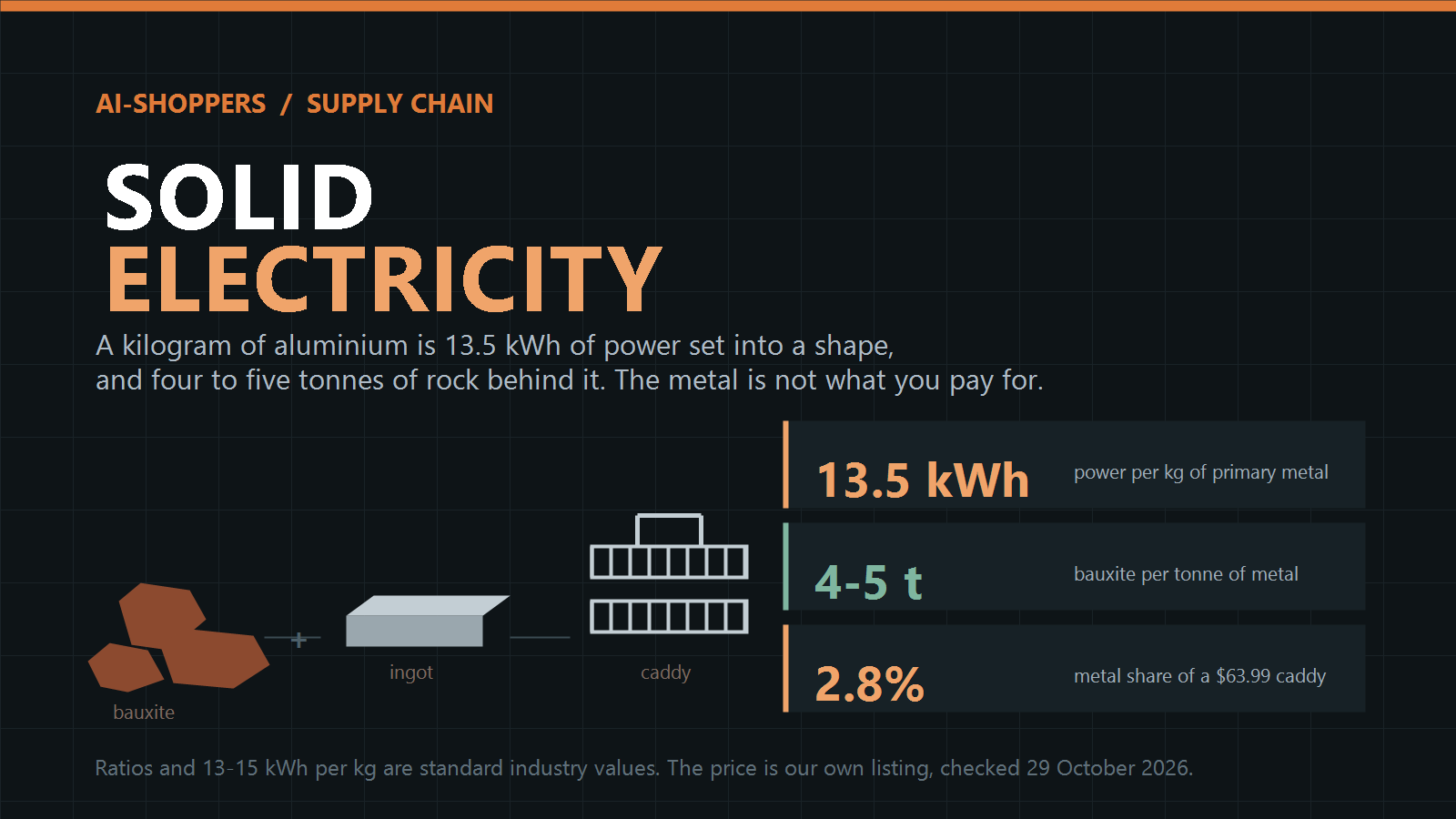
One kilogram of new aluminium carries about 13.5 kilowatt-hours of electricity inside it. A tonne carries 13.5 megawatt-hours, which is more than a typical American household uses in a year. When you hang an aluminium basket on a shower screen, you are hanging a block of frozen power, shipped from a place that had power to spare — and the metal itself, at today’s prices, is the cheapest thing in the parcel.
1. The metal is electricity that stopped moving
Aluminium is the most abundant metal in the earth’s crust and one of the hardest to prise out of it. It never appears as a metal in nature, because it is too reactive: it holds on to oxygen with about 1,600 kilojoules per mole of alumina, and no amount of charcoal in a furnace will break that bond. It took until 1886, when Charles Martin Hall and Paul Héroult independently dissolved alumina in molten cryolite and ran a current through it, for aluminium to stop being a laboratory curiosity priced like silver.
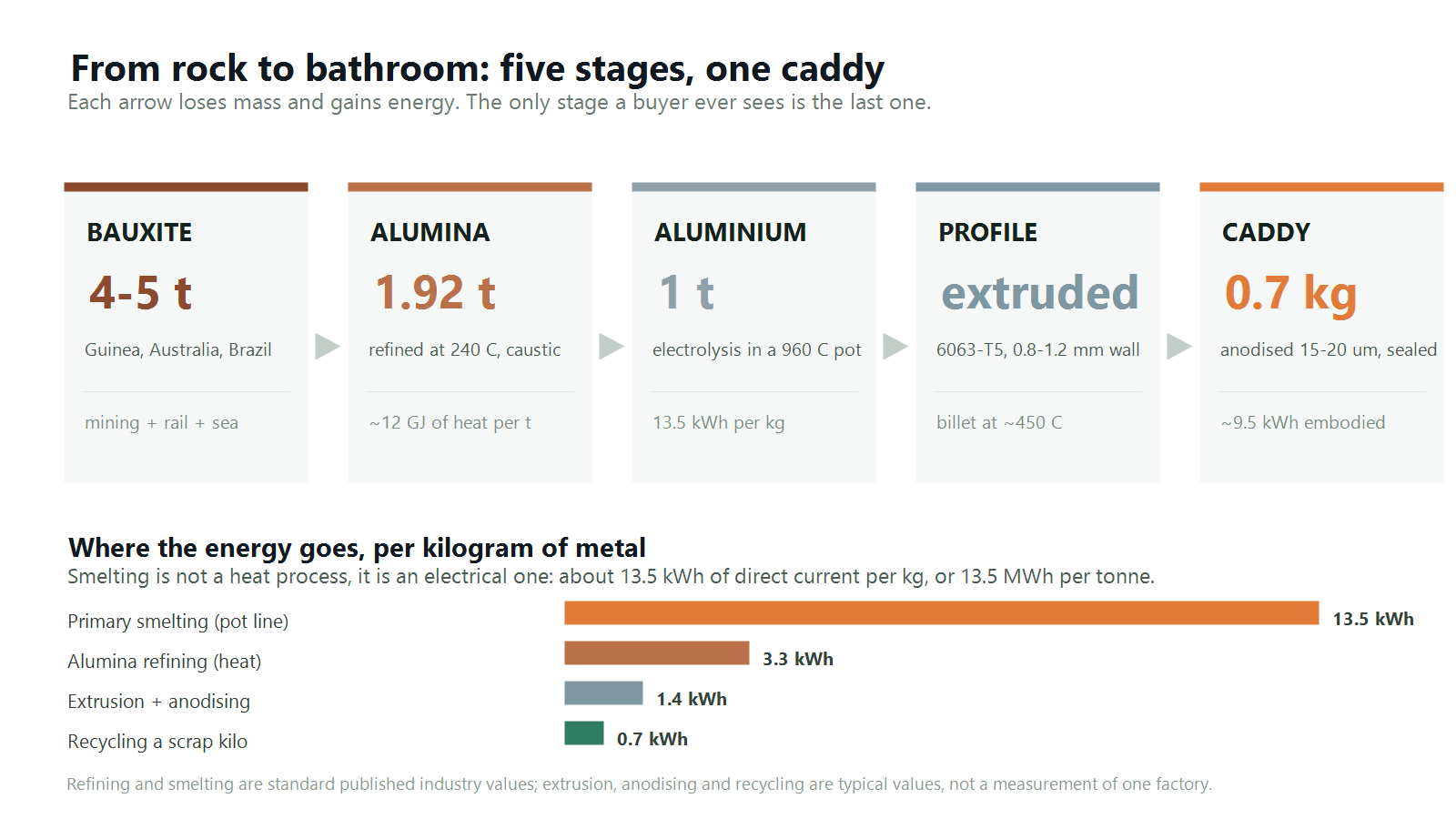
That process is still the one in use. Alumina is dissolved in a bath of molten cryolite at roughly 960 °C, and a direct current of hundreds of thousands of amperes is passed through it. Aluminium metal plates out at the cathode; oxygen bubbles off at the carbon anode and burns it away, which is why a smelter consumes about 0.4 to 0.45 kg of anode carbon for every kilogram of metal it makes.
The energy figure is the one worth memorising: 13 to 15 kilowatt-hours per kilogram of primary aluminium, with the best smelters at the bottom of that band. Electricity is the largest single cost in the metal — commonly quoted at a third to 40 percent of the cash cost — and it is the reason the industry’s map looks the way it does.
A 0.7 kg caddy contains 0.7 × 13.5 = 9.5 kWh of embodied electricity. That is about eight hours of an average American household’s consumption, or three full dishwasher cycles. At a US residential rate of roughly 15 to 17 cents per kilowatt-hour it would cost about $1.50 at the meter — but a smelter does not pay residential rates, and that difference is the entire aluminium industry.
2. Four to five tonnes of rock behind every tonne of metal
Before any of that electricity is spent, the ore has to become a powder pure enough to dissolve. Bauxite — a reddish, clay-like rock with 30 to 60 percent available alumina — is dug in open pits, crushed, and digested in hot caustic soda at around 240 °C under pressure. The Bayer process dissolves the alumina out of the iron and silica, then precipitates it back as a white hydrate that is calcined to pure alumina.
The ratios are stable enough to use as planning figures: about 2 tonnes of bauxite yield 1 tonne of alumina, and about 1.92 tonnes of alumina yield 1 tonne of aluminium. Multiply, and a tonne of metal starts as roughly four to five tonnes of rock. Every tonne of alumina also leaves behind roughly one to one and a half tonnes of red mud, the alkaline residue that has become one of the industry’s harder environmental problems — stored in ponds and dry stacks, not sold.
None of this happens where the metal is eventually used. Bauxite comes overwhelmingly from a handful of places: Guinea, which ships well over 100 million tonnes a year and sends most of it to China; Australia, with the Weipa and Gove deposits; Brazil; and Indonesia. Refining follows either the mine or a port with cheap heat, so alumina plants cluster in Australia and China. China refines close to 60 percent of the world’s alumina and smelts a similar share of its primary metal.
3. The map follows the power station
If smelting is a third to 40 percent electricity, then a smelter is a power station with a factory attached, and it will move to wherever firm, cheap electricity can be contracted for ten or twenty years. That single fact explains the geography better than any list of countries.
It is why there are smelters in Iceland, Norway and Quebec — hydroelectric power, cold climate, deep-water ports for alumina imports — and why the Gulf states built aluminium industries on associated gas. It is also why China’s smelting capacity has been migrating south and west, into Yunnan and neighbouring provinces, to sit on hydropower. Yunnan’s wet season runs roughly from June to October, and in the dry months the province has repeatedly curtailed smelter load to keep the lights on elsewhere. A metal whose price depends on rainfall is a metal with a seasonal heartbeat.
For a buyer, the practical consequence is that the origin printed on a carton tells you very little about where the metal came from. A caddy extruded and anodised in Guangdong may hold aluminium smelted in Yunnan from alumina refined in Shanxi from bauxite dug in Guinea. Four countries, five stages, one basket.
| Stage | Where it mostly happens | Why there and not somewhere else |
|---|---|---|
| Bauxite mining | Guinea, Australia, Brazil, Indonesia | Shallow, high-grade deposits near tidewater; the ore is heavy and low-value, so it travels by ship in bulk or not at all |
| Alumina refining | China, Australia | Needs caustic soda, heat and a port; often sited at the mine mouth or the smelter’s quay |
| Primary smelting | China (about 60%), India, UAE, Russia, Iceland, Norway, Canada | Follows long-term cheap electricity: hydro, gas, or a province with surplus capacity |
| Extrusion | China (Guangdong/Foshan), Vietnam, Turkey | Die shops, press capacity and anodising lines in the same industrial estate; short lead times matter more than labour cost |
| Anodising and sealing | Same clusters | A chemical line next to the press: the sealing bath is the step cheap factories quietly skip |
| Assembly and packing | Same clusters | Hardware, foam and cartons are bulky and cheap; nobody ships them twice |
4. Then somebody has to draw a shape
Extrusion is the step that turns a cast billet into the thing you recognise. A billet of alloy 6063 — the standard architectural alloy, magnesium and silicon in small amounts — is heated to around 450 to 500 °C and pushed through a steel die shaped like the cross-section you want. The profile comes out continuous, is quenched, cut to length and artificially aged to the T5 temper.
This is why hollow, thin-walled shapes are cheap in aluminium and expensive in almost anything else: a caddy’s basket floor with slots and a rolled edge is one die, one pass, no welding. A steel version of the same shape would need to be formed from wire and welded at a few hundred points, and every weld is a place where rust starts in a wet room.
Wall thickness is where the grades actually differ, and it is almost never printed. A load-bearing basket rail is commonly 0.8 to 1.2 mm; discount stock runs thinner, and a 0.6 mm rail that looks identical in a photograph will bow under three one-litre bottles within a season. Photographs cannot show thickness, which is why the weight of the finished item is a better proxy than any picture.
5. Twenty microns of oxide
Raw aluminium is a poor choice for a bathroom. It is soft enough to scratch with a sponge, and its natural oxide layer is a few nanometres thick — enough to stop it rusting, not enough to survive soap, shampoo and a scrubbing brush. Anodising thickens that layer deliberately: the part becomes the anode in a sulfuric acid bath, and the current grows an oxide film that is hard, porous and integral to the metal rather than painted onto it.
Architectural anodising runs about 15 to 20 micrometres. Put that next to a human hair at roughly 70 micrometres and the coating is about a quarter of a hair’s width. It also grows half in and half out: a 20 µm film consumes around 10 µm of the original surface and adds around 10 µm above it, which is why a badly polished part shows streaks after anodising rather than before.
The pores are the point and the problem. Freshly anodised aluminium is a honeycomb of vertical tubes, which is how dye gets in; if the tubes are left open, dye and dirt get in later, and the part goes blotchy. Sealing — a hot water or nickel-acetate bath that swells the pores shut — is the step that decides whether the finish lasts five years or five months. It is invisible in a listing, cheap to skip, and impossible to test after the fact. The failure looks like a chalky white bloom along the basket edges, usually within the first winter.
6. Why a caddy is aluminium at all
Here is the part that surprises people who assume aluminium is chosen because it is light. Per kilogram, aluminium is not stiffer than steel — it is much less stiff. Young’s modulus is about 69 GPa for aluminium against 200 GPa for steel, and the density is 2.70 g/cm³ against 7.85. Divide one by the other and the specific stiffness comes out at roughly 25.6 versus 25.5 MN·m/kg: effectively identical. A beam designed to the same deflection weighs the same in either metal.
So if a caddy is aluminium, it is for three other reasons. It does not rust, which matters more in a shower than anywhere else in a house. It extrudes into thin hollow sections cheaply, so the stiffness can be put where it is needed without welding. And the loads are small — three bottles, a sponge, maybe 3 kg — so the design is limited by stiffness and corrosion, not strength. Steel would work, weigh more, and start staining the grout within a year.
The opposite logic runs for cutting tools, where mass is a feature rather than a cost: a 7-inch shear in 6Cr13 stainless is heavy in the hand because steel is nearly three times as dense as aluminium, and that mass is part of what keeps the blade from chattering through a coat. Same supply chain logic, opposite conclusion, and both are decided by the same table of densities.
7. Where the $11.82 goes
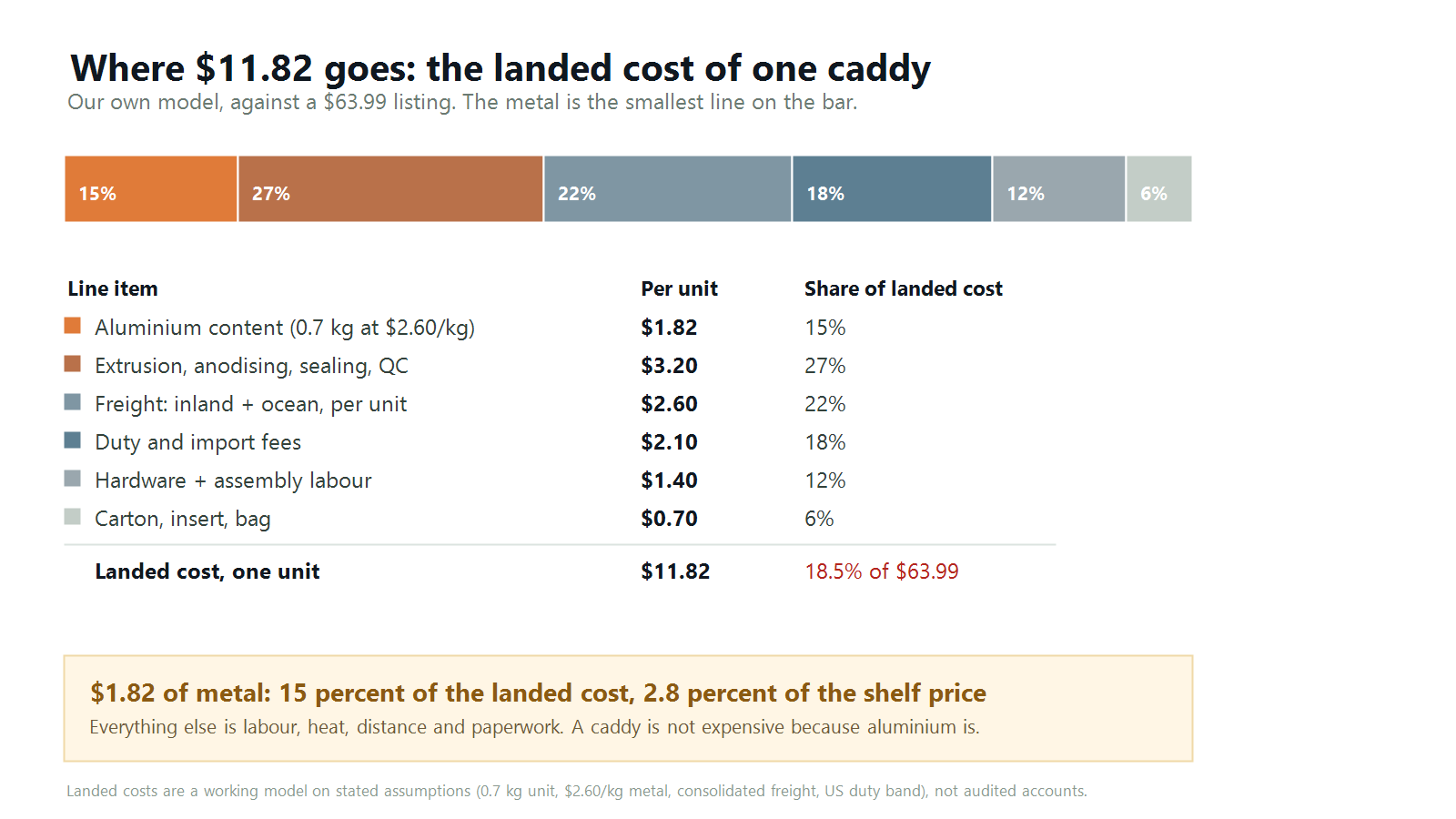
Now put a price on the chain. Assume the caddy above weighs 0.7 kg — the figure we use throughout, because the listing does not state one — and that metal is bought at $2.60 per kilogram, the region LME aluminium has traded in recently. That is $1.82 of aluminium.
| Line | Per unit | Assumption behind it |
|---|---|---|
| Aluminium content | $1.82 | 0.7 kg at $2.60/kg |
| Extrusion, anodising, sealing, QC | $3.20 | Die time, chemical line, labour, yield loss |
| Freight, inland plus ocean | $2.60 | Consolidated sea freight, per-unit share |
| Duty and import fees | $2.10 | US import band for this class of article |
| Hardware and assembly | $1.40 | Hooks, pads, screws, fitting labour |
| Carton, insert, bag | $0.70 | Printed carton plus foam and polybag |
| Landed cost | $11.82 | 18.5 percent of the $63.99 shelf price |
Two readings of that table are worth carrying away. The first: the metal is 2.8 percent of the shelf price and 15 percent of the landed cost. Whatever you think you are paying for when you buy a metal household object, it is not the metal. The second: everything after the metal — the press, the chemical bath, the ship, the customs broker — is what a factory can actually compete on, and it is where the difference between a $20 caddy and a $64 caddy lives.
This is also why “aluminium prices are up” is a weak explanation for a price increase on a small household item. A 20 percent move in the metal price changes our $1.82 line by 36 cents, or half a percent of the shelf price. A 20 percent move in freight changes it by 52 cents. A change in the return rate changes it by more than both.
8. What the chain lets you check before buying
None of this is academic if you are choosing between two listings. Supply chain facts show up as four things you can ask about or inspect.
- Stated weight. A double-basket aluminium caddy in this size class lands around 0.5 to 0.9 kg. A listing quoting 300 g is a thinner section, or a different material with a metal-sounding name.
- Alloy and temper. “6063-T5” or “6061” is a real answer. “Aluminium alloy” alone usually means the cheapest extrusion available.
- Finish type. Anodised, powder-coated, or painted. Anodised and powder-coated both survive a bathroom; paint on a wet edge does not, and it is the cheapest of the three.
- Hook gap. Shower glass is typically 6 to 10 mm thick. A hook designed for 6 mm will tilt and eventually slip on a 10 mm screen — measure the screen, not the picture.
The general lesson transfers to every category in this catalogue. A product’s price is rarely set by its headline material. It is set by the number of process steps after that material, the distance it travels, and the share of units that come back — and only one of those three is ever printed on a listing.
Gear referenced in this guide
None of these are required to use the method above. They are the three items in our catalogue that this article’s numbers were written against: one aluminium, one mixed-material, one steel, listed so the weights and prices can be read in the same order.
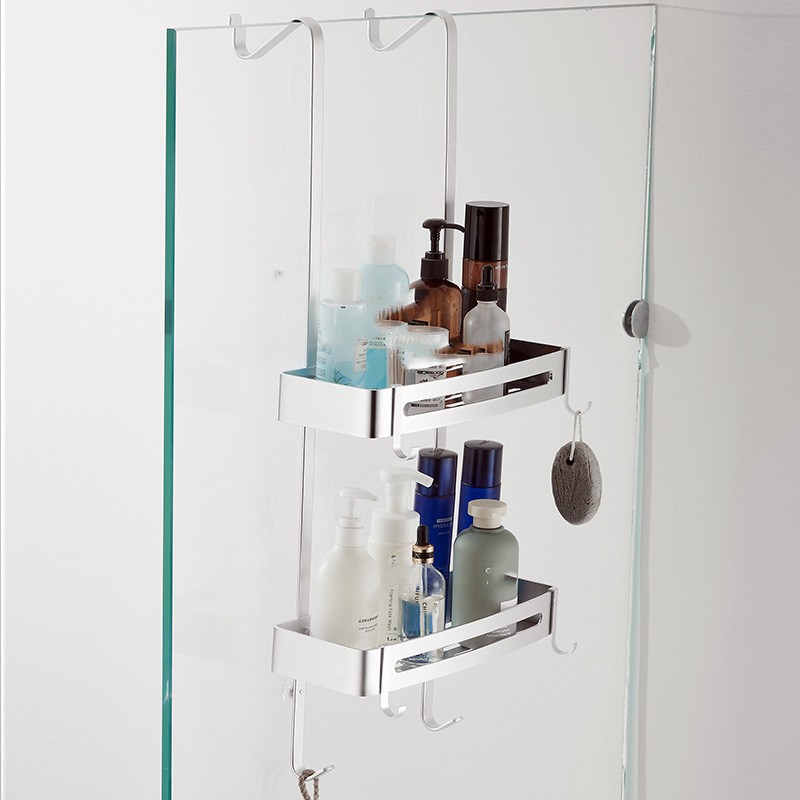 Aluminium Hanging Shower Caddy$63.99View details
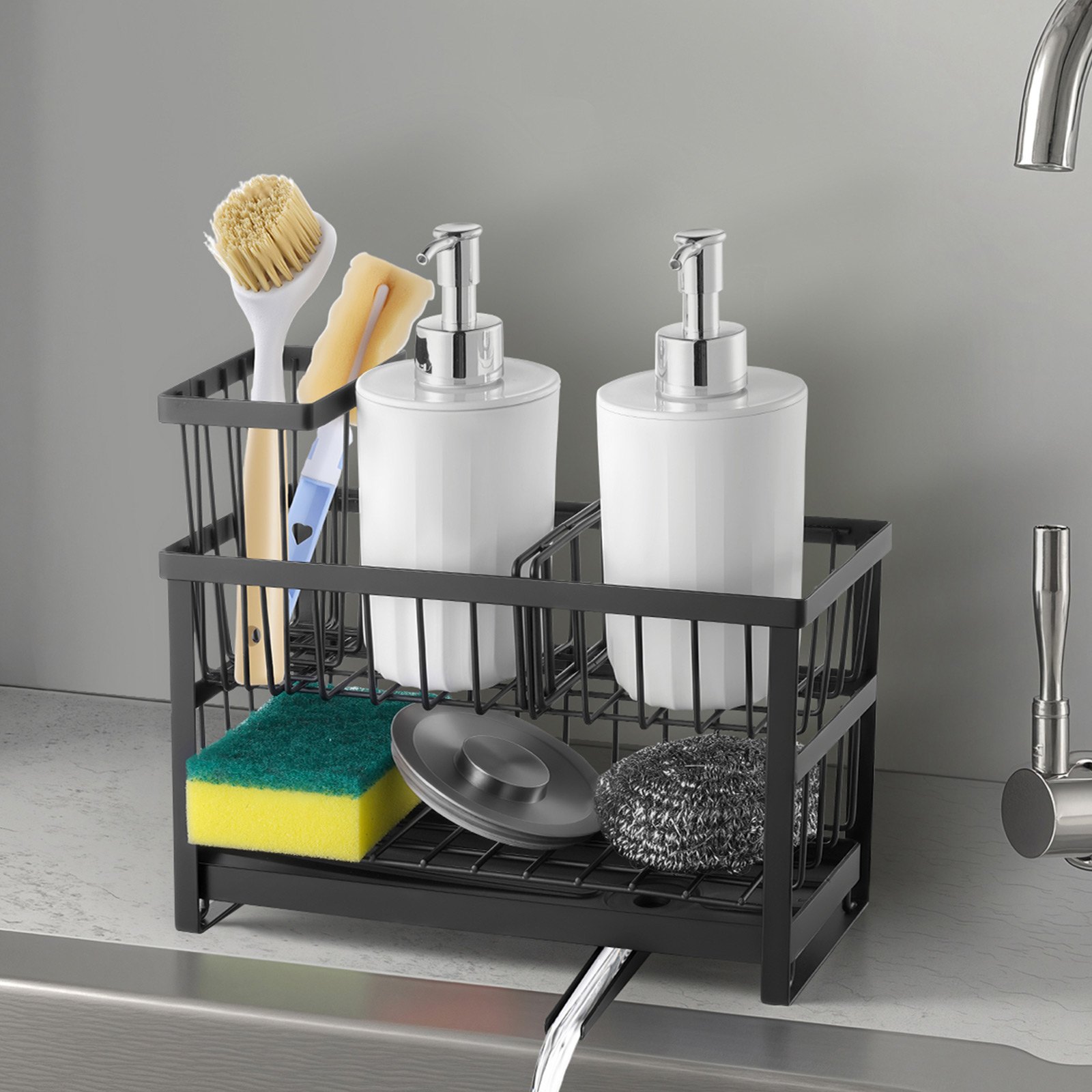 Kitchen Sink Caddy Organizer$65.99View details
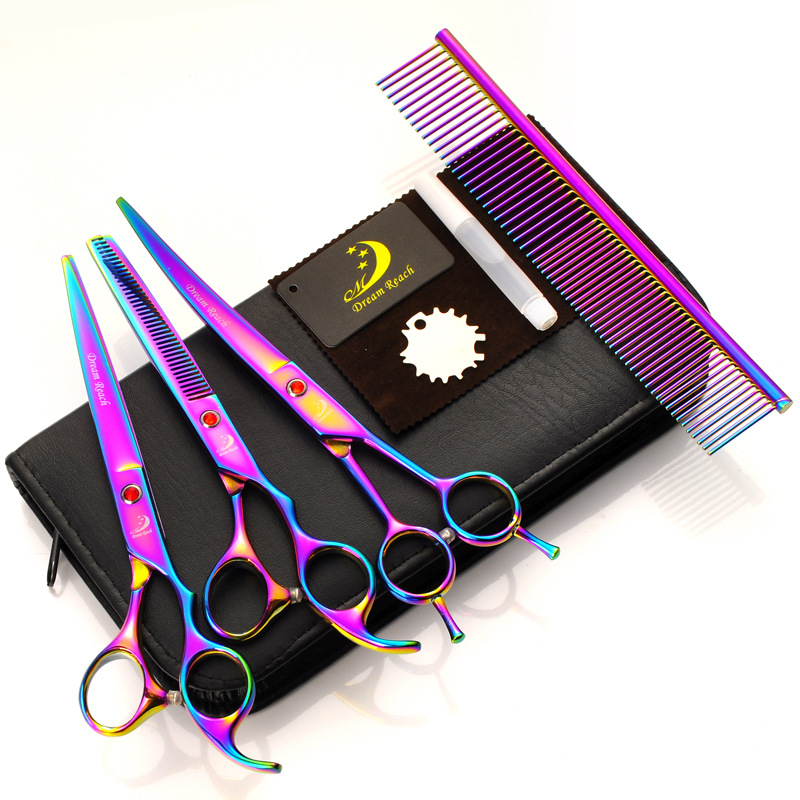 Pet Grooming Scissors, 7-Inch$68.99View details
The sink caddy is the useful comparison: our listing states 800 g for it, which is the kind of number the shower caddy’s listing is missing. Ask for the weight before you compare, and the rest of the arithmetic in this article is only four multiplications away.
Frequently asked questions
Is aluminium really more expensive to make than steel?
Per kilogram of finished metal, yes — primary aluminium takes about 13.5 kWh of electricity per kilo, against roughly 5 to 6 kWh per kilo for primary steel. But the comparison that matters is per part, not per kilogram: an aluminium extrusion of a given stiffness weighs roughly the same as the steel equivalent, while being rust-free and easier to form into hollow sections. For a bathroom fitting, that usually wins.
Does recycled aluminium make a product cheaper?
It should. Remelting scrap takes roughly 5 percent of the energy of primary smelting — about 0.7 kWh per kilogram instead of 13.5 — so the energy line nearly disappears. In practice recycled content is rarely declared on household goods, and mixed scrap with paint, screws and seals is not free to sort, so the saving shows up in the metal price only when volumes are large.
What is the white chalky bloom on an anodised caddy?
It is usually an unsealed or badly sealed oxide layer. Anodising leaves a porous film; if the pores are not closed in a hot sealing bath, moisture and detergent get in and the surface corrodes from inside the coating. Once it blooms, it cannot be polished out, because the damage is in the oxide rather than on it.
Why does the listing not give a weight or wall thickness?
Because most listings are written from a supplier’s marketing sheet, and those sheets carry the things that photograph well — dimensions of the whole item, colour, number of tiers. Wall thickness and unit weight are manufacturing data; they are the first things to ask a seller for, and the fastest way to tell a real spec sheet from a copy of one.
Will a shower caddy hold three one-litre bottles?
A properly made double-basket caddy will, since 3 kg is well within what a 0.8 mm rail carries. The failure point is rarely the rail; it is the hook, which tilts on glass thicker than its gap and slides down. Check the hook gap against your screen thickness, and keep the heaviest bottle in the lower basket, closest to the frame.
Prices are from our own product pages, checked 29 October 2026: the aluminium caddy at $63.99, the kitchen sink caddy at $65.99 with a stated weight of 800 g, the 7-inch 6Cr13 shears at $68.99. Bauxite-to-alumina and alumina-to-aluminium ratios, 13 to 15 kWh per kilogram of primary aluminium, red mud output, China’s share of refining and smelting, recycled-metal energy and the Young’s modulus and density figures are standard published industry and materials values. The 0.7 kg unit weight, the per-line landed costs are our own planning assumptions, written out so you can substitute your own numbers.
Compare on Amazon — this category usually has more brands, sizes and price points there.
Check current prices on Amazon →
As an Amazon Associate we earn from qualifying purchases. The price you pay is unchanged. Disclosure