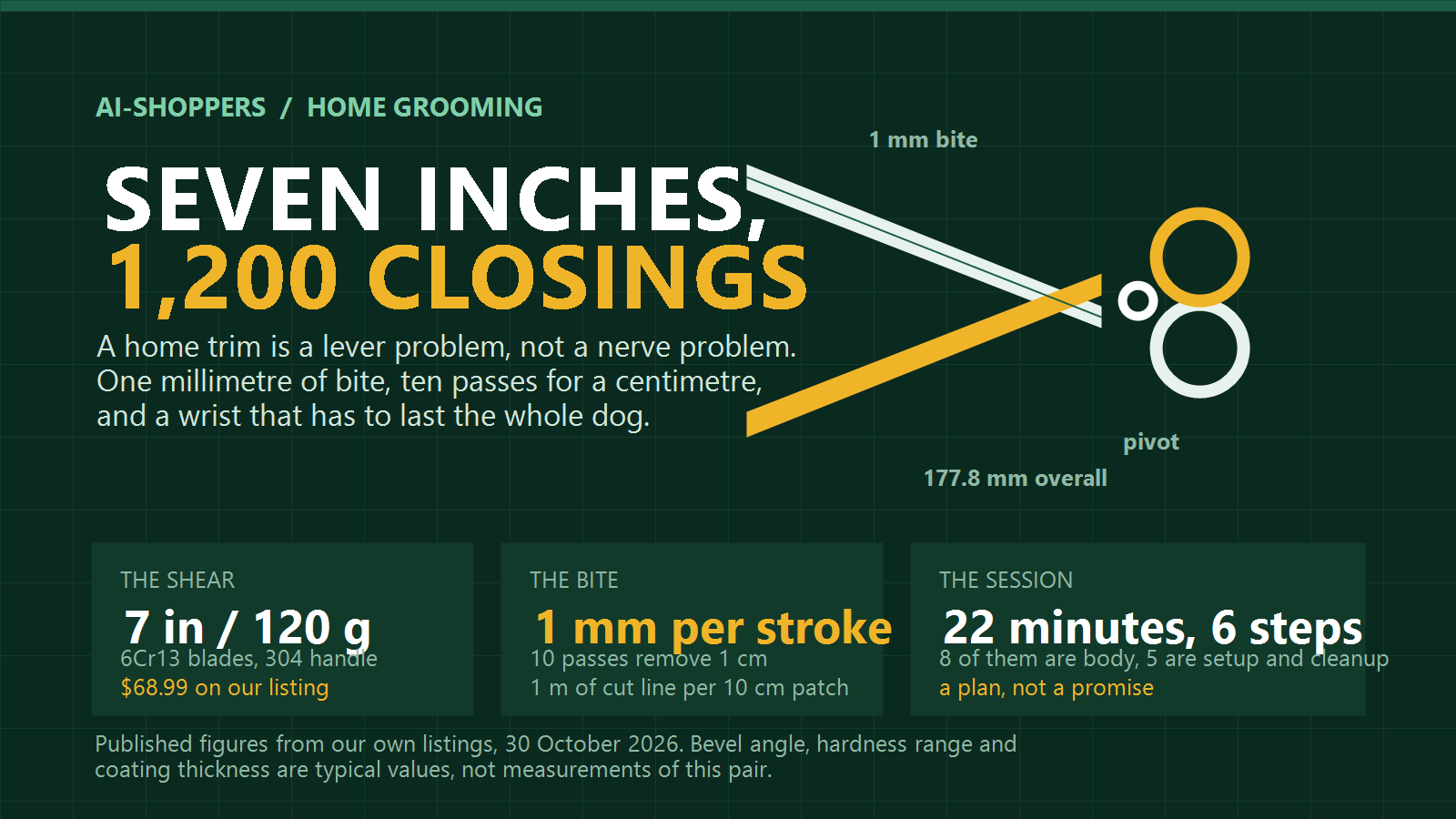
Almost nobody who comes back from a bad at-home trim comes back because the dog would not hold still. They come back because the tool folded the coat instead of cutting it, and the fold looks like a haircut from three metres away and like an accident from thirty centimetres. Everything else — the restraint, the treats, the bath — is downstream of a 1 mm blade gap and a pair of blades that either meet cleanly or do not. This is what the numbers on a 7-inch grooming shear actually mean, where the twenty minutes of a home groom go, and what keeps the blades working for years instead of months.
1. A trim is about 1,200 closings of a 1 mm bite
Start with the only two numbers that decide how a home trim feels. The listing gives an opening size of 1 mm and an overall length of 7 inches — 177.8 mm. One millimetre is the bite: the thickness of coat that can enter between the blades on a single stroke. It is smaller than most people assume, and that is deliberate.
Do the arithmetic for a modest job: tidy a 10 cm × 10 cm patch of a dog that has 3 cm of coat, and take it down to 2 cm. That is 1 cm of length to remove, and at 1 mm of bite it takes ten passes over the same patch. Each pass is a 10 cm stroke, so the patch costs one metre of actual cutting — for one square of a body that has a dozen of them.
Now count the closings. A relaxed hand closes a shear about once a second. Twenty minutes of trimming is therefore roughly 1,200 closings, and every one of them is a chance for the blade to slide rather than cut. This is the number that explains why home grooming is tiring in a way that does not match how little hair seems to come off: the work is not in the coat, it is in the repetition. It is also why a shear that needs 1.6 kg of force instead of 0.8 kg stops being a tool at about closing 400.
2. What the seven inches are actually for
A longer shear is not a bigger pair of scissors. It is a longer lever, and the length buys three specific things.
Reach without knuckles. At 177.8 mm, the hand sits far enough from the cutting line to work along a flank, around a hock and over a paw without the knuckles pressing into the animal. Contact is what makes a dog flinch, and flinching is what makes a line crooked. A 4.5-inch shear cuts just as well and puts your hand roughly 5 cm closer to the skin.
Stroke length, and therefore passes. The usable cutting edge of a 7-inch shear is roughly 60 mm of the 177.8 mm — the rest is handle, pivot and the tips that taper away. A longer stroke means fewer repositionings: the same 10 cm patch is crossed in two strokes rather than three or four, and the total closings for a full body fall by something like a third. Fewer closings is less friction, less heat and less chance of a slip.
Weight where it does not help. This pair is 120 g. Held horizontally, the mass sits about 90 mm from the grip, so the wrist carries a static moment of roughly 0.11 newton-metres — 0.12 kg × 9.81 m/s² × 0.09 m. A 200 g shear of the same length gives 0.18 N·m, and over 1,200 closings the difference is why some people’s hands are shaking by the last paw. Lighter is not automatically better — too light and the blade skips in a thick coat — but 120 g is on the good side of the trade for home use.
The one-line version: 7 inches is a reach decision and a stroke-length decision, not a sharpness decision. If you are trimming faces and paws only, a shorter shear is easier to control. If you are taking a body down, length pays for itself in fewer passes.
3. Sharp cuts; dull folds. That is the whole failure mode
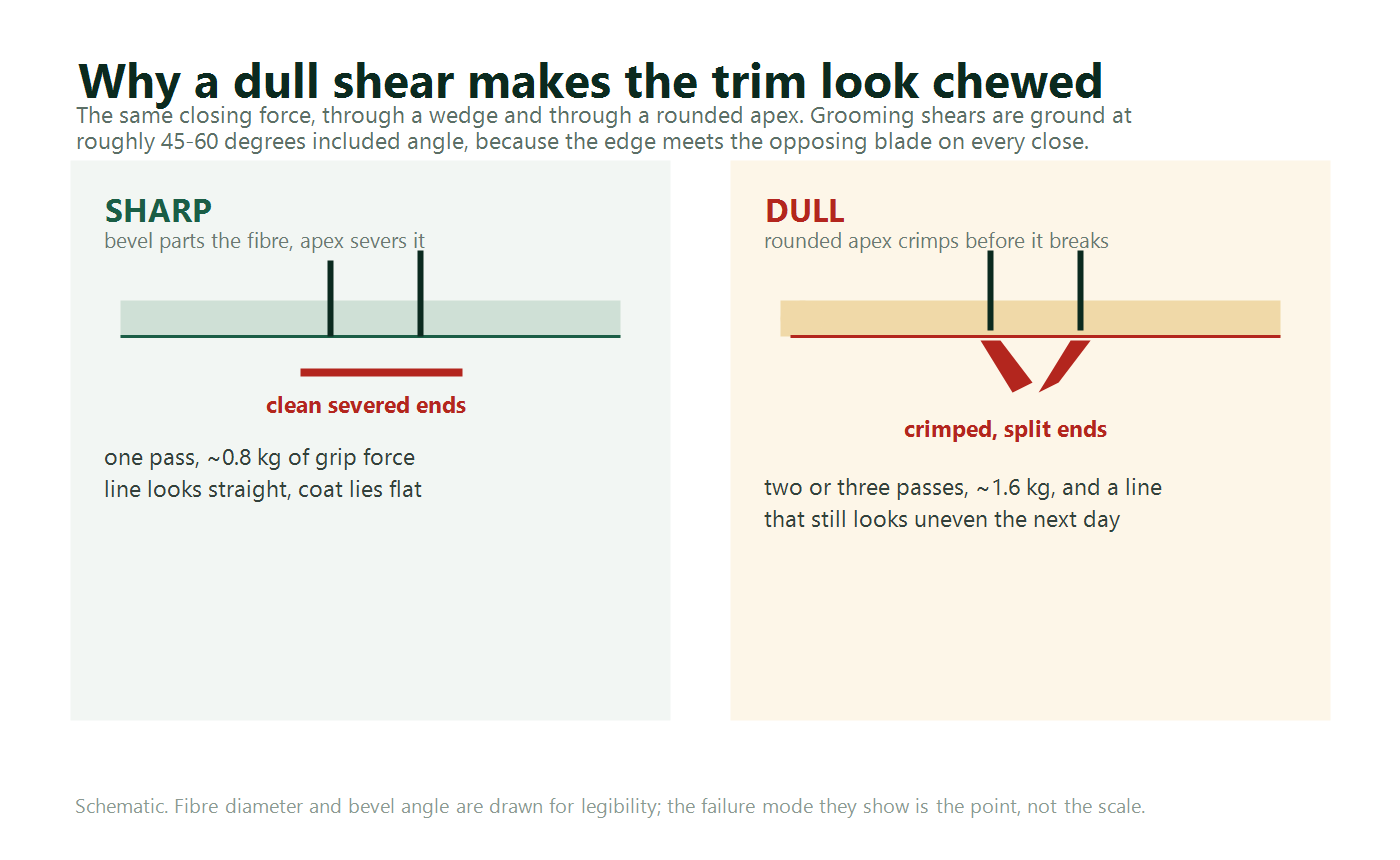
Hair is not cut by pressure, it is cut by a wedge. A sharp bevel parts the fibre and severs it in one pass. A dull bevel has rounded over — at 20× magnification the apex is a radius rather than a line — so it pushes the fibre against the opposing blade and crimps it before it finally breaks. The fibre ends up bent, split or crushed rather than severed.
On the dog, this shows up as a cut line that looks chewed, a coat that stands up in the days afterwards, and a session that takes twice as long because the same line is being crossed three times to get it even. On the shear, it shows up as a growing force requirement: the blades start to “climb” over each other instead of shearing, and the tension screw has to be tightened to compensate — which makes it worse, because overtightening flattens the contact faces that do the cutting.
Two practical rules follow. First, do not cut wet coat. Wet fibres clump, a clump is thicker than the bite, and the blade rides over it instead of through it. Second, do not cut matted coat. A mat is a felted mass, not hair; shears will blunt on it and the skin underneath is already pulled tight. Mats get dematted or clipped, never scissored.
4. 6Cr13, 304 and a coating that is not decoration
The listing names three materials, and only one of them is doing the cutting.
| Spec on the listing | What it is | What it means in the hand | What it does not mean |
|---|---|---|---|
| 6Cr13 stainless | A Chinese-standard martensitic grade: about 0.6% carbon, 13% chromium. Production shears in this grade are typically hardened into the mid-50s HRC. | Holds an edge through a normal home season and resists rust from damp hands. | It is not a super-steel. Our listing does not publish a hardness figure, so the mid-50s is the grade’s usual range, not a measured value for this pair. |
| 304 stainless handle | Austenitic 18/8 steel, roughly 200 HV as supplied — it cannot be hardened by heat treatment. | Rust-proof under soap and water, comfortable when wet, and it will outlive the edge. | It does not make the shear “harder”. The handle is a grip, not a cutting surface. |
| Electrophoresis finish | An e-coat, typically 10–25 µm, applied electrostatically and cured. | Matte, low-glare, and it keeps fingerprints and water off the flat faces between sessions. | It is not a sharpening aid. The coating sits behind the bevel and chips at the pivot if the screw is forced. |
| 1 mm opening | The bite: coat thickness admitted per stroke. | Control. It is what stops a single slip from taking a divot. | It does not mean the shear is slow — that is the trade you accept for safety near skin. |
| 7 inch / 120 g | 177.8 mm overall, 120 g, packed in a 200 × 220 × 60 mm box. | Reach plus a low enough weight to finish a session without a shaking hand. | It does not make it a face shear. For eyes, muzzle and paw pads, shorter and blunter is safer. |
Read the table down the middle column and the design logic is consistent: a hard, corrosion-resistant edge for the part that cuts, an unhardened, rust-proof handle for the part that is held, and a coating for the part that is looked at and wiped. That is a sensible allocation of cost in a $68.99 tool. What it is not is a professional shear — a groomer’s working pair is usually a convex-edged shear in a higher-carbon steel with a hand-tuned pivot, and it costs two to four times as much. The difference is not sharpness on day one. It is how many grooms the sharpness survives.
5. Restrain the mouth, not the body
Most home trims fail at the restraint stage, and the usual fix — a second pair of hands holding the dog still — solves the wrong problem. A dog that is being physically restrained has a reason to struggle. A dog that is licking has a reason not to.
That is the entire argument for a licking mat during grooming, and it is arithmetic rather than opinion. Peanut butter runs about 590 kcal per 100 g, so a level tablespoon — roughly 16 g — is about 94 kcal, which is a serious chunk of a small dog’s day and should be counted against the food bowl, not added to it. Transfer rate is the useful variable: at 0.5 to 1.5 grams a minute, that tablespoon buys somewhere between 11 and 32 minutes of continuous, occupied licking. The formula is simply minutes = grams ÷ grams per minute, so a teaspoon (about 5 g) buys a third of that, which is exactly right for a paw tidy that takes four minutes.
The mat in this guide is 20 × 15 cm, 180 g, with four separate textured zones and suction cups on the back. The zones matter more than they sound: four areas mean four small smears of different textures rather than one big one, and a dog works through them in sequence instead of finishing in ninety seconds. The suction cups are what make it usable on a bath wall or a table edge at nose height, where the dog is standing rather than lying down — and a standing dog is a dog you can walk around.
Placement rule: the mat goes where the dog’s head naturally is when the part you are trimming is presented to you. For a flank, that is a table edge at chest height. For paws, it is the floor. Move the mat, not the dog — every repositioning of the animal costs you the calm you just bought.
6. The twenty-minute budget
Here is where a realistic home session actually goes, for a medium-coat dog that is brushed out and dry before you start. The point of writing it down is that the trimming part is smaller than people expect, and the setup part is larger.
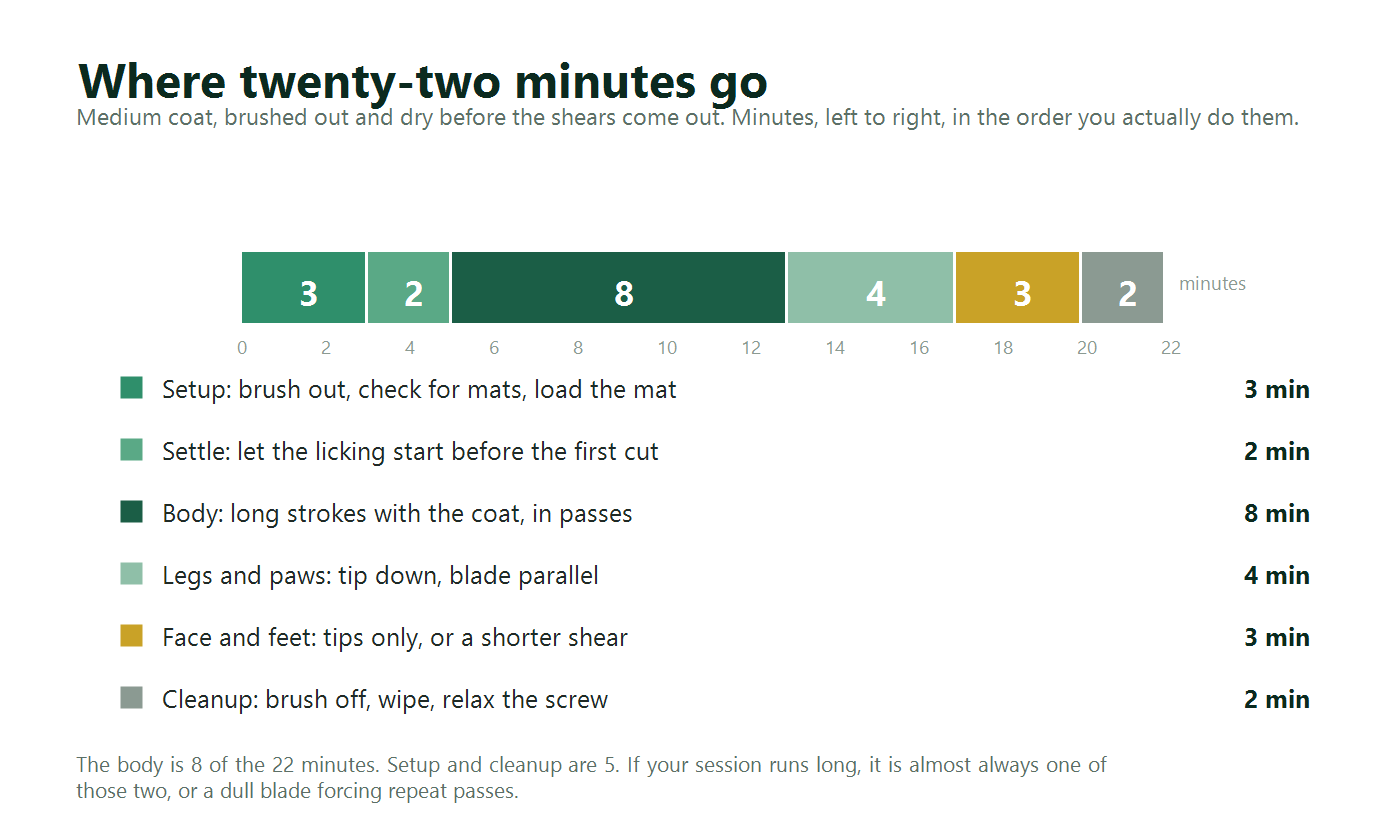
Minutes 0–3, setup. Brush the coat out completely and check for mats by running a comb to the skin. Any mat you find now is a mat you will otherwise discover with the blade. Wipe the shears with a dry cloth, check the pivot for hair, and put the mat down with a teaspoon of something soft on it.
Minutes 3–5, settle. Let the dog start licking before the first cut. Cutting first and treating second teaches the animal that the mat is a bribe for something unpleasant; treating first makes the mat the event and the trim the background.
Minutes 5–13, body. Work in the direction the coat grows, in long strokes, taking the length down in passes rather than trying to remove everything in one. Because the bite is 1 mm, one pass is one millimetre — so decide the target length before you start, and count. Eight minutes covers a flank and a back at roughly two strokes a second with repositioning.
Minutes 13–17, legs and paws. This is where the 120 g matters, because the shear is being held at an angle, tip down, for most of it. Trim with the flat of the blade parallel to the leg, never across a fold, and lift each paw towards you rather than reaching under.
Minutes 17–20, face and feet. The last three minutes are the ones to spend with a shorter, blunter tool or with the tips only. Nothing near an eye needs the full blade.
Minutes 20–22, cleanup. Brush the cut coat off, wipe the blades, and put the shears away closed with the screw relaxed a quarter turn.
7. Maintenance is four habits and one interval
A 6Cr13 shear does not wear out from cutting hair — hair is soft. It wears out from three things: water left on the bevel, hair packed into the pivot, and the edge meeting something harder than hair.
Dry it every time. Wet steel in a closed drawer is the normal failure path. Wipe the blades dry after every session, and if the shear was used on a wet dog, dry it again an hour later — water creeps into the pivot gap and stays there.
Oil the pivot, not the blades. One drop of light machine oil at the screw, worked in by opening and closing ten times, then wiped. Oil on the bevel collects hair and dust and turns into a grinding paste.
Respect the tension screw. If the blades fold coat instead of cutting, the answer is almost never “tighten it”. Test by holding the shear tip up and letting the moving blade fall under its own weight: if it does not fall, the screw is too tight; if it flops loosely, it is too loose. Adjust in quarter turns.
Store it closed, off the tips. A shear dropped on its tip is a shear with a nick, and a nick is a line in every subsequent trim.
The interval: sharpen after roughly 20 to 40 home grooms, or the first time the blade starts pushing coat rather than cutting it. Professional sharpening of a grooming shear typically runs $15–25 depending on where you are, which against a $68.99 purchase is a maintenance cost worth planning rather than discovering. Do not sharpen a convex or offset shear yourself unless you know what the original bevel angle was; a home sharpening that changes the angle changes how the blades meet, and the shear never cuts the same way again.
8. When to put the shears down
Four situations are not tool problems and will not be solved by a better shear.
Matting that reaches the skin. A pelted coat has to be clipped, not scissored, and clipping a matted dog is a groomer’s job because the skin is pulled into the mat and a blade can catch it.
Double coats in summer. Shaving a husky or a shepherd does not cool the dog; it removes the insulation and can damage regrowth. Deshedding with a rake is the correct tool and it is a different purchase.
Anything within 5 mm of an eye, an ear canal or a skin fold. Scissor tips are the single most common home-grooming injury, and it happens in the last two minutes when the hand is tired.
A dog that is panicking rather than annoyed. An animal that is thrashing is not a training problem to be worked through in one session. Stop, feed the rest of the treat, and split the trim across three days. The coat grows back; a bad association does not fade as fast.
None of this is a reason not to do it yourself. A home trim with a sharp 7-inch shear, a mat that keeps the mouth busy and a plan of twenty-two minutes will beat a rushed professional clip on cost by an order of magnitude and on stress by a wide margin — for the dogs that tolerate it. The tool is the cheap part. The discipline of stopping at minute twenty is the part that keeps the results good.
Frequently asked questions
Is a 7-inch shear too big for a small dog?
For a body trim on a small dog, it works, but the length is mostly wasted: you will use the back third of the blade. Where it becomes a liability is around faces and paws, where a shorter shear gives more control. Many home groomers end up with two pairs — a 7-inch for body work and a 4.5- or 5-inch for detail.
Does a 1 mm opening mean the shear is slow?
It means one stroke removes one millimetre of length, so a 1 cm reduction takes ten passes over the same patch. That is a deliberate trade: a small bite is what prevents a single slip from taking a divot out of the coat, especially near skin folds. Speed comes from stroke length and from not having to fix mistakes.
Can I use these shears on a wet dog?
No. Wet coat clumps into bundles thicker than the 1 mm bite, so the blade rides over the clump and folds it, and water left in the pivot is the usual cause of rust spotting. Bathe first, towel and air dry, then trim.
How often do grooming shears need sharpening?
For home use, roughly every 20 to 40 grooms, or as soon as the blade starts pushing coat rather than cutting it. Sharpening typically costs $15–25. Do not wait for the shear to start folding hair — by then you have already trimmed a coat badly and overtightened the screw trying to compensate.
How much peanut butter is safe on a licking mat?
A teaspoon to a tablespoon, counted against the day’s food. Peanut butter is about 590 kcal per 100 g, so a 16 g tablespoon is roughly 94 kcal — a real share of a small dog’s intake. Never use xylitol-sweetened peanut butter; xylitol is toxic to dogs.
Gear referenced in this guide
Neither of these is required to trim a coat, and a sharp pair of any decent shears plus a smear of peanut butter on a plate will get you most of the way. They are the two items the numbers above were written against, priced from our own listings on 30 October 2026.
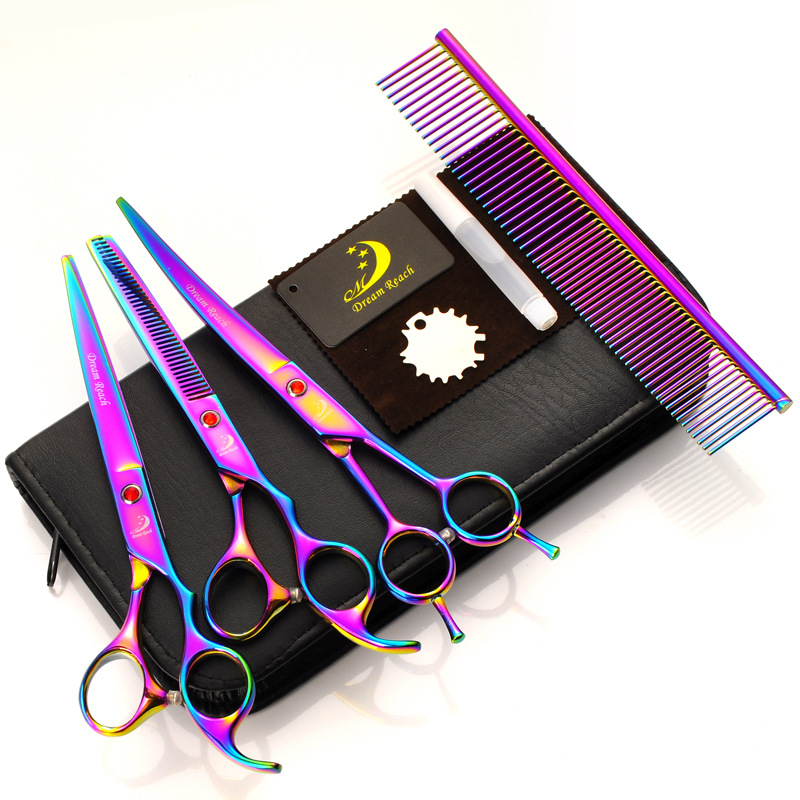
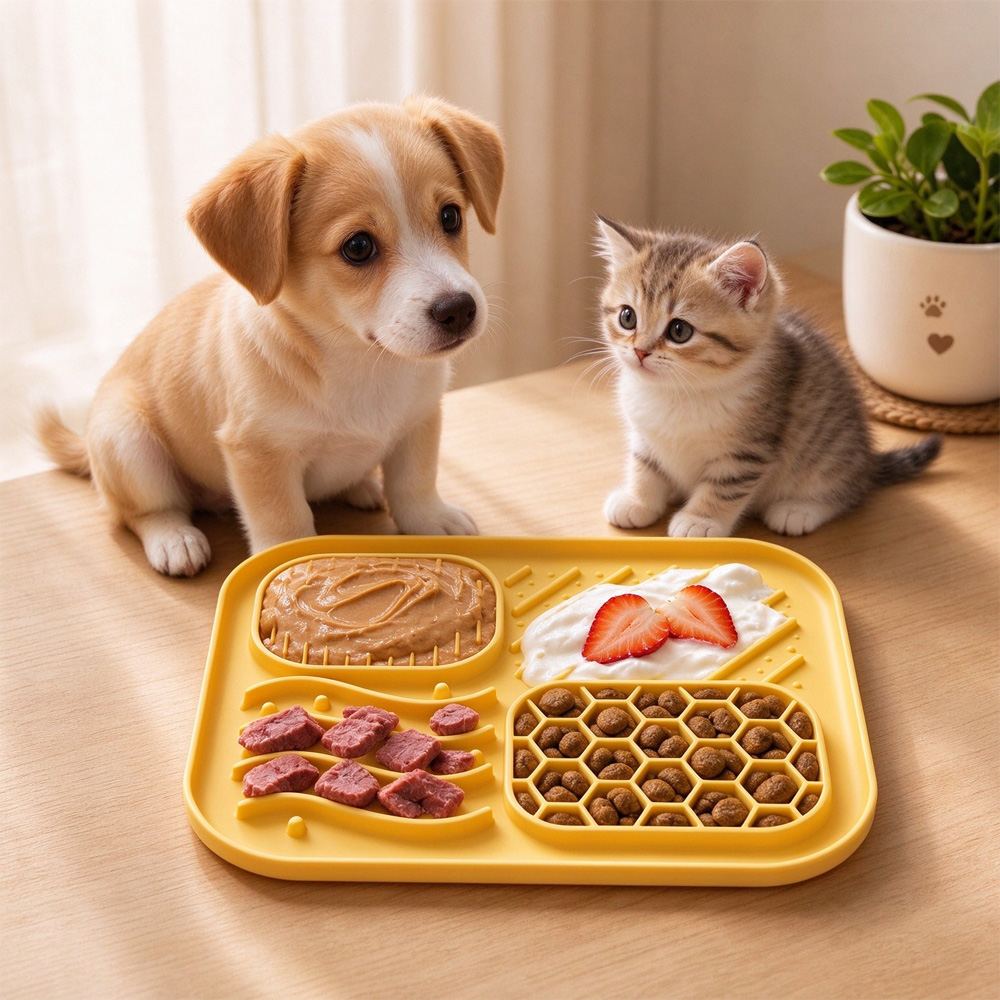
Prices are read from our own listings on 30 October 2026. The 7-inch, 1 mm opening, 6Cr13, 304 handle, electrophoresis finish, 120 g weight and 200 × 220 × 60 mm package size are the manufacturer’s published figures; the 20 × 15 cm size, 180 g weight and four zones are likewise the published figures for the mat. The hardness range for 6Cr13, the 45–60° bevel angle and the 10–25 µm coating thickness are typical values for the grade and the process, not measurements of these two items. Peanut butter at about 590 kcal per 100 g is a standard food-composition figure. Everything derived here — closings per session, metres of cut line, newton-metres at the wrist, minutes of licking — is arithmetic on those inputs, and should be read as an estimate that you can re-run with your own dog’s numbers.
Compare on Amazon — this category usually has more brands, sizes and price points there.
Check current prices on Amazon →
As an Amazon Associate we earn from qualifying purchases. The price you pay is unchanged. Disclosure