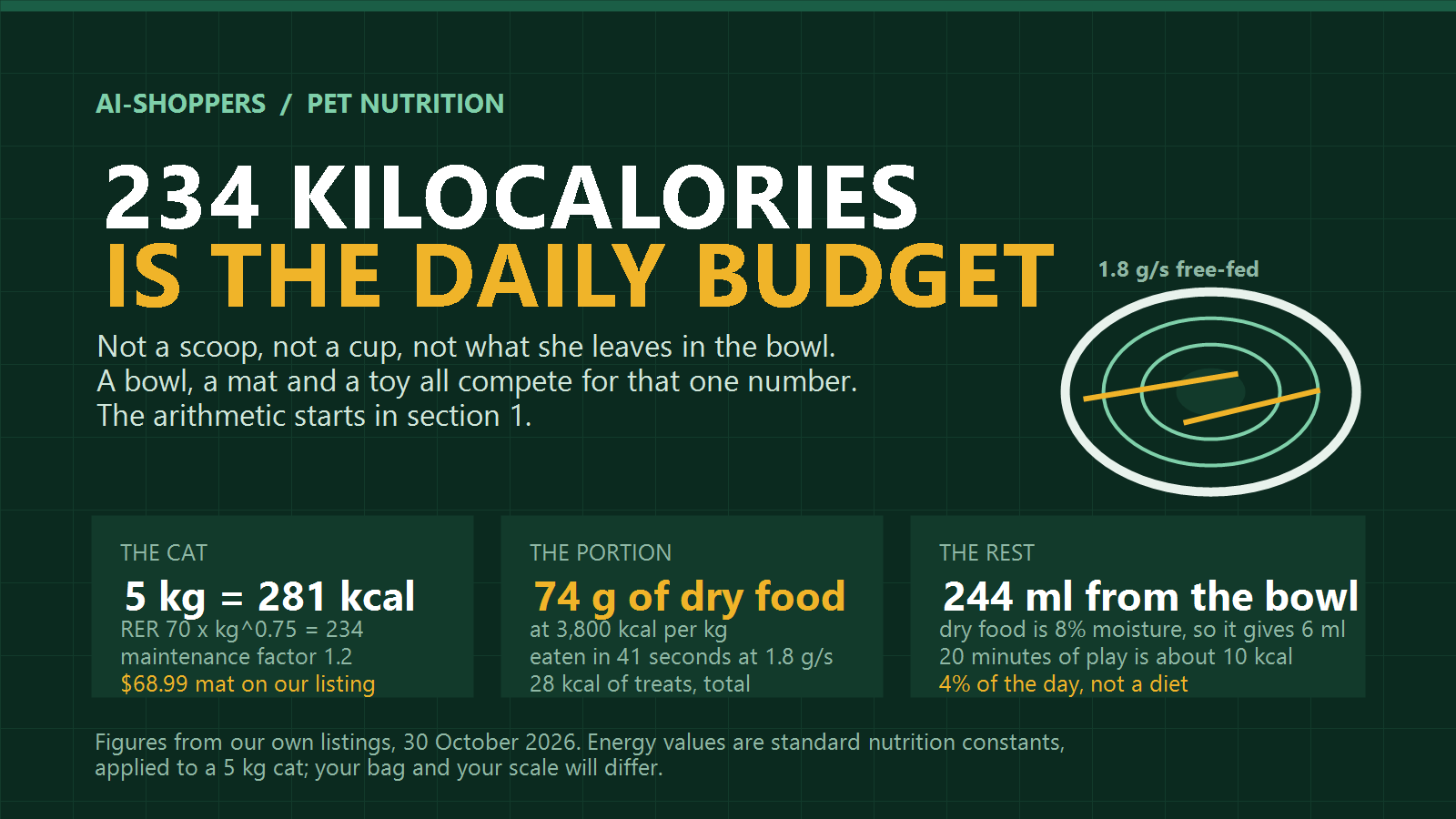
A five-kilogram indoor cat needs about 281 kilocalories a day. Not a scoop, not a cup, not “what she leaves”: 281 kcal, plus or minus a little depending on age and activity. Every bowl, mat and toy in the pet aisle is competing to influence that one number, and almost none of the packaging tells you how. Here is the arithmetic, run on a cat you can weigh on a kitchen scale, and the three tools that change how those calories are delivered rather than how many there are.
1. The formula, and why nobody puts it on the bag
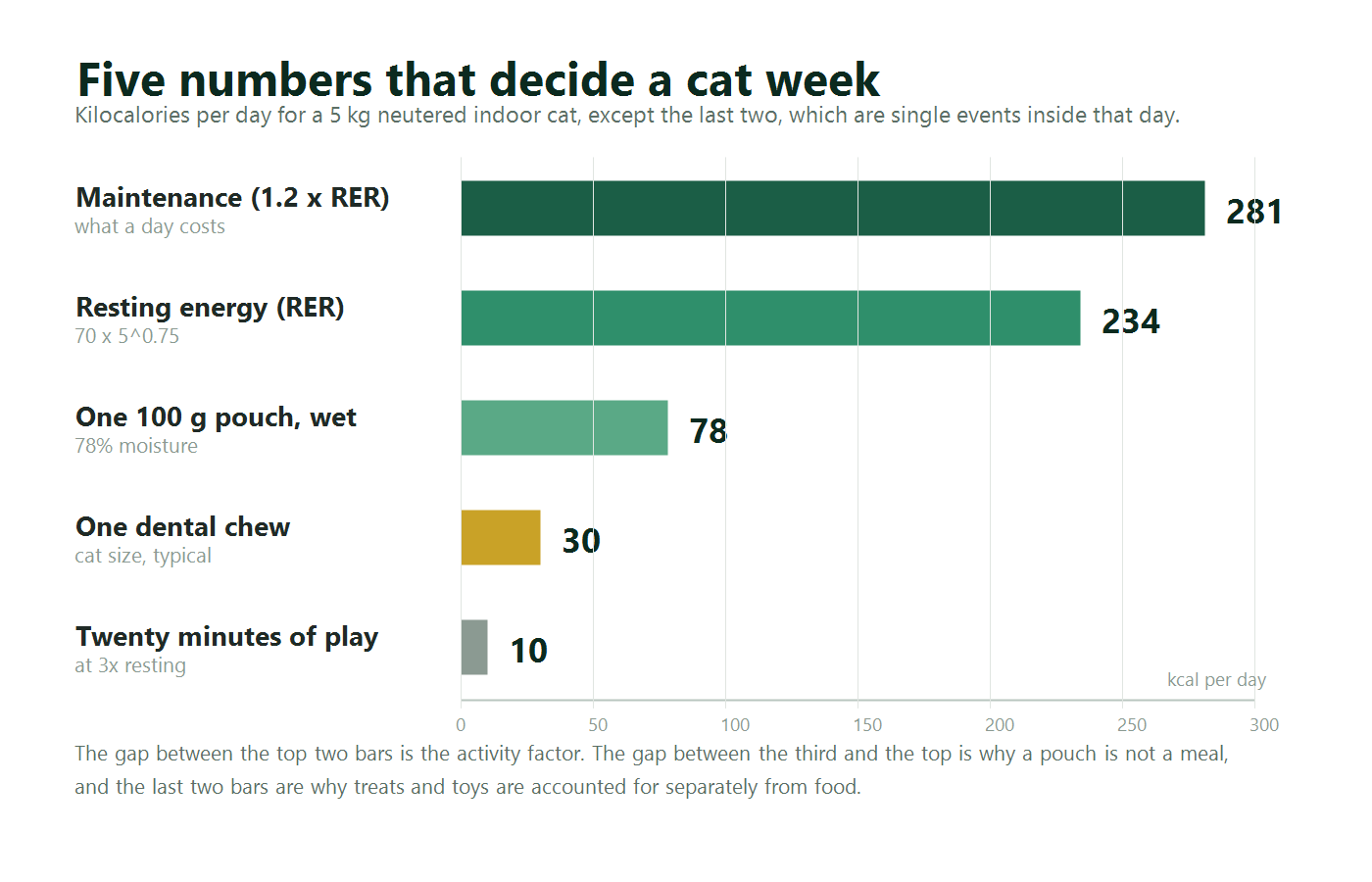
Veterinary nutrition starts from resting energy requirement, and the equation is not a secret: RER = 70 × body weight in kilograms raised to the power 0.75. The exponent is there because heat loss scales with surface area rather than mass, which is why a 3.5 kg cat and a 7 kg cat do not eat twice and half as much as each other — they eat 179 and 301 kcal before any activity factor.
Run it for the weights people actually own. Then multiply by a maintenance factor: about 1.2 for a neutered, indoor, middle-aged animal, 1.4 for an intact or very active one. The 1.2 column is the number that matters for most households reading this.
| Body weight | RER (70 × kg0.75) | Maintenance at 1.2× | Daily dry food at 3,800 kcal/kg |
|---|---|---|---|
| 3.5 kg (7.7 lb) | 179 kcal | 215 kcal | 57 g |
| 4.0 kg (8.8 lb) | 198 kcal | 238 kcal | 63 g |
| 5.0 kg (11.0 lb) | 234 kcal | 281 kcal | 74 g |
| 6.0 kg (13.2 lb) | 268 kcal | 322 kcal | 85 g |
| 7.0 kg (15.4 lb) | 301 kcal | 362 kcal | 95 g |
Two things fall out of that table immediately. First, the whole range from a slim adult to a chunky one is about 150 kcal — one and a half cans of food, not a different diet. Second, 74 g of dry food is a small pile. Most people free-pour, and a free-poured bowl that sits out all day is not measured in grams; it is measured in “until she stops”.
2. Reading the bag without believing it
Pet food in the US declares metabolisable energy, usually as kcal/kg somewhere in the small print and sometimes as kcal per cup or per can. The split matters: two bags at 3,500 and 4,200 kcal/kg differ by 20 percent, which for a 5 kg cat is 11 g a day — about 40 g a week, about 2 kg of body weight a year if nothing else changes. That is the entire obesity conversation in one division.
Do it in this order. Weigh the animal on a bathroom scale holding it, or on a kitchen scale in a box. Compute RER. Multiply by 1.2. Divide by the kcal/kg on the bag, in grams. Then weigh that portion once, put it in a cup you keep, and stop estimating. The arithmetic is not the hard part; the hard part is that a “cup” of kibble varies from 70 to 130 g depending on kibble size and how settled the bag is, which is a 60 percent error band before you have even started.
3. The treat budget is 28 kilocalories
Guidelines put treats at no more than about 10 percent of daily calories, which for our 281 kcal cat is 28 kcal. Not 28 treats. Twenty-eight kilocalories, total, for the day.
| Treat | Typical weight | Energy | Fits in a 28 kcal budget |
|---|---|---|---|
| Freeze-dried chicken cube | 3 g | ~12 kcal | 2 |
| Soft cat treat | 1.5 g | ~5 kcal | 5 |
| Dental chew (cat size) | — | ~30 kcal | 0.9 — one blows the budget |
| Peanut butter, one tablespoon | 16 g | ~94 kcal | 0.3 |
| Slice of cooked chicken breast | 10 g | ~16 kcal | 1.75 |
This is where most weight gain actually happens, and it happens for a social reason rather than a nutritional one: the treat is how the household says hello. The fix is not to stop; it is to pay for the treat out of the meal. Take 12 kcal of kibble out of the bowl, put it in the treat tin, and hand it over one piece at a time. The cat gets twelve greetings instead of one, and the daily total does not move.
4. A meal that takes forty seconds is a meal the cat did not have
Now the part the bowl is for. A cat eating 74 g of kibble at a relaxed 1.8 g per second finishes in 41 seconds. A hungry cat does it in twenty. Either way, the stomach is full long before the satiety signals arrive: gut hormones that say “enough” are usually described as acting over fifteen to thirty minutes, not fifteen to thirty seconds. Forty seconds of eating followed by twenty minutes of feeling unfed is the mechanism behind the 4 a.m. demand, the counter surfing and the bowl-flipping.
A puzzle bowl does not reduce calories; it stretches the same 74 g across a longer window. A board divided into channels, or a shallow maze with a central peak, does not let a cat take the food in a straight line. If the shape forces a half-second reposition per 0.35 g of kibble, the same meal becomes about 105 seconds, and with a genuinely awkward board and a cat that has to work it out, two to four minutes is realistic. Still short of the hormonal window, but long enough that the animal stops bolting and starts handling food — which is the behaviour the bowl is actually selling.
The arithmetic also sets the limit of the idea. You cannot stretch a 74 g meal past the point where the cat gives up, and if it gives up you have not slowed the meal, you have cut it. Feed the same weight in two or three rounds instead of one, and the total time at the bowl triples without changing the daily number.
What the board does not do
It does not stop a cat from eating too much if the bowl is refilled whenever it looks empty, and it does not slow a cat that has already learned to tip the board over. Watch the first three meals: if the food is on the floor, the puzzle failed and you are back to a plain bowl with a measured portion.
5. Thirty grams of paste is the whole treat budget
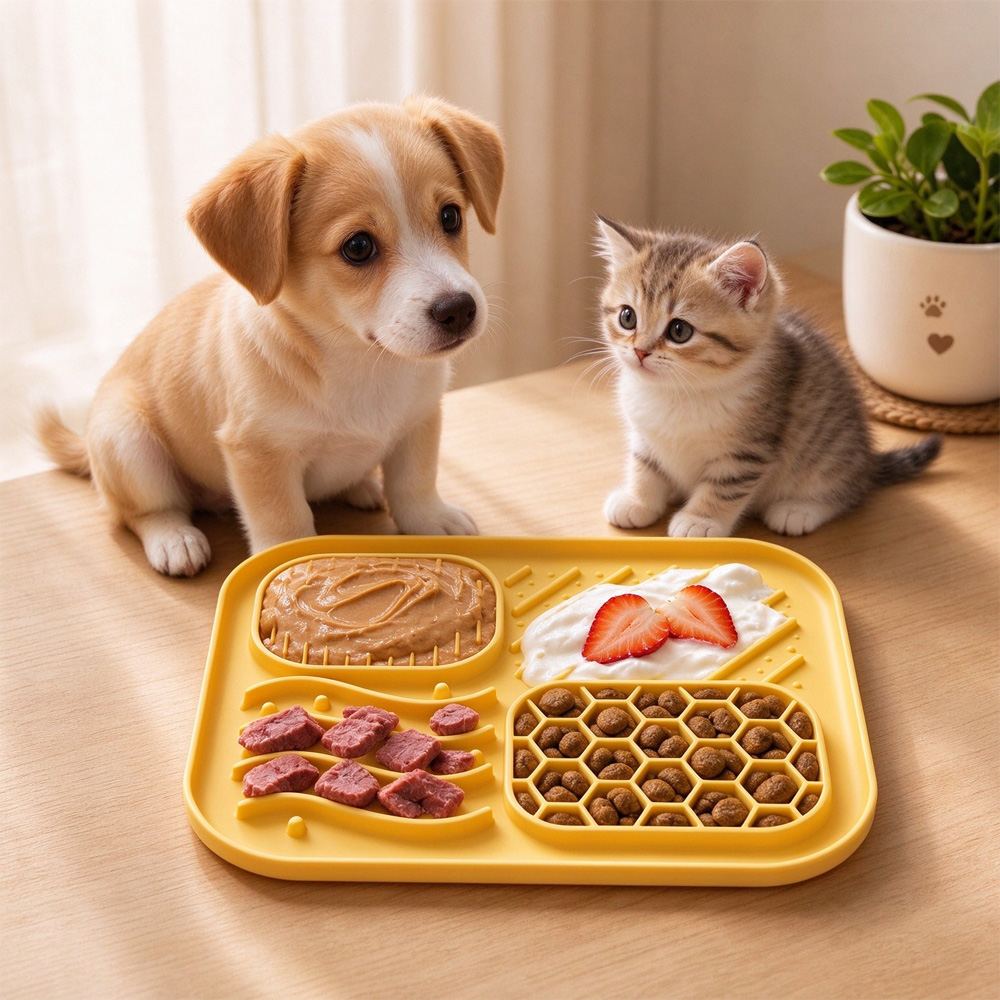
The licking mat works on a different clock. It is a silicone sheet with four textured zones and suction cups, and it holds a smear rather than a pile. Take 30 g of wet food at about 0.9 kcal/g and you have 27 kcal on the mat — the entire daily treat allowance, delivered in a form that takes ten to fifteen minutes to remove.
That is a fair trade, and it is why the mat is the tool that survives contact with a real household. Two rules keep it honest. Weigh the smear the first few times, because a “light coating” of peanut butter can be 30 g before it looks like anything. And never use xylitol-sweetened peanut butter: xylitol is dose-dependently toxic to dogs and the amount in a “reduced sugar” jar is not a small amount.
6. Water is the number nobody counts
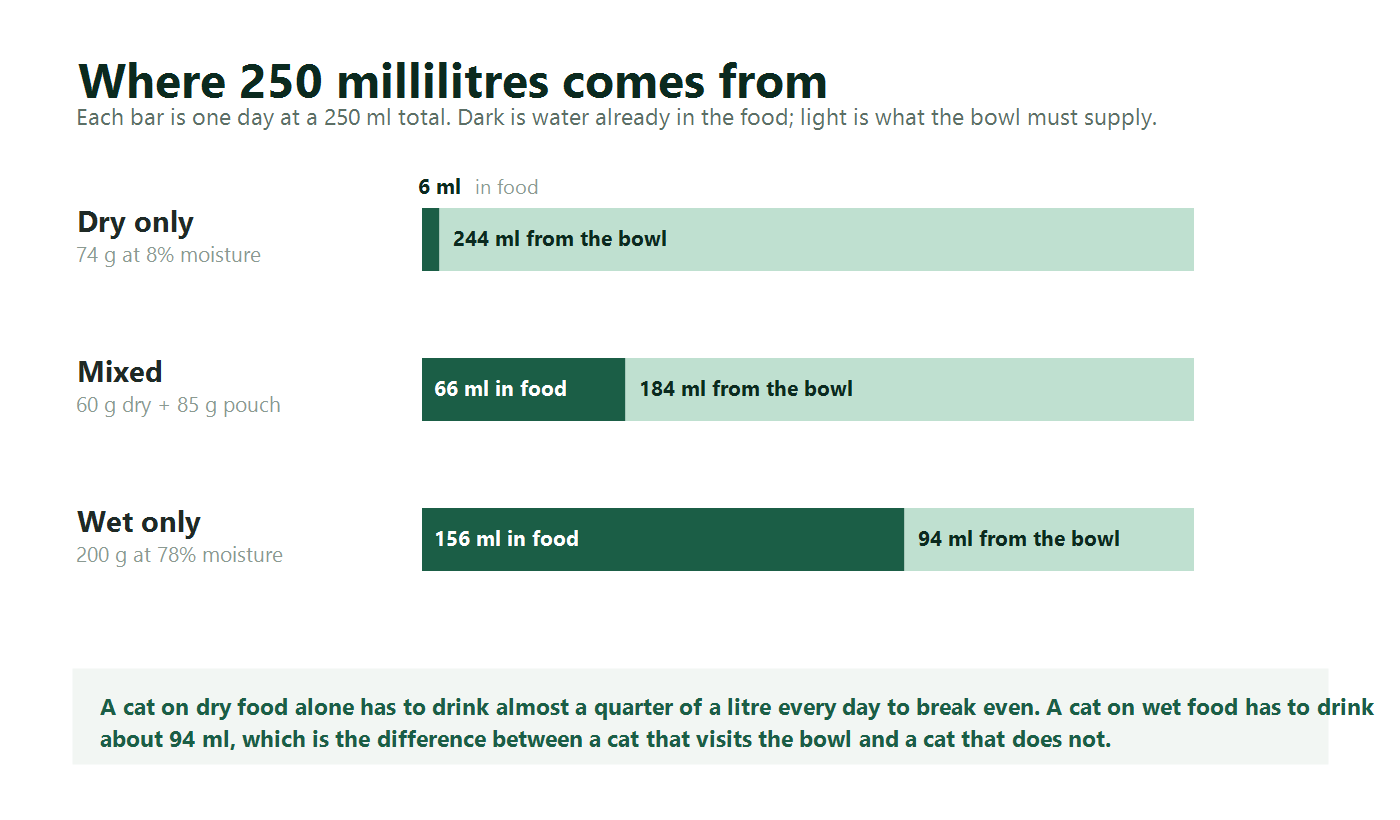
Cats evolved as desert-adjacent hunters and drink less than their body weight suggests they should. A working figure is 40 to 60 ml per kilogram per day, so 200 to 300 ml for a 5 kg cat, and the food contributes some of it.
| Day | From food | Still needed from the bowl |
|---|---|---|
| 74 g dry at 8% moisture | ~6 ml | ~244 ml |
| 60 g dry + 85 g pouch at 78% moisture | ~66 ml | ~184 ml |
| 200 g wet only | ~156 ml | ~94 ml |
This is the strongest argument for wet food that has nothing to do with protein quality, and the strongest argument against free-feeding dry food to a cat that rarely visits the water bowl. It also explains why the slow-feeder bowl and the water bowl should not be adjacent: cats that have to work for food tend to drink immediately afterwards, and a bowl wedged against the wall is a bowl they walk past.
7. The toy is not exercise; it is a sequence
Be honest about the energy. A 20-minute play session at roughly three times resting metabolism, on a cat whose resting rate is 234 kcal per 24 hours, works out to about 10 kcal — under 4 percent of the daily total. Nobody is playing a cat slim.
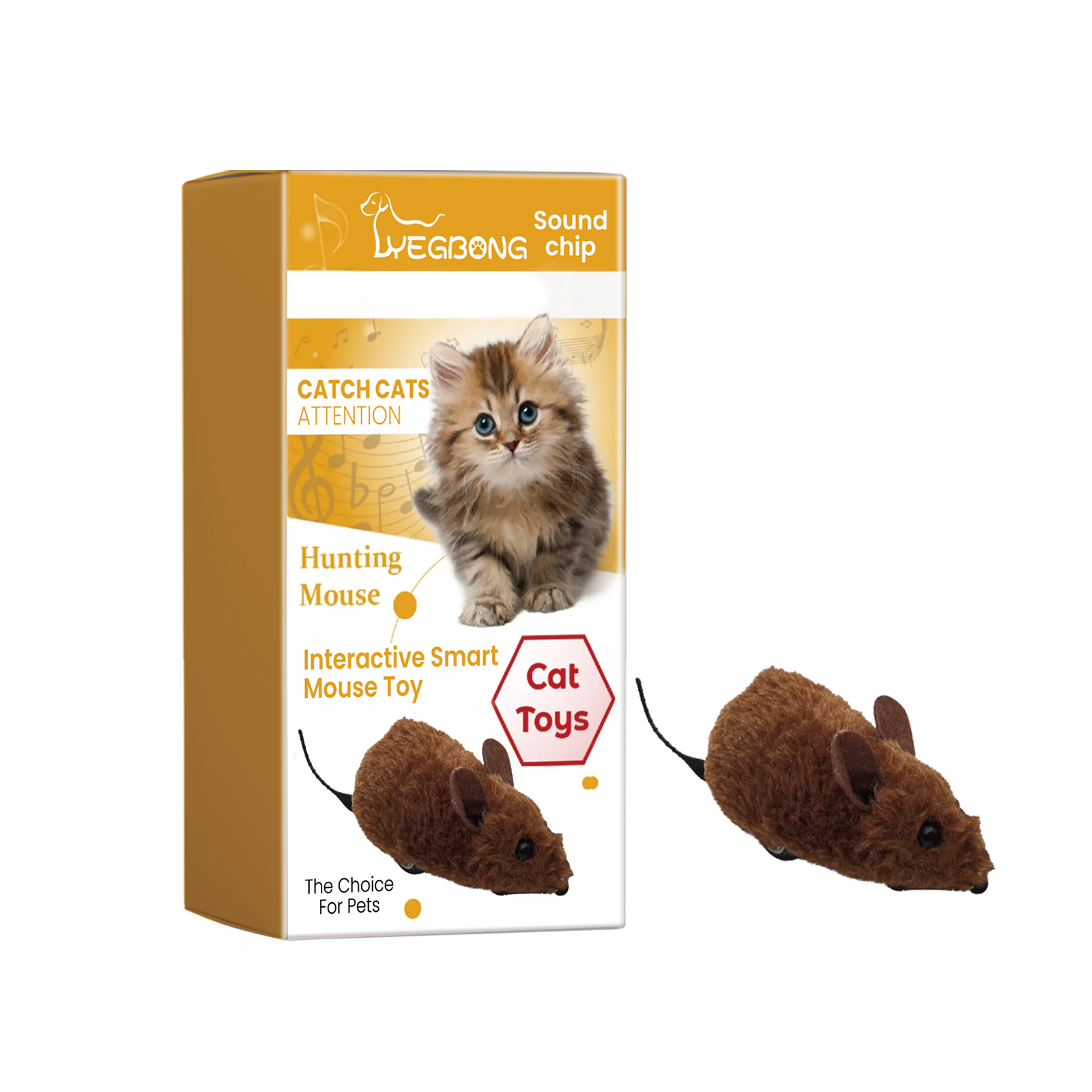
What the moving toy does is complete a sequence: stalk, chase, pounce, catch, and then eat. The last step is the one that gets skipped, and it is the one that closes the loop. A ten-second hunt that ends with a small piece of food is more satisfying to the animal than twenty minutes of chasing that ends with the toy being put in a drawer. That is why an interactive toy paired with a treat — or with part of the measured meal — outperforms the same toy used as pure exercise, and why the toy and the treat budget in section 3 have to be planned together.
8. What the three tools cost, per day
Priced from our own listings on 30 October 2026: the licking mat at $68.99 and the interactive mouse at $77.99. Both together are $146.98, which over three years is about 13 cents a day. That is the correct comparison, not the sticker price: a single 85 g pouch of prescription wet food costs more per week than the amortised mat, and the mat is the item that keeps working after the food is gone.
It is also the honest comparison for a $68.99 mat. Nothing in the arithmetic above depends on the mat being expensive; a plain plate plus a smear of the measured meal does most of the same job. What the money buys is suction, a shape that holds food in four zones, and something that survives the dishwasher, and that is worth paying for only if the alternative is a bowl that gets refilled instead of measured.
9. Where the daily number goes wrong
Three failure modes, in order of frequency.
The cup. Volume measures of kibble are not reproducible, and the error is systematic in the generous direction. Weigh once a week, not once a bag.
The second bowl. Two cats, two bowls, one of them eating 60 percent of both. Feed in separate rooms for a fortnight and the arithmetic becomes visible.
The treat drift. Twenty-eight kilocalories is small enough that four extra cubes a day is an 8 percent surplus, and 8 percent is the difference between a 5.0 kg cat and a 5.4 kg cat in a year. Weigh the animal monthly; the scale on the floor is a better instrument than any app.
10. Frequently asked questions
Is 281 kcal a day right for every 5 kg cat?
No. It is 1.2 times resting energy requirement, which suits a neutered indoor adult. A young intact cat may need 1.4 times (about 328 kcal), a senior or a cat on a weight-loss plan considerably less. Use it as a starting point, weigh the cat every two to four weeks, and adjust by 10 percent at a time.
Do puzzle feeders actually slow eating down?
They lengthen the meal, but the size of the effect is entirely down to the board. A shallow maze adds seconds; a board that requires the cat to move food through channels adds minutes. Measure it once with a stopwatch, and if the meal is still under 90 seconds the board is decoration.
Can I put wet food in a slow-feeder bowl?
Yes, and it works better than kibble for duration, because wet food cannot be inhaled in a straight line. Rinse it within the hour; silicone and plastic channels hold odour, and a bowl that smells of last week’s food is a bowl the cat will refuse.
How much peanut butter is safe on a licking mat?
A teaspoon (about 5 g, roughly 30 kcal) for a cat, a tablespoon (16 g, about 94 kcal) only for a large dog and only as a meal replacement. Never xylitol-sweetened peanut butter: xylitol is toxic to dogs.
My cat ignores the interactive mouse. Is that normal?
Common. Motion toys get a reaction from a hunting-driven cat and nothing from a cat that has decided the toy is not prey. Try it at dusk, move it away from the cat rather than towards it, and pair the catch with a piece of the measured meal. If there is still no interest after a week, spend the money on a scale and better food instead.
Gear referenced in this guide
Neither of these is required to feed a cat correctly, and a kitchen scale plus a plain bowl will get most households further than either of them. They are the two items the arithmetic above was written against, priced from our own listings on 30 October 2026.
The energy formula (70 × kg0.75), the 1.2–1.4 maintenance range and the 10 percent treat guideline are the standard figures used in veterinary nutrition guidance, including the WSAVA Global Nutrition Guidelines and the AAFCO calorie statements printed on US pet food. The 3,800 kcal/kg figure is a typical metabolisable energy for adult dry cat food, not a measurement of a specific bag; read your own label. Water turnover of 40–60 ml/kg and the 8 percent versus 78 percent moisture split are typical values, again label-dependent. Everything derived here — grams per day, meal duration, the 28 kcal treat budget, 10 kcal for twenty minutes of play, the 244 ml left in the bowl — is arithmetic on those inputs, and you can re-run it with your own cat’s weight and your own bag. Prices are read from our own listings on 30 October 2026.
Compare on Amazon — this category usually has more brands, sizes and price points there.
Check current prices on Amazon →
As an Amazon Associate we earn from qualifying purchases. The price you pay is unchanged. Disclosure