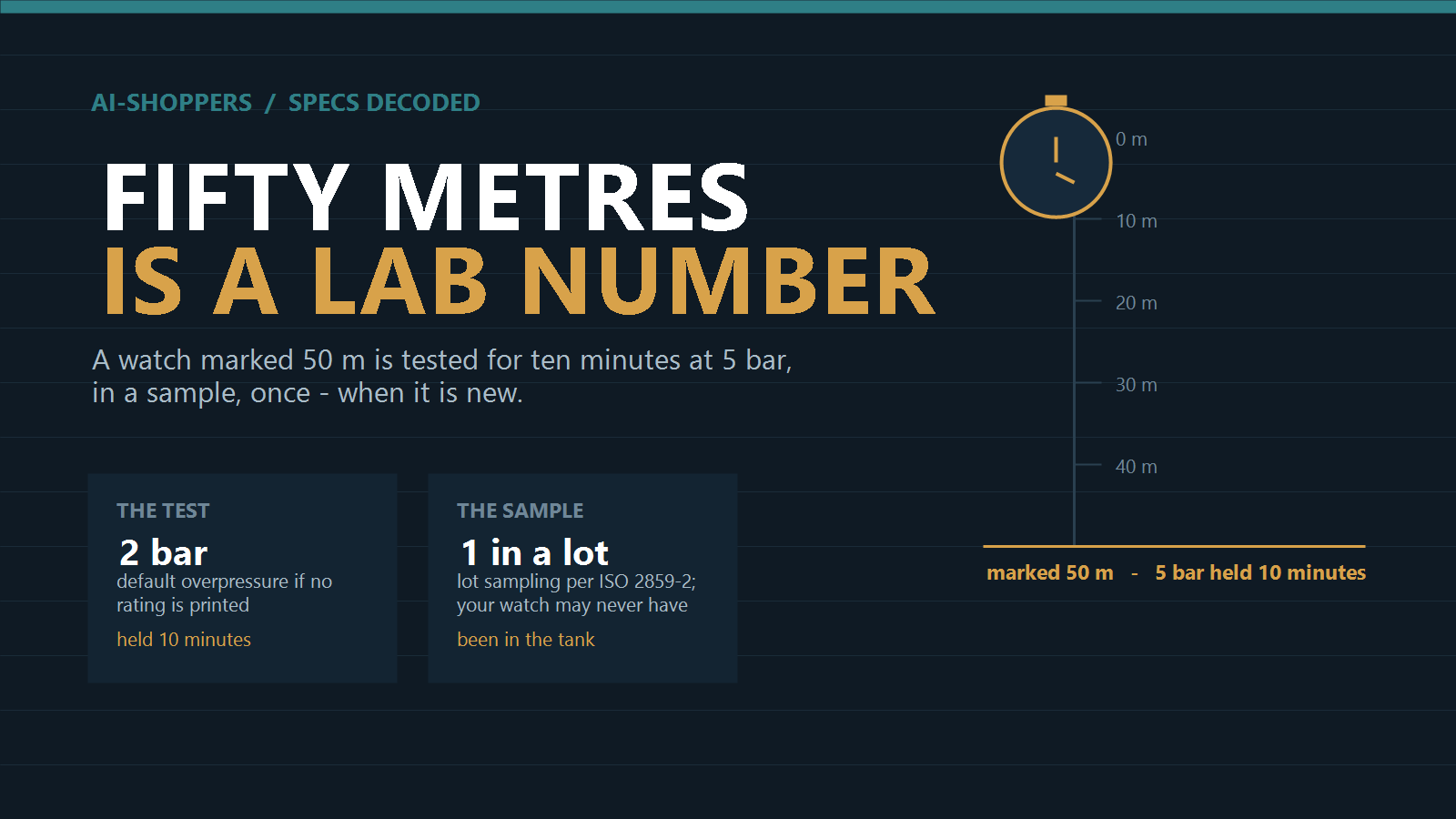
A watch backing is one of the few places left in retail where a marketing department has to print a number a laboratory can check. It says 50 m. It does not say what happened in the tank to earn that 50 m, how long it was held there, how many watches were in the batch, or what the seal will do in three summers. Those details are in the standard, and once you read them the marking stops being a promise about swimming and becomes a description of one test.
1. What the number on the back is actually measuring
The relevant standard for ordinary watches is ISO 2281, published in 1990 and replaced in 2010 by ISO 22810, which extends the idea of water resistance to defined activities rather than a single depth figure. Both versions work from the same logic: a watch is not “waterproof”, and the word is prohibited in the marking, because nothing about a case with a moving crown and a battery hatch is permanent. It is water-resistant to a stated pressure, for a stated time, when new.
The 1990 test battery is worth listing, because each line is a different way a watch fails in real life:
- Immersion. The watch sits in 10 cm of water for one hour. Ten centimetres, not fifty metres — the depth in the marking is applied later, as pressure, not as an actual descent.
- Crown and pushers. Still at 10 cm, a 5 N force is pressed perpendicular to the crown for ten minutes. That is roughly the weight of a half-litre bottle resting on the button, and it is the test that catches a seal that only works when nothing touches it.
- Condensation. The watch is warmed on a plate at 40–45 °C, then a drop of water at 18–25 °C is placed on the crystal. Any fog on the inside of the glass eliminates the sample.
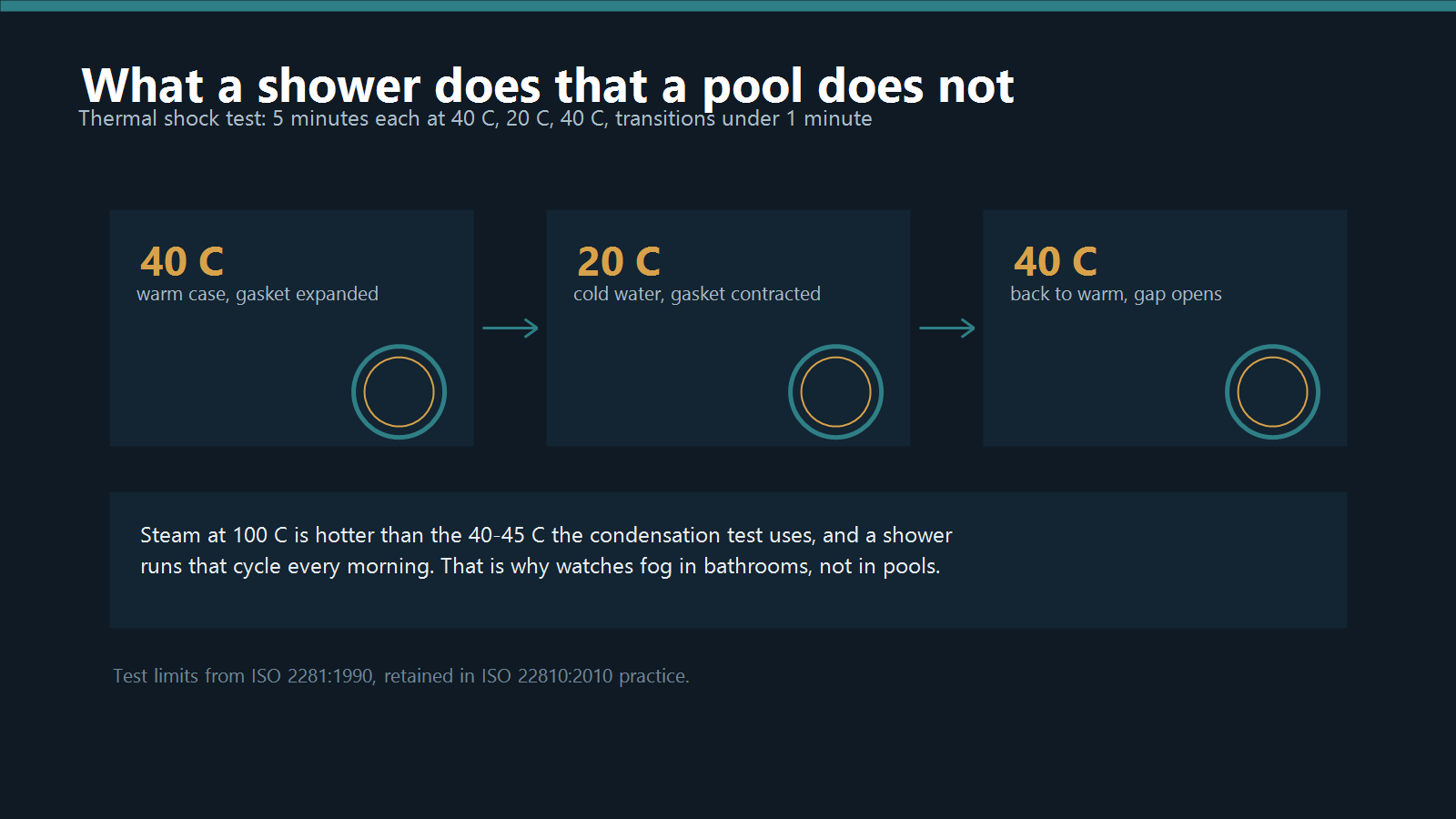
- Thermal shock. Five minutes at 40 °C, five at 20 °C, five at 40 °C again, with each transition inside a minute.
- Overpressure. The case is pressurised in a vessel to the rated pressure for ten minutes — or to 2 bar if the watch carries no rating at all. Then air at 2 bar, with any leak above 50 micrograms per minute counting as a failure.
Two consequences follow, and they matter more than the rating itself. First, a sample is tested, not every watch: the standard works with lot-sampling procedures, so the 50 m on your case back describes a batch, and an individual watch can be outside it. Second, the marking is a static pressure held for ten minutes. It is not a depth you can stay at, and it is not a statement about the seal two years from now.
2. Converting the rating into water
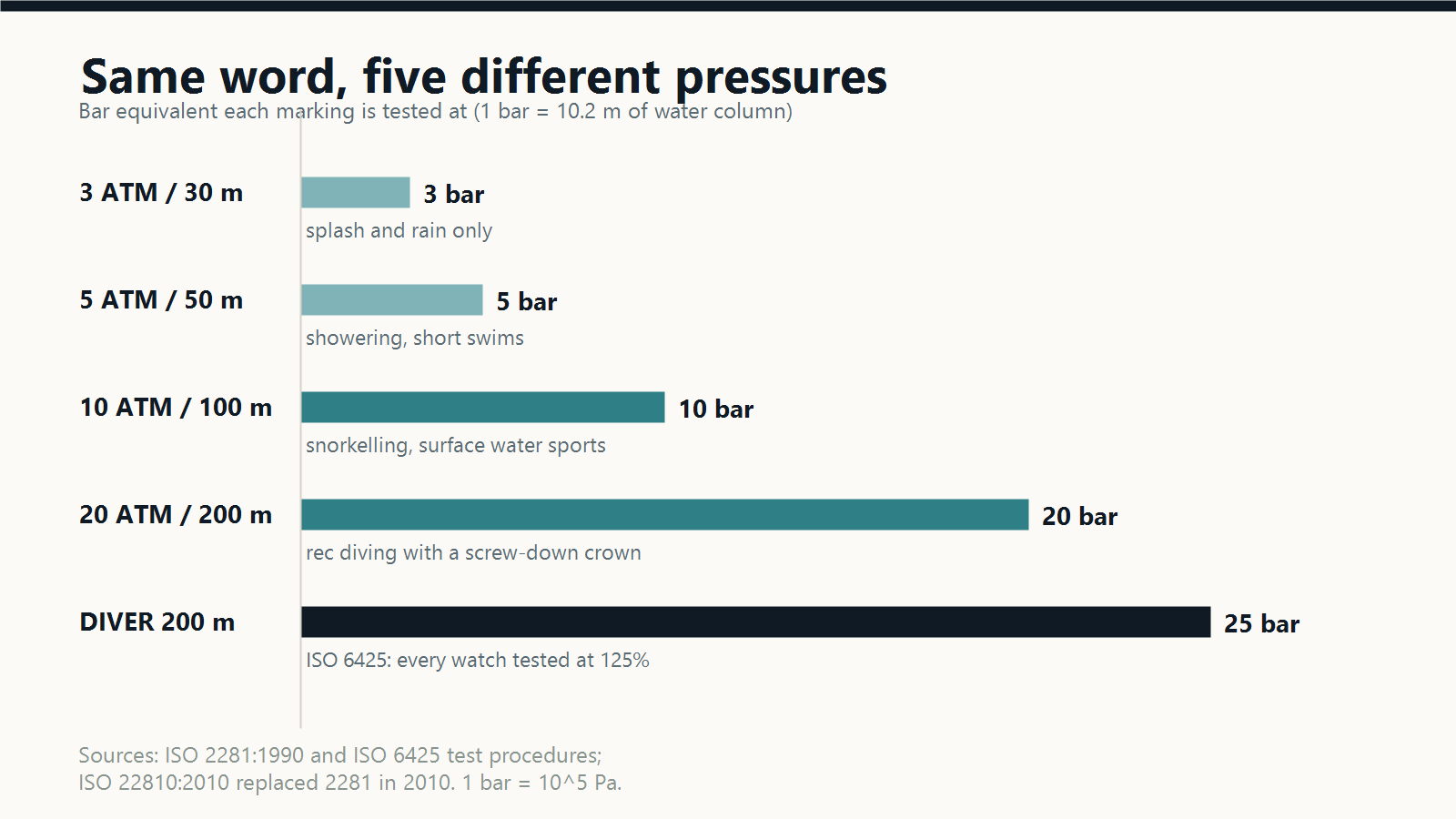
The unit behind the marking is the bar, and 1 bar is 100,000 pascals, which is the pressure of a column of water about 10.2 m high. That is the entire conversion. A watch marked 50 m is tested at 5 bar, which equals 51 m of static water column; a watch marked 100 m is tested at 10 bar, which equals 102 m. The round numbers on the dial are a rounding of a pressure, and the pressure is what the tank applies.
| Marking | Test pressure | Water-column equivalent | What it survives, in practice |
|---|---|---|---|
| No rating | 2 bar (default) | 20.4 m | Rain and a wet counter. Not a shower. |
| 3 ATM / 30 m | 3 bar | 30.6 m | Splashes, hand-washing. Not swimming. |
| 5 ATM / 50 m | 5 bar | 51 m | Showering, short swims at the surface. |
| 10 ATM / 100 m | 10 bar | 102 m | Snorkelling and surface water sports. |
| 20 ATM / 200 m | 20 bar | 204 m | Recreational diving, screw-down crown assumed. |
| DIVER’S 200 m | 25 bar (125%) | 255 m | ISO 6425, every watch tested, not a sample. |
The gap between the ordinary marks and the diver’s mark is the part most people never see. ISO 6425 requires a minimum rating of 100 m, a time-preselecting device, legibility at 25 cm in the dark, and a magnetic test at 4,800 A/m. It also applies 125 percent of the rated pressure — a 200 m watch is held at the equivalent of 250 m — for two hours, after 50 hours of immersion at 30 ± 2 cm, and it tests the spring bars at 200 N each, because a watch that survives the water but loses its strap at depth is not a dive watch. Certified watches carry the word DIVER’S on the dial. Watches with a 200 m marking and no such word have been designed to look like that category without the paperwork.
Dynamic pressure is smaller than the folklore
Watch marketing likes to claim that a hand moving through water multiplies the pressure enormously. The arithmetic is less dramatic. A hand travelling at 10 m/s — faster than competitive swimmers move their hands — generates about 50 kPa of dynamic pressure, which is the equivalent of 5 m of extra depth. That is a real margin for a 5 ATM watch used at the surface and an irrelevant one for a 200 m diver. It is not a reason to swim with a 30 m watch, but it does mean the “your arm swing triples the depth” line in a listing is a sales argument, not a calculation.
3. Why the shower is the hard part
Pressure is the easy half of water resistance. Temperature is the half that ends watches, and the test battery shows exactly why: the standard runs the case through 40 °C, 20 °C and 40 °C in fifteen minutes precisely because materials expand and contract at different rates. A steel case, a plastic gasket and a mineral crystal do not grow by the same amount when warmed, so every cycle opens and closes a microscopic gap at the seal.
A shower runs that cycle once a day. Steam sits near 100 °C, well above the 40–45 °C the condensation test uses, and the case is small enough to follow the air temperature within a minute or two. This is the mechanism behind the most common complaint in watch repair: the watch that never left the house fogs up after a hot shower, while the one worn in a swimming pool for years stays dry. The pool is a constant 26 °C and 1 bar at the surface. The bathroom is a thermal cycling rig.
4. The seal is a consumable, not a feature
Gaskets are rubber, and rubber has a service life measured in years, not decades. Manufacturers of certified dive watches recommend a pressure test by an authorised service centre annually or every two to three years, with the seals replaced, and that recommendation is written into the ISO 6425 material itself rather than added by marketing. The same ageing happens in a $30 watch; the only difference is that nobody sends it in.
Two events reset the clock on a seal, and both are openings of the case. The first is a battery change on a quartz watch, which is every two to three years in normal use and is the moment most water damage is introduced — the back comes off, the old gasket is reused, the case is closed without a pressure test. The second is any repair that involves removing the crystal or the crown. If the back has been off and no one tested it afterwards, the rating on the back is a memory of the factory, not a property of the watch in your hand.
The economics are worth stating plainly. A pressure test at a jeweller costs money, and a sports watch in our own listing sells for $28.99. Once a watch is worth less than the test, the sensible policy is not to buy the test but to change the use: keep it out of water, and treat the rating as decoration. That is not a criticism of the watch. It is the correct reading of the numbers.
5. Reading a listing that leaves the rating out
Most budget sports watches in the $25–35 band, including the two in our own catalogue at $28.99 and $29.99, do not print an ATM figure at all. That silence is information. An unrated watch is not the same as a 3 ATM watch: 3 ATM at least implies a sample passed a 3 bar hold. A listing with no rating, no crown type and no case-back description gives you nothing to test, so the honest assumption is splash resistance at best — rain, a wet sleeve, washing your hands with the watch pushed up the wrist.
Four lines to look for before you buy
- ATM or WR, with a number. “Water resistant” alone means nothing measurable; “5 ATM” or “WR50M” is a test result.
- Crown type. A screw-down crown threads into the case and adds a mechanical seal; a push-pull crown relies on one O-ring and is what the 5 N test is probing.
- Case back. A screw-down back with a gasket seat is serviceable; a snap back is cheaper and usually reused without a new gasket.
- Stated use. “Suitable for swimming” and “suitable for showering” are different claims, and a listing that says neither has made no claim at all.
6. Three checks you can run at home
The glass test. Warm the watch gently — a few minutes in a pocket is enough — then put a drop of cold water on the crystal, wait a minute and wipe it dry. Fog on the inside of the glass means moisture is already in the case, and the watch needs drying before it corrodes, not after.
The crown check. Push-pull crowns should seat flush with the case, with no wobble when you press them lightly. A crown that stands proud, or that turns too freely, is a seal that is no longer compressed. On a screw-down crown, the threads should engage without grit; cross-threading is the most common way a good watch loses its rating.
The reset rule after any opening. If the back has been off, assume the rating is void until it is tested. That applies to a battery swap at a mall kiosk as much as to a repair. The cost of the assumption is a wet watch; the cost of the test is a known quantity you can compare against the price of the watch itself.
Frequently asked questions
Can I swim with a 5 ATM watch?
At the surface, in fresh water, for short periods — that is what the 5 bar test is sized for, and manufacturers classify 5 ATM as suitable for showering and swimming. It is not a rating for diving, for high-speed water entry, or for a watch whose gasket is five years old. A 5 ATM rating on a new watch and the same marking on a used one are not the same claim.
Why does my watch fog up only in the bathroom?
Because the bathroom combines the two worst conditions: steam near 100 °C and a fast temperature cycle. The condensation test in the standard reproduces exactly this, with the case warmed to 40–45 °C and a cold drop on the glass. Fog on the inside means water vapour is already inside the case, which usually points to a seal that has aged or a back that was closed without a new gasket.
Does a higher ATM rating mean a better watch?
It means a higher test pressure and, above 100 m, usually a screw-down crown and a thicker case. It says nothing about the movement, the crystal or the strap. A 20 ATM watch with a soft mineral crystal scratches as easily as a 3 ATM one, and the rating has no bearing on timekeeping accuracy.
Is “waterproof” a real specification?
No. The standard prohibits the term for watches, which is why you see “water resistant” on anything from a reputable maker. A listing that says waterproof is either translating loosely or ignoring the standard, and either way the word is not a number you can check.
How often should a watch be pressure tested?
Manufacturers of certified dive watches recommend annually or every two to three years, with seals replaced. For an everyday watch, the practical trigger is any opening of the case — a battery change, a repair — plus any sign of fogging. Testing a watch that has never been opened and shows no condensation is optional; testing one that has just had its back off is not.
Gear referenced in this guide
Three items from our own listings, priced on 31 October 2026. None of them is required for anything above: the checks in this guide work on any watch you already own, and the two watches below are unrated, which the article treats as splash-only rather than as a swimming watch.
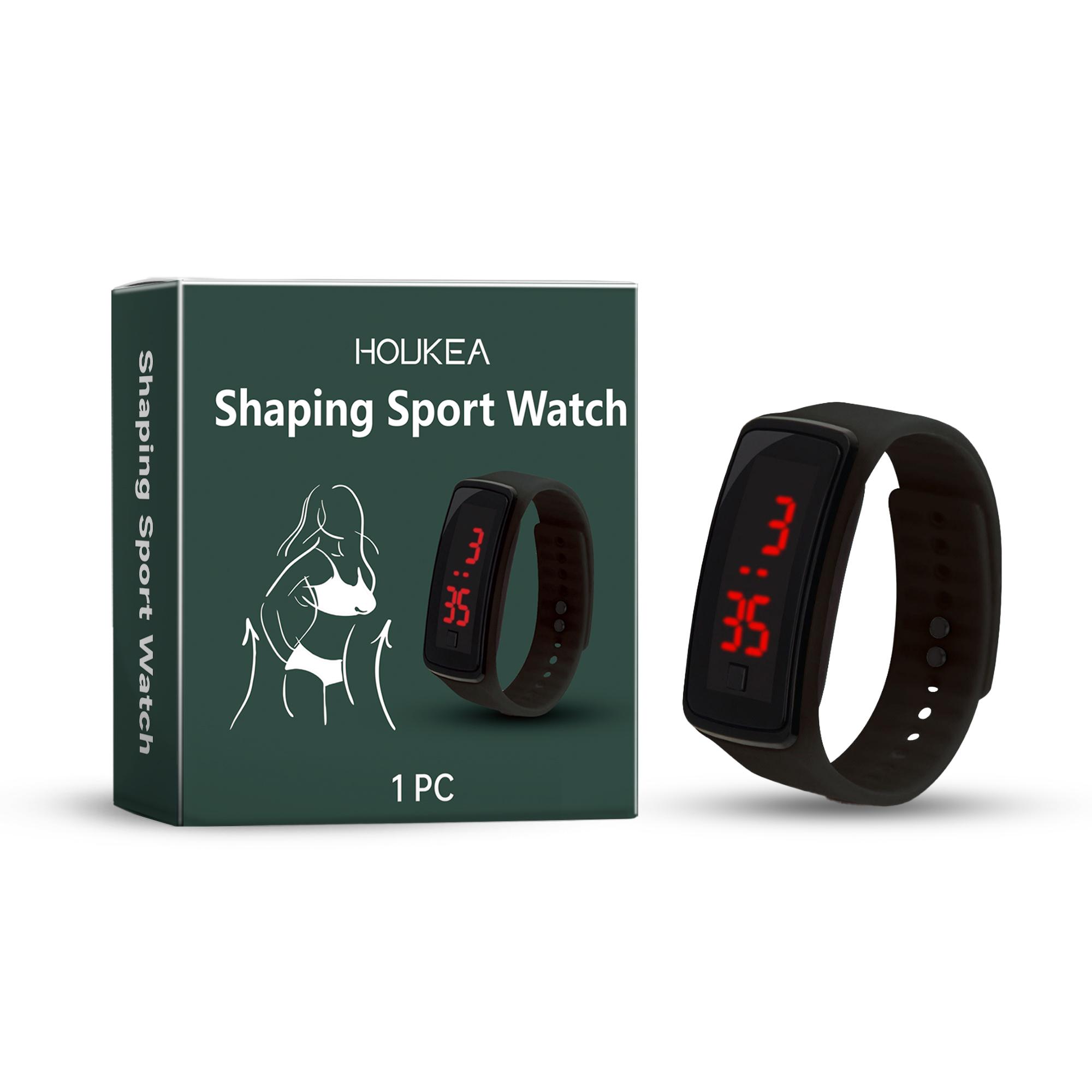
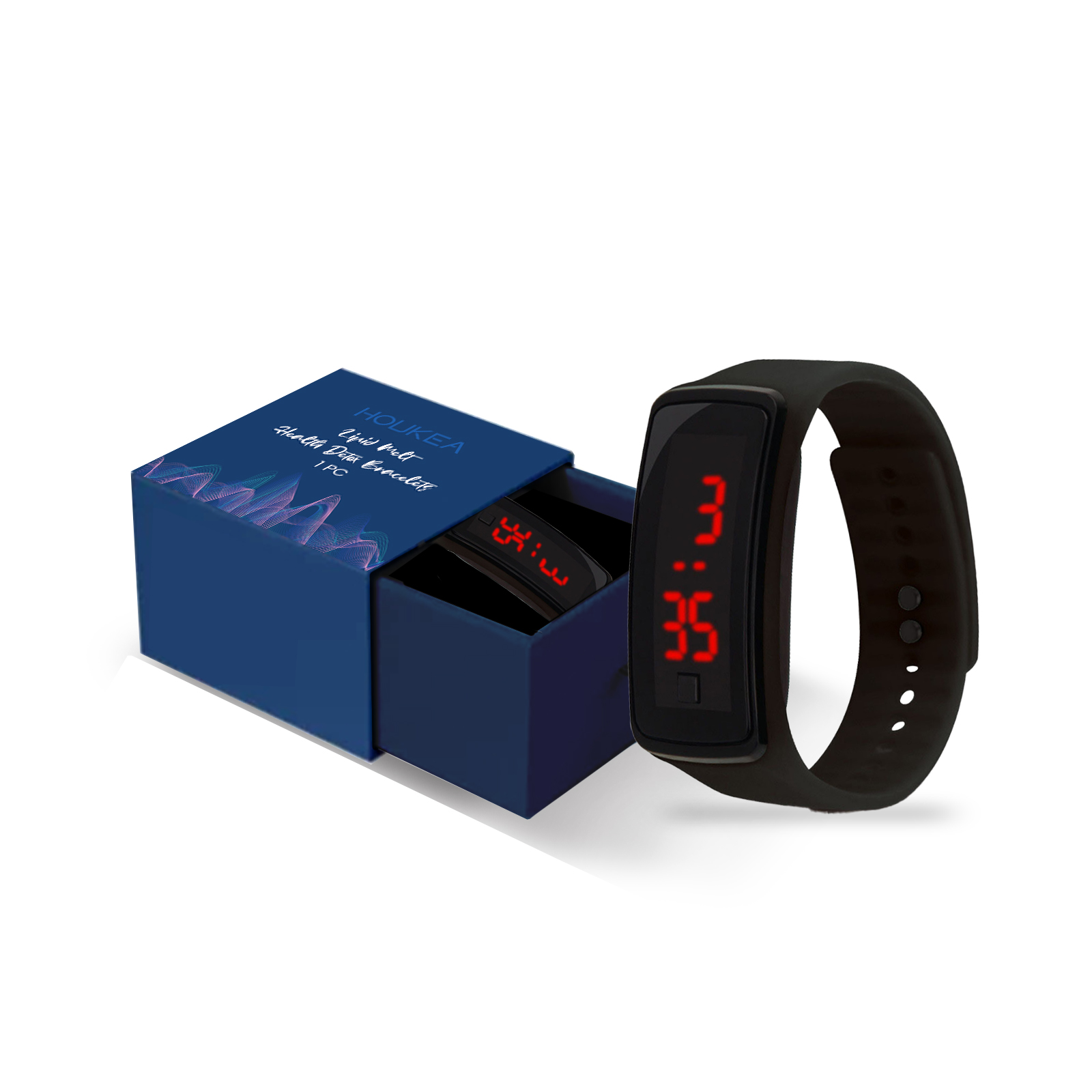 Houkea Sports Watch$29.99View details
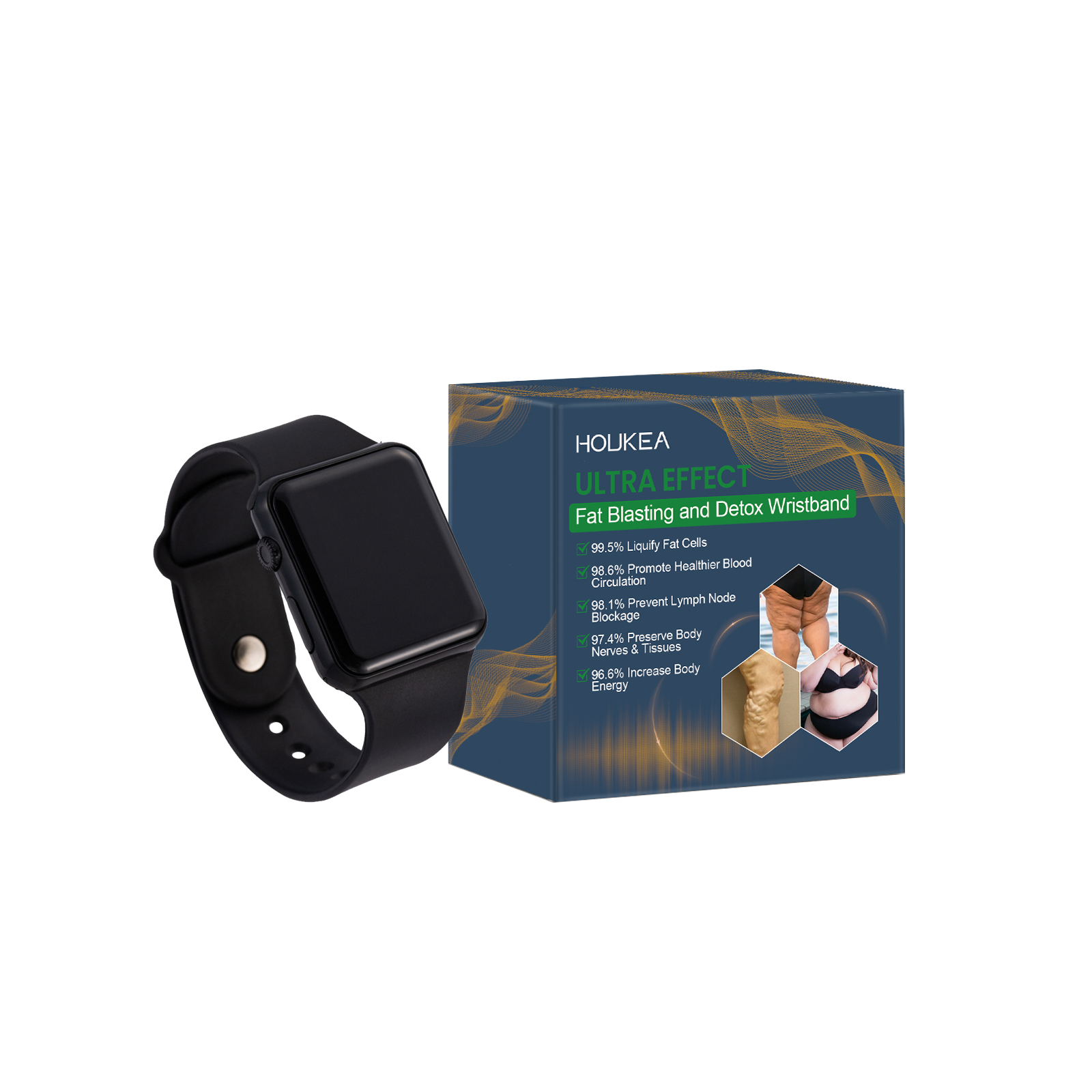
 Fashion Sports Watch$28.99View details
 Silicone Watch Bracelet$29.99View details
Prices and warehouse terms — US stock, dispatch in 1–2 business days, delivery in 2–6 — are read from our own listings on 31 October 2026; neither watch listing states an ATM or WR figure, which is the reason section 5 exists. The test parameters in sections 1 to 3 — 10 cm for one hour, 5 N on the crown for ten minutes, the 40–45 °C condensation plate, the 40/20/40 °C thermal cycle at five minutes a stage, the 2 bar default overpressure held ten minutes, the 50 µg/min air-leak limit, the 125 percent overpressure for ISO 6425, the 50-hour immersion at 30 ± 2 cm, the 4,800 A/m magnetic test and the 200 N spring-bar pull — are the procedures specified in ISO 2281:1990 and ISO 6425, as summarised in the standard’s published test descriptions (accessed 31 October 2026); ISO 22810:2010 replaced ISO 2281 in 2010. The conversion 1 bar = 100,000 Pa = 10.2 m of water column and the 50 kPa figure at 10 m/s are arithmetic on those units, and you can re-run every depth in the table with your own numbers.
Compare on Amazon — this category usually has more brands, sizes and price points there.
Check current prices on Amazon →
As an Amazon Associate we earn from qualifying purchases. The price you pay is unchanged. Disclosure