Every bathroom mat is sold on comfort and judged on the two seconds after the shower stops. That is the whole specification: you are standing on a wet, hard, cold surface with one foot in the air, and whatever you put down has to hold. The useful way to choose one is not by colour or by how thick it feels underfoot. It is by working out how much water leaves the tray, how far it can travel, and which of the three surfaces in the step-out zone is allowed to slide. Do that arithmetic once and the shortlist gets very short.
1. Two seconds, one decision
The American housing stock makes this unavoidable. A standard tub is 60 inches long, a standard shower tray is 36 by 36 inches or 60 by 32, and neither is drained by the time you step out of it. Whatever the tray does not keep is on the floor, and the floor is glazed ceramic — a material chosen for being easy to clean and hard, which is the same set of properties that makes it unforgiving when it is wet.
Bathrooms are also where a specific kind of injury happens: the CDC’s analysis of emergency-department visits put non-fatal bathroom injuries among people aged 15 and over at about 234,000 a year, with the bathtub or shower area and the floor around it among the leading locations. Those numbers are not a product claim. They are the reason the step-out zone deserves ten minutes of measurement rather than thirty seconds of choosing.
2. What 76 litres leaves behind
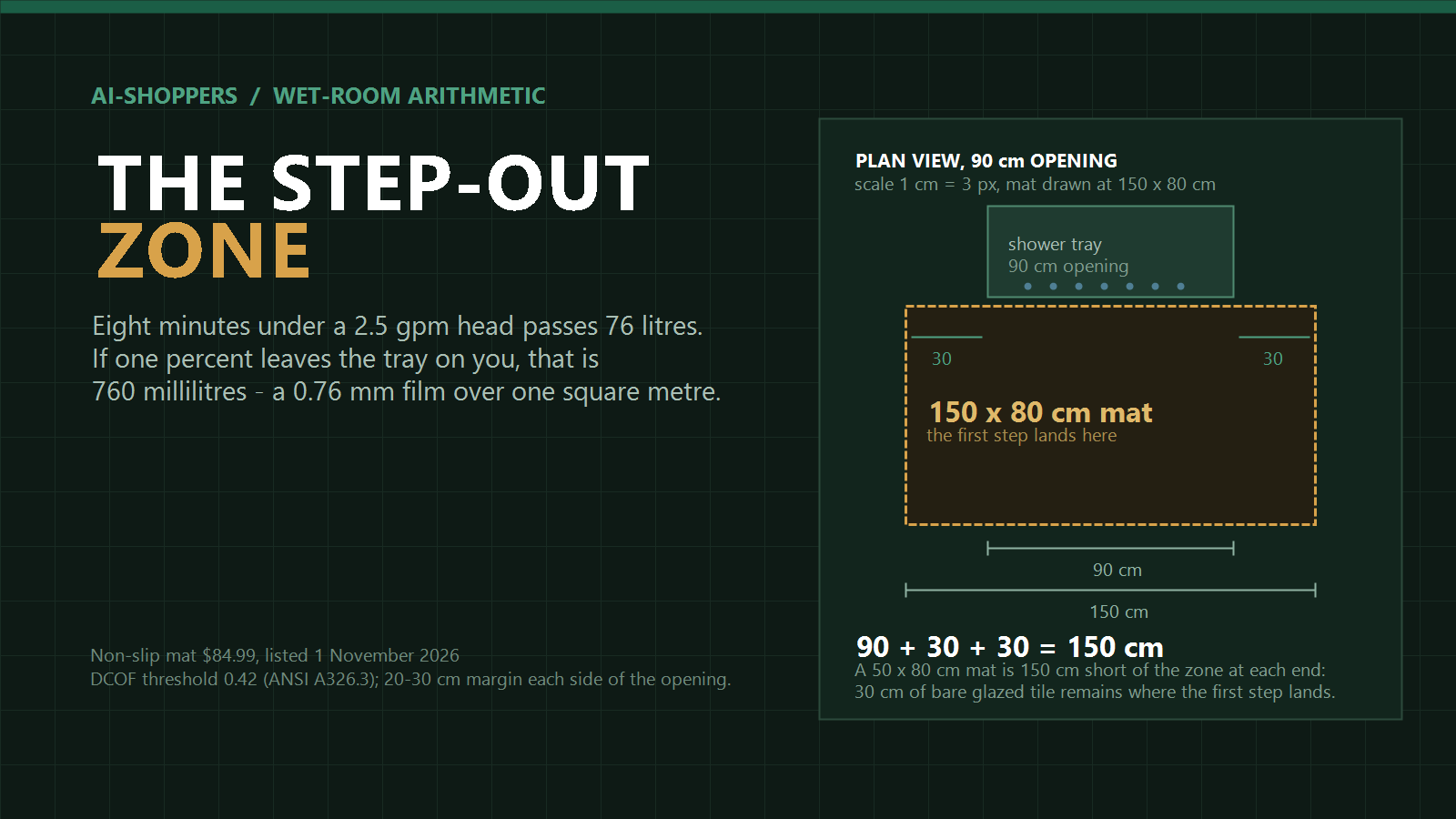
Start with the water, because the water is what changes the floor. Since 1992 the US federal standard for a showerhead has been 2.5 gallons per minute, about 9.5 litres per minute, and most heads sold today are built to that ceiling. An eight-minute shower therefore passes roughly 76 litres through the tray.
Nearly all of that goes down the drain. The number that matters is the fraction that does not — the film on skin and hair, the water held in a towel that is already soaked, the puddle that collects in the tray lip and gets walked through. Assume one percent leaves with you. That is 0.76 litres, spread across the first metre of floor you cross.
Now do the division that makes it concrete. 760 millilitres over one square metre is 0.076 millilitres per square centimetre, and because a millilitre spread over a square centimetre is a millimetre deep, that is a film 0.76 millimetres thick. Tile is smooth at the scale of microns. The film is not a damp patch on a rough surface; it is a layer several times deeper than the surface it sits on.
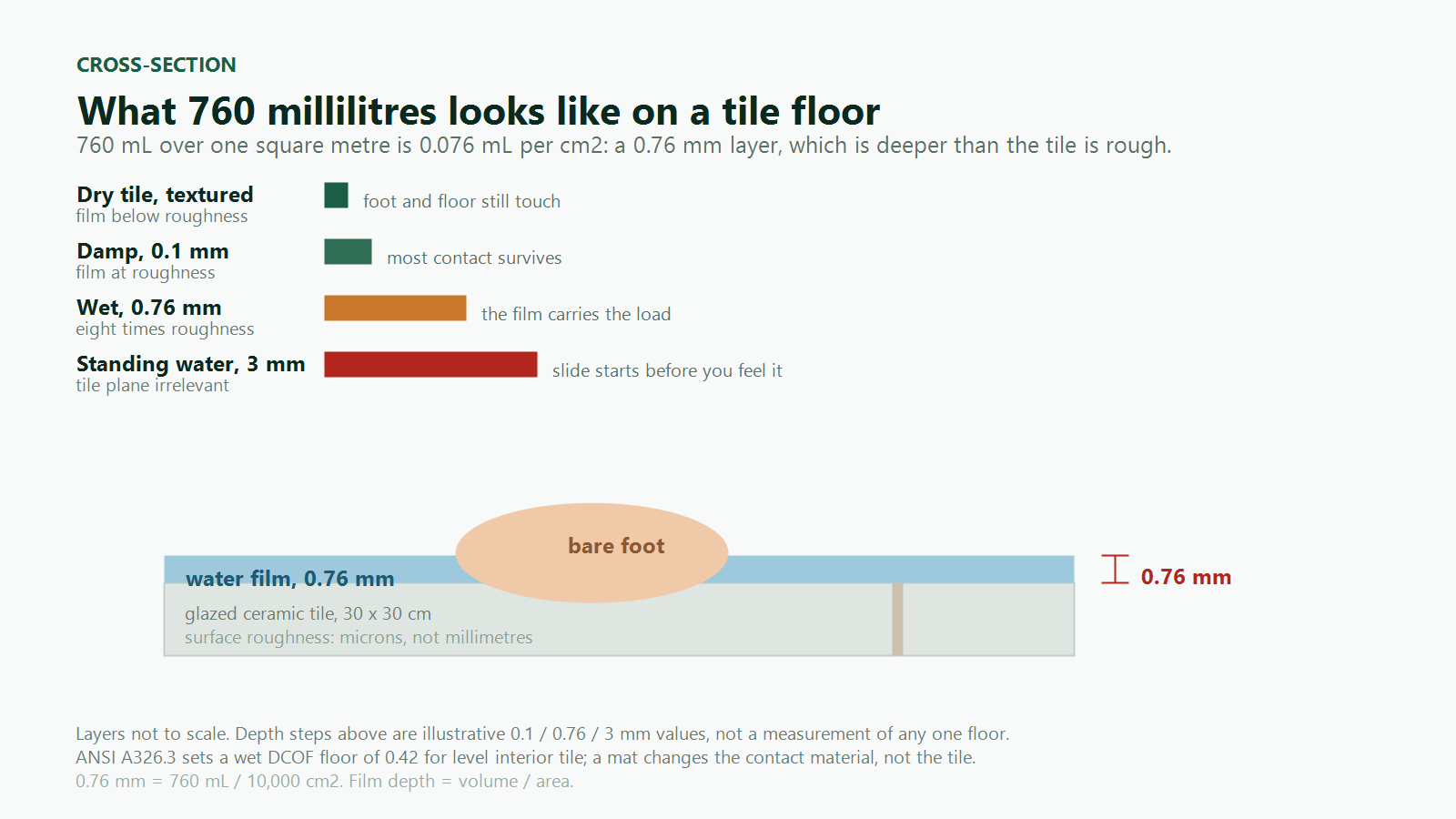
Two consequences follow, and they are why a mat is not decoration. First, the failure is not gradual: the film does not slowly make the floor less grippy, it switches the contact material. Second, the water keeps coming. A single shower puts down that film; a household of three showering twice a day does it six times, and a mat that holds water instead of passing it simply relocates the problem to the next step.
3. The number on the tile’s spec sheet
Tiles are tested for this. ANSI A326.3 is the American standard for measuring the dynamic coefficient of friction of hard surface flooring, and for level interior floors it sets a wet DCOF of 0.42 or higher. DCOF is measured while a surface is sliding, which is the relevant number for a foot that is already moving; static friction describes the moment before, which is not the moment you fall.
The distinction matters when you shop, because “non-slip tile” in a listing usually means a texture, not a test. A honed or matte porcelain with a visible grain will score better wet than a polished glaze, and a polished glaze with a 0.42 rating is still a polished glaze — the standard is a floor, not a guarantee for a wet bare foot. Bathroom tile is often selected by the person who cleans it, not the person who steps out of the shower onto it.
This is the gap a mat fills, and it fills it in a specific way: by replacing the contact pair. Foot on pile is a different problem from foot on glaze, and the mat’s own underside becomes the second contact that has to hold.
4. Three contacts, three ways to fail
A mat in a wet room is three surfaces doing three jobs, and any one of them can fail on its own.
Foot to mat top. A wet foot on a wet cotton or microfibre pile is not a high-friction pair. What saves it is drainage and depth: water that can move down into the pile instead of sitting on top leaves fibre in contact with skin. This is why a thin, saturated mat is worse than no mat at all — it has stopped absorbing, and it is now a wet textile on a hard floor with a slippery underside.
Mat to floor. This is the failure everyone has experienced, and it is almost always the backing rather than the pile. A rubberised or latex-dotted underside grips glazed tile; a plain woven back, or a backing that has been through too many hot washes and gone hard and shiny, slides. On a wet floor it slides at the exact moment you are least able to correct.
Water past the mat. The mat can hold perfectly and still fail, if it is too small. Water that lands beyond its edge is on bare tile again — and that is the edge your second foot finds.
The order to check things in: backing first, size second, absorbency third, colour last. A mat with a good underside in the wrong size is a smaller problem than a mat in the right size with a slippery back, and a beautiful mat that cannot be washed becomes a damp object within a month.
5. The 30 cm rule
Sizing is the part that is measurable before you buy, so measure it. The rule of thumb is to take the width of the shower or bath opening and add 20 to 30 centimetres on each side; the mat then covers the width a person actually steps into, including the diagonal step when they turn to reach a towel.
That rule collides with the most common mat size on the market. A 50 by 80 centimetre mat is the default in most shops, and an 80 centimetre mat under a 90 centimetre opening leaves five centimetres uncovered at each end — not a disaster, but the first step lands half on tile. Run the same rule across typical openings and the picture is clear:
| Opening width | + 20 cm each side | + 30 cm each side | Common mat that fits |
|---|---|---|---|
| 60 cm (small tray) | 100 cm | 120 cm | 60 × 90 or 60 × 100 |
| 70 cm (compact bath) | 110 cm | 130 cm | 70 × 120 runner |
| 80 cm (standard tray) | 120 cm | 140 cm | 80 × 120, or two mats |
| 90 cm (walk-in) | 130 cm | 150 cm | runner, or 2 × 80 cm side by side |
| 170 cm (bath, long side) | 210 cm | 230 cm | two mats, one per exit |
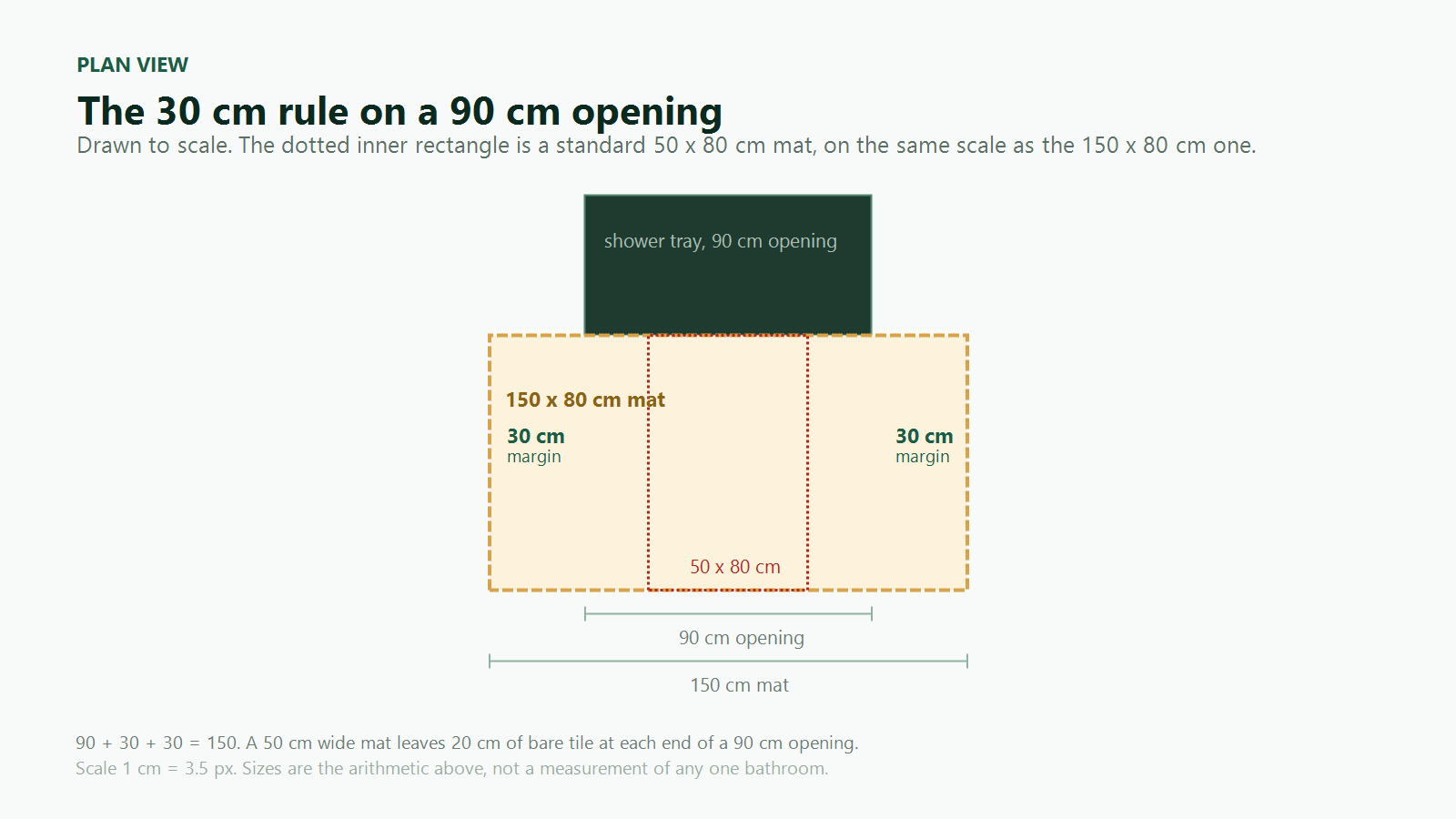
Two side notes on shape. Depth matters less than width, because the step happens forward and the turn happens sideways — a 60 centimetre deep mat is generous, a 40 centimetre deep one is adequate if the door clears it. And a bath with two usable exits needs two mats or one long runner; a single mat at one end guarantees a bare tile landing at the other.
6. Thickness is a drying problem
The instinct is to buy the thickest mat on the shelf. Thickness buys comfort for about four seconds and costs drying time for the rest of the day, and in a bathroom with an extractor fan and no window, drying time is the variable that decides whether the mat is pleasant or sour by Thursday.
A deep pile holds more water, and water leaves a textile by evaporation from its surface, so a deep pile holds water further from the air. The result is a mat that is still damp at the base twelve hours later — and a mat that is never dry is a mat that is always at the slippery end of its own performance. Medium pile that feels dry within a few hours beats the thickest option in a small, poorly ventilated room; this is one of the few places where the cheaper construction is also the better one.
The second thickness question is the door. A bathroom door typically clears the floor by 8 to 12 millimetres, which is why “low profile” appears in every mat listing that has thought about it. Measure the gap before you buy a mat with a deep pile: a mat that the door drags across every morning is a mat that will be folded, bunched, or removed, and a folded mat is a trip hazard of its own.
7. The wash is the maintenance
A bathroom mat is one of the few textiles where washing is not optional housekeeping but part of the product working. Skin cells, soap residue and the oils that come off feet all reduce absorbency, because they coat the fibre that is supposed to take water in. A mat that has stopped absorbing is not dirty in a way you can see; it is dirty in the only way that matters here.
The routine that keeps one working:
Weekly: machine wash at 40 °C on a normal cycle, on its own or with towels, not with anything that sheds lint into the pile.
Never: fabric softener. It is designed to coat fibres, and coating is exactly what you are trying to avoid. The same applies to dryer sheets.
Drying: air dry flat or on a low tumble. High heat is what turns a rubberised backing hard and glossy, and a hard, glossy backing is the beginning of a sliding mat.
Monthly: pick the mat up and look at the underside. If the grip pattern has gone smooth, polished, or is flaking off in patches, the mat is finished regardless of how the top looks.
That last check is the one nobody does, and it is the one that matters. The top of a mat ages gracefully — pile flattens, colour fades, still absorbs. The backing ages badly and silently, and the first symptom of a failed backing is a fall.
8. Four places a mat makes it worse
A mat is a solution in the step-out zone and a hazard in four other places. Put it in the wrong one and it adds a slip surface rather than removing one.
Inside the shower tray. A mat on a sloped tray holds water under itself, prevents the tray draining properly, and — if it is a suction-cup type — becomes a place for mould to establish. The tray has its own texture and slope; leave it alone.
Over a floor drain. Bathroom floors with a linear or point drain are graded to move water to it. A mat across the drain turns the whole floor into a shallow puddle, and the puddle is the thing you were trying to avoid.
Directly against a door that drags. Covered above: the mat bunches, and a bunched mat is worse than a wet floor because it fails unpredictably.
In front of a bath with a shower screen and no room to step back. If the only place to stand is the mat itself while the screen is open, water lands on the mat continuously and it saturates in one shower. In that layout, the mat belongs at the point where you step out, half a metre back, not against the tray.
9. What $84.99 has to earn
Our own mat is listed at $84.99. That is not a supermarket price, and the honest way to judge it is cost per year rather than cost at the till: divide the price by how long the mat stays functional, meaning how long the backing holds and how long it still absorbs after washing.
| What you buy | Price | Years in service | Cost per year |
|---|---|---|---|
| Supermarket-tier mat, replaced yearly | $15.00 | 1 | $15.00 |
| This mat, replaced at 3 years | $84.99 | 3 | $28.33 |
| This mat, replaced at 5 years | $84.99 | 5 | $17.00 |
| This mat, replaced at 8 years | $84.99 | 8 | $10.62 |
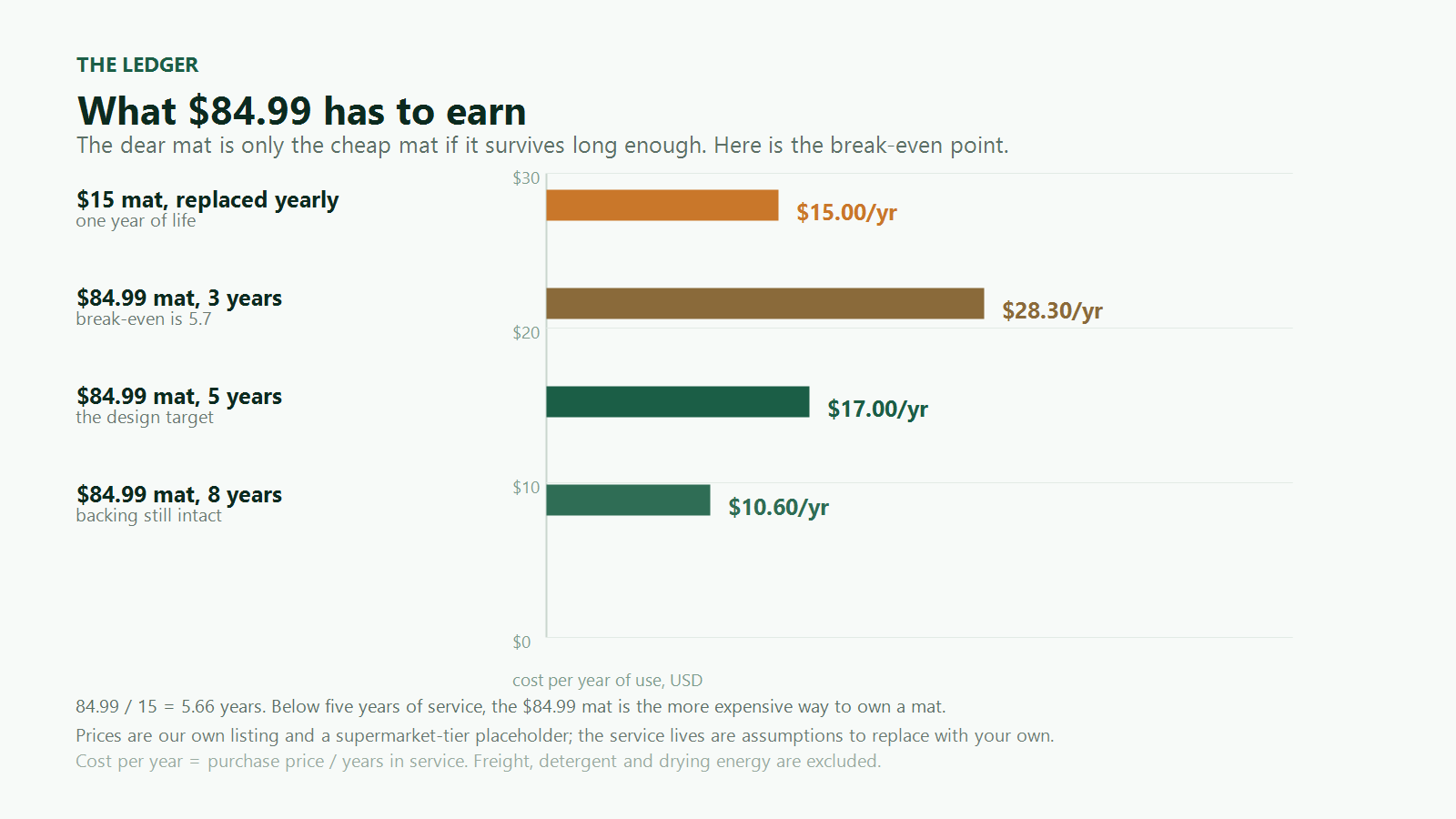
So the case for a mat at this price is not “it is nicer”. It is the specific combination of a backing that is still gripping after a hundred washes, a pile that still absorbs, a profile low enough for the door, and a size that actually spans the opening. If any of those four fails in year two, the arithmetic above collapses and a $15 mat replaced every year was the better buy.
Two things worth knowing before you order: our listing ships in 4–7 days to most US addresses and carries a 30-day return window from delivery, and the size and colour come as shown in the photographs — so measure the opening and the door gap first, then match the picture to your floor rather than the other way round.
10. The five-minute version
Measure the opening. Add 30 centimetres each side. Check the door gap. Check the underside in the photograph — you want a grip pattern, not a woven back. Prefer medium pile in a small bathroom. Wash it weekly at 40 °C with no softener, dry it low, and look at the backing once a month. Everything else about a bathroom mat, including which one you end up buying, follows from those five decisions, and all five can be made before you spend anything.
Frequently asked questions
How much water actually leaves a shower on a person?
An eight-minute shower at the US federal 2.5 gallons per minute — 9.5 litres per minute — passes about 76 litres through the tray. The fraction that leaves with you is small, but a film of as little as 0.76 millimetres across one square metre of floor is 760 millilitres, which is deeper than the tile is textured. That is why the floor fails suddenly rather than gradually.
Is a non-slip tile enough without a mat?
ANSI A326.3 sets a wet DCOF of at least 0.42 for level interior floors, and a matte or honed tile that meets it is genuinely safer than a polished glaze. But DCOF is a laboratory number for a clean floor at a defined wetness. Soap residue, conditioner and hair change the surface, and a bare foot on wet glaze is a different contact pair from a shoe on a tested floor. A mat changes the contact material; it does not depend on the floor’s rating.
What size mat do I need for a 90 cm shower opening?
Add 20 to 30 centimetres each side, so 130 to 150 centimetres wide. A standard 50 by 80 centimetre mat leaves about five centimetres of bare tile at each end of a 90 centimetre opening, and rather more on the diagonal step you take when turning to reach a towel. If a single mat that wide is impractical, two mats side by side at the exit work.
Why does my mat slide when the floor is wet?
Almost always the backing, not the pile. Rubberised or latex-dotted undersides grip glazed tile; plain woven backs do not, and a backing that has been through repeated hot washes goes hard and glossy and loses grip. Check the underside monthly — if the pattern has smoothed or is flaking, replace the mat even if the top still looks fine.
Can I put a mat inside the shower tray?
Better not. A mat on a sloped tray traps water underneath, slows drainage, and gives mould a place to establish. The tray is designed to shed water by slope; the mat’s job starts on the flat floor outside it, at the point where the first step lands.
Gear referenced in this guide
Two items from our own listings, priced on 1 November 2026. Neither is required: a towel doubled on the floor and a five-minute measurement of the step-out zone will get most bathrooms to a safer place. The arithmetic above is written so you can decide whether the rest is worth buying.
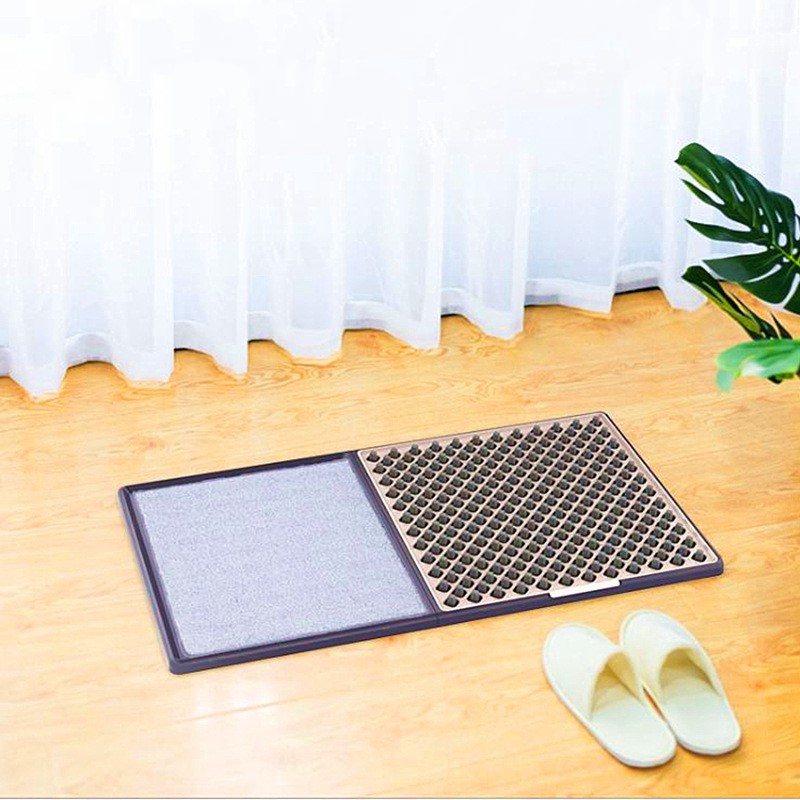
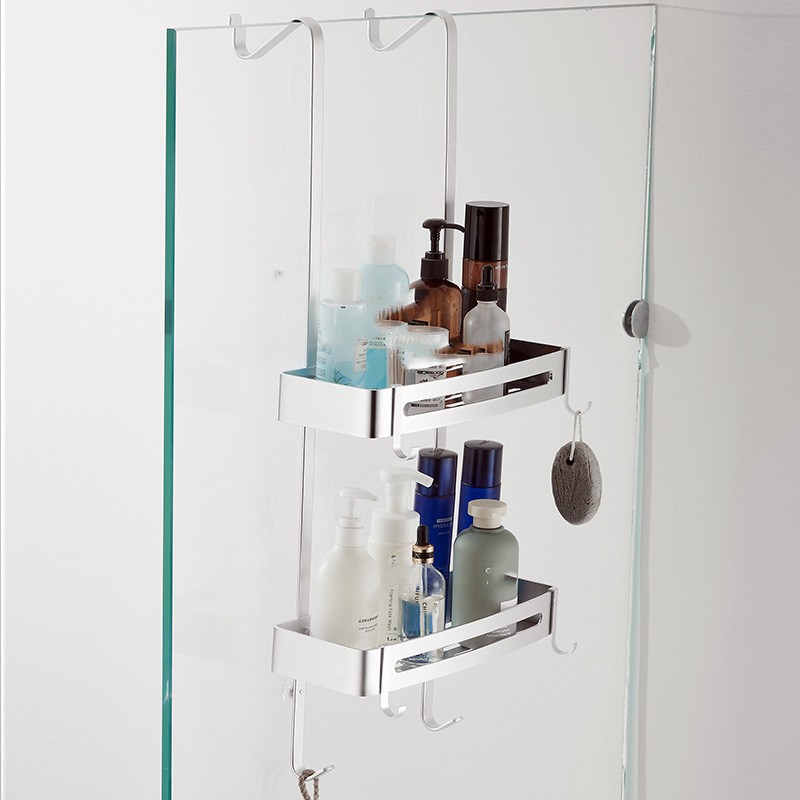
The mat’s $84.99 price, machine-washable care, grip underside, low profile, 4–7 day US transit and 30-day return window are read from our own listing on 1 November 2026; the caddy is listed at $63.99 on the same date with an aluminium frame, double basket and an open wire base that drains. The 2.5 gallon per minute showerhead limit is the US federal standard set by the Energy Policy Act of 1992. The 0.42 wet DCOF threshold is ANSI A326.3 for level interior flooring materials. The 234,000 annual non-fatal bathroom injuries among people aged 15 and over is the CDC’s analysis of emergency-department data. The 76 litres, 760 millilitres, 0.076 mL/cm² and 0.76 mm figures are arithmetic on an eight-minute shower at 9.5 L/min with a one-percent carry-over assumption — change the assumption and the film depth changes with it. The 20–30 centimetre margin and the 5.66-year break-even are the site’s own sizing guidance and the price division shown above.
Compare on Amazon — this category usually has more brands, sizes and price points there.
Check current prices on Amazon →
As an Amazon Associate we earn from qualifying purchases. The price you pay is unchanged. Disclosure