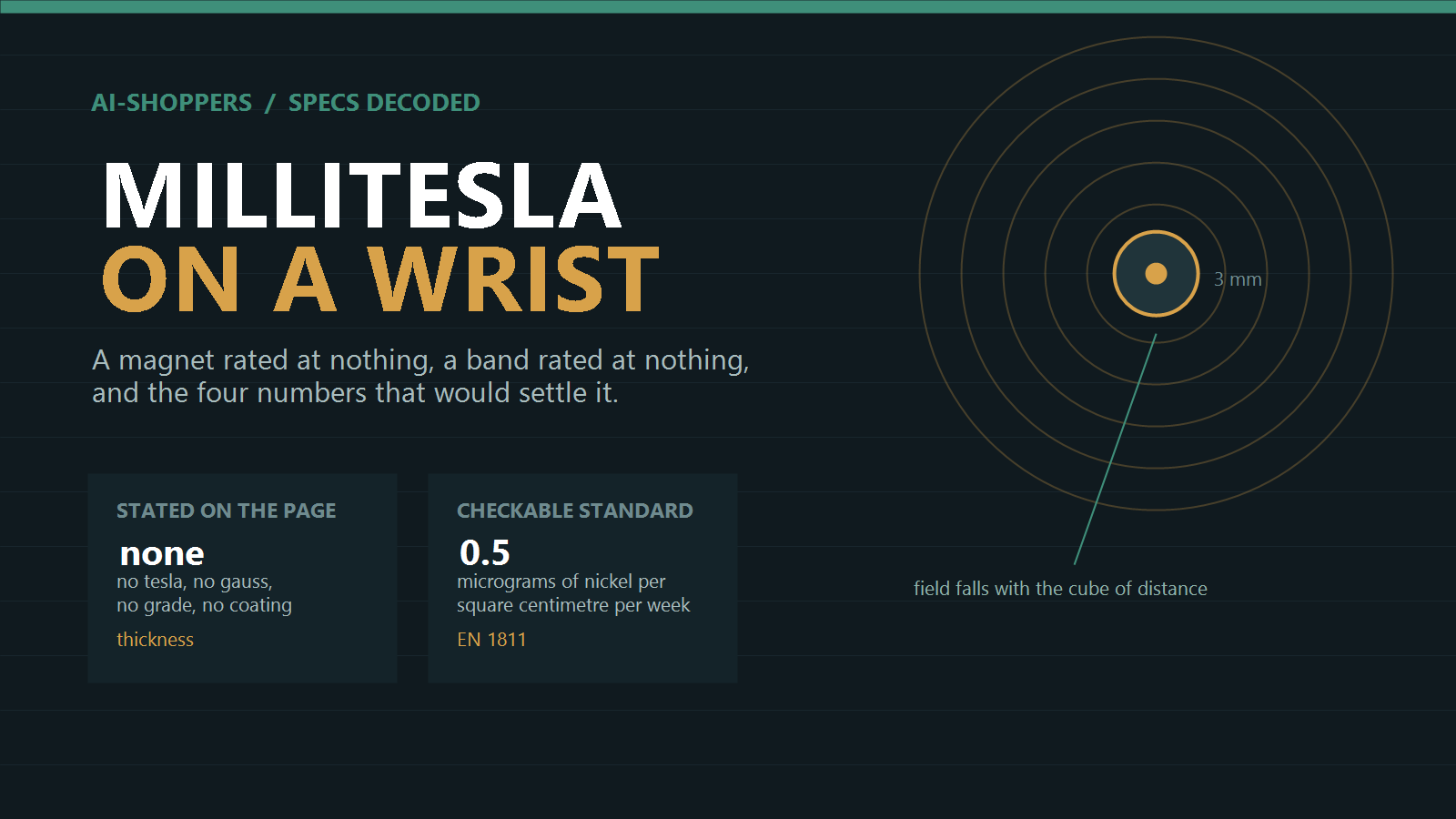
A magnetic ring in our own catalogue costs $79.99 and the page never says how strong the magnet is. That is not a small omission. Field strength, distance from the skin and the material the field passes through are the entire physics of the product, and without them the buyer is choosing a finish, not a function. The arithmetic below puts numbers on the three claims that get made for this kind of jewellery — magnetic, graphene and “ion” — so the decision can be made on something other than the photograph.
1. The unit nobody prints
Magnetic field is measured in tesla, and one tesla is ten thousand gauss. Those are the only two units that matter here, and a listing that shows neither has told you nothing about the magnet inside it. For scale: a fridge magnet holds a note with a surface field of roughly 5 millitesla; a 10 mm neodymium disc of the kind used in a clasp reaches about 0.2 to 0.3 tesla at its face; an MRI scanner runs at 1.5 or 3 tesla. The whole wearable category lives at the bottom of that range, and the difference between a good example and a bad one is a factor of ten, not a factor of a thousand.
So the first question at the counter is not “is it magnetic” but how many millitesla, at what distance. A number with no distance attached is not a specification. Magnets are not rated like a battery; they are rated like a lamp, where the brightness depends on where you stand.
2. Distance is the whole story
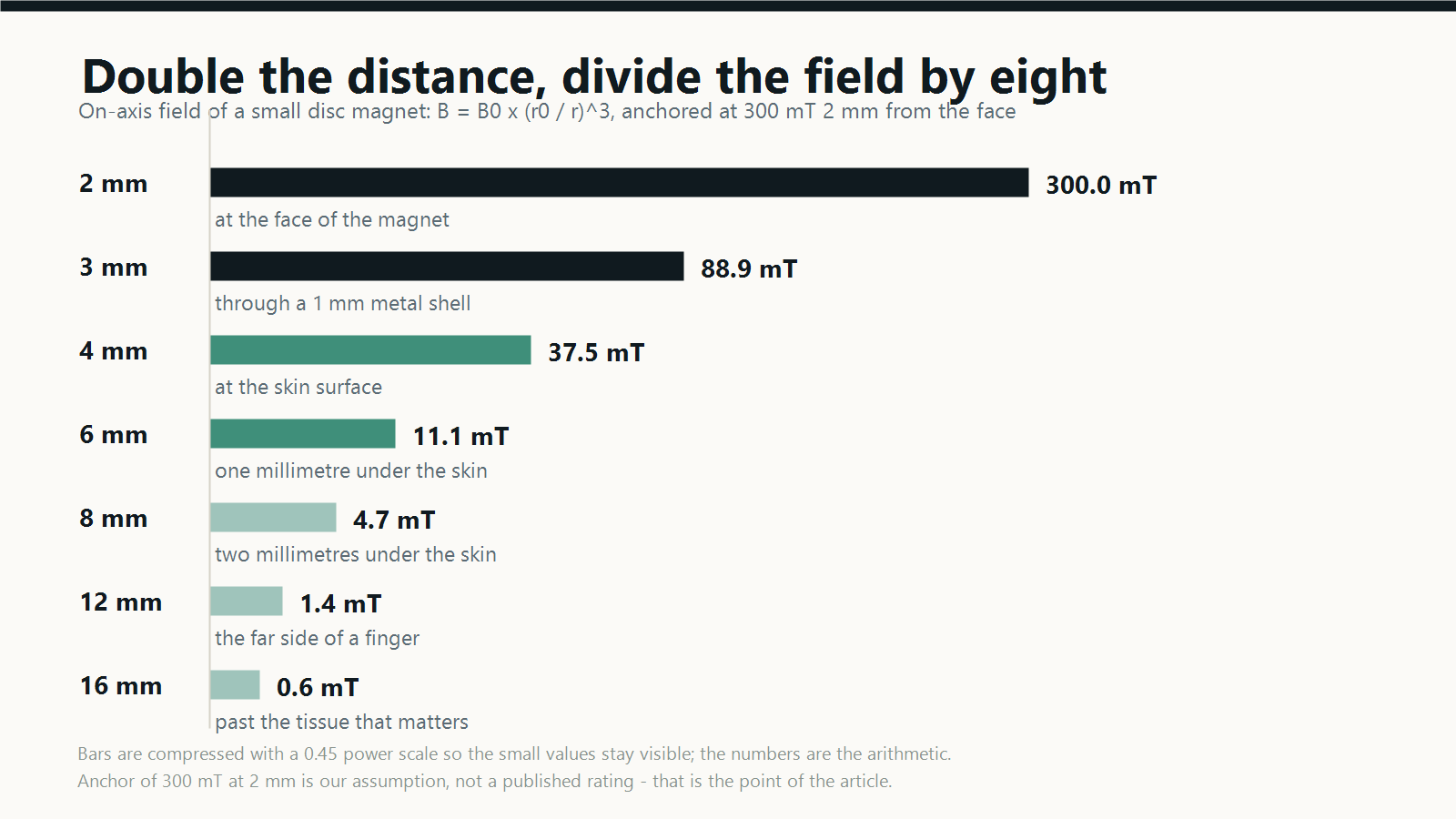
A small disc magnet behaves, beyond a few millimetres, like a dipole, and a dipole’s field falls with the cube of distance. Double the distance and you divide the field by eight, not by two. That single exponent explains more about wearable magnets than any marketing copy: the metal shell of the ring, the thickness of the skin, and the millimetre of air under a loose band each remove most of what was there.
| Distance from the magnet face | Field on axis | What sits at that distance |
|---|---|---|
| 2 mm | 300 mT | Inside the setting, against the metal |
| 3 mm | 88.9 mT | Through a 1 mm shell |
| 4 mm | 37.5 mT | Skin surface |
| 6 mm | 11.1 mT | 1 mm under the skin |
| 8 mm | 4.7 mT | 2 mm under the skin |
| 12 mm | 1.4 mT | Far side of a finger |
| 16 mm | 0.59 mT | Past the tissue a wrist band is sold to reach |
Read the table as a budget. If the ring’s magnet sits 3 mm below the inner surface because of a thick setting, the skin receives 89 mT at best, and a band that sits loose by another 2 mm delivers 11 mT. Both products could honestly say “strong neodymium magnet”. Only one of them has a number that survives the geometry.
The check that costs nothing: ask for the field in millitesla at a stated distance, or at least the magnet grade (N35, N42, N52) and diameter. N52 in a 12 mm disc is a real, checkable combination. “Strong magnet” is not.
3. What thirty millitesla does to a wrist
Skin, muscle and blood are water with solids in them, and water is diamagnetic: its volume susceptibility is about −9.05 × 10⁻⁶. Diamagnetic means it is very slightly repelled by a field, and the force is proportional to the field multiplied by its gradient. Work it through for a wearable magnet: with 0.03 T at the skin and a gradient of about 10 T per metre across the tissue, the force density inside the tissue is roughly 2 pascals.
Two pascals is the pressure of a sheet of paper resting on your hand. Systolic blood pressure is about 16,000 pascals, so the magnetic force is around seven thousand times smaller than the pressure the artery already handles. Nothing in the wrist is ferromagnetic in any useful sense: the iron in haemoglobin is bound inside a porphyrin ring as Fe2+, and its response to a field is overwhelmed by thermal motion at body temperature. A magnet does not pull blood anywhere.
This is where honesty is required in both directions. The physics shows the force is negligible; it does not, by itself, prove that a static field has no biological effect at all, and static magnets have been studied for decades for musculoskeletal pain with results that are inconsistent and generally no better than placebo. What the physics does establish is what the product is: a piece of metal with a field you can measure at one centimetre and not at ten.
4. Move it, and you get millivolts
Faraday’s law is the only route from a static magnet to an electrical effect in the body, and it needs motion. A conductor moving through a field generates a voltage equal to field × length × speed. A bracelet sweeping past the skin at 0.1 metres per second through 0.03 T, across a 5 cm path, generates 0.15 millivolts. A nerve fires at a threshold around 10 millivolts. That is a factor of sixty short, and it is why nobody has built a medical device out of a moving ring.
The comparison that makes the scale concrete is the scanner. An MRI runs at 1.5 T, fifty times the field at the face of a wearable magnet, and it is switched on and off in milliseconds to induce currents deliberately. If a 30 mT static field did what the listings imply, the imaging suite would not need gradient coils at all.
5. The graphene band has nothing to move
Graphene’s headline number is real: in-plane thermal conductivity of roughly 3,000 to 5,000 W per metre-kelvin, several times copper. The mistake is assuming that number transfers to a moulded wristband. A band is a polymer loaded with a few percent of filler, and thermal conduction in a composite needs a connected path; at low loading the particles sit in a polymer matrix that conducts at around 0.2 W per metre-kelvin, and the blend behaves like the polymer, not like the filler.
More fundamental is the steady-state argument. A worn band has no heat source inside it. Within minutes it reaches skin temperature, and once two surfaces are at the same temperature, no heat flows between them regardless of conductivity — a copper bar at 33 °C transfers nothing to skin at 33 °C. Whatever a bracelet claims about warmth or far-infrared, the band and the wrist are in thermal equilibrium for as long as you wear it.
6. The ion bracelet is a cell with no circuit
“Ion” usually means copper or a copper-zinc pair, and there the physics is at least real: copper sits at +0.34 V against the standard hydrogen electrode and zinc at −0.76 V, so a pair of them in an electrolyte gives an open-circuit voltage of about 1.10 V. Sweat is an electrolyte — sodium chloride at roughly 0.5 percent. So a two-metal bracelet on a sweaty wrist is a battery.
The problem is the circuit. A battery does work only when current can leave one terminal and return to the other, and the only return path here is through skin, whose resistance is tens of kilohms when dry and a few kilohms when wet. Put 1.1 V across 10 kilohms and you get 0.11 milliamps, dissipating about 0.12 milliwatts. A TENS unit, the clinical device this claim borrows its language from, runs at 1 to 50 milliamps with electrodes placed to force current through a specific nerve. The bracelet is three orders of magnitude below the device and has no electrode geometry at all.
7. The three numbers a listing can be held to
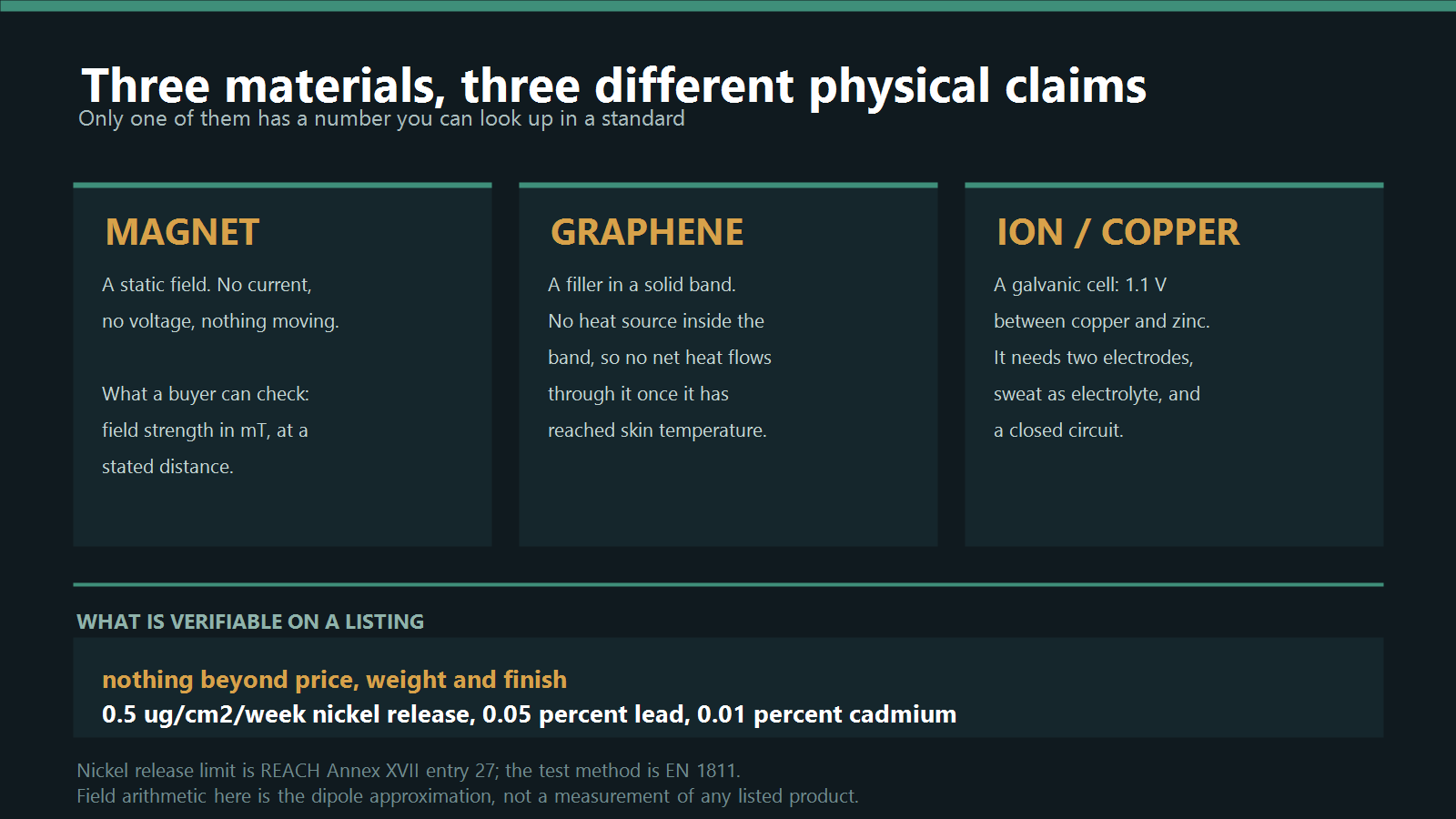
If the field and the current cannot be verified from a listing, the materials can, because they are regulated. Under REACH Annex XVII, items intended for prolonged skin contact must not release more than 0.5 micrograms of nickel per square centimetre per week; the test method is EN 1811, with EN 12472 for the abrasion pre-treatment. Jewellery is separately restricted to 0.05 percent lead and 0.01 percent cadmium by weight. Those are the numbers that decide whether a cheap ring gives you a rash, and they are absent from most product pages.
Run the nickel figure over a year and it stops being abstract. A ring with 20 cm² of skin contact, releasing at the legal maximum, emits 10 micrograms a week, which is 0.52 milligrams a year. That is a limit designed to keep sensitised skin from reacting, not a recommendation that you wear it in the shower.
Plating is the other visible variable. Decorative plating on fashion jewellery is typically 0.5 to 3 micrometres thick, and sweat sits at pH 4.5 to 6.5. Thin plating over a dissimilar metal is a corrosion cell by design: once the layer is breached, the underlying metal corrodes faster than it would alone, which is why a ring turns a finger green in summer and not in winter.
8. Fit, mass, and the seven cents a day
A ring that is too loose moves, and movement is the one thing that changes the field at the skin: 2 mm of slack cuts the delivered field from 37.5 mT to 11 mT in the table above. Fit matters more than grade. Half a millimetre of clearance at the knuckle, no pinching at the base of the finger, and a band that does not rotate under its own weight is the whole specification.
Then the arithmetic that makes the price comparable. Divide the price by the days you will actually wear it:
| Item | Price | Cost per day over 3 years | Cost per year |
|---|---|---|---|
| Magnetic ring | $79.99 | $0.073 | $26.66 |
| Graphene bracelet | $80.99 | $0.074 | $27.00 |
| Ion bracelet | $28.99 | $0.026 | $9.66 |
At seven cents a day the ring is not an expensive object; it is a cheap one that costs $80 up front. The comparison that matters is against the thing it replaces. A stainless steel band with no magnet in it wears for the same three years at a fifth of the price, and if the appeal was the look, that is the honest trade.
Before you wear one: anyone with a pacemaker, an ICD, a cochlear implant or an insulin pump should keep a magnet away from the device. Manufacturers typically advise 15 cm of separation, and an MRI suite will ask you to remove it. This is not a reason to avoid jewellery; it is a reason to read the second paragraph of a listing that only talks about the first.
9. Five checks at the counter
One: a field number with a distance attached, in millitesla or gauss. Two: a stated magnet grade and diameter, because those two figures predict the field. Three: plating thickness in micrometres, or a statement that the item is solid stainless rather than plated. Four: a nickel-release statement referencing EN 1811, which is the only line on the page that speaks to what happens after a month of sweat. Five: the weight, because a hollow 3 g ring feels like a toy and a 12 g one does not.
If a listing answers none of those, it is still allowed to be a nice ring. It is just not a product you can evaluate, and at $79.99 the difference between evaluating and guessing is worth the two minutes it takes to ask.
Frequently asked questions
Does a magnetic ring actually do anything?
Physically it produces a static field that falls to about 37 millitesla at the skin and 4.7 millitesla two millimetres under it. The force that field exerts on tissue works out at roughly 2 pascals, about seven thousand times less than blood pressure. Static magnets have been studied for pain with inconsistent results; the field is real, the effect is not established.
How strong should a magnetic bracelet be?
Strong enough to still have a number at the skin, which for a small disc means 30 to 100 millitesla after the shell. Because field falls with the cube of distance, a looser fit costs more than a weaker magnet: 2 mm of extra gap divides the field by roughly three.
Is graphene in a bracelet worth paying for?
As a filler it changes the look and the feel of the band. As a heat path it cannot do anything measurable, because a worn band reaches skin temperature and then transfers no heat at all. Graphene’s 3,000 to 5,000 W per metre-kelvin figure describes a single layer, not a moulded composite.
What does an ion bracelet actually release?
A copper-zinc pair in sweat forms a cell of about 1.10 volts, but with skin resistance in the kilohms the current is around 0.11 milliamps, roughly a thousandth of a TENS unit. Without two electrodes and a closed circuit there is no path for current to do work.
What should I check on the listing before buying?
Field strength in millitesla at a stated distance, magnet grade and diameter, plating thickness, a nickel-release statement to EN 1811, and the weight in grams. If none of those appear, you are buying a finish rather than a specification.
Gear referenced in this guide
Three items from our own catalogue, priced on 1 November 2026. The arithmetic above is deliberately written so that it applies to any of them, and to anything else in the category: the field, the fit and the plating are the specification, and none of the three listings states them.
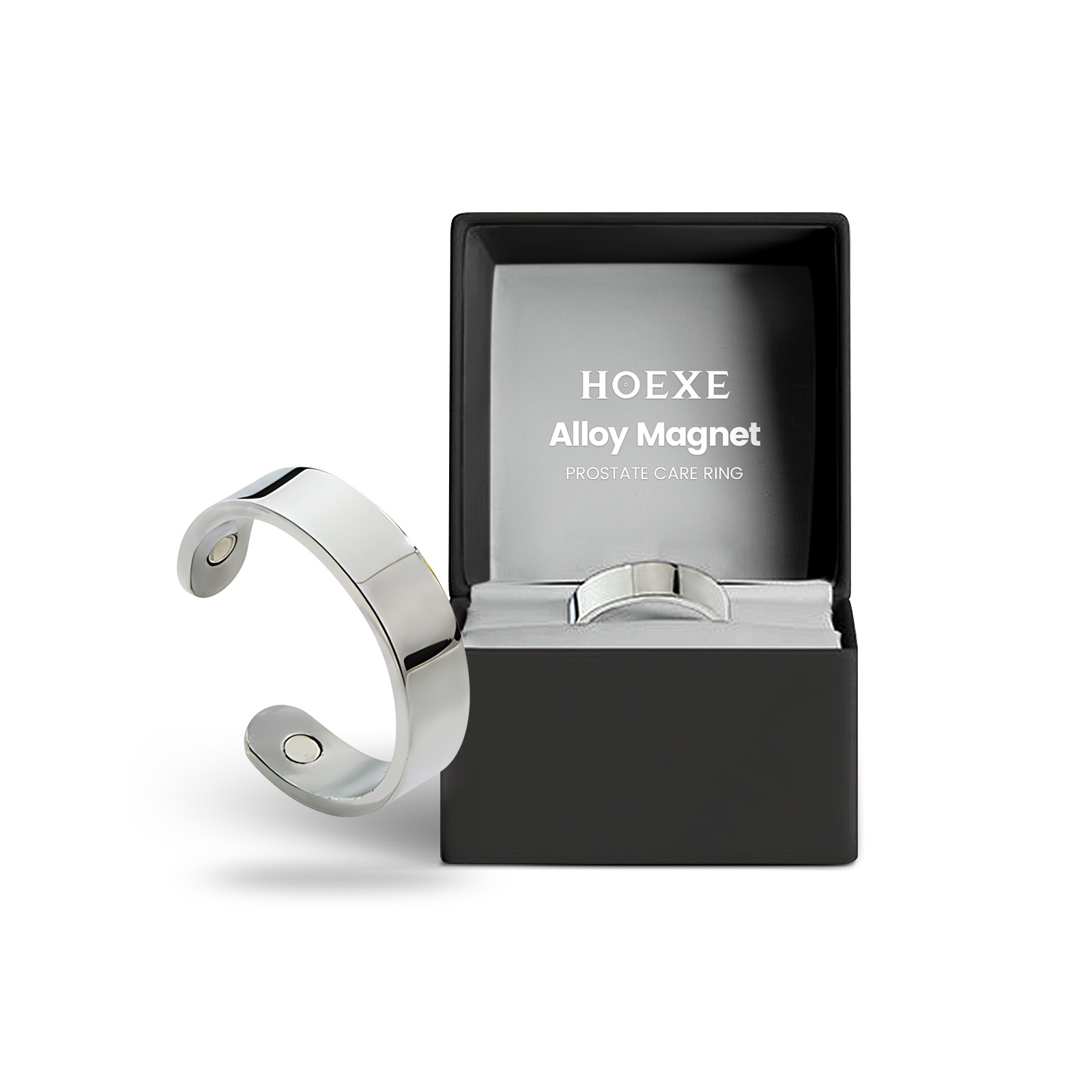 Hoexe Silver Magnetic Ring$79.99View details
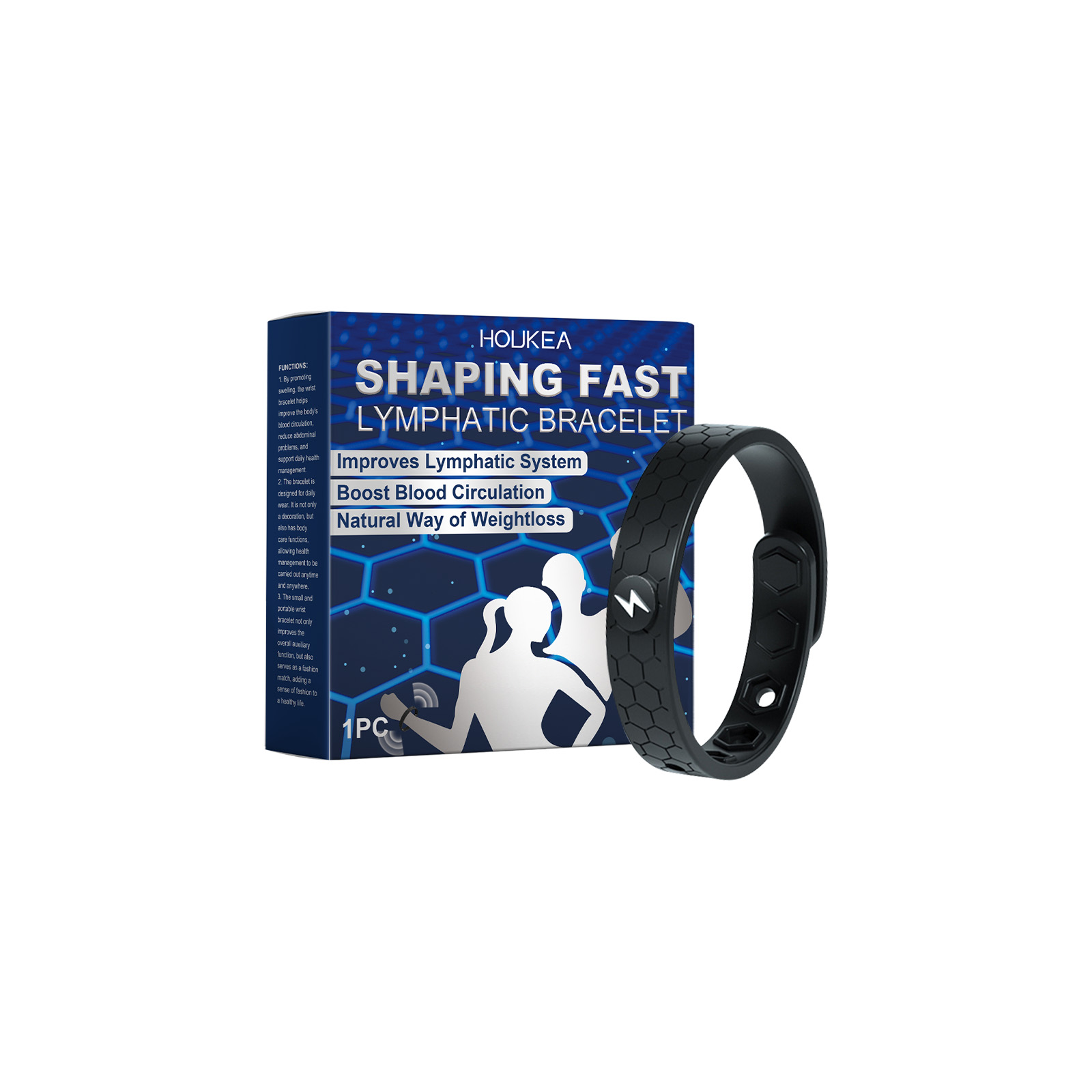 Houkea Graphene Bracelet$80.99View details
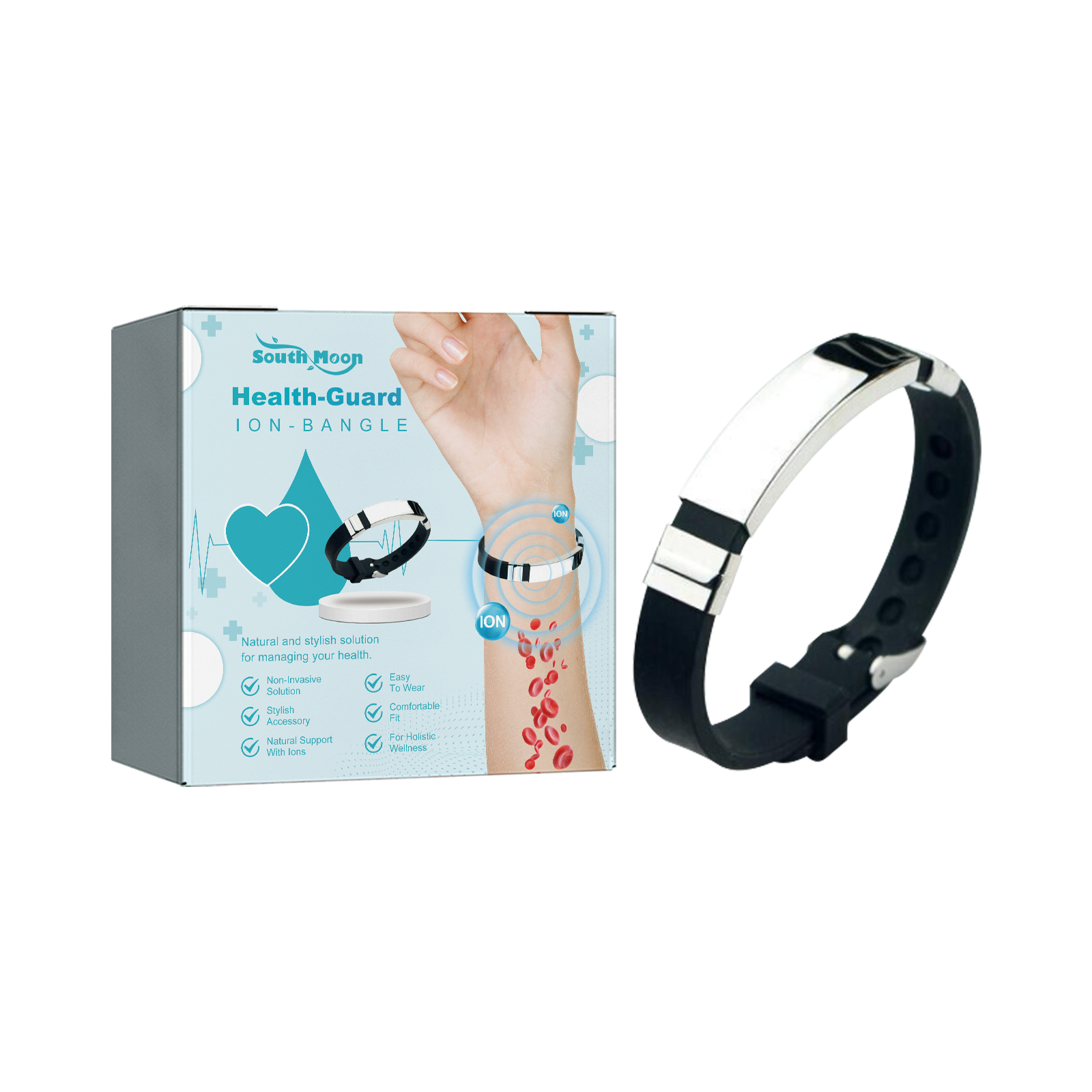 Ion Bracelet$28.99View details
The $79.99, $80.99 and $28.99 prices, the US warehouse, the 1–2 day dispatch, the 2–6 day delivery and the 30-day return window are read from our own listings on 1 November 2026. The figures of 300 mT at 2 mm and every value in the distance table are the dipole approximation, B = B0(r0/r)³, anchored on that assumption rather than on a measurement of any listed product. The 0.03 T skin value, the 10 T per metre gradient and the resulting 2 pascals are order-of-magnitude arithmetic using water’s volume susceptibility of −9.05 × 10⁻⁶; blood pressure of 120 mmHg is 16 kPa. The 0.15 mV Faraday figure assumes 0.03 T, 0.05 m and 0.1 m/s. The 1.10 V cell, the 10 kohm skin resistance, 0.11 mA and 0.12 mW follow from standard electrode potentials for copper and zinc and from that resistance; TENS output of 1 to 50 mA is the usual clinical range. The nickel limit of 0.5 micrograms per square centimetre per week, the 0.05 percent lead limit and the 0.01 percent cadmium limit are REACH Annex XVII restrictions; EN 1811 and EN 12472 are the test methods. Plating thickness of 0.5 to 3 micrometres and sweat pH of 4.5 to 6.5 are typical industry ranges, not legal limits. Cost-per-day figures divide each price by 1,095 days.
Compare on Amazon — this category usually has more brands, sizes and price points there.
Check current prices on Amazon →
As an Amazon Associate we earn from qualifying purchases. The price you pay is unchanged. Disclosure