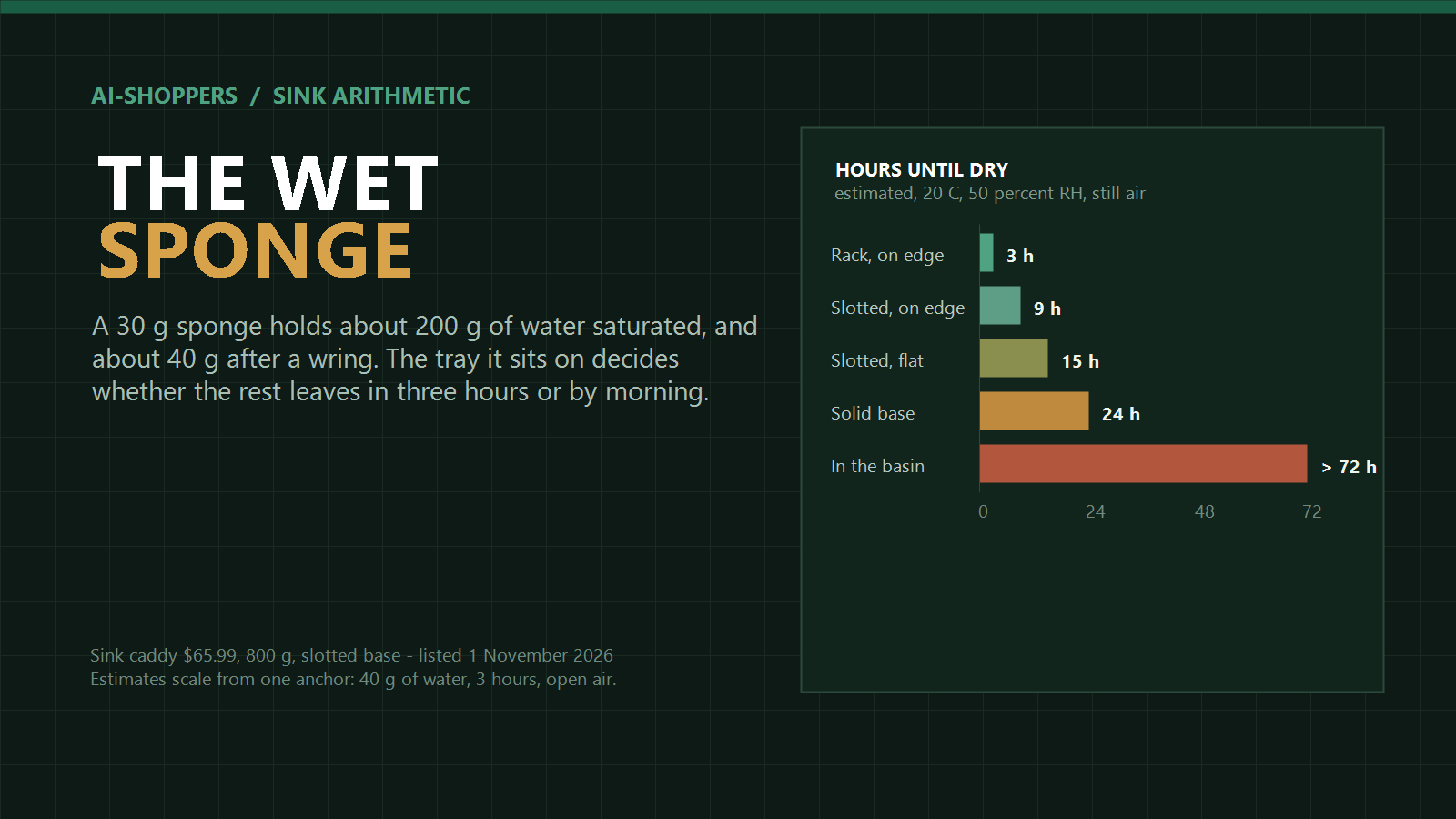
A sink caddy is sold as storage and bought for how it looks beside the tap. Functionally it is a drainage device, and there is exactly one number on it that changes an outcome: how much of its base is open. Everything else — two compartments, a sponge shelf, a bottle well, an 800 g body — is arrangement. This guide puts the water where you can see it, because the difference between a sponge that dries in three hours and one that is still damp at breakfast is not brand, price or colour. It is contact area and air.
1. The only functional claim on the box is the base
Read a caddy listing and count how many of its sentences would still be true if the base were solid. “Two compartments.” Still true. “Keeps sponge and brush within reach.” Still true. “Wipe-clean surface.” Still true. “Slotted base so water runs out rather than pooling” — that one is the product. Every other line describes a shape, and shapes are cheap. A moulded plastic tray from a hardware shop does the same job for a tenth of the money; what the extra buys is finish, weight and looks, not function.
That is not an argument against buying one. It is an argument for judging it by the base and the fit, and for knowing what the base can and cannot do. A slotted caddy does not dry a sponge. It stops the sponge from lying in its own water, which is a smaller claim and a much more useful one.
2. What the sponge is carrying when you set it down
A typical cellulose dish sponge is about 11 by 7 by 3 cm, roughly 230 cubic centimetres of volume, and weighs around 30 g dry. Open-cell cellulose holds close to 0.85 ml of water per cubic centimetre of sponge, so a fully saturated one is carrying about 200 g of water — nearly seven times its own dry mass. A firm hand-wring leaves 15 to 20 percent behind: 30 to 40 g.
Those two numbers set the whole problem. Forty grams is a small amount of water with a large surface area spread through it, and it will leave in an afternoon. Two hundred grams, sitting on a solid tray with a millimetre of film underneath, has nowhere to go. The sponge does not dry from the top down; it dries from every surface at once, and the underside is the surface that gets blocked.
For scale: one millimetre of water spread over one square metre is one litre. A caddy holding a 0.4 mm film across a 30 by 10 cm base is holding 120 ml under the sponge — more water than the sponge itself contains after a wring.
3. A basin is a sealed room, and that changes the physics
Evaporation is limited by how much water vapour the air can still accept. At 20 °C, saturated air holds 17.3 g of water per cubic metre. A typical kitchen sink basin, 40 by 35 by 20 cm, encloses 28 litres of air, so it takes 0.48 g of water to saturate that headspace.
At the rate a sponge loses water in open air — call it 13 g an hour, from the anchor below — the air inside a closed basin is saturated in about two minutes. After that, evaporation does not stop, but it slows to the rate at which moisture can escape past the rim. In practice that is a tenth of the open-air rate or less, which is why a sponge left in the basin is still wet the next morning even though it is sitting in the open, not in a puddle.
This is the mechanism behind the familiar complaint that sponges smell. A 2017 study in Scientific Reports from a research group at Furtwangen University found up to 5 × 10¹⁰ bacteria per cubic centimetre in used kitchen sponges. Wet, warm, nutrient-rich and undisturbed is the entire recipe; common spoilage organisms double every 20 to 30 minutes at room temperature, so a single cell is a visible biofilm in under a day. Drying is not a hygiene ritual, it is the intervention that removes the condition they need.
4. Contact area, not slot area, is what moves the number
The useful way to model a caddy is a heat-sink problem in reverse. Water leaves through exposed surface; plastic in contact with the sponge blocks that surface and, worse, wicks water back up by capillary action. A sponge resting flat on a solid base exposes its top and four thin sides and hides the entire bottom face — for an 11 by 7 cm sponge, 77 cm2 of the roughly 300 cm2 total surface, and the face closest to the water.
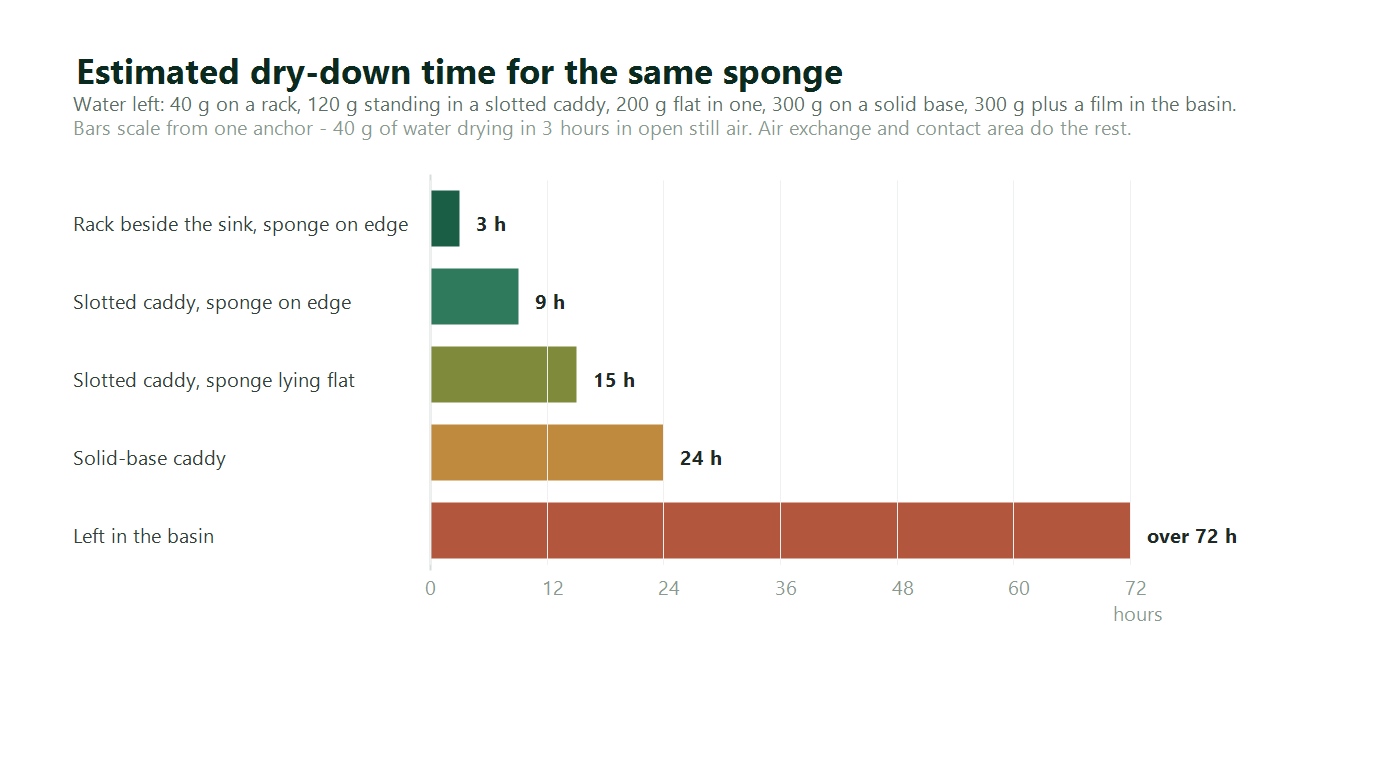
The anchor is the only empirical claim here. A wrung sponge on a rack beside the sink, in a normal kitchen at about 20 °C and 50 percent relative humidity, is dry in roughly three hours. That is 40 g leaving at about 13 g an hour. Scale from there and the order of the setups is fixed by two variables: how much water is left in the sponge, and how much air reaches the underside.
| Where the sponge sits | Water it still holds | Air under the base | Estimated dry time |
|---|---|---|---|
| On a rack, on edge | 40 g | Full | 3 hours |
| Slotted caddy, on edge | 120 g | Most of the base | 9 hours |
| Slotted caddy, lying flat | 200 g | Through the slots only | 15 hours |
| Solid-base caddy | 300 g including film | None | 24 hours |
| Left in the basin | 300 g plus film | None, and saturated air | Over 72 hours |
The spread between the best and worst row is a factor of 24, and none of it comes from the caddy’s price. It comes from whether the sponge is standing on edge and whether anything is touching its bottom face.
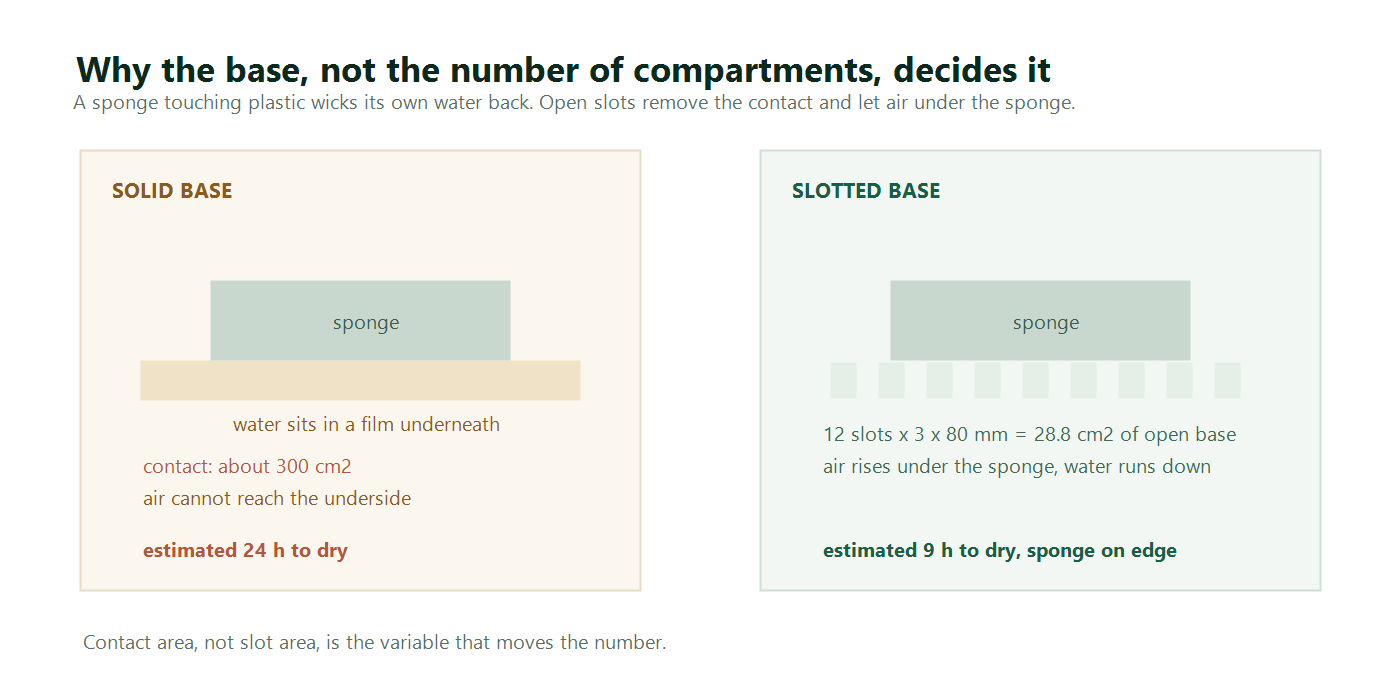
Run the drainage numbers and something counter-intuitive appears. Twelve slots of 3 mm by 80 mm are 2,880 mm2, or 28.8 cm2 of open base. Three hundred millilitres of water will pass through 28.8 cm2 in seconds under even a centimetre of head. Drainage speed is not the problem and never was. The slots matter because they remove contact, and because they let air reach the face that would otherwise be sealed. A caddy with generous slots and a deep lip that the sponge still rests on has solved nothing.
5. The payback that never arrives
Caddies are often sold on the idea that they save money on sponges. Do the arithmetic. A basic cellulose sponge costs about $0.35; replaced weekly, that is $18.20 a year. The caddy in this guide is $65.99, so it takes 3.6 years of weekly sponges just to break even — and that assumes the caddy extends sponge life at all, which it does only if the sponge actually dries between uses.
Reframe it honestly: $65.99 over three years of daily use is 6 cents a day, and what it buys is a counter that does not smell and a sponge that is dry when you pick it up. That is a reasonable thing to buy. “It pays for itself” is not.
The same logic explains why a cheaper caddy with a solid base is the worse purchase even at a fifth of the price: it will keep the sponge wet, the sponge will be replaced more often, and the money saved on the tray goes into the consumable.
6. Fit, mass and the four measurements worth taking
The 800 g body is doing real work. A caddy is pushed sideways every time a wet hand grabs a sponge, and a light tray walks across the counter until it hits the wall. Mass also lowers the centre of gravity when a full bottle is standing in the second compartment, which is the load case that tips a narrow base. If your counter is stone and the caddy is light, expect to move it back twice a day.
| Measure before buying | Why it decides the purchase | Threshold that works |
|---|---|---|
| Tap base to wall | The caddy has to sit clear of the spout swing and the lever arc | At least the caddy width plus 2 cm |
| Counter to spout outlet | A bottle must stand upright under the tap to be refilled in place | 22 cm for a 500 ml bottle |
| Open area in the base | Determines whether air reaches the underside | 20 cm2 minimum |
| Empty mass | Stops the caddy sliding when a wet sponge is pulled out | 600 g or more |
| Base finish at the welds | Standing water finds bare mild steel first | No exposed weld or cut edge |
Note what is not on that list: the number of compartments. A third section holds a brush, and a brush that sits in water has exactly the same problem as a sponge. If anything, the brush is worse, because its bristles wick water and its handle is usually the part that stays submerged.
7. Four minutes a week
A caddy only earns its price through maintenance, and the routine is short. Once a week, empty it, rinse the base under the tap and wipe the underside dry with a cloth — the film that collects there is soap residue, not clean water, and it is what feeds the smell. Stand the sponge on its edge rather than flat, which halves the contact area for free. Replace the sponge monthly rather than waiting for the smell, because by the time it smells, the biofilm is days old.
If the caddy has a bottle compartment, take the bottle out before wiping. Soap left in the well dries into a skin that re-wets the moment the next drop lands, and the well becomes the one place in the caddy that never dries at all.
Questions buyers ask
Does a slotted caddy really stop sponges smelling?
It removes the standing water and lets the underside dry, which removes the condition bacteria need. It does not sterilise anything. A slotted caddy used with a sponge that is never stood on edge, or never rinsed, will still smell — the slots are necessary, not sufficient.
How long should a kitchen sponge last?
A month is a sensible replacement interval for a sponge used daily on dishes. Sanitising extends the interval a little, but a sponge that dries fully between uses is doing more for you than one that is disinfected and left wet.
Is stainless steel better than plastic for a wet caddy?
Only if the steel is the right grade and the welds are finished. 304 stainless handles standing water; cheaper 201 or bare welded joints pit first, and a pit is where the coating fails. A plastic body with a good open base has no corrosion problem at all, which is why the base design matters more than the material.
Can I put the sponge in the dishwasher?
You can, and it will come out cleaner, but the dishwasher does not solve the wet-underside problem. A sponge that goes back onto a solid base returns to the same wet, warm, undisturbed state within hours.
The caddy costs $65.99. Is that justified?
Not on sponge savings — 3.6 years of weekly sponges equals the price. It is justified if you want a heavy, stable caddy that stays where you put it and drains properly, and if you will actually stand the sponge on edge. If either of those is unlikely, a $12 rack does the functional job.
Gear referenced in this guide
One item from our own listing, priced on 1 November 2026. None of the arithmetic above depends on buying it: a rack, a spare centimetre of counter and the habit of standing the sponge on edge will get you most of the way.
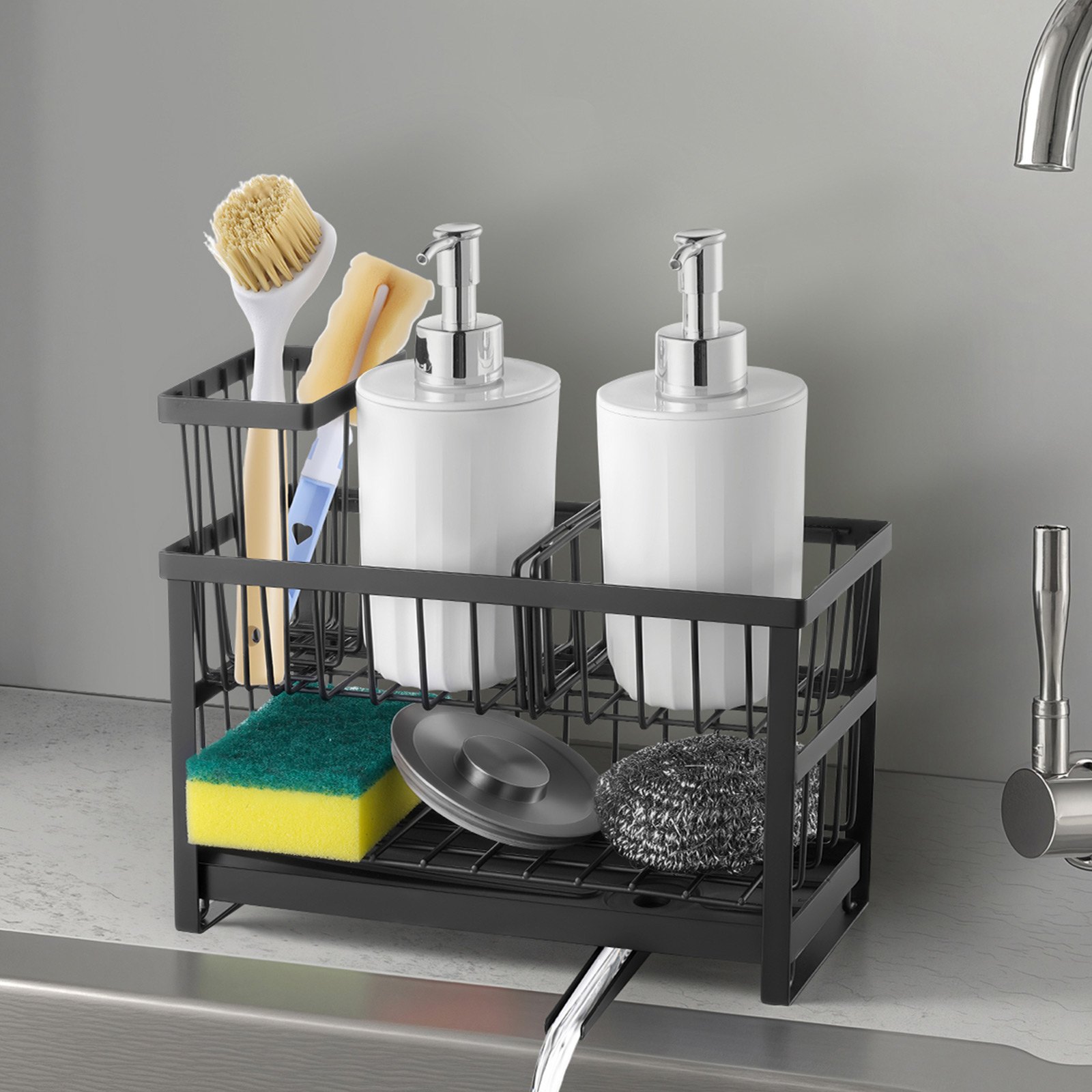
The $65.99 price, the 800 g weight, the two compartments, the slotted base, the 1–2 day US dispatch, the 2–6 day delivery and the 30-day return window are read from our own listing on 1 November 2026. The 30 g dry mass, 230 cm3 volume and 0.85 ml per cm3 water capacity are typical values for a cellulose dish sponge, not measurements of a specific one; the 200 g saturated and 40 g wrung figures follow from them. The 13 g per hour evaporation rate is one anchor — 40 g drying in three hours in open still air at about 20 °C and 50 percent relative humidity — and every dry-down hour in the table is that anchor scaled by water mass and air exchange. They are estimates, not lab results. The 17.3 g per cubic metre saturation figure is the standard value for air at 20 °C; the 0.48 g headspace figure assumes a 40 by 35 by 20 cm basin. The 5 × 10¹⁰ per cm3 figure is from the 2017 Scientific Reports study of used kitchen sponges; the 20 to 30 minute doubling time is a general figure for common spoilage bacteria at room temperature. The 3.6 year payback assumes a $0.35 sponge replaced weekly.
Compare on Amazon — this category usually has more brands, sizes and price points there.
Check current prices on Amazon →
As an Amazon Associate we earn from qualifying purchases. The price you pay is unchanged. Disclosure