Almost every dog needs its nails shortened every three to four weeks for its whole life, and most owners get it wrong twice before they get it right: once by taking off far too little, and once by taking off too much. This guide is about the second mistake — where the quick sits, how to stay in front of it, and exactly what to do if you nick it.
Why long nails are not just a cosmetic problem
A nail that reaches the floor does more than click. It pushes the toe joint upward, and over months that changes the angle the whole foot stands at. Owners usually notice it as a dog that suddenly refuses long walks, or one that looks like it is walking on its heels.
The tell is easy to hear: on a hard floor, a dog with correctly short nails walks almost silently. If you can hear clicking at every step, the nails are already past due.
Dewclaws deserve their own paragraph. The nail on the inside of the front leg never touches the ground, so it never wears down and nobody thinks to trim it. Left alone it curves back into the pad, and by the time it is noticed it has usually been growing into the skin for months. Check both dewclaws every single session.
Where the quick actually is
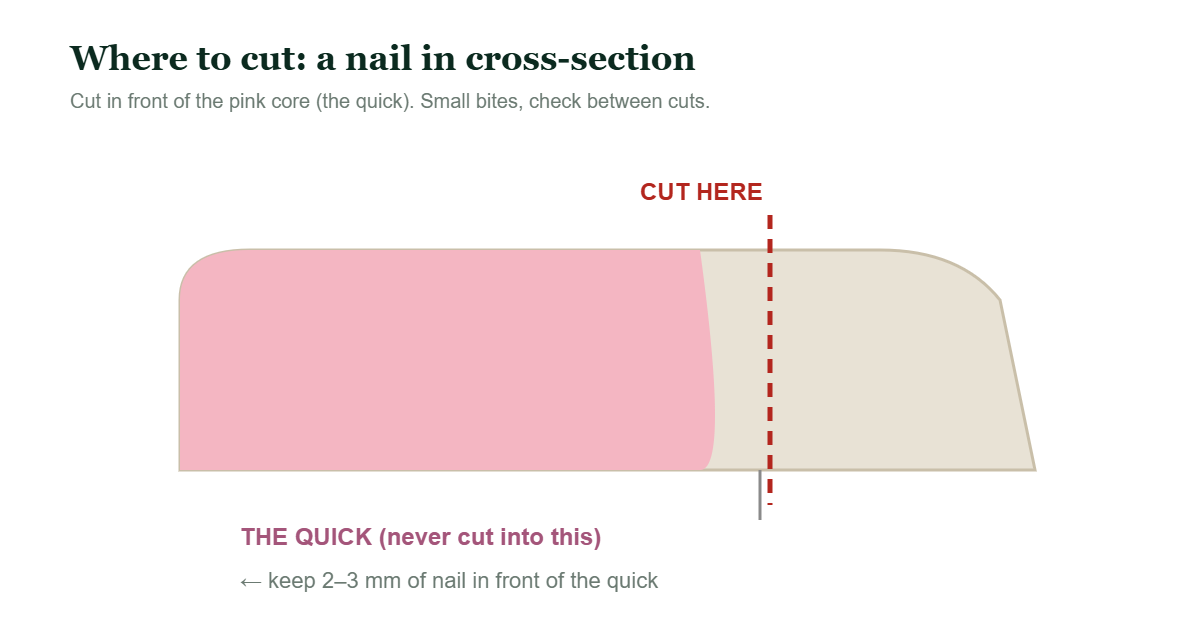
The quick is the live blood and nerve supply that runs inside the nail from the toe outward. On a light-coloured nail you can simply see it as a pink core with a darker tip in front of it. On a black nail you cannot, which is why dark-nailed dogs have a reputation for being harder.
You do not have to guess. Hold a small torch against the side or underneath of the nail and look for the point where the nail stops letting light through — that soft transition is roughly where the quick ends. If the nail is completely opaque, cut less than you think you should and check again in two weeks.
Nails grow roughly one to two millimetres a week, and the quick recedes as the nail grows out and is shortened. That is the whole trick: frequent, small trims let the quick retreat, and a receded quick is a nail you can safely cut short. Leave it eight months and the quick has grown back out with the nail, which is exactly why the nails that get trimmed least are the ones that bleed most.
The 10-second decision: how much to take
Work in slivers of one to two millimetres and stop with two to three millimetres of solid nail in front of the quick. Cut straight across, or with a very slight bevel toward the tip. Cutting diagonally down toward the pad creates a thin, weak edge that splits on the next walk.
| What you see | What it means | What to do |
|---|---|---|
| Grey, chalky centre on the cut face | You are still in dead nail | Take one more thin sliver |
| Pink, waxy looking centre | You are close to the quick | Stop for this session |
| Dark spot or pinprick of blood | You are at the quick | Stop, apply pressure |
| Nail clicks on a hard floor | Overdue | Book a session this week |
| Nail curves into the pad (dewclaw) | Long overdue, painful | Trim in stages or see a vet |
Clipper or grinder?
Both work. The difference is noise and feel, and most dogs will tell you which they tolerate.
| Clipper | Rotary grinder | |
|---|---|---|
| Speed | Seconds per nail | Slower, one nail at a time |
| Noise | Short and mechanical | Continuous whine |
| Risk of bleeding | Can cut past the quick in one bite | Pink dust appears before the quick, easy to stop early |
| Edge quality | Can splinter thick nails | Smoother, rounded edge |
| Best for | Most dogs, nervous dogs, quick sessions | Dogs with thick nails, owners who are unsure about depth |
A six-step routine that costs two minutes
1. Do it after a walk, not before. A tired dog argues less.
2. Sit on the floor with the dog, not above it. Standing over a dog reads as pressure and the head turns away.
3. Work one paw per session to begin with. Four short successful sessions teach a dog far more than one long one.
4. Hold the paw with the thumb on the pad and the fingers on top, so a single slip does not pull the leg.
5. Take a sliver, look, then decide. The pause is the skill. Anyone can press a handle; the judgement is knowing when to stop.
6. Reward and finish on a win. Then wipe the blades and store them closed. Nails trimmed on a calm dog are the only ones that stay trimmed.
How often, by dog
| Dog | Typical interval | Note |
|---|---|---|
| Puppy | Every 1–2 weeks, one or two nails | Short, frequent sessions set the habit for life |
| Small breed, indoors | Every 2–3 weeks | Soft floors wear nothing down |
| Medium breed, daily walks | Every 3–4 weeks | Front nails still wear slower than the back |
| Large breed on pavement | Every 4–6 weeks | Check dewclaws regardless |
- Nails are dry — cut after a bath and they are soft and tear
- Blades are sharp; a dull clipper crushes and splinters
- Torch to hand for dark nails
- Styptic powder within reach, not upstairs
- Two or three treats already in your pocket
What to avoid
Do not cut a nail you cannot see the end of, in one confident bite. Do not trim nails right after a bath while they are soft. Do not hold a paw high off the ground and pull. Do not use household scissors or wire cutters — they crush the nail instead of cutting it, which hurts and splinters. And do not skip the dewclaws because they never touch the floor; that is precisely why they need doing.
Frequently asked questions
My dog has black nails and I cannot see the quick. What do I do?
Cut thinner slivers than you would on a light nail and look at the cut face after every one. The centre changes from chalky grey to a waxy pink as you approach the quick, and that change is your stop signal. A torch held against the side of the nail also shows where light stops passing through.
How much nail should be left in front of the quick?
Two to three millimetres is a comfortable margin. Half a centimetre is unnecessary and leaves the nail able to click; none at all is how you get blood.
My dog screams before I even cut. Is something wrong?
Usually it is memory rather than pain — a previous session that bled or that involved being restrained. Go back to handling the paws with no clippers in sight for a week, then trim a single nail and stop. Pairing the clippers with a treat before anything happens is what breaks the association.
Can I use human nail clippers?
No. Human clippers are designed for a flat nail and a different angle, so they crush and split a dog nail rather than cutting it cleanly. Pet clippers are shaped to enclose a rounded nail.
How do I know if I am doing it often enough?
Walk your dog across a hard floor and listen. Silence means you are on schedule; clicking means it is time; and a dog that stands with its toes lifted off the ground needs a vet look rather than another trim.
Gear referenced in this guide
These are the two clippers in our own range that suit this job. Neither is required — a sharp clipper and a styptic pencil from any brand will do the same work.
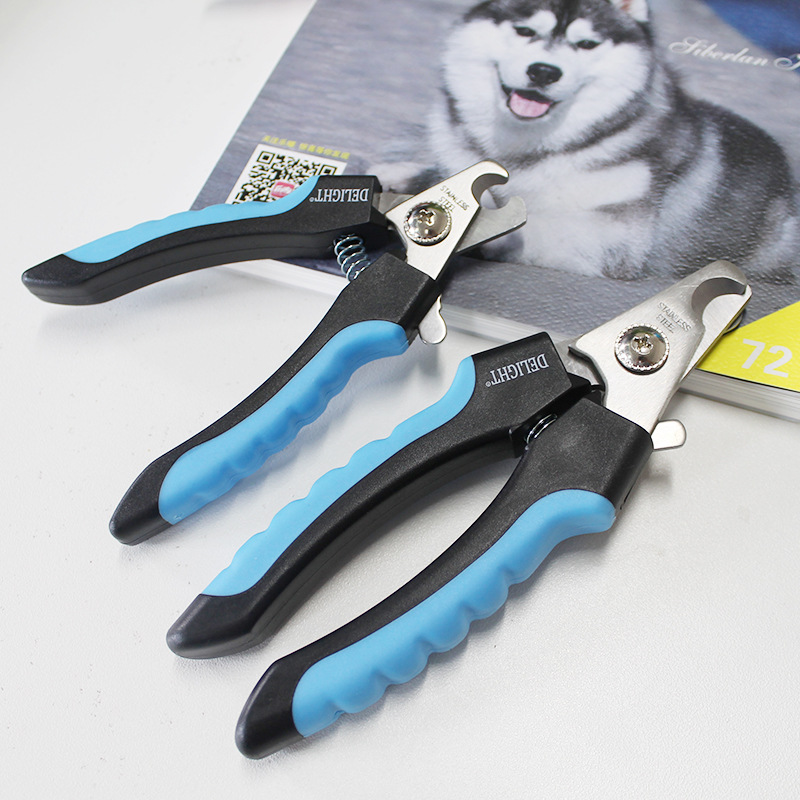 Stainless Steel Pet Nail Clipper for Dogs and Cats$58.99View product
 Panda Pet Nail Clipper with Hair-Catch Comb$53.99View product
Written for ai-shoppers.com. Sizes, intervals and growth rates above are typical values for adult dogs; individual animals vary, and a vet or groomer is the right call if a nail has grown into the pad.
Compare on Amazon — this category usually has more brands, sizes and price points there.
Check current prices on Amazon →
As an Amazon Associate we earn from qualifying purchases. The price you pay is unchanged. Disclosure