A kitchen knife is one of the most globally assembled objects in your house. The steel may be rolled in Sweden or Japan, the blade blanked and hardened in one country, the handle fitted in another, and the box printed somewhere else entirely. Four places do most of that work – and knowing which one you are actually paying for explains almost every price difference on the shelf.
The four places that matter
Yangjiang, in Guangdong, China is commonly described as the country’s cutlery capital and one of the largest knife-producing clusters in the world, with thousands of related businesses ranging from steel traders to handle-makers to exporters. Its strength is volume and range: it will produce a usable stamped knife, a forged knife, and everything in between, to whatever specification a buyer pays for.
Seki City, in Gifu, Japan has a blade-making history that goes back roughly eight centuries to swordsmithing, and it remains the recognised centre for Japanese kitchen cutlery. Its reputation rests on heat treatment and hand finishing rather than on scale.
Solingen, Germany is the classic European cutlery town, and its name carries a protected designation in Europe – a product sold as Solingen steel has to meet origin rules, which is why the word is guarded so carefully on packaging.
Thiers, France plays the same role for French cutlery, with a long history of small workshops producing both mass-market and high-end blades.
What each place is actually good at
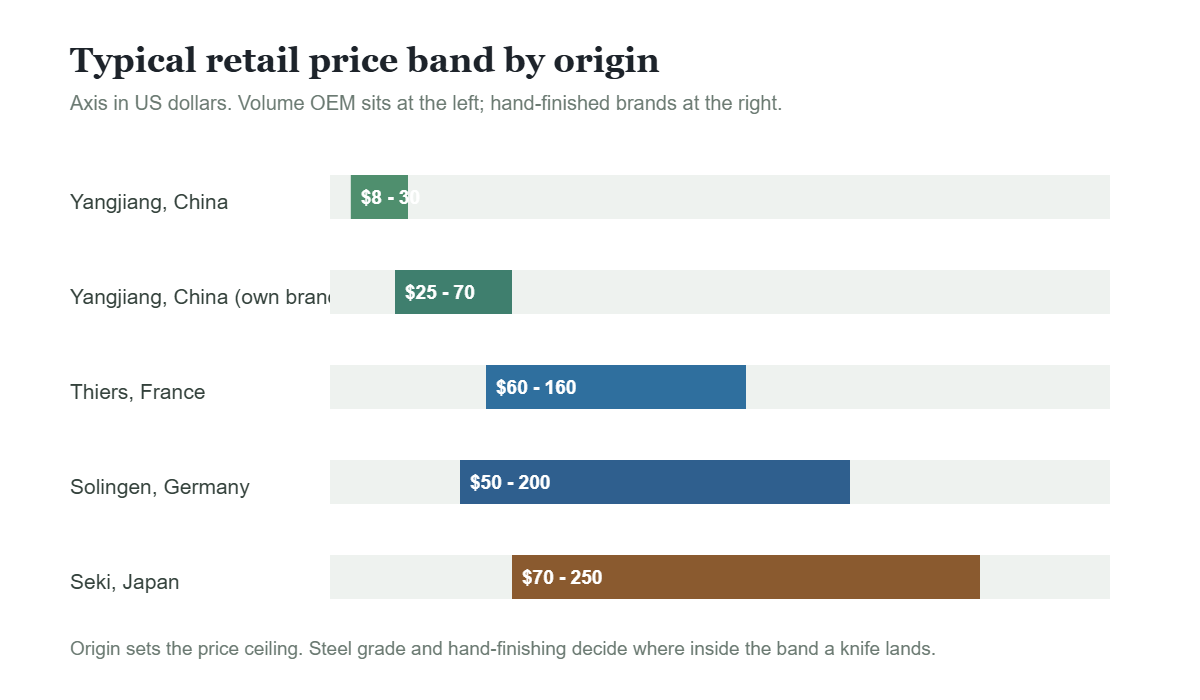
| Origin | Known for | Typical steel | Typical retail band |
|---|---|---|---|
| Yangjiang, China | Volume, range, OEM for Western brands | 3Cr13 to 5Cr15MoV, 440C copies | $8-30; own brands $25-70 |
| Seki, Japan | Heat treatment, thin edges, hand finishing | VG-10, AUS-10, carbon steels | $70-250 |
| Solingen, Germany | Consistency, tough geometry, brand protection | X50CrMoV15 and similar | $50-200 |
| Thiers, France | Workshop production, regional styles | Sandvik grades, carbon steels | $60-160 |
Steel is the part that crosses borders
Very few knife towns make their own steel. The alloy almost always arrives from a specialist mill, and the mill name is often a better guide to what you are buying than the country on the handle.
| Grade | Where it usually comes from | Character |
|---|---|---|
| VG-10 | Japan (Takefu area) | Hard, takes a keen edge; common in Seki knives |
| AUS-10 | Japan | Around 1% carbon; good edge retention at a lower price |
| 12C27 / 14C28N | Sweden (Sandvik) | Very fine-grained, tough, easy to sharpen; favoured in France and the Nordics |
| X50CrMoV15 | Germany | Tough and corrosion-resistant; the classic Solingen-style alloy |
| 440C | United States (and copies worldwide) | High carbon, high chromium; widely copied, quality varies enormously |
How a forged blade is actually made
The steps matter because they explain the price. A forged blade is heated and shaped, then goes through a hardening cycle – typically around 1,050-1,080 C – followed by tempering at roughly 180-200 C to trade a little hardness for toughness. Get that wrong by 20 degrees and the same steel becomes either chippy or soft.
After heat treatment the blade is ground, usually by hand on a water-cooled wheel to avoid overheating the edge, then polished. Hand grinding is where the visible difference between a $15 knife and a $150 knife first appears, because it is the step that cannot be automated without losing the geometry. Handles are fitted next, then the knife is sharpened and checked. A production knife may spend minutes in grinding; a hand-finished one can take the better part of an hour per blade.
Reading “made in” honestly
The phrase hides more than it reveals. A knife can be forged, hardened and ground in one country and merely assembled or boxed in another; “designed in Germany” and “made in Germany” are legally different claims, and only the second one carries the origin rules with it. The pattern-welded blades sold as Damascus add a further wrinkle: the layer count describes how the outer billet was folded, while the cutting performance comes from the core steel – so a listing that names 73 layers but never names the core alloy is selling you the pattern, not the edge.
The six things worth checking on any listing
- Steel named? VG-10, AUS-10, 14C28N, X50CrMoV15 – or just “stainless”?
- Hardness range? An HRC band tells you more than any photo.
- Core steel, if pattern-welded? Layer counts alone say nothing about the edge.
- Grinding described? Hand-ground versus machine-ground is the real cost line.
- Blade thickness and spine? 2 mm and 3 mm behave very differently in the hand.
- Origin wording exact? “Made in”, “forged in” or “designed in” mean different things.
Frequently asked questions
Does a Chinese-made knife mean a bad knife?
No. The same Yangjiang workshops supply both cheap supermarket knives and reputable Western brands to that brand’s specification. The specification, not the postcode, decides the quality.
Is Solingen steel better than Japanese steel?
They aim at different things. German-style alloys tend to be tougher and easier to maintain; Japanese steels are usually harder and take a keener edge but are less forgiving. Neither is universally better.
Why do Japanese knives cost so much?
Labour and rejection rates. Thin geometry and hand grinding take time, and a blade that fails the final check cannot be sold. You are buying the hours, not the raw steel.
What is the difference between Damascus and normal steel?
Damascus describes a pattern-welded construction – layers folded to create the visible pattern after etching. Many such blades are a hard core clad in softer layers, so the core alloy is the performance question.
How do I compare two knives in a shop?
Check the named alloy and the HRC range first, then the spine thickness and the edge angle. If a listing gives none of those, its price is being set by styling rather than specification.
Gear referenced in this guide
Two knives from our own range that map onto the sections above – one pattern-welded with a named core steel, one hand-forged everyday chopper. Neither is required to cook well.
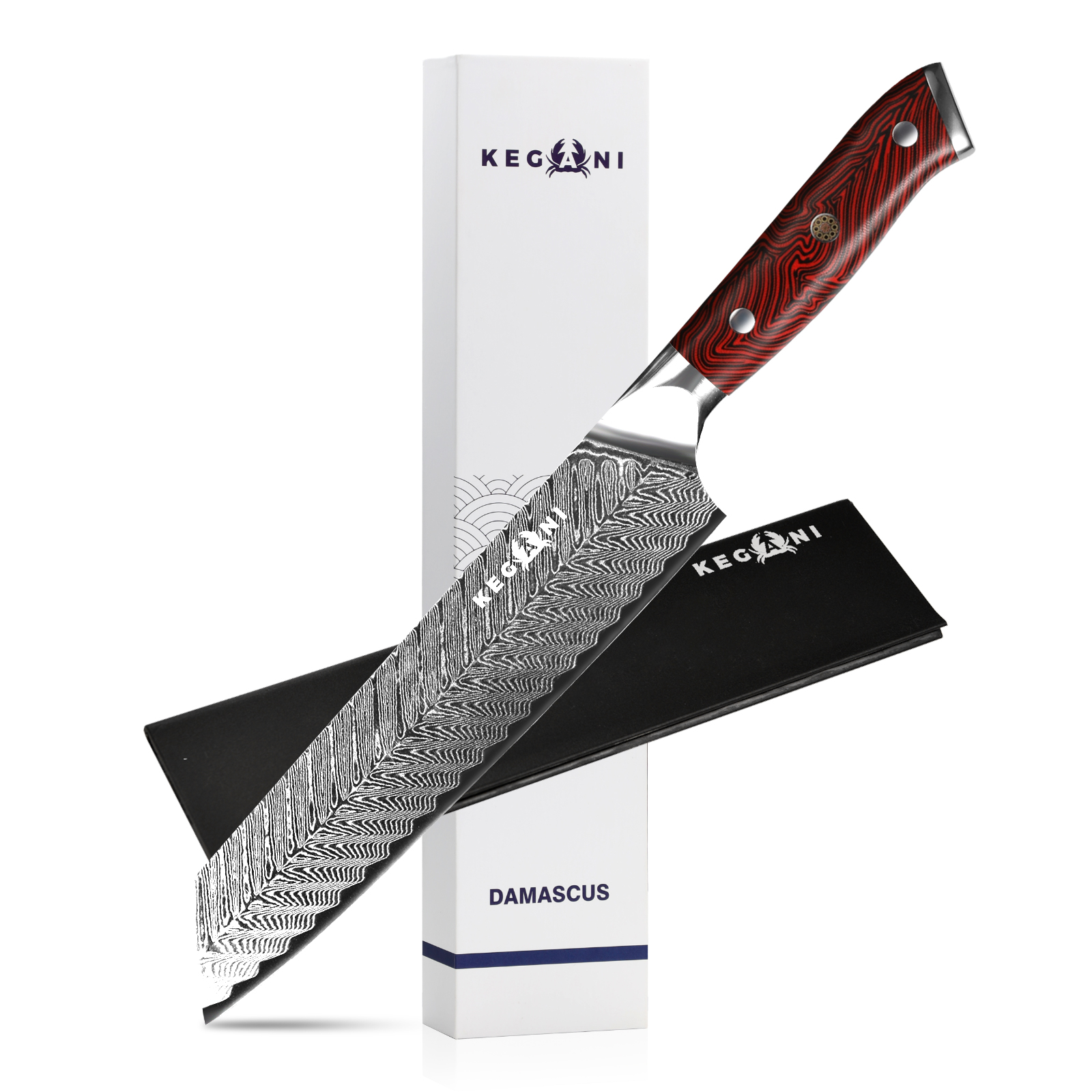 7 Inch Damascus Meat Cleaver, 73 Layers AUS-10 Steel Butcher Knife$102.99View product
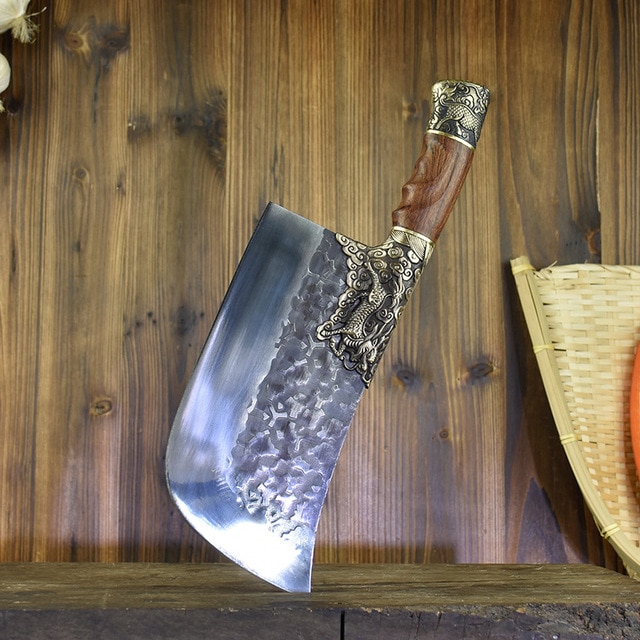 Hand-forged Bone Chopping Kitchen Knife, Dual-use Chef Knife$20.99View product
Written for ai-shoppers.com. Production figures, price bands, steel origins and heat-treatment temperatures above are typical, widely quoted ranges for orientation rather than specifications of any single product; the exact listing for an item is always the authority.
Compare on Amazon — this category usually has more brands, sizes and price points there.
Check current prices on Amazon →
As an Amazon Associate we earn from qualifying purchases. The price you pay is unchanged. Disclosure