Four campers, four countries, four entirely different ways of making dinner. The differences are not about budget. They follow from what is sold in a shop, what the local camping ground provides, and what a country grew up cooking on indoors. Here is what each tradition actually does, and what each one gets right.
Japan: the cassette stove and the convenience store
Japanese car camping is built around a small flat gas cassette stove – a cheap, quiet single burner that clips under a slim canister. It is what most households already own for tabletop cooking, so taking it camping requires no purchase and no learning curve.
The food side is equally distinctive: Japanese campers lean heavily on prepared food from supermarkets and convenience stores, cooked or heated rather than built from raw ingredients. The result is a very light kitchen – one burner, one small pot, one kettle, and almost nothing to wash. It is also ruthlessly tidy: the pack-out-everything norm is strongest here, and leaving no trace is the default rather than a virtue.
The US: two burners, cast iron and the fire ring
North American car camping spreads out. Because the vehicle is parked next to the pitch, weight stops mattering, and the kit grows: a two-burner propane stove, a percolator, a dutch oven, a folding table and a cooler that weighs more than the tent.
The campfire is part of the menu rather than decoration. In many campgrounds the fire ring is the centre of the site, and cooking over coals – foil packets, corn, marshmallows – is a tradition in its own right. That pattern also shapes the gear: heavier pans, long-handled tools and heat gloves sell here in a way they never do in Japan.
Scandinavia: the alcohol burner and the boiled coffee
Sweden gave the world the Trangia-style alcohol stove: a simple brass burner in a windproof stand, with a pot that nests into the same unit. It is slow, silent and almost unbreakable, and it is the default across much of Scandinavia.
The culture around it matters as much as the hardware. Coffee is boiled directly in the pot rather than filtered, and the whole ritual – fire, kettle, quiet – is the point. Cooking is treated as part of being outdoors, not as an interruption to it.
Britain and Ireland: the brew kit and the gas canister
British camping compresses everything around one question: how fast can you get a hot drink going in bad weather? That favours screw-on gas canister stoves and a small kettle, with the rest of the meal assembled from bread, cheese and a frying pan.
Wind is the constant enemy, which is why folding windscreens are treated as essential equipment here rather than an accessory, and why sheltered picnic-table cooking is so common.
How long each fuel actually takes
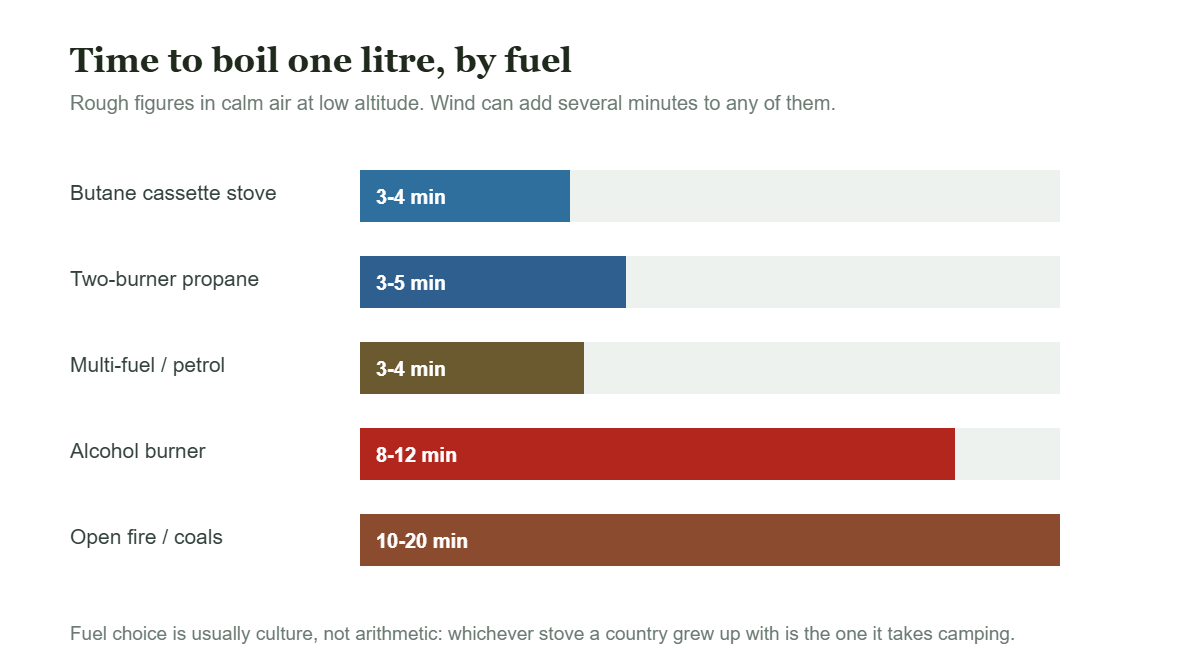
| Fuel | Time to boil 1 L | Character |
|---|---|---|
| Butane cassette stove | 3-4 min | Quiet, cheap, hard to use below about 5 C |
| Two-burner propane | 3-5 min | Car camping only; heavy cylinder |
| Alcohol burner | 8-12 min | Silent, near-indestructible, slow in cold |
| Multi-fuel / petrol | 3-4 min | Works in deep cold; more maintenance and smell |
| Open fire | 10-20 min | Not controllable; best treated as an oven |
What each tradition gets right
The Japanese approach wins on simplicity: fewer items, less washing, more time sitting down. The North American approach wins on range – you can genuinely roast, bake and fry for a group. The Scandinavian approach wins on durability and calm; nothing on a Trangia breaks, and nothing about it hurries you. The British approach wins on pragmatism in bad weather.
The useful move is to borrow deliberately rather than pack for every tradition at once. A gas burner for speed plus one cast-iron pan for the fire covers almost everything a weekend needs, and it weighs less than either tradition’s full kit.
- One burner, one pot, one pan – not three of each
- A windscreen, if the burner does not have one built in
- Fuel bought at the destination, not carried abroad
- One wet bag for dishes and one dry bag for the clean ones
- A plan for leftovers that does not involve a cooler
What the fuel actually costs per trip
The fuel is where traditions diverge most in running cost. A 230 g isobutane canister costs about $6-9 and will boil somewhere in the region of 12-15 litres of water in calm conditions – roughly a full weekend of cooking for two people. A one-pound propane cylinder costs $5-8 and runs a 10,000 BTU burner for about an hour and a half to two hours, which is why two-burner car kits rarely finish a cylinder in a weekend.
An alcohol burner is the cheapest per boil – around 100 ml of fuel per litre of water, with a litre of spirit costing a few dollars – but it is the slowest, so it costs you time instead of money. Firewood sits in between: free where collecting dead wood is allowed, and around $6-10 per bundle where it is sold at the gate.
| Fuel | Typical cost | What that buys |
|---|---|---|
| 230 g isobutane canister | $6-9 | About 12-15 L boiled, or a two-person weekend |
| 1 lb propane cylinder | $5-8 | Roughly 1.5-2 hours on a 10,000 BTU burner |
| Alcohol (spirit) | A few dollars per litre | About 100 ml per litre boiled; slowest option |
| Firewood | Free to $6-10 a bundle | Uncontrollable heat; best treated as an oven |
The practical conclusion is that fuel cost is rarely the deciding factor. Time, availability and the weather decide far more than the price per litre boiled.
Frequently asked questions
Which stove should a beginner buy?
A screw-on gas canister stove with a built-in pot support. It is the easiest to control, widely available, and the fuel is sold in most outdoor shops.
Is an alcohol stove slower in cold weather?
Yes, noticeably, and it takes longer to reach a boil overall. Its advantage is silence and reliability rather than speed.
Why do US kits weigh so much?
Because they can. Car camping puts the vehicle beside the pitch, so the weight penalty of a two-burner stove and cast iron is not paid in sweat.
Can I cook on a campfire instead of carrying a stove?
Where fires are permitted, yes – but it takes longer, is harder to control, and depends on dry wood. Treat it as an oven rather than a hob.
What is the single most useful extra?
A windscreen. It is cheap, weighs almost nothing, and it is the difference between a quick meal and a long wait in every tradition above.
Can I take a camping stove on a plane?
An unused, fully purged stove usually can be packed; a canister that has ever held fuel generally cannot, and neither can most liquid-fuel bottles. Buying fuel at the destination avoids the whole question.
Does altitude change boiling time?
Yes. Water boils below 100 C as you gain height, so a kettle comes to the boil sooner – but food cooks more slowly, which is why high-altitude cooking feels misleading.
Gear referenced in this guide
Three travelling items from our own range that suit this kind of kit. None of them is required to cook outside.
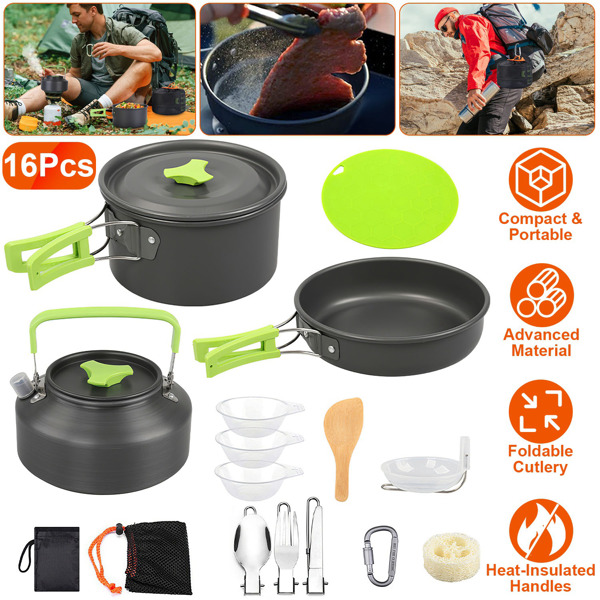 16 Piece Camping Cookware Set, Outdoor Cooking Kit$93.99View product
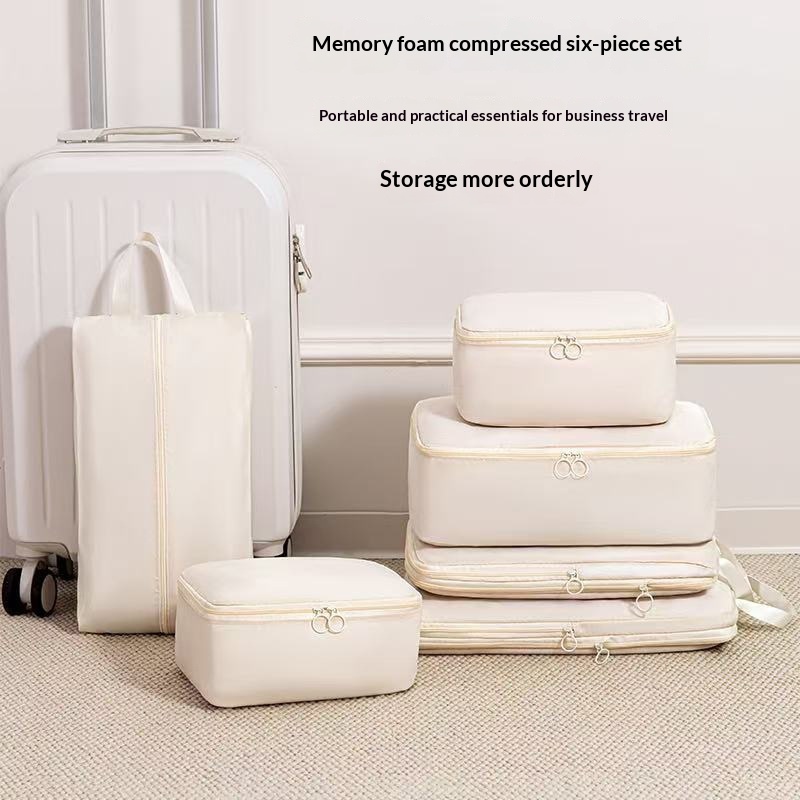 Compressible Travel Storage Bags Set (6-Piece)$44.99View product
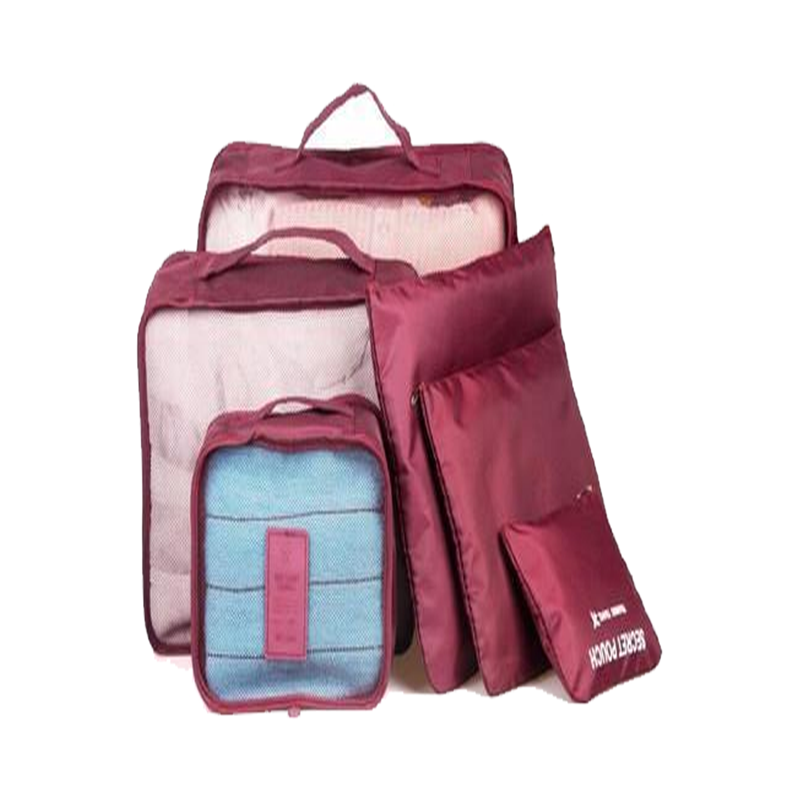 Portable Travel Luggage Packing Cubes Organizer Set (6 Pieces)$33.99View product
Written for ai-shoppers.com. Boil times and stove characteristics above are typical figures for orientation rather than specifications of any product; altitude, wind and temperature move all of them.
Compare on Amazon — this category usually has more brands, sizes and price points there.
Check current prices on Amazon →
As an Amazon Associate we earn from qualifying purchases. The price you pay is unchanged. Disclosure