Bathroom storage gets sold on looks: bamboo, matte black, ribbed glass, brushed brass. None of that tells you whether the thing will hold a litre of shampoo at shoulder height without pulling the tiles off the wall. This piece is the other half – the numbers that decide whether a shelf gets used every day or becomes the place where half-empty bottles go to die. Everything below is either a dimension you can check with a tape measure or a physical fact you can check with a kitchen jug.
1. A corner is a triangle, not a shelf
Trace a corner along both walls and you get 90 degrees and a triangle in between. With 40 cm of clear wall on each side – a common amount beside a basin – that triangle encloses roughly 0.08 square metres of floor. Two corners give you 0.16. A single 60 by 30 cm shelf gives 0.18, so a pair of corners is worth about one shelf, except the corners already exist and cost nothing.
The catch is shape. A fixed box pushed into a corner has a back corner you cannot reach, and the deeper the unit the bigger that dead zone: at 30 cm deep the last 8-10 cm is storage you can see and not touch. That is the honest argument for a rotating corner unit – it turns the unreachable back into the front of the shelf for the two seconds you need it, then gets out of the way of the shower door.
2. The only height band that matters is 90-150 cm
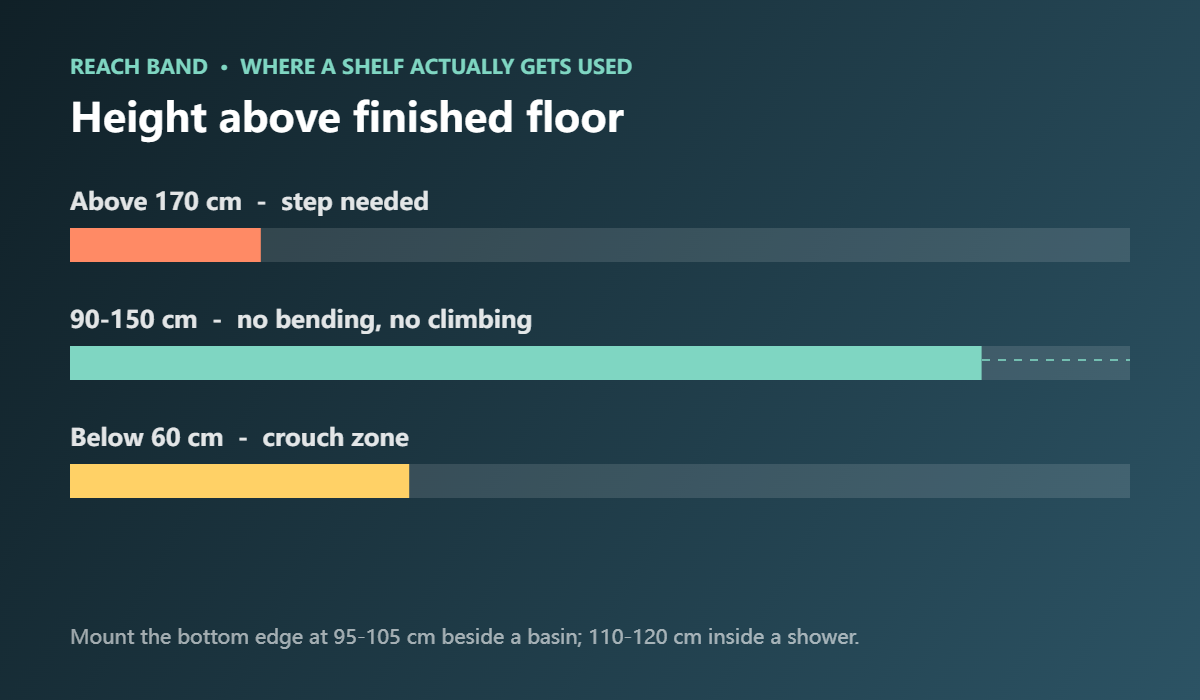
Between roughly 90 cm and 150 cm above the finished floor, a shelf sits in the band most adults reach without bending or climbing. Above 170 cm you need a step for anything at the back; below 60 cm you are crouching, and crouching shelves fill with things nobody uses. This is why wall-mounted storage beats a floor caddy more often than people expect: on the wall you choose the height, and on the floor you inherit whatever height the designer picked.
Two placement rules follow. Beside a basin, mount the bottom edge of the unit at 95-105 cm so the top tier lands inside the comfortable band. Inside a shower, mount it at 110-120 cm, which keeps the lower bottles clear of the spray pattern at hip height while staying reachable with a wet hand.
3. Swinging beats reaching: 20-30 cm
A fixed corner shelf gives you whatever your arm can reach around. A rotating one adds the distance it travels: typically 20-30 cm at the outer edge. That does not sound like much until you are standing in a 75 cm wide shower with a bottle in one hand and a wet floor underfoot. The number to check before buying is swing clearance – the unit needs that 20-30 cm clear of the shower door, the towel rail and your elbow, or it becomes a fixed shelf that also rattles.
4. Water is the heaviest thing you store
Storage is judged by what it holds when full, not when empty. A one-litre shampoo bottle weighs about 1.05 kg. Five of them, plus conditioner, body wash and a razor, is a 6-8 kg load on a shelf that might be fixed with two screws or a strip of adhesive. Adhesive plates on smooth tiles typically hold 3-5 kg when new, and less once the tile is damp or the surface is textured. So the rule is blunt: under 5 kg adhesive can be fine; over 5 kg, use screws and plugs into something solid.
On a rotating unit, keep the heavy bottles at the wall end. The outer edge is a lever arm, and every extra 10 cm from the pivot multiplies the pull on the mount – which is exactly where cheap fixings fail first.
5. Spray reaches 1.2 m, so drainage beats material
A shower head at two metres throws water in a cone that wets a band roughly 1.0-1.3 m up the opposite wall. Anything mounted inside that band gets soaked every time somebody showers, which is why drainage matters more than the label on the box. A caddy with open wire or slot drainage dries in minutes. A flat tray holds a 2-3 mm film of water around the bottle bases, and that film is what becomes the pink-orange biofilm people blame on hard water. Tip the tray out weekly, or buy the version with holes in the bottom.
6. Humidity: 70-90%, then a 20-40 minute cooldown
During a shower, bathroom humidity climbs into the 70-90% relative humidity range; with an extractor fan running it falls back towards the rest of the house in roughly 20-40 minutes. Two practical consequences. First, plastic and powder-coated steel shrug this off, uncoated mild steel does not, and 304 stainless survives where 201-grade stainless starts to spot. Second, never seal a damp caddy flat against the wall: a few millimetres of air gap behind the unit is the difference between a dry wall and a black line of mould six months later.
7. What goes where
| Item | Where it belongs | Number that matters |
|---|---|---|
| Shampoo, conditioner | Lowest tier, wall side | 1 L is about 1.05 kg |
| Body wash, shower gel | Lowest tier | Keep total under 5 kg if adhesive-mounted |
| Razor, sponge, loofah | Open wire basket | Dries in minutes, not hours |
| Face wash, serum | 95-105 cm beside the basin | Inside the 90-150 cm band |
| Cotton buds, floss | Top tier or a drawer | Small items need a lip or a lid |
| Cleaning spray | Below 60 cm or a closed cabinet | Out of the splash band |
8. Store by frequency, not by bottle size
Most people store by bottle size: the big ones go where they fit. That is backwards. Store by how often you touch the thing. The two items you use every day go at 90-110 cm on the side you reach with your dominant hand; weekly items go higher or lower; the bulk refills go under the basin and stay there.
Then decant. A one-litre bottle refilled into a 250 ml pump is 0.75 kg lighter, fits a narrower shelf, and removes the reason people mount shelves too deep in the first place. The litre lives in the cupboard and gets poured once a month, which also means the expensive bottle is not the one getting soaked by the shower.
9. A five-minute audit before you buy anything
- Measure both walls of the corner from the corner itself. Under 35 cm on either side, a corner unit will not sit flush.
- Mark 90 cm and 150 cm on the wall with tape. Whatever you mount should sit inside that band.
- Add up the full bottles you intend to keep there. If the total passes 5 kg, plan for screws.
- Check the swing: 20-30 cm of clear travel in front of a rotating unit.
- Look for a dark line where the old shelf met the wall. That is a ventilation problem, not a cleaning problem, and it will come back.
10. What the numbers do not fix
Two things resist arithmetic. The first is a bathroom with no extractor fan: no caddy survives that indefinitely, and a 20-40 minute cooldown turns into three hours with the door shut. The second is a household where nobody empties the tray. Storage that requires a ritual fails; storage that drains by itself gets used for a decade. Buy the boring, ventilated version – it is the only upgrade that keeps paying.
Frequently asked questions
Does a rotating corner unit hold as much as a fixed shelf?
Same footprint, less dead space. The gain is access rather than volume: you can actually reach the back 8-10 cm that a fixed box hides, and you can load it without kneeling inside the shower.
Can I mount a shower caddy without drilling?
Yes, if the load stays under about 5 kg and the tiles are smooth, clean and dry. Adhesive plates are rated 3-5 kg when new and lose grip on textured or damp surfaces, so anything holding full litre bottles should be screwed.
Why does my caddy turn pink or orange?
That is biofilm growing in standing water, not a stain from hard water. Flat trays hold a 2-3 mm film around the bottle bases; a slotted or wire basket that drains, rinsed weekly, does not.
What height should a shower shelf be?
Mount the bottom edge at 110-120 cm. That keeps the lower tier out of the 1.0-1.3 m splash band while staying reachable with a wet hand, and it stays inside the 90-150 cm comfortable reach band.
How do I stop mould appearing behind the shelf?
Leave a few millimetres of air gap behind the unit, run the extractor for the full 20-40 minute cooldown, and do not push a damp caddy flat against the tiles. Mould behind a shelf is a ventilation problem first.
Honest disclosure: measurements and weights here are practical rules of thumb, not manufacturer specifications. Check the published dimensions of any unit against your own wall before ordering.
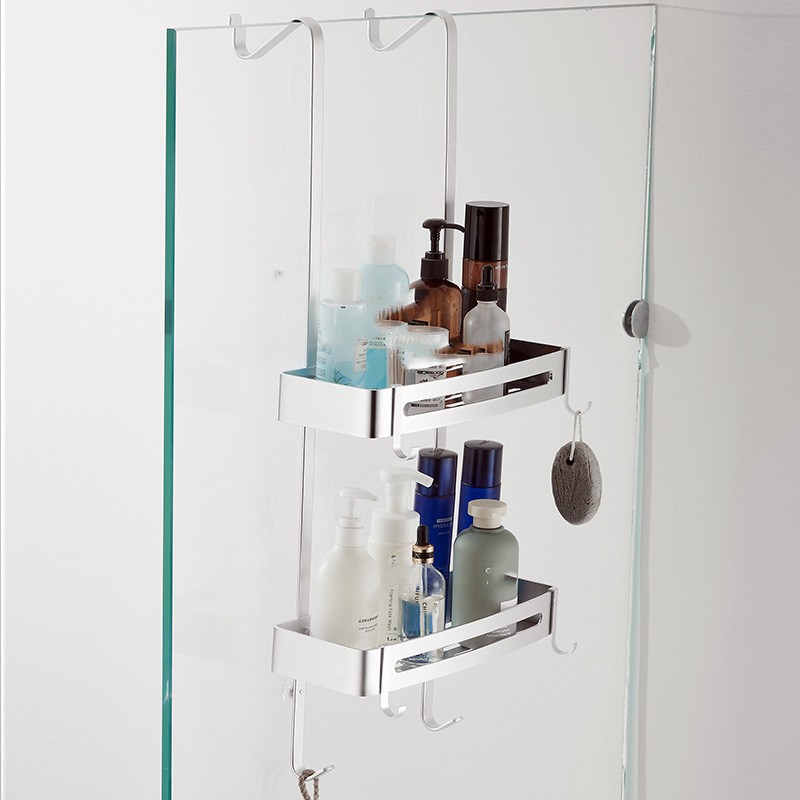
Aluminium Hanging Shower Caddy, Double Basket
Hangs over the screen, drains through, holds the daily bottles at 110 cm instead of on the shower floor.
$63.99
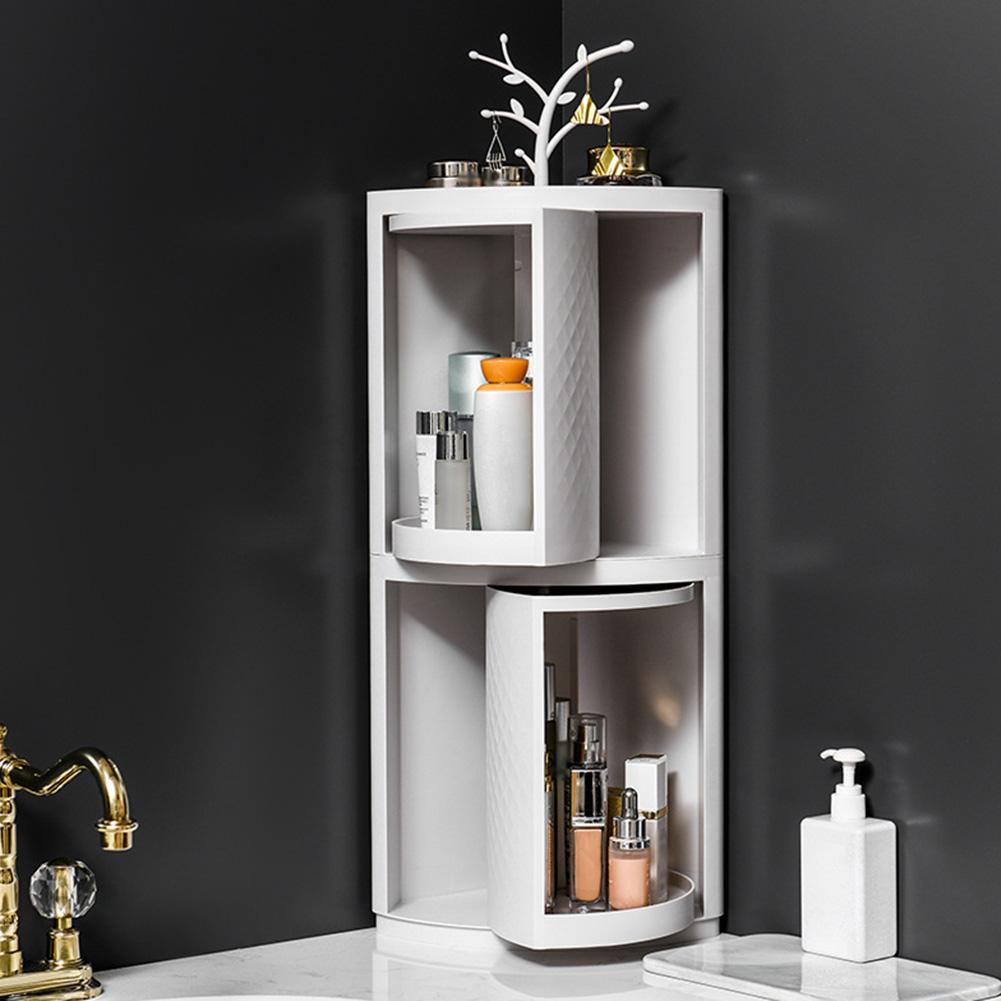
Rotatable Corner Bathroom Organizer, Wall-Mounted
Uses the dead triangle in the corner and swings 20-30 cm out so the back of the shelf is reachable.
$54.99
Compare on Amazon — this category usually has more brands, sizes and price points there.
Check current prices on Amazon →
As an Amazon Associate we earn from qualifying purchases. The price you pay is unchanged. Disclosure