When you compare two home goods online, the visible numbers are price, dimensions and maybe a colour. The number that decides whether the seller can offer that price at all is usually hidden: shipping weight. It is the reason a plastic corner organizer and a bamboo drawer box can look like the same class of product while one costs three times as much to move. This piece takes four real listings, weighs them, and shows where the money actually goes.
1. Two numbers, not one
Every parcel is charged on the greater of two values: its actual weight and its volumetric weight. Actual weight is what the scale says. Volumetric (or dimensional) weight is a proxy for how much space the parcel occupies, calculated as length x width x height in centimetres divided by a carrier divisor – commonly 5000 or 6000 for international parcel services.
Take a box measuring 40 x 30 x 25 cm. That is 30,000 cubic centimetres. Divided by 5000, the volumetric weight is 6 kg. If the product inside actually weighs 2.1 kg, the carrier bills 6 kg. The product is not heavy; the box is. This single mechanic explains why flat-pack furniture, nesting bowls and collapsible crates exist, and why a “light” item can still ship in an expensive band.
2. Four items, weighed
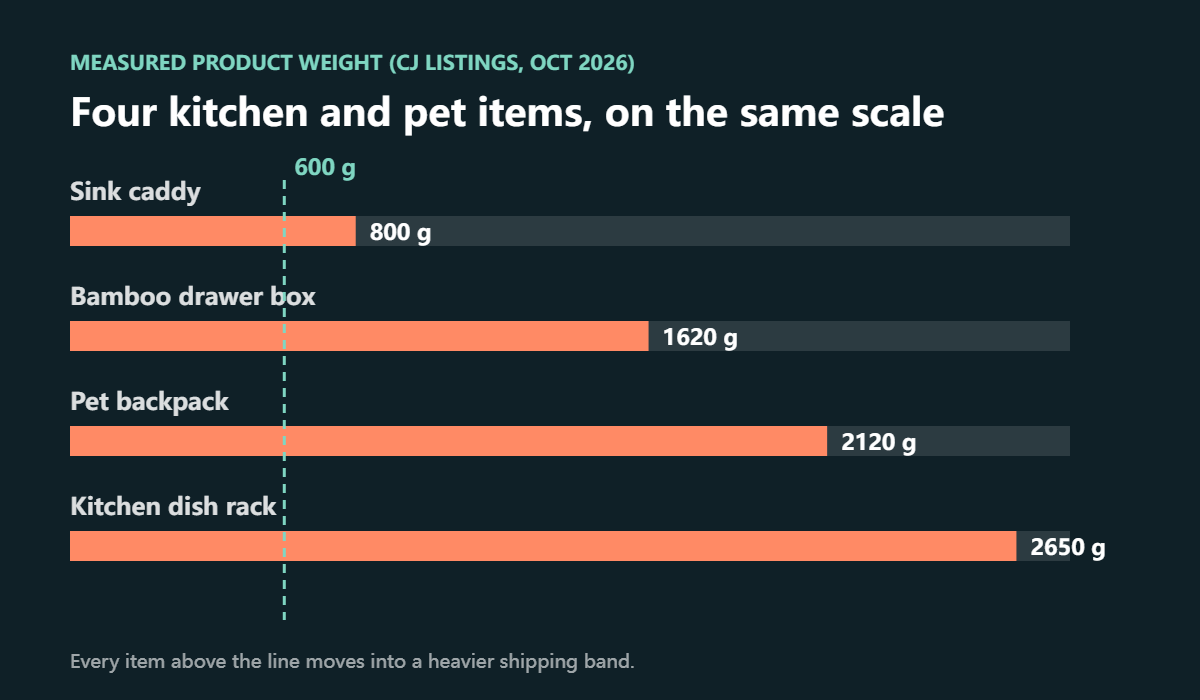
These are published product weights from supplier listings we reviewed in October 2026, all in categories that look comparable on a shelf:
| Item | Material | Product weight | Band |
|---|---|---|---|
| Kitchen sink caddy | Plastic composite | 800 g | Parcel |
| Bamboo drawer organizer | Bamboo wood | 1,620 g | Heavy parcel |
| Foldable pet backpack, 40 L | 600D Oxford cloth | 2,120 g | Heavy parcel |
| Kitchen dish rack | Carbon steel | 2,650 g | Heavy parcel |
Same aisle, same rough purpose, four different shipping economics. The caddy at 800 g sits just above the light-parcel line; the dish rack at 2,650 g is more than three times heavier before the box is even counted.
3. Why 600 g is the line that matters
Most international e-commerce carriers price in bands, and the first meaningful break usually sits around 500-600 g. Below it, a parcel can move as a light packet with simplified handling; above it, it enters the standard parcel stream with sorting, dimensional checks and higher per-kilo rates. The exact cut-off varies by carrier and route, but the shape is consistent: the first 600 g is cheap, and every band above it adds disproportionately.
For a seller, that 600 g line is not a detail. It changes the landed cost by enough to decide whether an item can be advertised at all. A 600 g item and a 2,120 g item can differ by more than the wholesale price of the product itself once international postage is applied.
4. Material is a shipping decision
Compare the same object in three materials. An aluminium shower caddy is hollow, thin-walled and typically under 500 g; the same caddy in coated steel is 700-900 g; in ceramic or stone it can pass 2 kg before packaging. The aluminium version costs more per unit at wholesale and less to ship, which is why it often lands at a similar retail price while feeling like the better product.
Bamboo behaves the same way. A bamboo drawer box at 1,620 g is dense and rigid – good for how it feels, expensive for how it travels. Plastic alternatives at 300-500 g are lighter but need more internal packaging to survive the trip, which adds back some of the savings. There is no free lunch; there is only a choice about where the cost sits.
5. Design tricks that keep weight down
- Flat-pack and nesting. A box that ships assembled ships air. Nesting sets and knock-down frames cut volumetric weight by 40-60% in the same footprint.
- Hollow sections instead of solid. Aluminium tube at 1.2 mm wall carries the same load as a solid bar at a fraction of the mass.
- Textiles over rigid panels. Oxford cloth and mesh fold flat; bonded leather and MDF do not.
- One moulding, many parts. A single plastic mould used for three SKUs reduces packaging volume and lets items nest inside each other.
6. What this means when you are the buyer
You cannot see the seller’s freight invoice, but you can infer a lot from three numbers on the listing page. First, the product weight, if published. Second, the packed dimensions. Third, the delivery window: a 7-15 day window with tracking usually means a consolidated air parcel, while 20-30 days often means a slower lane with tighter weight economics.
Then do the volumetric arithmetic yourself: dimensions in centimetres, multiplied, divided by 5000. If the answer is several times the product weight, you are paying for air. That is not automatically bad – it is how a bulky but light item like a laundry basket reaches you at all – but it explains the price and tells you when a foldable alternative is worth choosing.
7. Five checks before you buy heavy-ish home goods
- Look for a stated weight. No weight and no dimensions is a red flag, not a bargain.
- Multiply the packed dimensions and divide by 5000. Compare that with the stated weight.
- Prefer hollow or flat-pack construction where the load does not need rigidity.
- Check the delivery window: 7-15 days usually means air consolidation; 20-30 days means sea or rail.
- Expect heavier materials – bamboo, steel, ceramic – to carry a price premium that has nothing to do with quality.
Frequently asked questions
What is volumetric weight, in one sentence?
It is the space a parcel takes up, converted into a billable weight by multiplying length x width x height in centimetres and dividing by a carrier divisor – usually 5000 or 6000.
Why does a 2 kg item sometimes cost more to ship than a 5 kg one?
Because the 2 kg item may occupy a much larger box. A light, bulky parcel can bill at 6 kg volumetric while a dense 5 kg parcel in a small box bills at 5 kg actual.
Is 600 g a universal cut-off?
No. It is a common first break point in international light-parcel pricing, but exact bands differ by carrier, route and service level. The principle – the first band is cheap, later bands are not – holds widely.
Do heavier materials always mean better quality?
No. Weight correlates with density, not with durability. A 400 g aluminium caddy can outlast a 900 g coated-steel one that rusts at the welds.
How do I estimate shipping on a listing that hides weight?
Use the packed dimensions, divide by 5000, and compare with the delivery window. If dimensions are missing too, treat the price as provisional and expect a heavier-than-expected parcel.
Honest disclosure: weights quoted here are published supplier figures for specific listings, not averages for a category. Packaging adds to both actual and volumetric weight, and carriers apply their own divisors.
Gear referenced in this guide
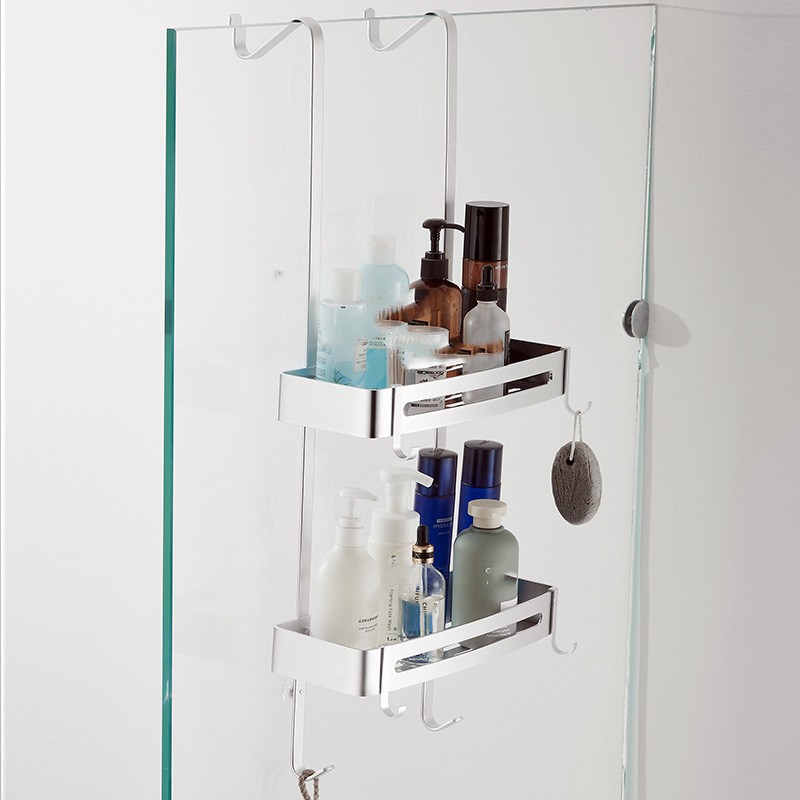
Aluminium Hanging Shower Caddy, Double Basket
Hollow aluminium and a hanging design: light to ship, drains through, no floor tray to clean.
$63.99

Rotatable Corner Bathroom Organizer, Wall-Mounted
Injection-moulded plastic, under 1 kg, and it uses the corner triangle most shelves waste.
$54.99
Compare on Amazon — this category usually has more brands, sizes and price points there.
Check current prices on Amazon →
As an Amazon Associate we earn from qualifying purchases. The price you pay is unchanged. Disclosure