The 12-Box Method: Packing a Kitchen So Nothing Gets Lost

A fixed twelve-box system for packing a kitchen: weight caps, labels and an unpacking order.

Twelve box kitchen packing method
Twelve boxes, numbered, opened in order.

Moving a kitchen is a logistics problem disguised as a chore. Most people pack by cupboard, which means the box marked “kitchen stuff” contains a colander, three bottles of sauce and the only ladle. The 12-box method fixes that by packing by function instead of by furniture – a fixed number of boxes, each with a known job, so unpacking is a sequence rather than an excavation.

1. Why twelve boxes

A typical kitchen holds 40-60 litres of “loose small items” once appliances and furniture are excluded. A 40 x 30 x 25 cm box is 30 litres, so twelve boxes gives you 360 litres of capacity – enough for a two-person kitchen with room for padding, and few enough that you can label and track every one. Anything beyond twelve is usually oversized equipment, which deserves its own category.
Twelve boxes with weight caps
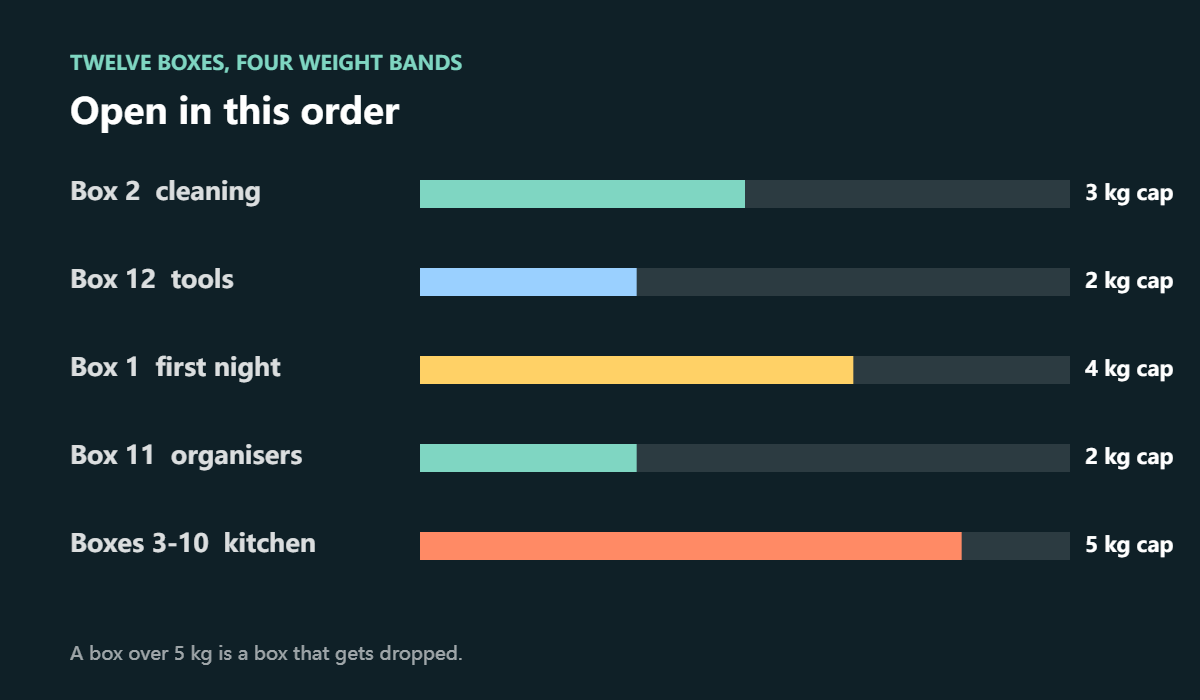
Weight caps per box: the number that keeps a move from becoming an injury.

2. The weight rule that protects your back

Keep every box under 5 kg. A 30-litre box filled with tins and jars reaches 12 kg without warning, and that is how people injure themselves on moving day. Pack heavy items – tins, oil, jars – in the smallest boxes at the bottom of the stack, and reserve the 30-litre size for bulky light things: plastics, tea towels, storage containers.

3. The twelve jobs

Box Contents Opens on Weight cap
1 First-night kit: kettle, mugs, tea, one pan, cutlery for two Night one 4 kg
2 Cleaning supplies, cloths, bin bags Before unpacking 3 kg
3-4 Dry goods, tins, jars (small boxes) Day two 5 kg
5-6 Plates, bowls, glasses, wrapped individually Day two 5 kg
7-8 Cookware, pans, baking trays Day three 5 kg
9 Utensils, knives, small tools Day two 3 kg
10 Small appliances, cables bagged separately Day three 5 kg
11 Drawer organisers and dividers, emptied Day one 2 kg
12 Open-first: scissors, tape, phone charger, marker Immediately 2 kg

4. Label three things, not one

A box that says “kitchen” tells you nothing at 9 p.m. with no dinner. Write three fields on the top and one side: the box number, the room it belongs to, and the day it opens. Numbering matters more than naming – a simple 1-12 sequence lets you find box 7 without reading twelve labels, and it makes the unpacking order explicit.

5. Pack the drawer organisers empty

This is the step people skip, and it costs them an evening. Take the cutlery dividers and drawer inserts out, wipe them, and pack them flat in box 11. A loaded organiser weighs more than the drawer it came from, arrives bent, and has to be emptied anyway. Empty inserts also act as padding between plates.

6. The first-night box is the whole trick

Box 1 is the only one that must be perfect. Kettle, two mugs, tea or coffee, one pan, a knife, two plates, cutlery for two, a tea towel, and a roll of paper towels. If that box is right, the first evening in a new home is normal instead of a takeaway-and-crisis; if it is wrong, you will be opening six boxes to find a fork.

7. Unpacking order, not packing order

Unpack box 2 first (cleaning), then 12 (tools), then 1 (first night), then the drawer organisers in 11 so the kitchen has structure before the contents arrive. Plates and dry goods come next, cookware last. Following the numbers means the kitchen is functional by the end of day two, even if the last two boxes sit unopened for a week.

8. What not to pack

Three things travel outside the boxes: knives (wrapped, in a rigid container), liquids over 500 ml (taped lids, upright, in a crate), and anything glass that would crush under a 5 kg box. Everything else can go in the twelve, provided you resist the urge to make box 7 “a bit fuller”.

9. The tools box deserves its own logic

Box 12 is not a junk box, it is the box that lets you open every other box. Scissors, a marker, packing tape, a screwdriver, a phone charger and a torch all live there, and it travels in the car with you rather than in the van. Because it stays with you, it also solves the most common moving-day failure: the tape is in the van, the van is at the other address, and the boxes cannot be sealed.

Add one thing people forget – a printed or written inventory on the inside of the lid. Twelve lines, one per box, with the number and the day it opens. When a box goes missing, you know which one it is within a minute instead of opening eight of them.

10. Fragile items: separate stack, never on top

Glasses, plates and anything with a lip get their own two boxes, wrapped individually and stacked upright – not laid flat and stacked on each other. A plate laid flat takes the weight of everything above it; a plate standing on edge takes almost none. Fill the gaps with tea towels rather than newspaper, because newspaper leaves ink on anything damp.

Mark those boxes “this side up” on two faces, not one. A single label faces the wall roughly half the time, and the person carrying the box is looking at the other side. And keep the fragile stack under 5 kg as well: the weight cap is not about strength, it is about what happens when a box lands badly.

11. The day-after checklist

Unpack in the numbered order and tick each box off as it empties. When box 3 through 10 are done, the kitchen works: plates, dry goods, cookware, utensils. If a box is still sealed after a week, ask whether its contents earned the space – the twelve-box system is also a quiet filter, because things that stay packed for a month rarely get used again.

Frequently asked questions

How many boxes for a one-person kitchen?

Eight is usually enough: drop one dry-goods box and one cookware box. Keep the first-night kit and the cleaning box regardless.

What size box is best?

40 x 30 x 25 cm (30 litres) for bulky light items, and roughly half that volume for tins and jars so each box stays under 5 kg.

Should I wash everything before packing?

Wipe plates and glassware dry, but do not wash and stack wet – trapped moisture in a sealed box for a week is how you get smells and mould.

How do I stop glasses breaking?

Wrap each one individually, stand them upright rather than stacked, and put them in a box that will not have anything placed on top of it.

What if I run out of boxes?

You are probably packing things you have not used in a year. Set those aside in a “decide later” pile instead of adding a thirteenth box – the fixed number is the method.

Honest disclosure: weights and volumes are practical estimates for household goods, not a packing standard.

Gear referenced in this guide

Bamboo kitchen drawer organizer

Bamboo Kitchen Drawer Organizer Box, 30.5 x 10.2 x 7.6 cm

Packs flat, weighs little, and gives a new kitchen its structure on day one.

$53.99

Rotatable corner bathroom organizer

Rotatable Corner Bathroom Organizer, Wall-Mounted

For the cleaning supplies that open first and never find a home afterwards.

$54.99

Compare on Amazon — this category usually has more brands, sizes and price points there.

Check current prices on Amazon →

As an Amazon Associate we earn from qualifying purchases. The price you pay is unchanged. Disclosure

Structured guide fields (summary, verdict, best for, criteria, pros and cons) appear here once content is added.
0 0 votes
文章评分
Subscribe
Notify of
guest
0 评论
Oldest
Newest Most Voted