“Bands are as good as weights” and “bands are a warm-up toy” are both slogans. The useful answer lives in two numbers: how the load changes through the movement, and the maximum tension a band can actually deliver. Get those two straight and you can pick between them for a specific exercise instead of for a personality.
Number one: the load curve
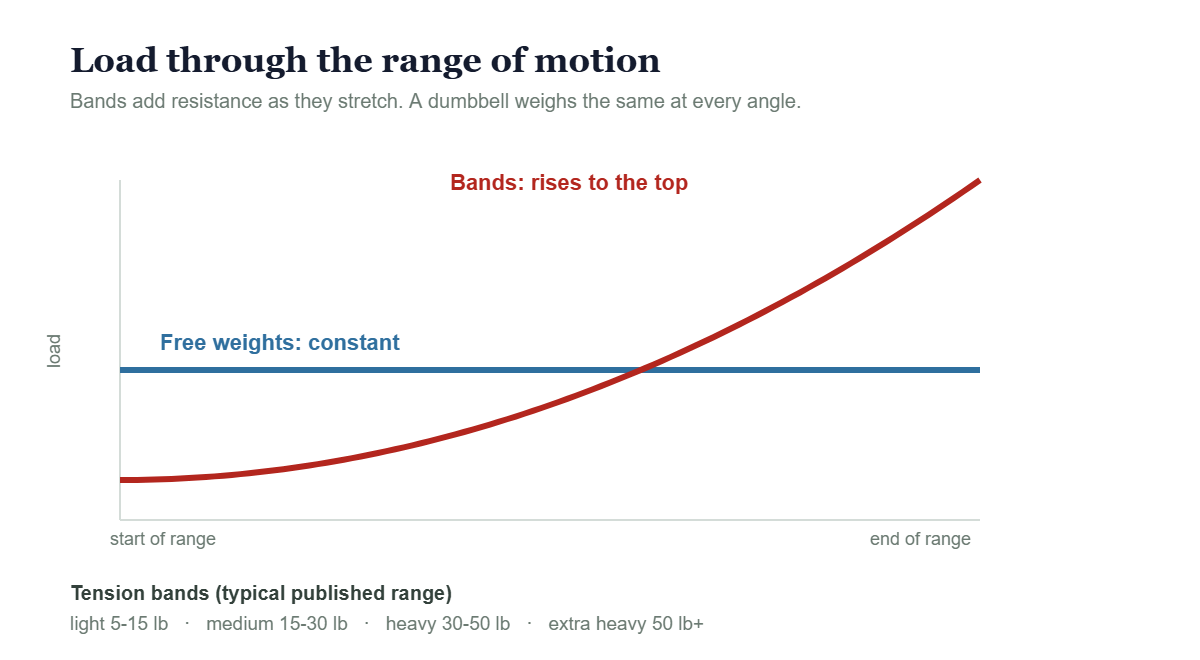
A dumbbell is honest. A 10 kg dumbbell is 10 kg at the bottom of the curl, at the top, and everywhere between. Your muscles are not equally strong through that range, which is why the bottom feels hard and the top feels like nothing.
A band is not like that. Its resistance climbs as it stretches, roughly in proportion to how far it has been pulled, so it is lightest where you are weakest and heaviest where you are strongest. Whether that is a feature or a fault depends entirely on the exercise. For a squat or a press it is a genuinely useful match. For the bottom of a curl it can mean the band does almost nothing.
Number two: how much tension you actually get
Bands are sold by resistance level, and this is where most buyers get lost, because the colour coding is set by the brand, not by any standard. One company’s red is another company’s medium and a third company’s light. What matters is the number printed on the band or the sleeve.
| Band level | Typical published tension | Rough equivalent |
|---|---|---|
| Light | 5-15 lb (2-7 kg) | Small dumbbells; shoulder and rotator work |
| Medium | 15-30 lb (7-14 kg) | A useful single dumbbell for arm and back work |
| Heavy | 30-50 lb (14-23 kg) | Two-handed pulling, hip and leg work |
| Extra heavy | 50 lb+ (23 kg+) | Below the useful load for squats in most cases |
Read the second column carefully. Those figures are usually quoted at a defined stretch — very often at double the resting length. A band rated “30 lb” is not delivering 30 lb when it is loose around your ankles; it delivers that when it has been pulled out to about twice its slack length. Latex loop bands typically start around 208 cm (82 in) in circumference, and most stretch safely to 200-300% of that.
Fabric or latex?
Flat latex bands are cheap, light and take up no room. They also roll up on the leg, pinch skin, and lose tension faster if they are stored in a hot car. Woven fabric bands cost more and are typically two to three times the resistance for the same width — they do not roll, they sit flat against the leg, and they take the abuse of squats and glute work far better.
The practical split: latex for upper body and mobility, fabric for lower body and anything you do with both feet on a band.
The comparison, honestly
| Bands | Free weights | |
|---|---|---|
| Typical cost | $15-60 for a full set | $1-2 per lb; an adjustable set $80-250 |
| Space needed | A doorway or a pole | 1.5 m2 of floor and safe storage |
| Load curve | Rises through the movement | Constant |
| Max useful load | Hard to exceed ~50 lb per band | Effectively unlimited |
| Portability | Fits in a laptop bag | Not portable at any useful weight |
| Durability | Latex ages; check monthly | Decades with plate care |
| Main risk | Snapping under load | Dropping a weight |
Where each one wins
Use bands for anything where the strong point of the movement coincides with the short muscle position: squats, hip thrusts, presses, rows, and the top of a pull-up. Use free weights where you need a measurable, repeatable load: progressive overload in 2.5 kg or 5 lb steps, and anything where you want to know exactly what you lifted.
The measurement point is the practical difference. Adding five pounds to a dumbbell is a number you can write down. Adding tension to a band means either stretching it further, which changes the exercise, or picking a different band, which is a jump of fifteen pounds or more.
How to programme either tool
Rep ranges are where the two tools finally behave the same way. Both build strength with heavy loads and few repetitions, and both build endurance with light loads and many repetitions; the difference is in the increments you can move between sessions.
| Goal | Reps per set | Which tool suits it |
|---|---|---|
| Strength | 3-6 heavy | Free weights, because you can add 2.5-5 lb |
| Muscle size | 8-12 moderate | Both work; weights are easier to progress |
| Endurance | 15-25 light | Bands, because the load is self-limiting |
| Rehab and mobility | 10-20 very light | Bands, because the load starts near zero |
If you are training at home with limited space, the honest recommendation is not one or the other. Buy a set of fabric bands for lower body and pulling work, and a pair of adjustable dumbbells for pressing and arm work. That combination covers every rep range above for well under what a single decent barbell and plates would cost, and it fits in a cupboard.
- Check the whole band each session — nicks first, then stretch marks that no longer spring back
- Replace latex bands roughly every 6-12 months under regular use
- Store them out of sunlight and out of a hot car; UV and heat age latex fast
- Anchor below chest height and to something that will not move
- Do not shorten a band by knotting it to increase tension — that concentrates stress at one point
Frequently asked questions
Can bands replace weights entirely?
For light-to-moderate training and mobility work, yes. Once you need loads beyond roughly 50 lb per band, or you need precise progression in small increments, free weights are the simpler tool.
How do I know which colour to buy?
Ignore the colour and read the printed tension in pounds or kilograms. Colour coding is brand-specific, so a red band from two different companies can be very different loads.
Why does my band feel heavier at the top of the movement?
Because that is how they work: resistance increases with stretch. If the top of the movement is too hard, step down a tension level or reduce the range.
Are bands dangerous?
They are safe when inspected and anchored sensibly. The common failures are a band that was already damaged, or an anchor above head height. Inspect before use and replace anything showing nicks.
How do I combine both?
Loop a band over a bar or dumbbell so the weight supplies a constant load and the band adds resistance at the top. That is the standard way to get the best of both curves.
How long does a fabric band last?
Longer than latex in most cases — the woven outer does not dry out the same way. Check the stitching and the inner elastic at the seams, which is where they fail first, and retire the band if the elastic shows through.
Gear referenced in this guide
Two items from our own range that match the sections above. Neither is required — the two numbers are the useful part.
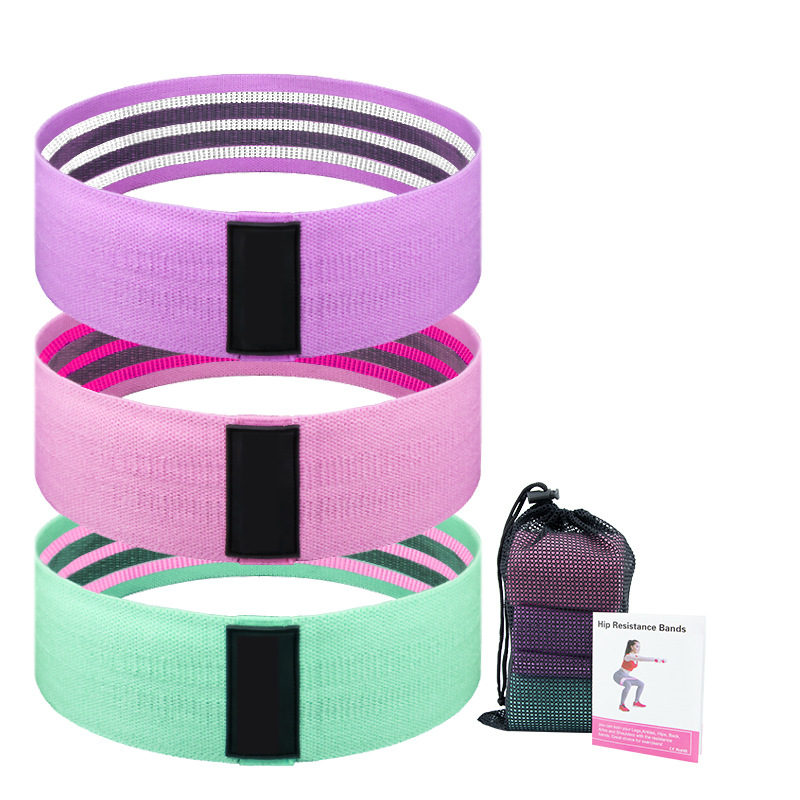 Fabric Resistance Bands Set with Carry Case$48.99View product
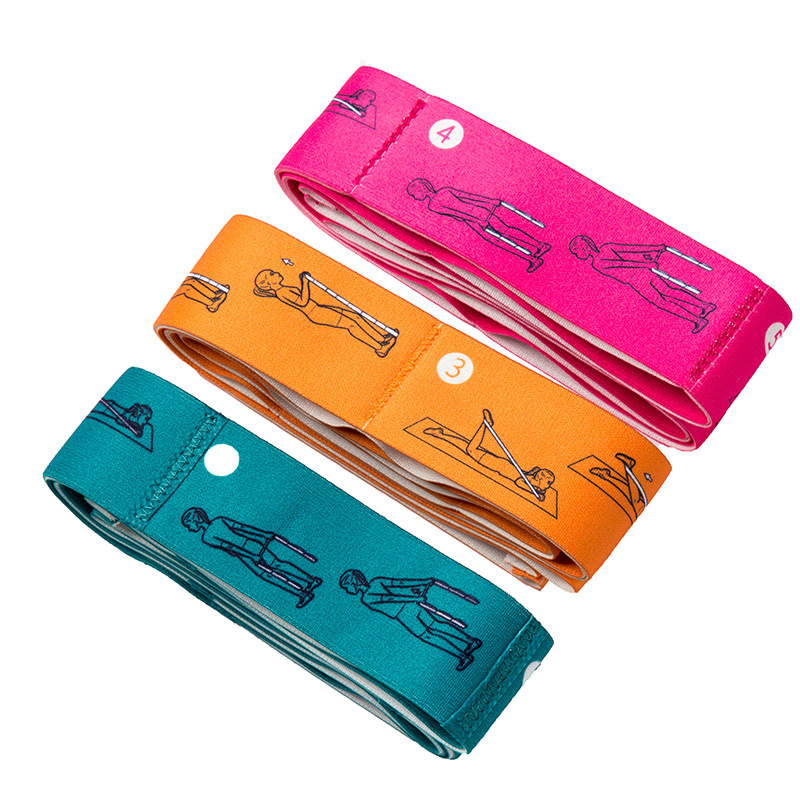 Yoga Stretch Band for Flexibility and Mobility Work$27.99View product
Written for ai-shoppers.com. Tension ranges and prices are typical published figures for planning, not specifications of any single product; manufacturers quote tension at different stretch percentages, so compare the printed numbers rather than the colours.
Compare on Amazon — this category usually has more brands, sizes and price points there.
Check current prices on Amazon →
As an Amazon Associate we earn from qualifying purchases. The price you pay is unchanged. Disclosure