Spices do not really go bad – they go quiet. The same jar of cumin can smell sharp for two years or taste like dust in six months, and the difference is almost entirely where it was kept. Three things destroy flavour: light, heat and air. Here is what each one does, how long spices really last, and the one storage decision most kitchens get wrong.
The three things that kill flavour
Light breaks down the volatile oils that carry aroma, and it does it faster than most people expect. That is the entire reason spice jars are sold in tinted glass or opaque tins; a clear jar on a sunny windowsill is a slow-motion experiment in losing the thing you paid for.
Heat accelerates every chemical reaction in the jar, including the ones you do not want. The commonly quoted guidance is to keep spices below about 20 C and out of direct sun; above roughly 38 C the loss of aroma compounds speeds up dramatically.
Air and moisture do two things: they oxidise the oils, and in humid kitchens they let powders cake into lumps that no longer measure or disperse properly. An airtight seal fixes both at once – and if your spice clumps in the jar, that is moisture, not age.
How long they actually last
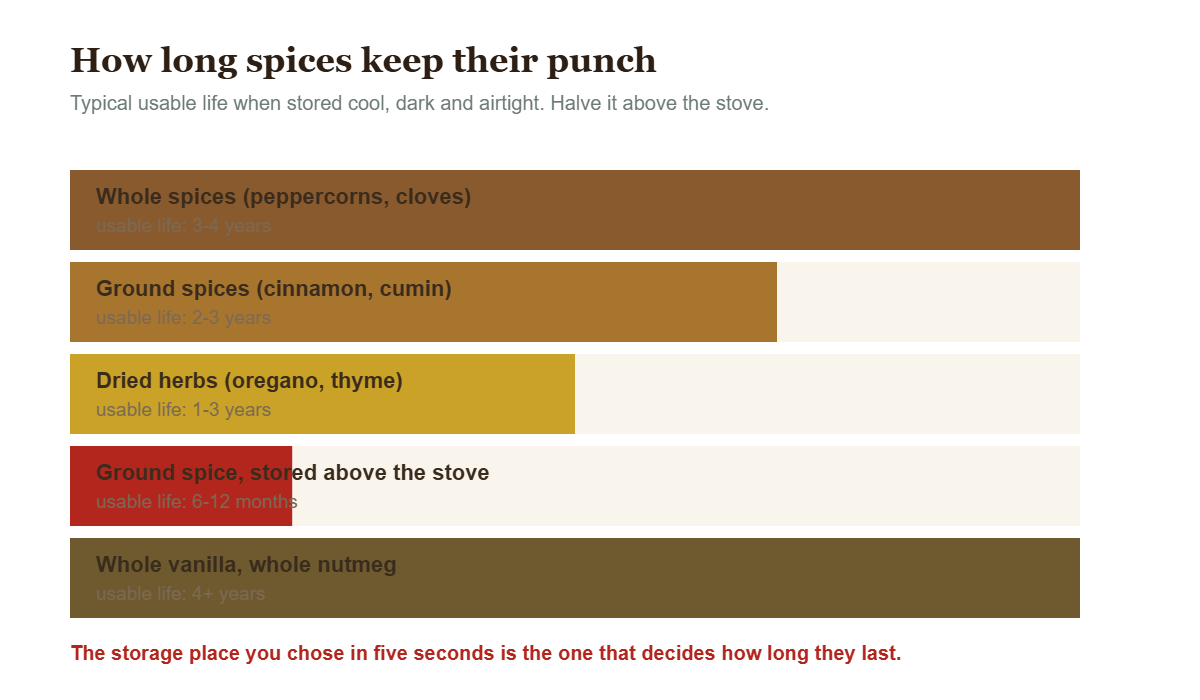
| What you have | Typical usable life | What shortens it most |
|---|---|---|
| Whole spices – peppercorns, cloves, cinnamon sticks | 3-4 years | Grinding them early |
| Whole nutmeg, whole vanilla | 4 years or more | Cutting into them |
| Ground spices – cumin, paprika, cinnamon powder | 2-3 years | Heat and light |
| Dried herbs – oregano, thyme, rosemary | 1-3 years | Crushing the leaves in storage |
| Any ground spice kept above the stove | 6-12 months | Constant warmth and steam |
The pattern is simple: the more surface area, the faster it fades. A whole peppercorn has almost none exposed; a fine powder has all of it exposed at once. That is why whole spices keep for years and ground ones keep for months in the same cupboard.
The five-second decision that matters most
Most kitchens store spices in the one place in the room designed to be hot and humid: the shelf beside or above the stove. It is convenient, and it is the single worst spot in the house. Every time you cook, that shelf gets a wave of heat and steam – which is precisely the combination the previous two sections told you to avoid.
Choosing containers that actually seal
A jar is only as good as its seal, and two designs do the job well: a screw lid with a silicone gasket, and a clamp lid with a rubber ring. Both stop the exchange of air that oxidises the oils. Loose metal tins that have been opened and closed a hundred times usually fail here – the lid no longer sits flush, and the spice slowly turns to powder-flavoured air.
Size matters too. A large jar that is three-quarters empty contains a lot of air, and every time you open it that air is exchanged. Matching the jar to the amount you actually have – or decanting into a smaller one as you use it up – keeps the headspace small.
Whole or ground?
Buy whole wherever you can and grind as you go. A peppermill is not a gadget for enthusiasts; it is the cheapest way to keep one of the most-used spices tasting like itself. The same logic applies to nutmeg, cumin and coriander seed: the whole version keeps for years, the ground version for months.
For the ones you cannot practically buy whole – paprika, turmeric, ground ginger – buy smaller quantities more often rather than a big bag because it was cheaper per gram. A kilo of paprika you use twice a year is not a bargain; it is a slow loss.
Labels and rotation
The other half of the problem is knowing what is in the jar. Once a label has faded or a jar has been refilled without a date, you have no way to tell whether it is two months old or two years old. Write the month and year on the lid when you fill a jar, and use the oldest first – a first-in, first-out rule that costs nothing and stops the quiet accumulation of dead spices at the back of the shelf.
- Store away from the stove, the oven and any sunny windowsill
- Use airtight jars with a gasket or a clamp – not a loose tin
- Keep the headspace small; decant into smaller jars as you use them
- Buy whole and grind as you go wherever it is practical
- Date every jar and use the oldest first
Frequently asked questions
How do I know if a spice is past it?
Smell it, then crush a little between your fingers and smell again. If it smells of almost nothing, it will taste of almost nothing. Colour is the second clue – paprika and turmeric fade visibly long before they go entirely.
Do spices go bad in a food-safety sense?
Rarely in the way perishable food does; the usual problem is lost flavour rather than spoilage. Mold is the exception, and it means moisture got in, so discard the jar rather than scraping off the top.
Is the freezer a good idea?
Only for whole spices you use rarely, and only in a genuinely airtight container. A cold, humid environment is not automatically safe – if air gets in, condensation is worse than the warmth you were avoiding.
Should I transfer spices into matching jars?
It looks better and it helps if the new jars seal properly. A decorative jar that does not seal is worse than the original packaging, so check the gasket before you commit.
Does grinding my own really make a difference?
Yes, and it is the largest single difference in this article: whole spices keep for years, ground ones for months. Grinding fresh means the aromatics are released when you cook rather than when you bought.
Gear referenced in this guide
Two storage items from our own range that match the advice above – a set of square jars and a rotating rack. Neither is required: an airtight jar from anywhere does the same job.
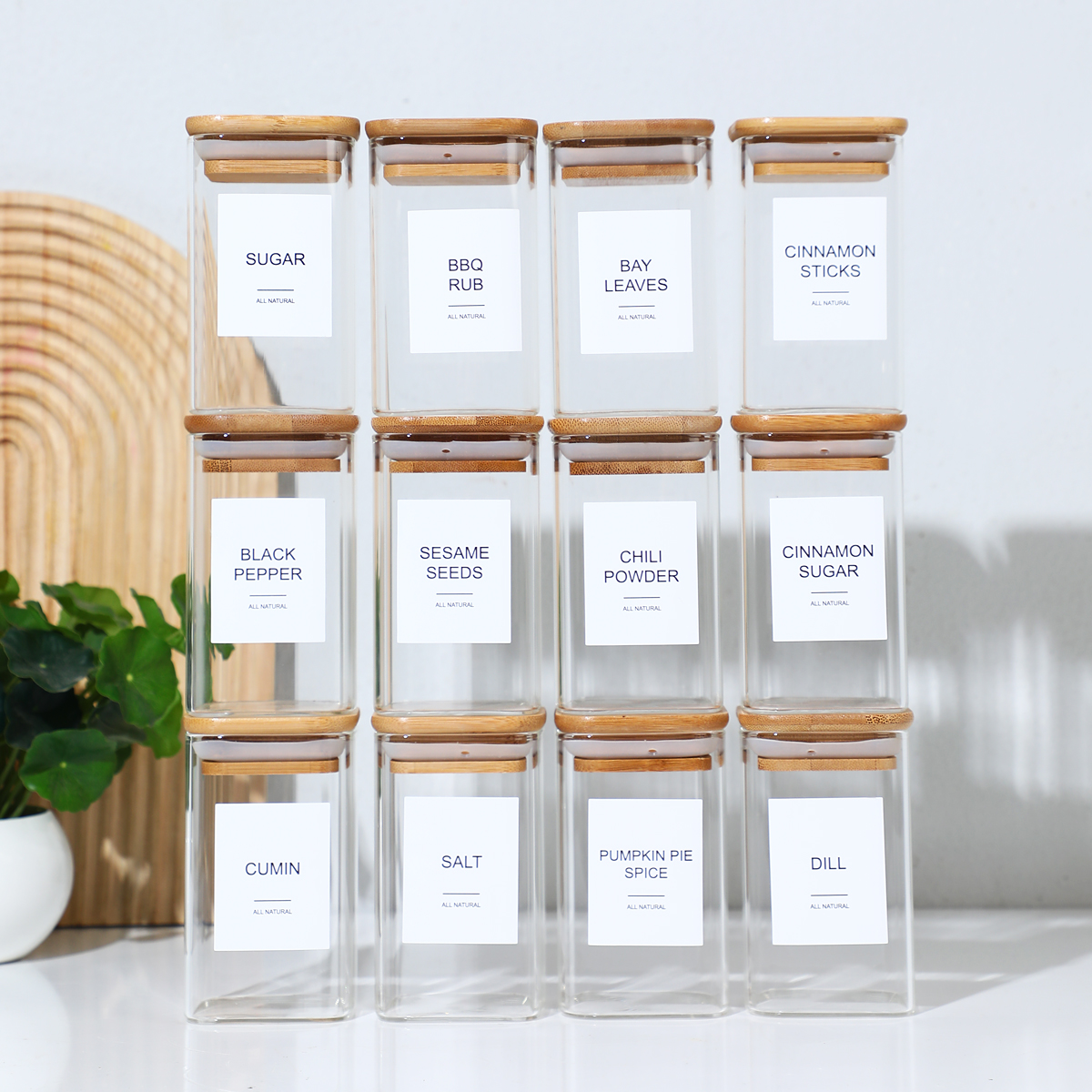 12 Pcs Square Spice Jars with 72 Stickers, Kitchen Seasoning Jars$58.99View product
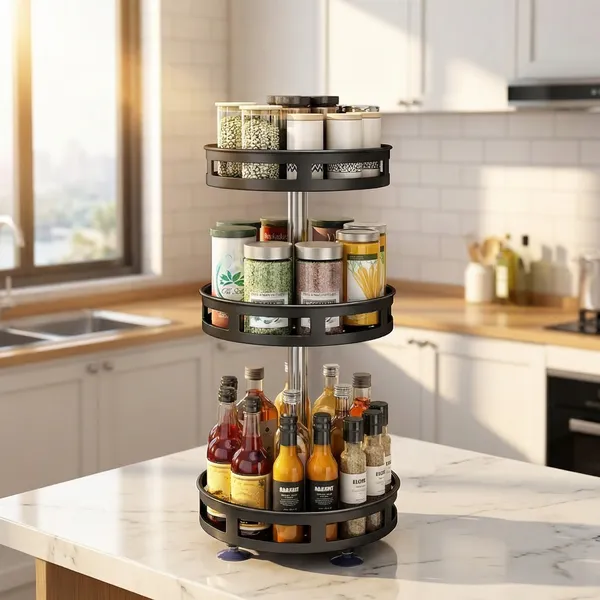 3-Tier Rotating Spice Rack Organizer, 360 Degree Steel Turntable$98.99View product
Written for ai-shoppers.com. Storage temperatures and shelf lives above are typical published figures for orientation rather than guarantees; how a spice was processed and how airtight your jar is will move them.
Compare on Amazon — this category usually has more brands, sizes and price points there.
Check current prices on Amazon →
As an Amazon Associate we earn from qualifying purchases. The price you pay is unchanged. Disclosure