Home goods do not have one price. They have a season. A fan bought in February and the same fan bought in July are not the same purchase, and the difference is not the product – it is who else is shopping that week. This is the calendar: when demand peaks in each category, how far ahead to order for a date you cannot move, and why the cheapest week of the year for a heater is the hottest one.

Why seasonality is so strong in home goods
Nobody strictly needs a fan in January. Demand is what moves, so stock levels and discounting follow it directly. In the peak month a retailer can sell everything it has at full price; two months later the same unit is dead stock taking up a warehouse shelf, and dead stock is what gets discounted.
There is a second, quieter effect: shipping. Almost all of this category is manufactured in the northern hemisphere, and production slots fill up ahead of the season. Order late and you are not only paying peak prices, you are queuing behind everyone else.
When each category peaks
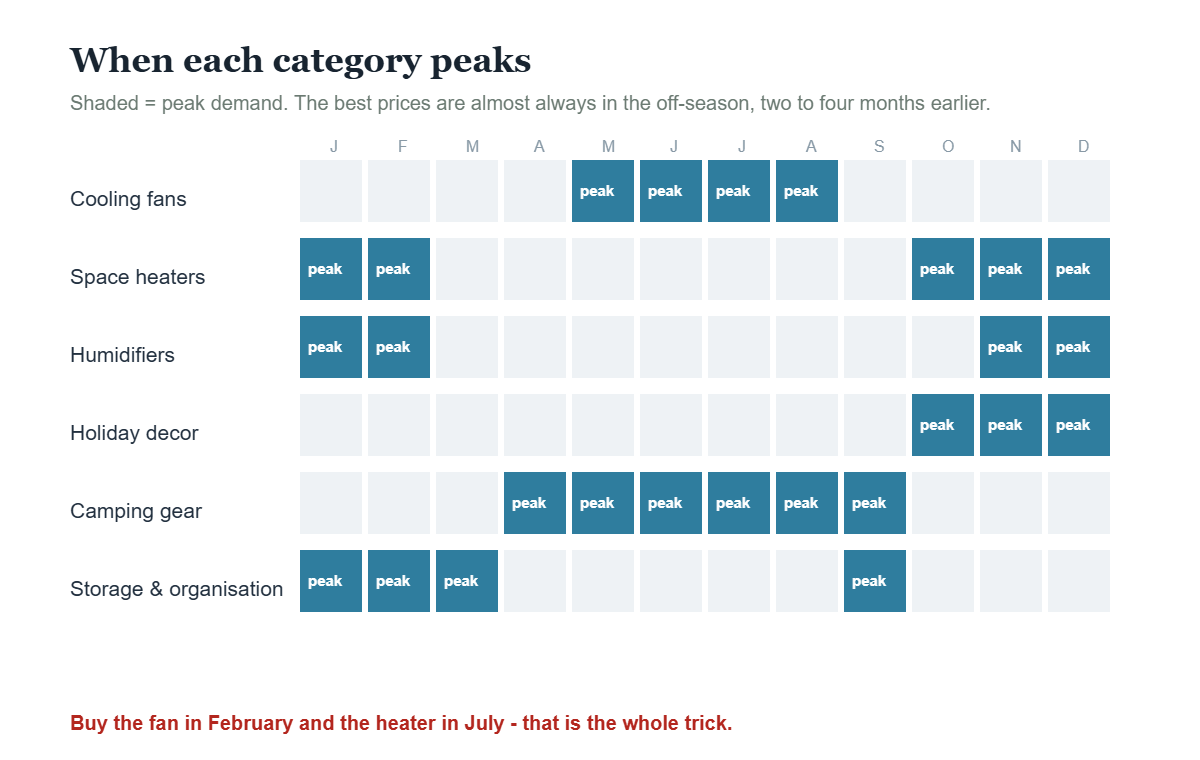
| Category | Peak demand | Best buying window | Why |
|---|---|---|---|
| Cooling fans | May-August | January-March | Nobody thinks about heat in winter; stock sits |
| Space heaters | October-January | June-August | Clearance after the cold snap ends |
| Humidifiers | November-February | Spring | Demand follows dry indoor air, not the shop calendar |
| Holiday decor | October-December | January-February | Post-season clearance is the deepest of the year |
| Camping gear | April-September | February-March | Buy before the first warm weekend, not after |
| Storage and organisation | January, September | March-May | New-year and back-to-school resolutions |
The lead-time calendar, backwards from the date
The harder version of this problem is a date you cannot move: a birthday, a move, a holiday. Work backwards instead of forwards, and count every stage.
| Stage | Typical time |
|---|---|
| Dispatch after ordering | 1-3 business days |
| Cross-border transit | 4-7 days for most air-freight parcels |
| Busy-period buffer | Up to 12 days in peak weeks |
| Last-mile and handover | 1-3 days |
| Total, comfortable | About 2 weeks |
Two weeks is the number to remember. If something has to arrive before a fixed date, the order needs to be placed a fortnight earlier – and in late November or December, add another week, because every parcel in the country is competing for the same delivery slots.
The four dates that matter in a year
Late November is the loudest discount event, but it is also peak demand: the sales are real, the choice is not. Popular lines sell out early and the sizes that remain are the ones nobody wanted.
Late December to mid-January is the real value window. Holiday decor, gift-packaged kitchen items and anything winter-shaped gets cleared at the deepest discounts of the year, precisely because demand has collapsed overnight.
March to April is the quiet, underrated one: spring cleaning drives storage and organisation, and last season’s heating and cooling stock is still being cleared.
August to September is the second half of the year’s demand curve – back-to-school pulls storage, desk and kitchen basics, then the run into the holiday quarter begins.
- Which month am I in, and is this category in its peak?
- Is the price a real discount, or a peak-season price with a red badge?
- If I need it by a date, is that date at least two weeks away?
- Is this the season when the colour or size I want is still in stock?
What seasonality does not explain
Not everything is cyclical. Genuine product improvements do not come back into fashion on a schedule, and a well-made item in a category you use daily is usually worth buying when you need it rather than waiting for a theoretical discount. Timing is a lever, not a substitute for knowing what you are buying – which is why the checks on any listing still matter more than the calendar.
A worked example: ordering for a date you cannot move
Suppose the parcel has to be in someone’s hands by 20 December. Work backwards. The last-mile and handover stage takes one to three days, so it must reach the local depot by 17 December. Transit is four to seven days, plus the busy-period buffer of up to a week in December, so it should leave the warehouse by 8 December. Dispatch takes one to three business days, which puts the order date at roughly 3-5 December – and that is with everything going well.
Move the target earlier and the arithmetic relaxes fast: for a 20 November date you can order on about 8 November with margin, and for anything in a quiet month you can leave it closer to ten days. The mistake people make is counting only transit, forgetting that dispatch, last-mile and the busy-period queue each take their own bite out of the calendar.
There is one more stage worth knowing about for large or heavy items: they may move by sea freight rather than air, which changes the lead time from days to weeks. If a listing mentions a longer estimate, believe it, and plan around the longest figure rather than the shortest.
Frequently asked questions
Is Black Friday actually the cheapest time to buy home goods?
It is the most discounted on paper, but it is also peak demand, so the best-selling lines sell out and the remaining choice is thin. For seasonal items, the January clearance is often better value.
How early should I order for a fixed date?
About two weeks for a normal week, and three in late November or December. Dispatch, transit and last-mile delivery each take time, and busy periods add to all of them.
Does buying off-season mean buying old stock?
For fans, heaters, humidifiers and decor, largely yes – and it does not matter. These products do not expire, and the design does not change meaningfully year to year.
What about appliances with batteries or electronics?
Buy those closer to use. A lithium battery sitting in a box for a year is genuinely worse than one made recently, so the off-season logic is weaker there.
Which category has the biggest seasonal gap?
Cooling and heating, by a wide margin. Demand for both is almost entirely weather-driven, which is exactly why their off-season discounts tend to be the deepest.
How far ahead should I order for a December date?
Roughly three weeks. Dispatch, transit, the busy-period buffer and last-mile delivery all add up, and December adds to every one of them.
Do bulky items take longer?
Often yes. Heavy or oversized goods may travel by sea, which turns a week-long transit into several weeks. Where a listing quotes a longer range, plan against the long end.
Gear referenced in this guide
Three items from our own range that illustrate the calendar above – a fan, a humidifier and a bit of holiday decor. None of them is required, and none of them is worth buying early unless you actually want it.
 Cooling USB Folding Fan, Portable$52.99View product
 Magic Shadow USB Air Humidifier with Projection Night Light$24.76View product
 Felt Christmas Tree Decoration Set, DIY Wall Hanging$12.99View product
Written for ai-shoppers.com. Seasonal windows, lead times and clearance periods above are typical patterns for planning rather than guarantees for any particular retailer or product; the actual stock and price in front of you is always the authority.
Compare on Amazon — this category usually has more brands, sizes and price points there.
Check current prices on Amazon →
As an Amazon Associate we earn from qualifying purchases. The price you pay is unchanged. Disclosure