Moving a kitchen is a logistics problem disguised as a chore. Most people pack by cupboard, which means the box marked “kitchen stuff” contains a colander, three bottles of sauce and the only ladle. The 12-box method fixes that by packing by function instead of by furniture – a fixed number of boxes, each with a known job, so unpacking is a sequence rather than an excavation.
1. Why twelve boxes
A typical kitchen holds 40-60 litres of “loose small items” once appliances and furniture are excluded. A 40 x 30 x 25 cm box is 30 litres, so twelve boxes gives you 360 litres of capacity – enough for a two-person kitchen with room for padding, and few enough that you can label and track every one. Anything beyond twelve is usually oversized equipment, which deserves its own category.
2. The weight rule that protects your back
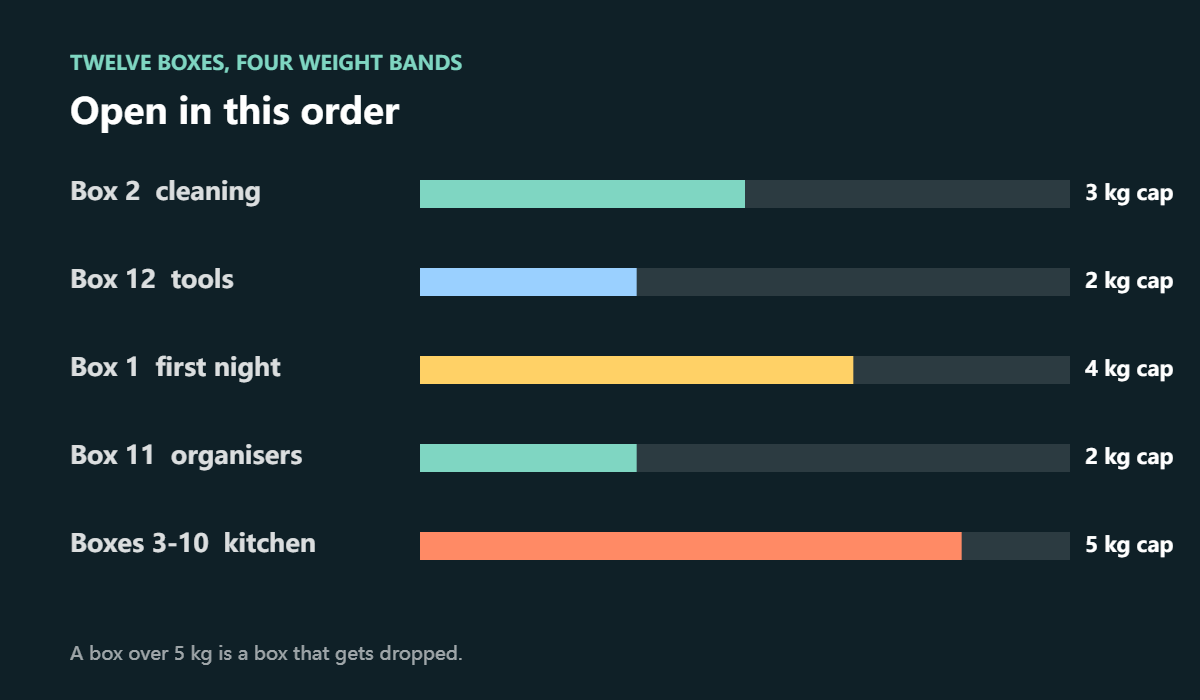
Keep every box under 5 kg. A 30-litre box filled with tins and jars reaches 12 kg without warning, and that is how people injure themselves on moving day. Pack heavy items – tins, oil, jars – in the smallest boxes at the bottom of the stack, and reserve the 30-litre size for bulky light things: plastics, tea towels, storage containers.
3. The twelve jobs
| Box | Contents | Opens on | Weight cap |
|---|---|---|---|
| 1 | First-night kit: kettle, mugs, tea, one pan, cutlery for two | Night one | 4 kg |
| 2 | Cleaning supplies, cloths, bin bags | Before unpacking | 3 kg |
| 3-4 | Dry goods, tins, jars (small boxes) | Day two | 5 kg |
| 5-6 | Plates, bowls, glasses, wrapped individually | Day two | 5 kg |
| 7-8 | Cookware, pans, baking trays | Day three | 5 kg |
| 9 | Utensils, knives, small tools | Day two | 3 kg |
| 10 | Small appliances, cables bagged separately | Day three | 5 kg |
| 11 | Drawer organisers and dividers, emptied | Day one | 2 kg |
| 12 | Open-first: scissors, tape, phone charger, marker | Immediately | 2 kg |
4. Label three things, not one
A box that says “kitchen” tells you nothing at 9 p.m. with no dinner. Write three fields on the top and one side: the box number, the room it belongs to, and the day it opens. Numbering matters more than naming – a simple 1-12 sequence lets you find box 7 without reading twelve labels, and it makes the unpacking order explicit.
5. Pack the drawer organisers empty
This is the step people skip, and it costs them an evening. Take the cutlery dividers and drawer inserts out, wipe them, and pack them flat in box 11. A loaded organiser weighs more than the drawer it came from, arrives bent, and has to be emptied anyway. Empty inserts also act as padding between plates.