A 30 m2 Studio: The Twelve Things That Actually Earn Their Space

Thirty square metres, twelve objects: what earns floor space in a studio and what steals it.

30 square metre studio
In a studio, floor area is the only currency.

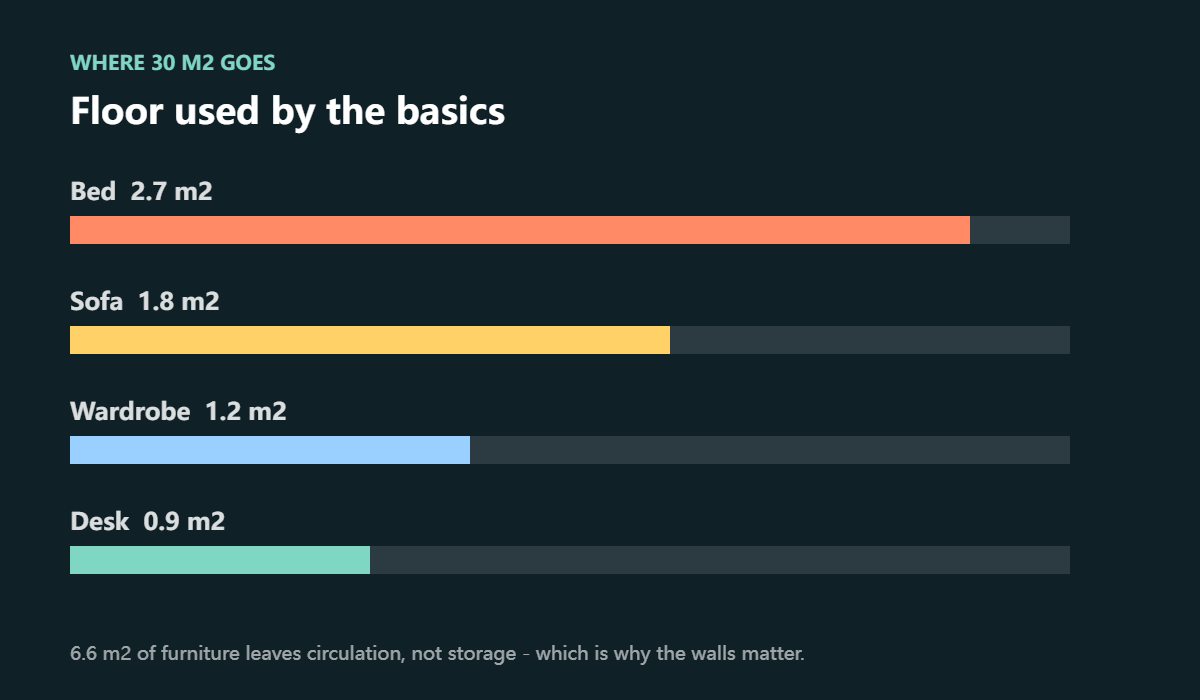
Thirty square metres is not a small apartment with a storage problem; it is a different way of deciding what to own. The maths is unforgiving: a bed takes 2.7 square metres, a sofa 1.8, a desk 0.9, and a 60 cm deep wardrobe running two metres takes another 1.2. That leaves circulation, not storage. What follows is the twelve-item list that survives that arithmetic – each one chosen because it does a job that would otherwise need floor space.

1. The floor is the budget

In a studio, floor area is the only currency. Everything you buy either uses it or frees it. A storage box on the floor is neutral at best; a wall-mounted shelf is a gain. A drawer unit that doubles as a bedside table is a gain; a separate bedside table is a loss. The test for any item: does it replace two things, or one?

2. Twice-vertical: the 90-150 cm band

The band between 90 and 150 cm above the floor is the only zone adults reach without bending or climbing, and in a studio it is almost entirely unused. A 2 m long wall holds roughly 3 square metres of usable vertical storage in that band, which is more than the floor space of a small wardrobe. Shelves and hooks inside that band cost nothing in floor area and get used every day. Above 170 cm you need a step; below 60 cm you are crouching.

3. Twelve things, one test each

Item Why it earns the space Number
Bed with under-bed clearance 135 L per box underneath 25-30 cm
One tall wardrobe Replaces a dresser plus a cupboard 60 cm deep
Wall shelf at 110 cm Storage without floor cost 3 m2 per 2 m wall
Over-door rack Uses the door swing dead space 5-10 kg
Nesting side tables Two surfaces, one footprint 2 in 1
Hanging caddy Bathroom bottles off every surface 5 kg full
Corner unit Turns a dead triangle into a shelf 0.08 m2
Fold-flat drying rack Dries then disappears 10 cm folded
Under-sink organizer Recovers the awkward volume 20-25 cm clear
One drawer insert Stops the cutlery scramble 30.5 x 10.2 cm
Wall hooks by the door Coats never reach the floor 3 hooks
Folding step stool Makes the top shelf usable 2-3 cm folded
Where floor area goes
Where 30 m2 goes before you store anything.

4. What does not earn its space

Anything single-purpose and large: a dedicated shoe cabinet, a bar cart, a full-size ironing board, a second sofa. Anything that needs clearance to work: a pull-out that blocks the only walkway, a dining table for six in a room that seats two. And anything bought for a future version of your life – the kitchen appliance you will use “when you have people over” occupies space every day for an event that happens twice a year.

5. The 5 kg rule on every wall

Wall storage fails for one reason: the fixing, not the shelf. Adhesive plates hold 3-5 kg on smooth, clean, dry surfaces; plasterboard plugs 10-15 kg; toggles 15-25 kg; screws into studs 30-40 kg. In a studio you cannot afford a shelf that comes down, because there is nowhere else to put what falls. Anything above shoulder height should go into studs regardless of its weight, because the accidental load – a hand, a bag, someone steadying themselves – is bigger than the stored load.

6. One-in, one-out, enforced

The rule only works if it is mechanical. Every new object that occupies volume requires an old one to leave the same day. Applied honestly, it caps the contents of a studio at what the storage can hold, and it turns “decluttering” from a weekend project into a two-minute decision. Without it, a 30 m2 flat accumulates at exactly the same rate as a house, and fails faster because there is less room to absorb the drift.

7. Lighting instead of furniture

A studio with good light feels larger than its floor area; one with a single ceiling bulb feels like a corridor. Two lamps at different heights – one at 45 cm beside the sofa, one at 150 cm in the corner – cost less than a piece of furniture, use no floor area, and change how the room reads at night. This is the cheapest square metre you will ever buy.

8. The move-in order that prevents regret

  1. Measure the floor and mark furniture footprints with tape before buying anything.
  2. Fix wall storage first – it defines where everything else can go.
  3. Buy the bed and wardrobe, then live with the gap for a week.
  4. Add the twelve items in order of how often you use them.
  5. Leave 80 cm of clear walkway and never fill it.

9. What the twelve-item list leaves out

It leaves out a dining table, because a 60 cm deep counter with two stools does the same job in half the footprint. It leaves out a bookshelf, because a 25 cm deep wall shelf holds more per square metre. And it leaves out the second wardrobe everyone thinks they need – the first one, with the right internal fittings, usually holds twice what people expect.

10. The entryway decides the rest

A studio has one transitional zone, and it does the work of a hallway, a cupboard and a mudroom at once. If the door opens onto clear floor, the room reads as bigger from the first second; if it opens onto shoes, every guest sees the clutter before they see the sofa. Three hooks, one 30 cm deep shelf and a lidded box are enough for two people – and all three sit inside the 90-150 cm band, so they cost no floor at all.

The mistake is buying a deep shoe cabinet. At 35-40 cm deep it takes 0.4 square metres and holds twelve pairs; a 25 cm wall shelf plus a box under the bed holds the same and leaves the floor clear.

11. Measure the walkway, then subtract

Every studio has one path from the door to the bed, and it needs 80 cm to be usable with a bag in your hand. Mark it with tape before furniture arrives. In practice that single measurement eliminates half the tempting purchases: anything that narrows the path below 80 cm will be moved within a month, usually into the path itself.

The same logic applies vertically. A shelf deeper than 30 cm over a walkway becomes a head-bump; a hook at 170 cm becomes a coat hanger for the ceiling. Staying inside the reach band is not only about comfort – it is what keeps the circulation clear.

Frequently asked questions

How much storage does a 30 m2 studio actually have?

Typically 8-12 cubic metres once under-bed, wardrobe and wall space are counted – roughly the contents of a one-bedroom flat, provided the vertical band is used.

Is wall storage safe on plasterboard?

Up to 15 kg with the right plugs, 15-25 kg with toggles. Above 25 kg, or above shoulder height, fix into studs.

What is the single best upgrade?

Under-bed clearance. A 25-30 cm gap under a standard bed holds three 90 x 60 x 25 cm boxes – about 405 litres – for the price of the boxes.

Should I buy a sofa bed?

Only if you need the second function weekly. A sofa bed is heavier, less comfortable daily, and its mechanism is the part that fails first.

How do I stop clutter returning?

One-in-one-out, enforced the same day, plus a fixed home for every object. Storage without a rule becomes a slower version of clutter.

Honest disclosure: dimensions and capacities are typical ranges for standard furniture, not a specification for your flat.

Gear referenced in this guide

Rotatable corner bathroom organizer

Rotatable Corner Bathroom Organizer, Wall-Mounted

Turns the dead corner of a small bathroom into reachable shelf space.

$54.99

Aluminium hanging shower caddy

Aluminium Hanging Shower Caddy, Double Basket

Hangs over the screen, drains through, and frees every bathroom surface.

$63.99

Compare on Amazon — this category usually has more brands, sizes and price points there.

Check current prices on Amazon →

As an Amazon Associate we earn from qualifying purchases. The price you pay is unchanged. Disclosure

Structured guide fields (summary, verdict, best for, criteria, pros and cons) appear here once content is added.
0 0 votes
文章评分
Subscribe
Notify of
guest
0 评论
Oldest
Newest Most Voted