
Every shelving failure starts with the same sentence: “it felt solid when I put it up”. Fixings are chosen by habit – whatever came in the box, or whatever is in the drawer – and the load is estimated by eye. The result is a shelf that holds for six months and then takes a tile with it. This guide sets out five common fixings, the loads they realistically carry, and the three surfaces that decide which one you need.
1. The five fixings
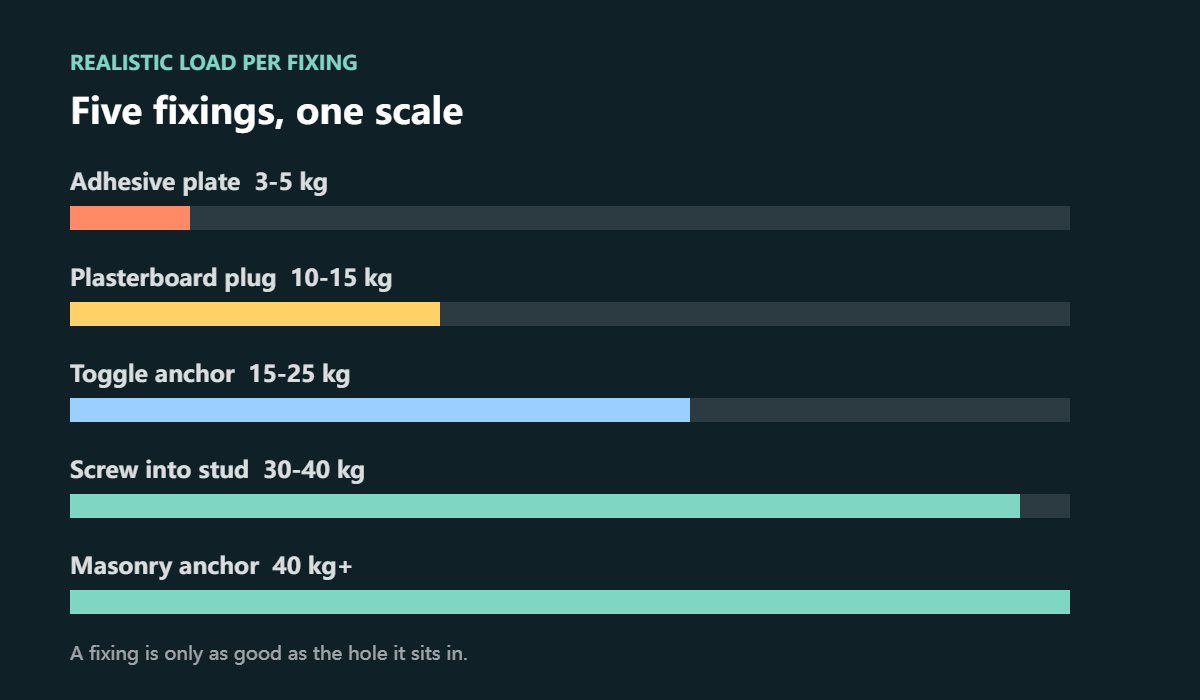
Adhesive strips and plates carry 3-5 kg on smooth, clean, dry surfaces. They fail on textured walls, on damp tiles and on cold paint, and they fail slowly – the first sign is a 1 mm gap at the top edge.
Plasterboard plugs (the metal or nylon expanding type) carry 10-15 kg in 12.5 mm board, provided the plug is the right size for the board and the hole is clean. They carry nothing in old, crumbly board.
Toggles and spring anchors spread the load behind the board on a 20-30 mm bar. They are the reliable option for hollow walls, at 15-25 kg per fixing when installed correctly.
Screws into timber studs are the benchmark: a 4.5 x 50 mm screw into a stud carries 30-40 kg in shear. The trick is finding the stud – a magnet for the plasterboard screws, or a 20 cm tap test.
Masonry anchors in brick or concrete take 40 kg and more, but only if the hole is drilled to the right depth and the dust is blown out. A hole drilled 10 mm too deep with dust left in it can halve the holding power.
2. Loads, in one table
| Fixing | Surface | Realistic load | Fails when |
|---|---|---|---|
| Adhesive plate | Smooth tile, glass, painted board | 3-5 kg | Damp, textured, cold, or cured short |
| Plasterboard plug | 12.5 mm board | 10-15 kg | Board is old or crumbly |
| Toggle / spring anchor | Hollow wall | 15-25 kg | Hole oversized, bar not seated |
| Screw into stud | Timber frame | 30-40 kg | Missed the stud, or split the timber |
| Masonry anchor | Brick, concrete | 40 kg+ | Dust in the hole, drilled too deep |
3. The surface decides, not the fixing
The same shelf needs three different fixings in three rooms. In a bathroom the wall is usually tile over board: adhesive works on the tile face until humidity weakens it; a plasterboard plug needs a hole through the tile and the board, and the tile will crack if drilled without care. In a kitchen the wall behind the counter is often plasterboard on battens, which means toggles. In a hallway it may be solid brick, where a masonry anchor is correct and everything else is overthinking.
Test before you buy: tap the wall. A hollow, drum-like sound over a wide area means board; a dull thud means solid. A magnet run across the wall finds the plasterboard screws and therefore the studs, usually at 400 mm or 600 mm centres.
4. Drilling tile without cracking it
Use a tile bit, not a masonry bit, and start at low speed with no hammer action. Put a strip of masking tape over the mark to stop the bit wandering, and keep steady pressure – bouncing is what cracks glaze. Drill through the tile first, then switch to the correct bit for the board behind. Blow the dust out of the hole; a plug seated in dust holds a fraction of its rating.
5. Adhesive: three rules
Clean with alcohol and let it dry. Press firmly for 30 seconds, then leave the full curing time – usually 24 hours – before hanging anything. Keep the load under 5 kg, and keep it near the wall rather than at the outer edge of a bracket, where leverage multiplies the pull.
6. Height changes the load
A shelf at 110 cm is pulled outward at roughly shoulder height, which is the direction fixings are weakest against. A shelf at 170 cm is pulled sideways and down, and people lean on it while reaching. The practical rule: anything above 150 cm should be fixed to studs regardless of what it weighs, because the accidental load – a hand, a bag, a person steadying themselves – is larger than the stored load.
7. What not to hang on plasterboard
Anything holding water. A 6 kg caddy with full bottles becomes 8 kg when the bottles are wet and 9 kg when someone leans on it, and a plasterboard plug that has been damp for a month has lost much of its grip. In a wet room, fix into studs or use a freestanding unit.
8. The five-minute check after hanging
- Load it fully, then wait 24 hours before trusting it.
- Look for a gap at the top edge – 1 mm means the fixing is creeping.
- Push down and out; movement of more than 2 mm is a problem.
- Check the screw heads: a loose head means the fixing is not seated.
- In a bathroom, check again after a week of showers, not a day.
9. Old walls and crumbly board
Plasterboard has a working life. In a 1970s house the board behind the tiles may have lost its strength at the cut edges, and a plug that grips in new board will spin in old board without holding. The test is simple: drill the hole, insert the plug, and tighten by hand. If the plug turns without expanding, the board is gone and no amount of torque will fix it – move to a toggle, or fix into the studs at 400-600 mm centres.
Lath and plaster is a different problem again: the keys behind the plaster can break away in sheets. Toggles are the only sensible option there, and even then a 10 kg shelf is ambitious. If the wall sounds hollow across a whole room, treat every fixing as a light one.
10. The one tool worth buying
A stud finder costs less than the damage one failed shelf causes, but a magnet is almost as good and never needs a battery. Run it across the wall until it snaps to a plasterboard screw, mark that line, and repeat every 400-600 mm. Three marks give you a stud; two marks plus a hollow tap give you a cavity. That is the whole survey, and it takes two minutes.
Add a 6 mm tile bit and a tube of construction adhesive and you can handle nine out of ten domestic jobs without a second trip to the shop – which, given a delivery window of 7-15 days in the US and 10-20 in the UK, Canada and Australia, is worth more than it sounds.
Frequently asked questions
How much can an adhesive hook really hold?
3-5 kg on smooth, clean, dry surfaces, and less in humidity or on texture. Keep heavy items near the wall and stay under the rating.
Can I hang a shelf on plasterboard without studs?
Yes, with toggles or spring anchors rated 15-25 kg per fixing. Ordinary plasterboard plugs are for lighter loads and older board holds them poorly.
Why did my shelf pull out of the wall?
Usually one of four: missed stud, hole drilled with dust left in, load at the outer edge, or adhesive used where screws were needed. All four are visible before failure.
How do I find a stud?
Run a magnet along the wall to find plasterboard screws (typically at 400 or 600 mm centres), or tap and listen for the change from hollow to solid.
Do I need a masonry bit for tiles?
No. Use a tile bit at low speed without hammer action, then change to the correct bit for the material behind the tile.
Honest disclosure: load figures are typical in-service values for correct installation, not certified ratings. Follow the fixing manufacturer’s specification.
Gear referenced in this guide
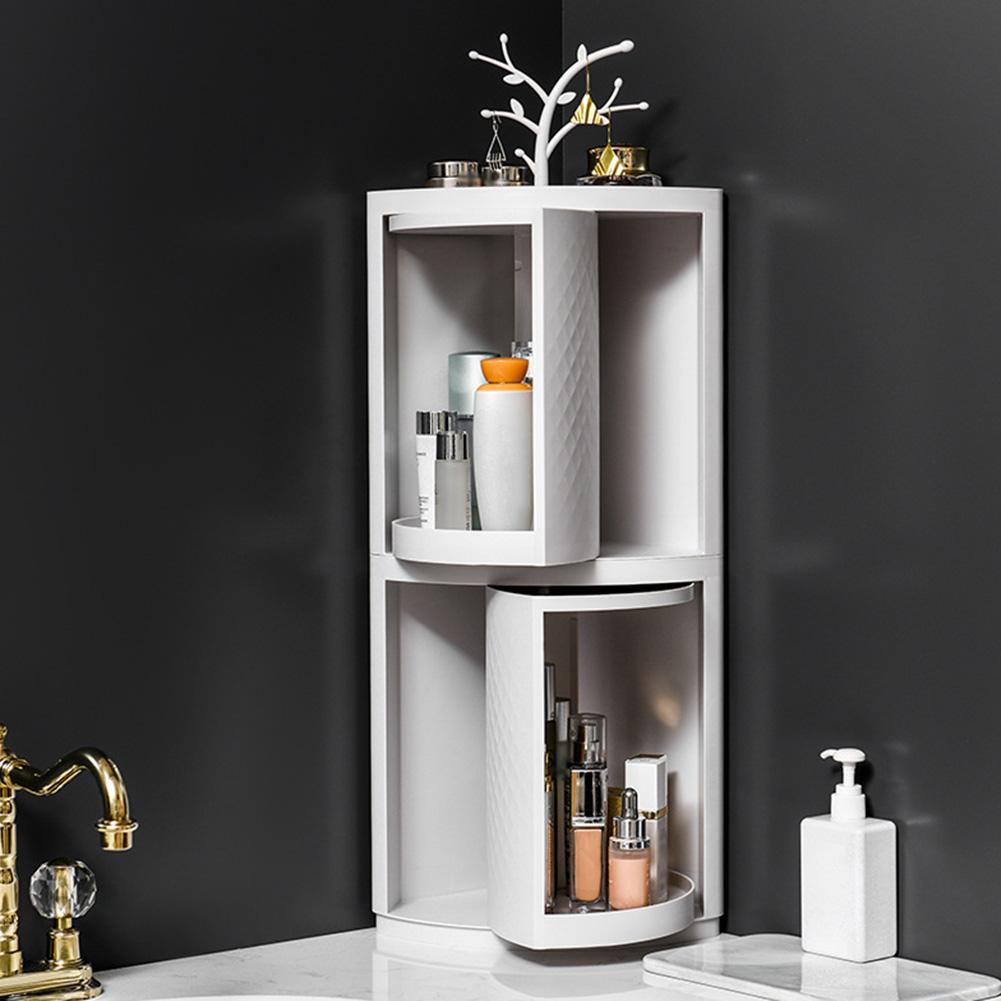
Rotatable Corner Bathroom Organizer, Wall-Mounted
Wall-mounted corner storage – the fixing choice in sections 3 to 5 decides whether it stays there.
$54.99
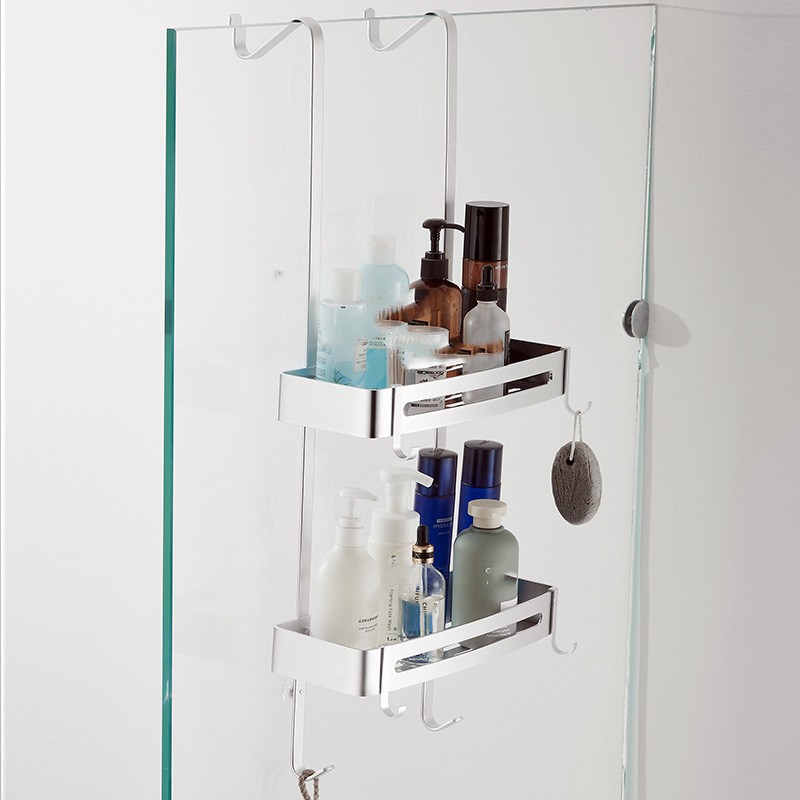
Aluminium Hanging Shower Caddy, Double Basket
Hangs over a screen, so no drilling at all – the lightest option in a wet room.
$63.99
Compare on Amazon — this category usually has more brands, sizes and price points there.
Check current prices on Amazon →
As an Amazon Associate we earn from qualifying purchases. The price you pay is unchanged. Disclosure
[…] assembly — the load path there is a different problem, closer in kind to the ones in our piece on what five wall fixings actually hold than to anything […]