
Sharing a bathroom is not a storage problem until two people put their things in the same 60 centimetres. Then it becomes a negotiation with no referee: whose bottle goes at the front, whose razor falls off the edge, whose towel ends up on the floor. The fix is not more shelves – it is a division of space that both people can follow without discussion.
1. Start with the counter, not the cabinet
A typical basin counter is 100-120 cm wide and 50-60 cm deep. Two people need roughly 30 cm of personal width each, plus a shared middle for soap and a hand towel. That leaves the counter effectively full before anything is stored, which is why the cabinet and the walls have to carry the load. Measure your counter, subtract 20 cm for the tap zone, and divide the rest by two – that number is your personal width, and it is usually smaller than people expect.
2. The 90-150 cm band belongs to both of you
The band between 90 and 150 cm above the floor is the only zone reached without bending or climbing, and it is the fairest space in the room: both people can use it. Put shared items there – toothpaste, hand wash, the daily moisturiser – and put personal items above or below. A shelf at 110 cm serves two people; a shelf at 170 cm serves whoever is tallest.
3. Two caddies beat one big shelf
The single most effective change is giving each person their own container. Two hanging caddies, one per side of the shower, end the “where is my razor” problem permanently and cost no floor space. A double-basket aluminium caddy holds about 5 kg when full, drains through slots instead of holding a 2-3 mm film of water, and can be lifted off in one movement – which is also what makes cleaning the screen a two-minute job.
4. Split the cabinet by height, not by side
Splitting a cabinet into left and right halves sounds fair and works badly: the left half is usually nearer the door, so it gets used more. Split by shelf instead. The top shelf holds shared bulk (spare towels, refills), the middle two are one each, the bottom holds heavy items – 5 kg per shelf is the practical limit for a 16 mm shelf, and a large shampoo bottle is 1.05 kg. Two people, four shelves, no overlap.
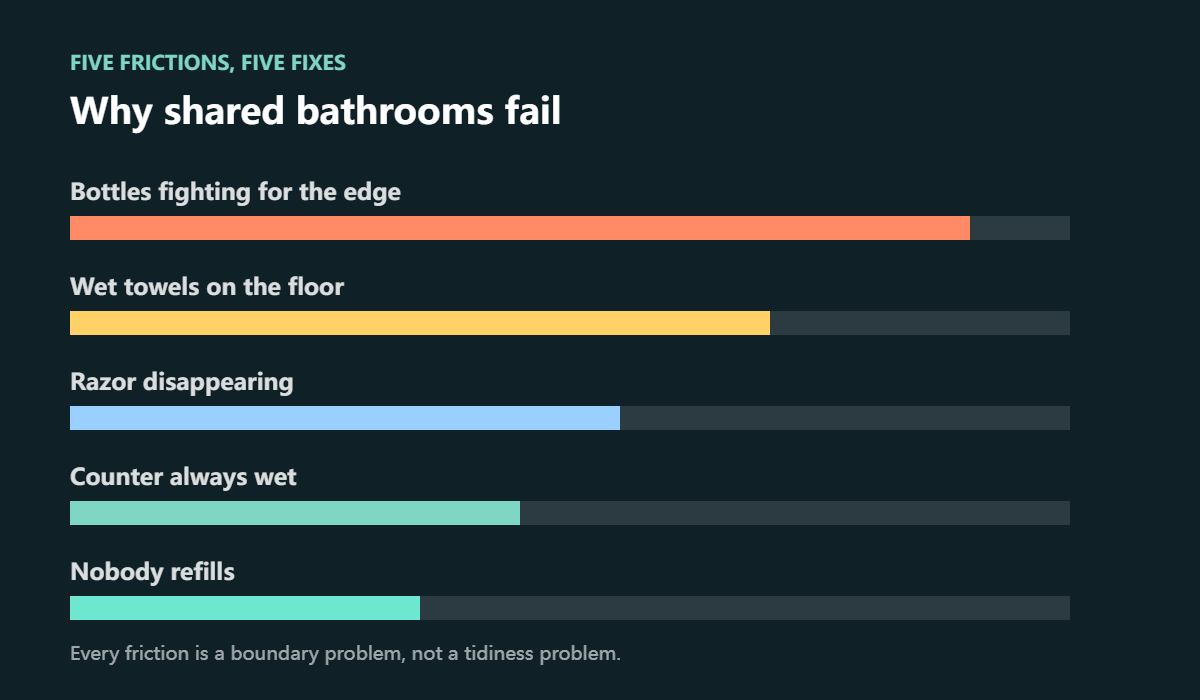
5. The five things that cause 90% of the friction
| Friction | Cause | Fix | Number |
|---|---|---|---|
| Bottles fighting for the edge | One shared shelf, no boundary | One tray per person | 30 cm each |
| Wet towels on the floor | One hook, two towels | Two hooks, 60 cm apart | 5 kg each |
| Razor disappearing | Shared caddy | Personal caddy | 2 units |
| Counter always wet | No drainage | Slotted holder | 2-3 mm film gone |
| Nobody refills | Shared stock, no owner | Alternate months | 12 refills/yr |
6. Hooks: the cheapest fix in the room
Two hooks on the back of the door solve the towel problem for about the price of a coffee. Space them 60 cm apart so two towels can dry without touching – towels that touch stay damp in the middle and smell within a day. Adhesive hooks hold 3-5 kg on smooth, dry paint; if the door is textured or the bathroom steams heavily, use over-door hooks rated 5-10 kg instead.
7. The shower: one wall, two zones
A 75-90 cm wide shower has two usable walls. Give each person half of one wall rather than one wall each – that keeps both caddies inside the 1.0-1.3 m splash band where they dry fastest, and leaves the other wall free for the shower head and controls. Height: mount the bottom edge at 110-120 cm, so the lowest bottles clear the spray at hip height while staying reachable with a wet hand.