A Closet That Holds What You Own: 60 Centimetres, 100 Centimetres and 15 Kilograms

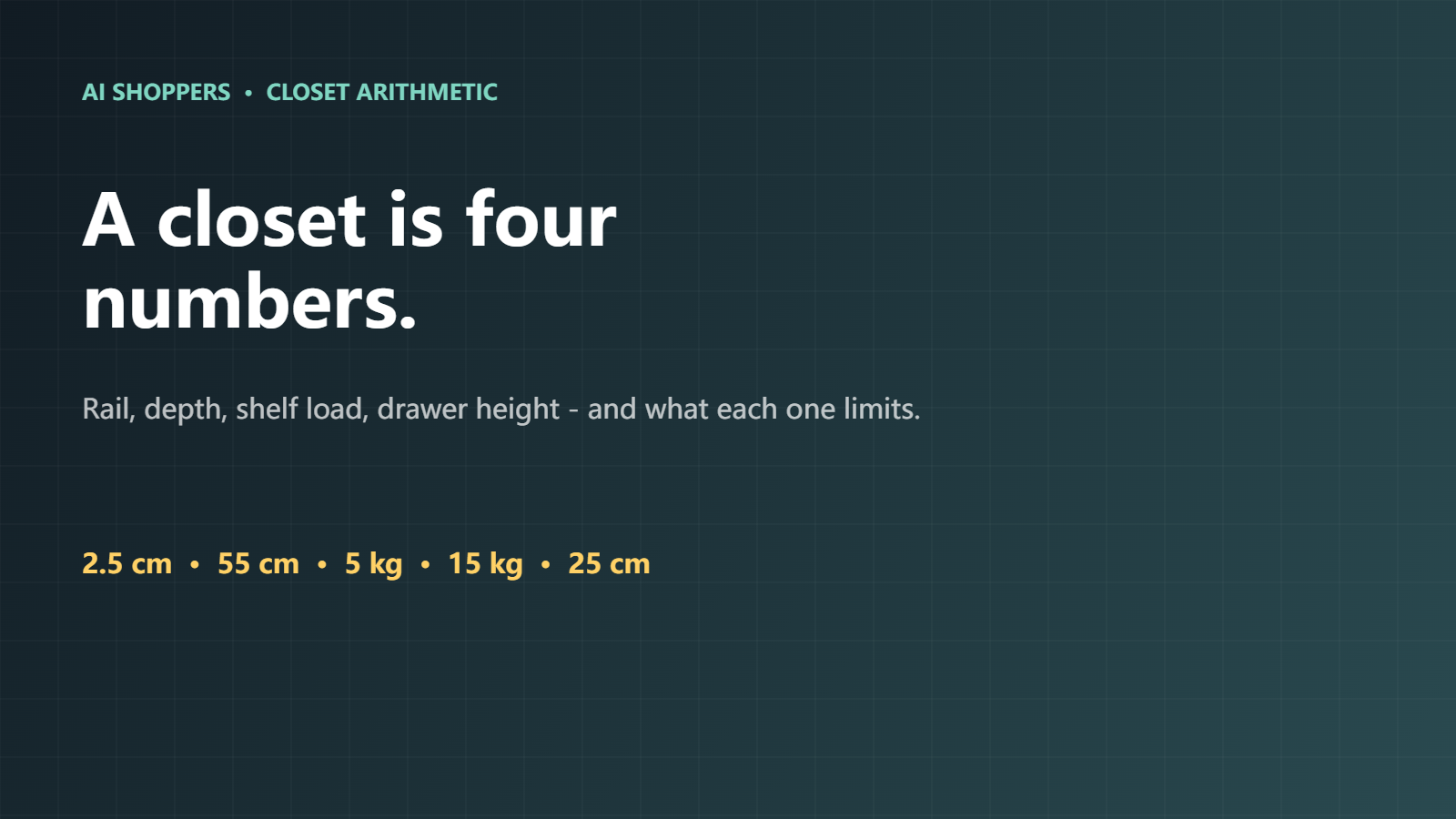
Rail, depth, shelf load and drawer height: the four numbers that decide what a closet holds.

Closet dimensions
Four numbers decide what a closet can hold.

Most closets are not too small; they are divided wrongly. A standard wardrobe is 60 cm deep and 100 cm wide per section, and that geometry sets hard limits: how many hangers fit, how much weight a rail carries, how deep a shelf can be before the back disappears. Once you know the four numbers, deciding what stays and what goes stops being an emotional exercise and becomes arithmetic.

1. The rail is the budget

A 100 cm rail holds roughly 15-20 garments on standard hangers, because each hanger needs about 2.5 cm of rail once clothes are on it – more for coats, less for shirts. That is the entire budget for hanging space in a standard section. Everything beyond it either goes on a shelf, in a drawer, or out of the closet. Measuring your rail and dividing by 2.5 gives you a number you can defend against every “but I might wear it”.

2. Depth: 60 cm outside, 55 cm usable

Wardrobes are 60 cm deep so that a hanger fits front-to-back with the door closed. Subtract the door and the back panel and you have about 55 cm of usable depth. That number matters because shelves deeper than 30 cm become two rows – and the back row is where things go to be forgotten. For folded clothes, 30-35 cm is the practical depth; the rest of the depth belongs to hanging, not stacking.

3. Double-hang: 40 cm each, not 50

A double-hang section splits one 200 cm height into two rails. Shirts need about 40 cm of vertical space, trousers 45, jackets 55 – so a double-hang works for shirts and folded trousers but not for coats. Putting a coat rail at 100 cm means the hem touches the lower rail; that is how clothes end up creased and how the lower rail becomes unusable.

4. The five-kilo shelf

A 16 mm shelf in a standard wardrobe carries about 5 kg before it starts to bow visibly. Five kilos is roughly eight jumpers or four pairs of jeans. That is less than most people assume, which is why the top shelf – the one loaded with “seasonal” items – sags in the middle after two winters. Heavier items belong on the floor of the closet or on a shelf with a mid-support.

5. The 15 kg question

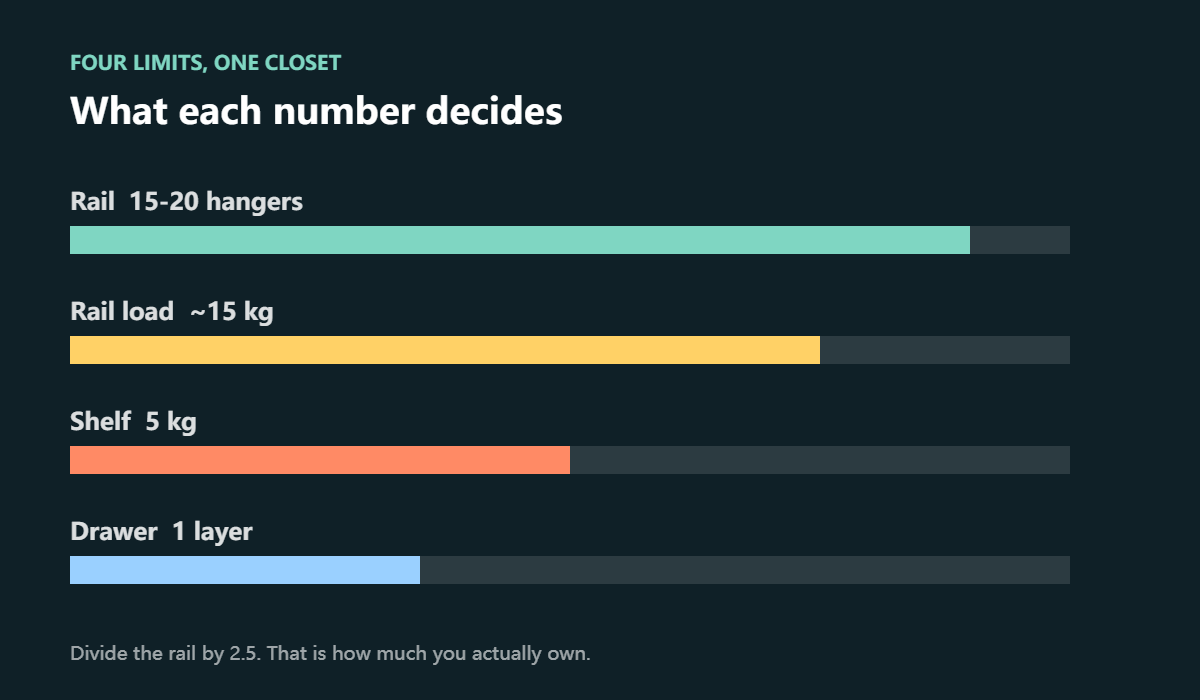
Element Typical limit What it means Failure sign
Rail, 100 cm 15-20 hangers 2.5 cm per hanger Clothes compressed, hard to slide
Rail load ~15 kg Coats are 1.5-2 kg each Rail bows, brackets pull
Shelf, 16 mm ~5 kg 8 jumpers Visible sag in the middle
Shoe shelf depth 25 cm 15-20 pairs Heels overhang the edge
Drawer height 15-20 cm One layer of folded tops Contents jam on closing
Closet limits
Four limits, one closet.

6. Shoes: 25 cm and 20 pairs

A pair of adult shoes occupies about 25 cm of depth and 30 cm of width, so a 100 cm wide shelf at 25 cm deep holds three pairs per row and roughly 15-20 pairs across four shelves. Anything deeper is wasted; anything shallower lets heels overhang and mark the door. Keep shoes off the floor of the closet if the closet is carpeted – moisture and grit destroy both.

7. Drawers beat shelves for small items

Small items – underwear, socks, belts, swimwear – belong in drawers 15-20 cm deep, one layer each. A shelf of loose small items becomes a pile within a week, and a pile hides what you own, which is the actual reason people “have nothing to wear”. A drawer with dividers shows everything at once; a 30.5 x 10.2 x 7.6 cm insert fits two abreast in a standard 60 cm drawer and keeps categories separate.
8. Fold vertically, not in stacks

Folding into a stack means the item at the bottom is invisible and gets worn least. Folding into a file – each item standing on edge – shows every garment at once and fits roughly 30% more into the same drawer, because you are not leaving air gaps between layers. The method costs nothing; it just requires the drawer to be shallow enough to see into, which is why 15-20 cm is the right height.

9. Seasonal rotation, twice a year

Two rotations a year – spring and autumn – keep the closet at the size of the current season rather than the size of the year. Coats out in April, linen out in October; the off-season lives in lidded boxes on the top shelf, labelled by destination. The rotation takes about an hour and frees roughly a third of the hanging space each time, which is more than any reorganisation product delivers.

10. What to remove, and how to decide

Three tests, applied in order. Does it fit right now? Has it been worn in the last twelve months? Would you buy it again at full price? A garment that fails two of the three is occupying 2.5 cm of rail and about 0.15 cubic metres of volume – the same space as a pair of shoes you actually wear. Removing twenty such items gives back half a metre of rail, which is the single biggest storage gain available in most bedrooms.

11. Measure in ten minutes

  1. Rail length, in centimetres, divided by 2.5 – your hanger budget.
  2. Usable depth: total depth minus door and back panel, usually 55 cm.
  3. Shelf height clearance: 30 cm for folded stacks, 40 cm for shirts hanging.
  4. Drawer internal height at the runner: 15-20 cm is one layer.
  5. Floor space for shoes: 25 cm depth, 30 cm width per pair.

12. The one-page plan

Write four lines and stick them inside the door: rail holds 18 hangers; shelves hold 5 kg each; drawers hold one layer; shoes live at 25 cm depth. Every future purchase gets checked against those four numbers before it comes home. It sounds bureaucratic for a wardrobe; it is the difference between a closet that works in year three and one that needs reorganising every spring.

Frequently asked questions

How many hangers fit on a 100 cm rail?

About 15-20 with clothes on them, at roughly 2.5 cm per hanger. Coats take more space than shirts, so a coat-heavy rail holds closer to 12.

How much weight can a wardrobe rail hold?

Roughly 15 kg in a standard section. Coats at 1.5-2 kg each reach that with eight or nine garments, which is why heavy outerwear belongs at the end nearest a bracket.

What is the right shelf depth for folded clothes?

30-35 cm. Deeper shelves become two rows, and the back row is where clothes stop being worn.

Why do my drawers jam?

Usually overfilling rather than the runner: a 15-20 cm drawer holds one layer of folded tops. Add a second layer and the contents catch on the frame.

Is double-hanging worth it?

For shirts and trousers, yes – two 40 cm rails replace one 80 cm span. For coats and dresses, no: they need 55-60 cm of drop.

Honest disclosure: dimensions and loads are typical values for standard wardrobe construction, not a specification for your unit.

Gear referenced in this guide

Cloth travel organizer

Cloth Card and Cosmetic Travel Organizer, 450 g

Flat and light: the packing logic that keeps a drawer visible, applied to a bag.

$67.99

Bamboo drawer organizer

Bamboo Kitchen Drawer Organizer Box, 30.5 x 10.2 x 7.6 cm

Two fit a 60 cm drawer abreast – the dividers that stop small items becoming a pile.

$53.99

Compare on Amazon — this category usually has more brands, sizes and price points there.

Check current prices on Amazon →

As an Amazon Associate we earn from qualifying purchases. The price you pay is unchanged. Disclosure

Structured guide fields (summary, verdict, best for, criteria, pros and cons) appear here once content is added.
0 0 votes
文章评分
Subscribe
Notify of
guest
0 评论
Oldest
Newest Most Voted