Laundry Without a Utility Room: 8 Kilograms, 60 Centimetres and a Fifteen-Minute Sort
8 kg, 60 cm and three baskets: laundry storage when there is no utility room.
No utility room: still clean clothes.
A washing machine is 60 cm wide and takes an 8 kg load; a dryer is the same. Together they need 1.2 metres of wall and a door swing. In a flat without a utility room, that geometry has to fit into a bathroom, a kitchen end or a hallway cupboard – and the storage that makes laundry bearable is not the machine, it is everything around it.
1. Start with the machine footprint
A freestanding washer is 60 cm wide, 60 cm deep and 85 cm tall. Stacked with a dryer it becomes 1.7 metres tall, which is the practical limit for reaching the top controls without a stool. Side by side, the pair takes 1.2 metres of width and leaves a 60 cm worktop above – the single most useful surface in a small laundry setup, because it is where the sorting happens.
2. The 15 cm gap nobody uses
Between the machine and the wall there is usually a gap of 2-15 cm for hoses and vibration. A narrow pull-out unit – 15 cm wide, 50 cm tall – holds detergent, softener and stain spray within reach without eating the worktop. It is the cheapest storage in the room and the one most often left as dead space.
3. Three baskets, not one
The fifteen-minute sort works because there are three destinations: whites, colours, and “hand wash or dry clean”. One basket forces a second sort later; three baskets in a row let you sort while unloading, in one pass. Each basket needs about 40 litres, which is roughly a 45 x 35 x 30 cm box – and 40 litres of dry laundry weighs 3-4 kg, which is liftable.
4. Loads, weights and the 8 kg number
Item
Weight
What it means
Note
8 kg drum
8 kg dry laundry
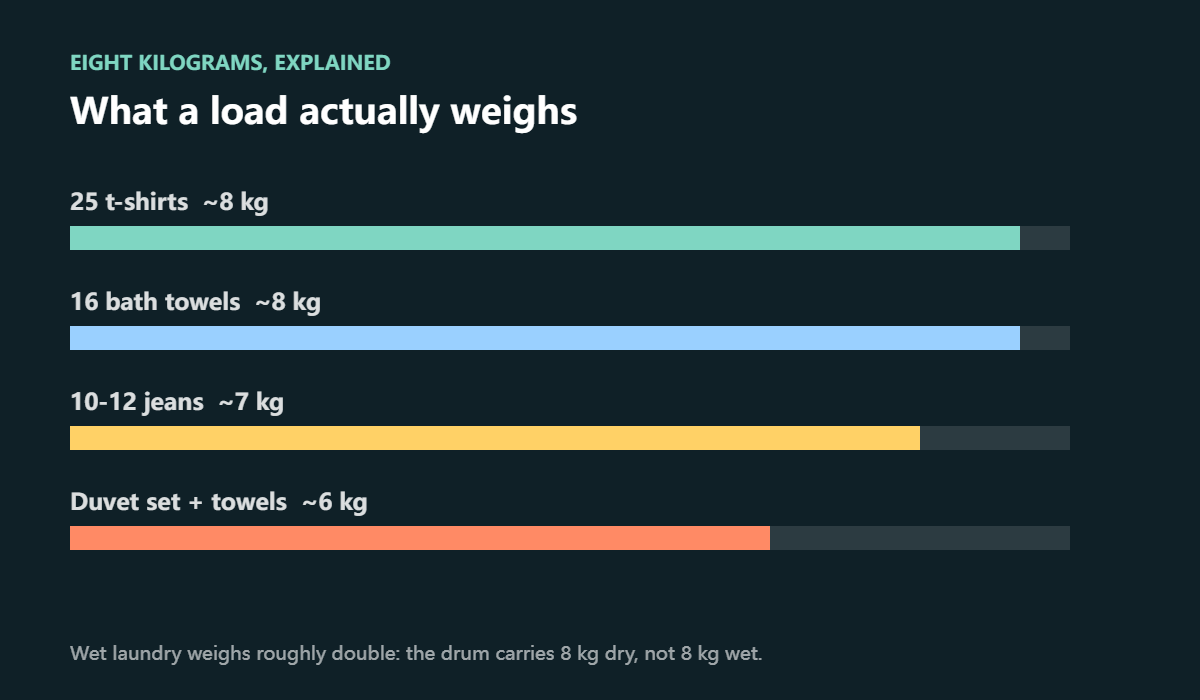
About 25 t-shirts
Wet weight is roughly double
Single duvet cover
~0.8 kg
Fits with sheets
Leave 20% space
Bath towel
~0.5 kg dry
16 per load
Wet: ~1 kg each
Jeans
~0.6 kg
10-12 per load
Heavy when wet
Full basket
3-4 kg
One load
Under the 5 kg lift limit
What an 8 kg load actually looks like.
5. Why the drum is only 80% full
An 8 kg drum takes 8 kg of dry laundry, but only if the clothes can tumble. Packed to the top, they cannot, and the machine uses more water, more detergent and more time for a worse wash. The practical rule is 80% of the rated load – 6.4 kg – which is about 20 t-shirts or one duvet set plus towels. Overloading is also what breaks drum bearings prematurely, and a bearing replacement usually costs more than the machine is worth.
6. Detergent: the 40 ml question
Most dosing instructions are written for a 5 kg load in soft water. In hard water, or with a full 8 kg load, 40 ml of liquid detergent is often right where 25 ml is too little and 60 ml leaves residue. Residue is what makes towels stiff and washing machines smell – not dirt. A 40 ml dose across 300 washes is 12 litres a year, which is a useful number when comparing concentrate against standard bottles.
7. The drying problem
An 8 kg wash holds roughly 6-8 kg of water after spinning, and that water has to go somewhere. A condensing dryer takes 2-3 hours per load and adds heat to the room; a heat-pump dryer takes longer but uses about half the energy. Without a dryer, a 1.8 metre drying rail holds one full load and needs 15-20 cm of wall space when folded – which is why fold-flat rails beat wall-mounted racks in small flats.