The Pet Corner: Five Kilos, Sixty Centimetres and Where the Leash Actually Goes
Three zones, 60 cm of wall and a 5 kg limit: where pet gear actually belongs.
Sixty centimetres of wall, three height zones.
Pet gear accumulates faster than almost anything else in a home: a leash, a harness, a towel, food, treats, a brush, nail clippers, the emergency vet card. None of it is large, and all of it ends up on the floor by the door. The fix is a dedicated corner with three height zones and a 5 kg limit – and it takes about 60 centimetres of wall to build.
1. Why the door is the right place
Every walk starts and ends at the same door, and every piece of gear is used in that sequence. Storing it anywhere else means walking through the flat twice per walk – about 700 extra steps a week for a dog walked twice a day. The door also has 200 cm of height and 80 cm of width that is usually empty, which is roughly 1.6 square metres of unused surface.
2. Three zones, three jobs
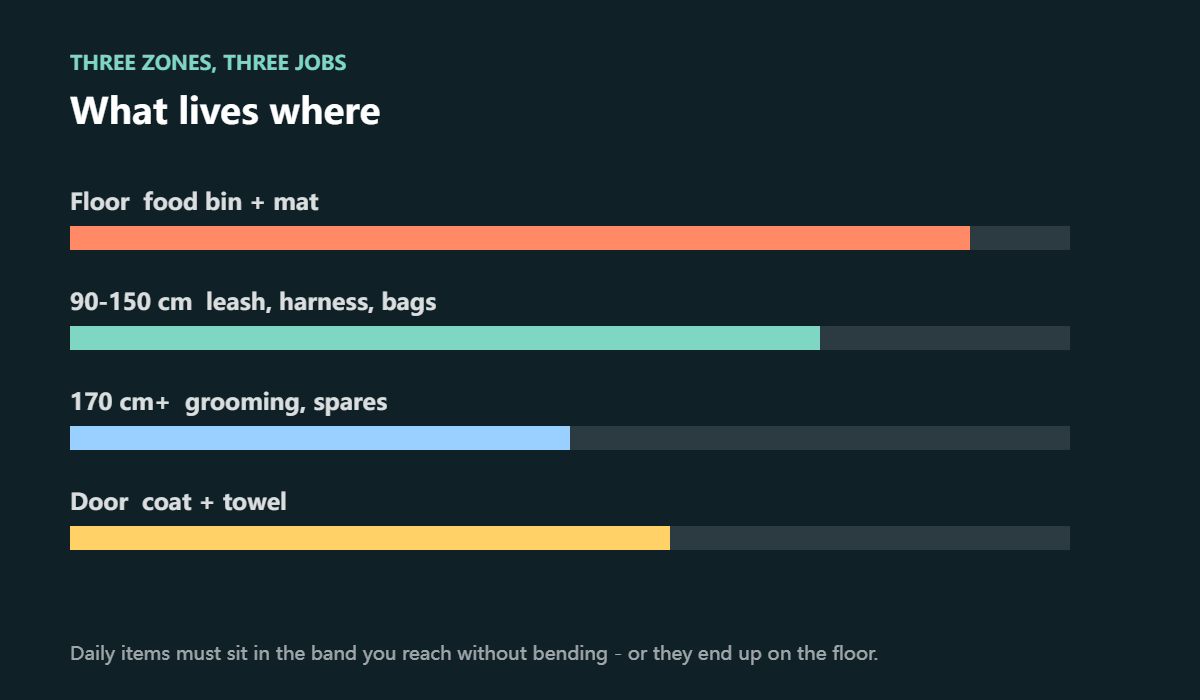
Zone A (below 60 cm): the heavy, dirty things – food bin, water bottle, towel. Below 60 cm is where you crouch, and it is exactly right for items you lift once a day rather than five times.
Zone B (90-150 cm): the daily items – leash, harness, bags, treats. This is the band reached without bending or climbing, and it is the only band that gets used reliably every single day.
Zone C (above 170 cm): the seasonal and the spare – grooming kit, spare harness, travel bowl. You need a step to reach it, which is fine for monthly items and bad for anything used daily.
3. The 5 kg rule for door hooks
Most over-door hooks carry 5-10 kg. That sounds generous until you add it up: a large dog harness is 0.3-0.6 kg, a retractable leash 0.4 kg, a raincoat 0.3 kg, a towel 0.4 kg, a treat pouch 0.3 kg. Six items is roughly 2.5 kg – inside the limit – but two leads plus a wet towel plus a bag of kibble is not. Keep food off the door; it belongs on the floor.
4. Food storage: the 10 kg number
A 10 kg bag of dry food is the most common size, and it is also the hardest to store: opened bags go stale in 4-6 weeks, and the bag itself does not stand up. A lidded bin of 15-20 litres holds about 8 kg and keeps the food sealed; the remainder stays in the original bag, folded and clipped. Store it below 25 C, away from the radiator, and never decant the whole bag into a bin you cannot seal properly.
5. What actually fits in 60 cm
Zone
Height
Items
Limit
Floor
0-60 cm
Food bin, water bowl, towel
8-10 kg bin
Daily band
90-150 cm
Leash, harness, bags, treats
2.5-3 kg
High shelf
170 cm+
Grooming kit, spares, travel bowl
5 kg shelf
Door back
80 x 200 cm
Leash, coat, towel
5-10 kg hooks
What lives where – and why the daily band matters most.
6. The wet-towel problem
A dog towel after a rainy walk holds 300-500 ml of water. Hung on a hook against a wall, it stays damp for a day and starts to smell within three. The fix is a hook on the back of a door, where air moves on both sides, or a small basket with a removable liner that goes in the wash with the towel. Either way, the towel needs air, not a closed box.
7. Grooming without a dedicated room
Brushing a dog produces a surprising volume of hair – a medium breed sheds roughly a carrier bag per week in season. A grooming kit that lives in one basket (brush, comb, nail clippers, styptic powder, treats) can be carried to wherever the dog is, which is the whole advantage over a fixed grooming station. Keep the basket above 170 cm so it is out of the way between uses.