Most storage advice assumes a garage, a loft or a spare room. Without one, bulky objects – the Christmas box, the suitcase, the folding chairs, the vacuum – have nowhere to go except the floor, where they cost circulation. The fix is not more cupboards; it is matching the shape of the object to a specific kind of space. There are five shapes that cover almost everything, and each one has a different home.
1. Shape one: the flat slab
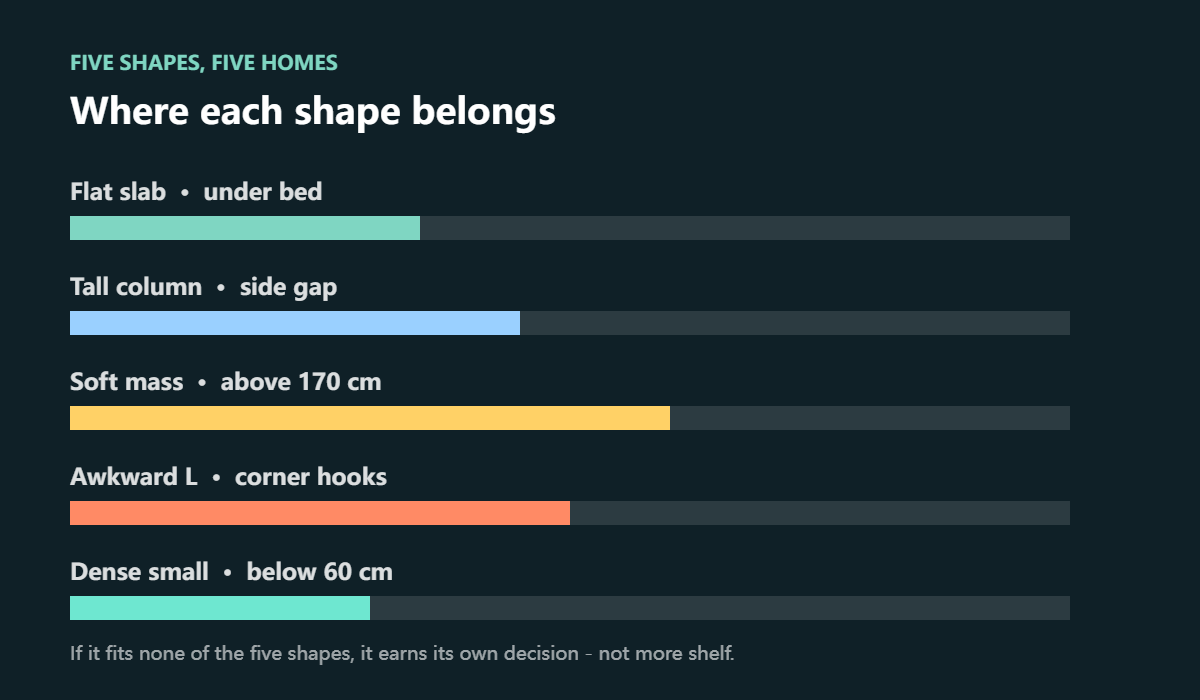
Suitcases, folding tables, framed pictures and ironing boards are flat and wide. They belong under a bed or behind a door, where the depth is 25-30 cm and the width is irrelevant. A standard single bed leaves 25-30 cm of clearance, which takes a 23 kg suitcase lying flat with room for two shallow boxes on top. The rule: if it is wider than it is tall, store it horizontally in the lowest available slot.
2. Shape two: the tall column
Vacuum cleaners, floor lamps, mops and rolled rugs are tall and narrow. They belong in a vertical slot – the 30-40 cm gap beside a wardrobe, behind a door, or at the end of a kitchen run. A 2 m ceiling gives you 200 cm of column height, and most of that is unused because people only think in shelves. One tension rod plus two hooks turns a 35 cm gap into a broom cupboard.
3. Shape three: the soft mass
Duvets, pillows, winter coats and curtains are soft and compressible. They belong in vacuum bags or lidded boxes above 170 cm, where nobody needs daily access. A double duvet compresses to roughly 40 litres, which fits a 60 x 40 x 30 cm box. The catch: never store soft items damp, and never seal them in a plastic bag in a cold room – condensation forms inside and the smell is permanent.
4. Shape four: the awkward L
Bikes, ironing boards, step ladders and drying racks are long with a protrusion. They are the hardest category, because no box fits them and they cannot be stacked. The practical answers are: a wall-mounted hook pair at 150-170 cm (for bikes, with the front wheel turned), a folding version that collapses to under 10 cm, or a dedicated corner where the protrusion fits into the angle of the room rather than into the walkway.
5. Shape five: the dense small box
Tools, tins, shoes, cables and paperwork are heavy for their size. They belong low – below 60 cm – and in small boxes, because a 30-litre box of tins weighs 12 kg and will not survive being lifted onto a top shelf twice a year. The rule here is inverted: the heavier the contents, the smaller the box and the lower the shelf.
6. Matching shape to space
| Shape | Examples | Best location | Key measurement |
|---|---|---|---|
| Flat slab | Suitcase, folding table, pictures | Under bed, behind door | 25-30 cm clearance |
| Tall column | Vacuum, mop, lamp, rolled rug | Side gap, behind door | 30-40 cm width |
| Soft mass | Duvet, coats, curtains | Above 170 cm | 40 L per duvet |
| Awkward L | Bike, ladder, drying rack | Corner, wall hooks at 150-170 cm | 10 cm folded |
| Dense small | Tools, tins, shoes | Below 60 cm | Maximum 5 kg per box |
7. The 5 kg rule, applied to boxes
Weight limits are not about the shelf; they are about the lift. A 30-litre box filled with tins reaches 12 kg, and that is the box that gets dropped on a stair or left in the hall for a month. Keep every liftable box under 5 kg, and reserve the 30-litre size for soft or bulky light items. Small, heavy things go in 10-15 litre boxes that can be carried one-handed.