Every home has one: the drawer where chargers go to breed. It weighs about 300 grams, contains six cables you cannot identify, and takes ninety seconds to find the one you need. The fix is not a bigger drawer – it is treating cables as a small inventory with known quantities, known lengths and one place each. This is a storage problem with unusually precise numbers.
1. Count what you own
Before buying anything, empty the drawer and count. A typical household has 6-12 cables and 3-5 chargers, of which 2-3 are used weekly. The rest are spares for devices that no longer exist, or cables for connectors abandoned two phone generations ago. A ten-minute cull usually removes 40% of the volume and leaves a set that can be identified at a glance.
2. The 300-gram reality
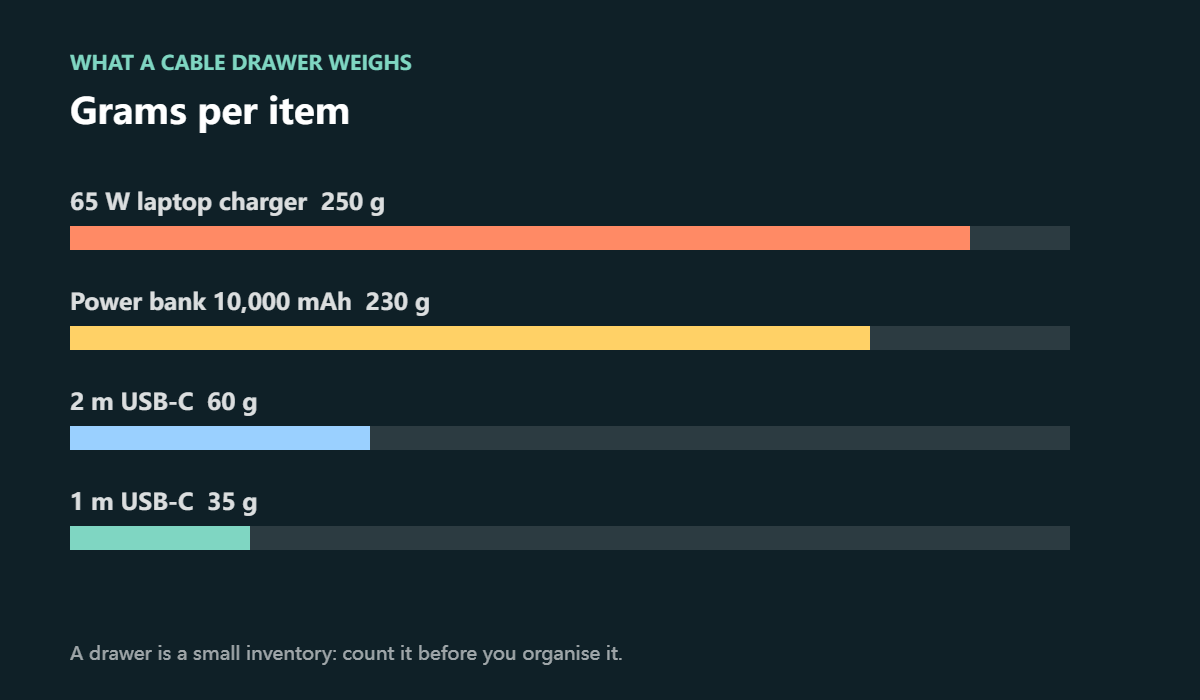
A 1-metre USB-C cable weighs 25-35 g, a 2-metre cable 45-60 g, a 65 W laptop charger 200-250 g, a 30 W phone charger 60-80 g, a 10,000 mAh power bank 200-230 g. A drawer holding six cables, two chargers and a power bank is therefore around 600-700 g – not 300. That matters because the drawer runner and the organiser both have limits: a 16 mm drawer bottom handles 5 kg, but a cheap runner starts to bind at 8-10 kg, and a tangled mass is heavier than a sorted one because of the knots.
3. Length is the whole problem
A 2-metre cable coiled badly occupies 15 x 15 x 5 cm – about 1.1 litres. The same cable coiled properly occupies 12 x 8 x 3 cm, about 0.29 litres. Four badly coiled cables equal a shoebox of dead space, which is why the drawer feels full at 600 g. The trick is a 15 x 10 cm pouch or a hook-and-loop tie: coil to 10 cm diameter, tie at both ends, and stack on edge like files.
4. One cable, one label
| Item | Weight | Coiled size | Where it lives |
|---|---|---|---|
| USB-C 1 m | 25-35 g | 8 x 6 x 2 cm | Daily pouch |
| USB-C 2 m | 45-60 g | 12 x 8 x 3 cm | Travel pouch |
| 65 W laptop charger | 200-250 g | 10 x 7 x 4 cm | Desk, fixed |
| 30 W phone charger | 60-80 g | 6 x 5 x 3 cm | Bedside |
| 10,000 mAh bank | 200-230 g | 14 x 7 x 2 cm | Bag, always |
5. Divide by location, not by type
Cables live where their devices live: one charger permanently at the desk, one at the bedside, one in the travel pouch. Sorting by type – “all USB-C together” – fails because the cable you need is always in the wrong room. Sorting by location means the drawer only holds what has no fixed home: spares, adapters, the card reader, the camera cable.
6. The insert that actually works
A drawer insert with 30.5 x 10.2 x 7.6 cm compartments fits two abreast in a standard 60 cm drawer and keeps categories separate: adapters, short cables, long cables, unknowns. The 7.6 cm depth is the important number – deep enough for a coiled 2-metre cable on edge, shallow enough that nothing buries underneath. A deeper box simply lets the tangle reform at the bottom.