
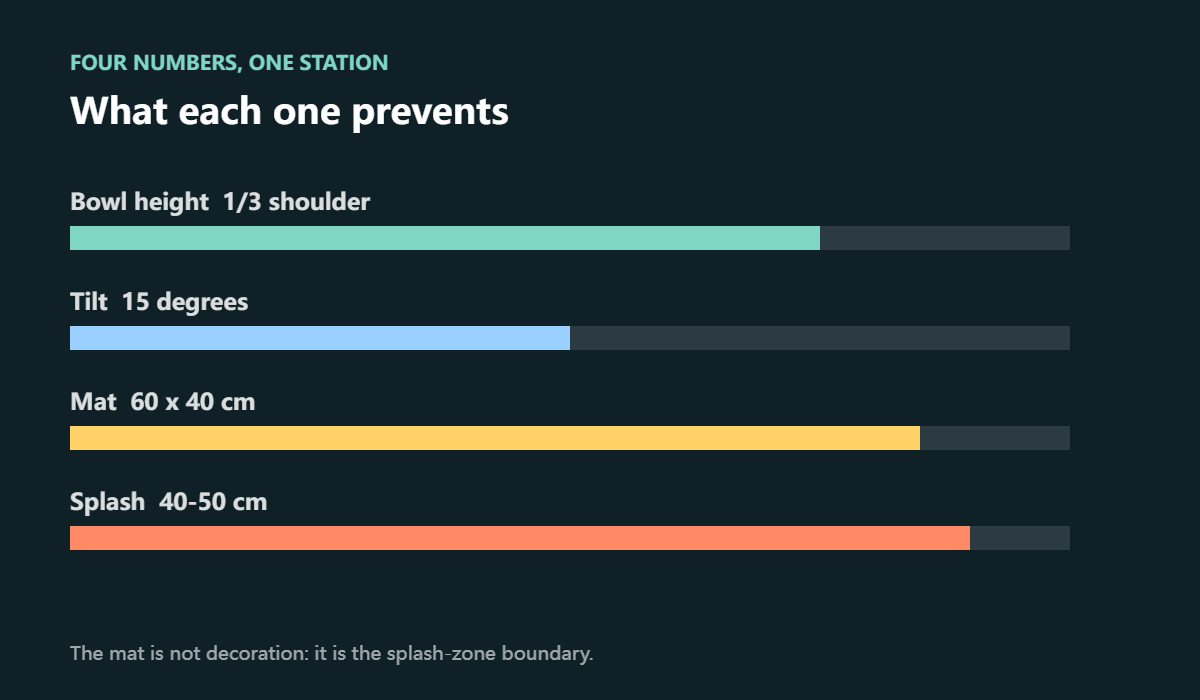
A feeding station looks like the simplest thing in the house – two bowls on a mat – and it is the one that decides how much kibble ends up on the floor, how often you wash the mat, and whether an older dog eats in comfort. The numbers are small: 10-15 cm of bowl height, a 15-degree tilt, a mat of 60 x 40 cm, and a 40-50 cm splash radius. Get them right and feeding stops being a daily cleaning job.
1. Bowl height is a joint decision
A cat eats comfortably with the bowl at floor level; a large dog does not. The rule of thumb relates bowl rim height to the dog’s shoulder: roughly one third of shoulder height for a raised feeder. A 60 cm beagle does well at 15-20 cm; a 70 cm Labrador at 20-25 cm. Below that, the neck angles down and the front legs splay; above it, the dog has to reach and swallows air.
2. The fifteen-degree tilt
A bowl tilted 15 degrees toward the animal reduces neck flexion without raising the rim. It matters most for flat-faced breeds and for older animals with arthritis, where a shallow angle is the difference between finishing a meal and leaving half of it. Tilted bowls also slow fast eaters slightly, because the food gathers at the low edge.
3. Why the mat is 60 x 40 cm
| Item | Typical size | Why | Watch out |
|---|---|---|---|
| Food bowl | 16-20 cm diameter | Fits a 10 kg bag portion | Too deep = whisker fatigue in cats |
| Water bowl | 18-22 cm | Holds 500-800 ml | Refill twice daily |
| Mat | 60 x 40 cm | Catches the 40-50 cm splash | Needs a raised lip |
| Raised rim | 1.5-2 cm | Stops water running off | Flat mats fail in a week |
| Stand height | 10-25 cm | One third of shoulder height | Adjustable is better |
4. The splash zone is 40-50 cm
A dog drinking from a 20 cm bowl flicks water roughly 40-50 cm in front of and beside the bowl; a cat flicks less but drinks more often. That is why the mat has to be wider than the bowls by at least 15 cm on each side – not for aesthetics, but because water lands there. A mat narrower than the splash zone simply moves the puddle onto the floor.
5. Material: what survives daily washing
Silicone mats tolerate hot water and dishwasher cycles and lie flat; TPR mats grip better but warp above 90 C; fabric mats with a waterproof backing look better and need machine washing twice a week. The number that matters is wash frequency: a mat that takes 30 seconds to wipe gets cleaned; one that needs a machine cycle gets left until it smells.
6. The 2 x 4 rule for cats
Cats prefer shallow, wide bowls – roughly 2 cm deep and 14-16 cm wide – because their whiskers touch the sides of narrow bowls. Two bowls side by side, 4 cm apart, separated from the water by at least 20 cm, matches most cats’ preference for not drinking where they eat. That last detail is the one most feeding stations get wrong.