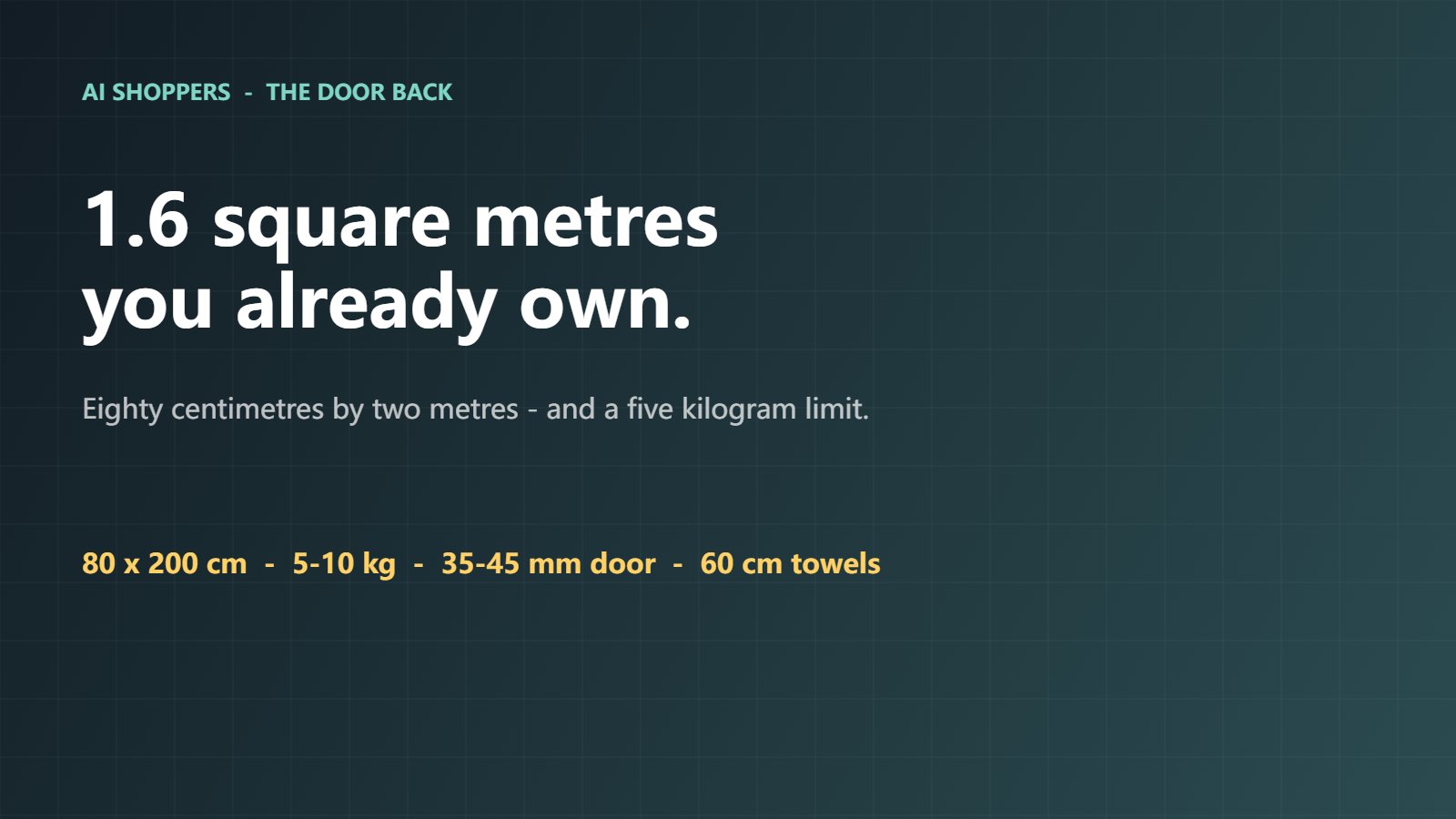
Every home has a surface that costs nothing and holds more than a shelf: the back of a door. A standard internal door is 80 cm wide and 200 cm tall, which is 1.6 square metres of unused vertical space – roughly the same as a small wardrobe, without taking a single centimetre of floor. What stops people using it is not space but load: most door-back failures come from hanging 12 kg on a hook rated for 5.
1. Measure the three clearances first
Before buying anything, measure three things: the clearance behind the door when open (usually 3-5 cm to the frame), the height from floor to the top hinge, and the gap under the door (5-15 mm). A rack deeper than the clearance stops the door opening; a rack taller than the hinge line fouls the frame. The under-door gap decides whether a floor-standing rack will scrape.
2. What a door can actually hold
| Fixing | Rated load | Realistic load | Fails when |
|---|---|---|---|
| Adhesive hook on painted door | 3-5 kg | 2-3 kg | Paint is gloss, cold or dusty |
| Over-door hook (steel) | 5-10 kg | 5-7 kg | Door top thinner than 35 mm |
| Over-door rack, 4 hooks | 10-15 kg | 8-10 kg | Load concentrated on one hook |
| Screw-in rail on solid door | 15-25 kg | 12-18 kg | Hollow-core door skin |
Two numbers matter more than the rating: the door thickness (most over-door hooks are designed for 35-45 mm) and the door material. A hollow-core door has a 3-4 mm skin over a cardboard honeycomb; a screw in it holds almost nothing, while a solid or fire door holds a proper rail.
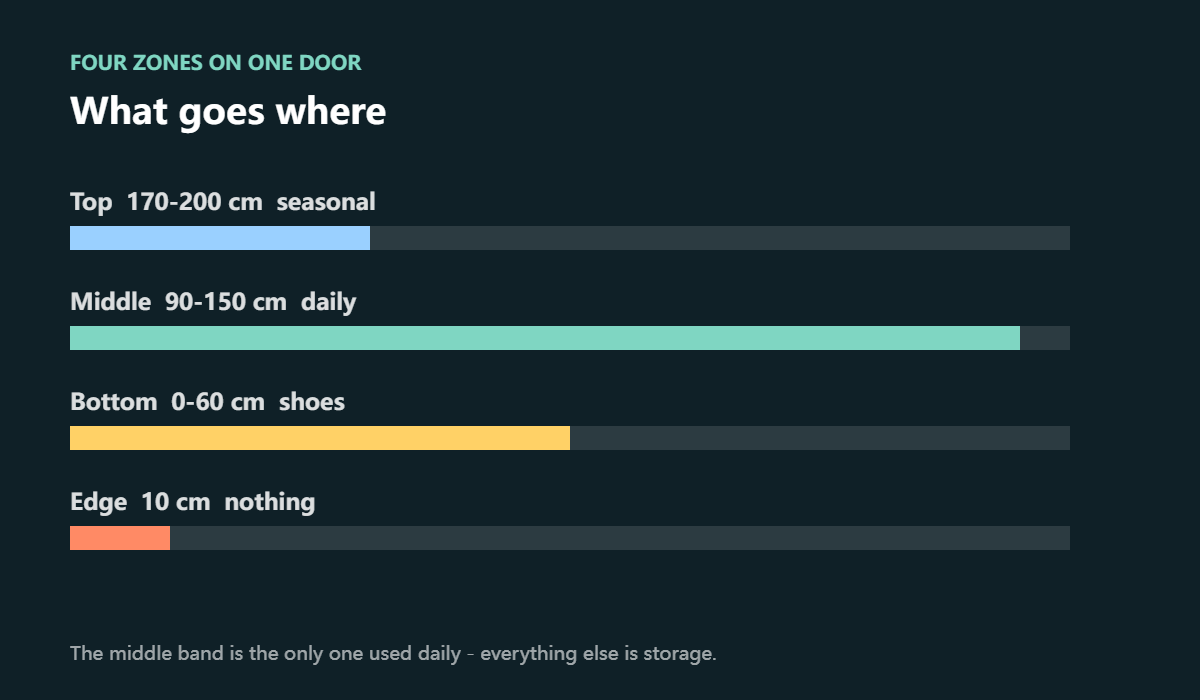
3. The four zones of a door
Top (170-200 cm): seasonal, light, rarely touched – spare bedding in a vacuum bag, hats. Middle (90-150 cm): the reach band, and the only zone used daily – coats, bags, towels, keys. Bottom (0-60 cm): shoes, umbrella, laundry bag. Edge (the 10 cm beside the hinges): nothing, because anything there blocks the swing.
4. Why the middle band is the whole point
Between 90 and 150 cm, an adult reaches without bending or climbing, which is why door-back storage works for coats and fails for boxes. Put the daily eight items in that band and the floor stays clear; put them at 180 cm and they migrate to a chair within a week. This is the same rule that governs kitchen shelves, applied to a surface that is already there.
5. Coats: the 1.5 kg reality
A winter coat is 1.5-2.5 kg, a wet one adds 0.5 kg, and a bag on the same hook adds another 1-2 kg. That is why the four-hook rack rated 15 kg is the right choice for a family hallway and a single adhesive hook is not. Spread the load: heaviest coat nearest a hinge-side hook, where the door is stiffest.
6. Towels and the 60 cm rule
Two towels hung closer than 60 cm apart stay damp in the middle and smell within a day. On an 80 cm door, that means two hooks maximum in the middle band, or one hook plus a rail. A wet towel also weighs about 0.5 kg more than a dry one, which is why bathroom door hooks should be steel, not adhesive.
7. Doors that should stay empty
Three exceptions: fire doors (never drill; and a rack can stop the door closing fully, which is a safety issue), doors with a self-closing mechanism (the added weight changes the closing force), and doors in a corridor narrower than 90 cm, where a rack with hanging items reduces the effective width below the fire-escape minimum.
8. What not to hang on a door
Anything over 2 kg on an adhesive hook; anything that swings (bags push the door); anything that leaks (a wet umbrella above a wooden floor); and anything you need both hands to lift, because you will be holding the door with one. The door-back is for items you grab in passing.
9. The 4 cm clearance problem
An over-door rack adds 3-5 cm to the door thickness. In a hallway where the door already opens to within 2 cm of a wall or a radiator, that is enough to stop it. Measure the gap with the door fully open; if it is under 5 cm, use hooks on the hinge side only, or move storage to the wall instead.
10. A five-point installation check
- Door thickness 35-45 mm, and not hollow-core if you plan to screw.
- Clearance behind the open door at least 5 cm.
- Load spread across at least two hooks.
- Nothing hanging below 10 cm from the floor, or it fouls a rug.
- Door still closes and latches with the full load on.
11. Cleaning and the dust line
The top of a door is a dust trap that nobody sees. Once a quarter, wipe the top edge and the hinge plates; dust there mixes with cooking grease in a kitchen and becomes a sticky film that transfers to hands. Two minutes, four times a year.
12. When a door is the wrong answer
If the hallway is the only circulation route, if the door is a fire door, or if you need to store more than about 10 kg, the door is not the place. The alternative is a 30 cm deep wall unit beside it, which costs floor but carries 30-40 kg and stays out of the swing. Choosing between them is arithmetic, not taste.
Frequently asked questions
How much weight can an over-door hook hold?
Typically 5-10 kg per hook, and 10-15 kg for a four-hook rack. Keep the load spread and stay under the rating; a wet coat plus a bag can reach 3-4 kg on one hook.
Can I use adhesive hooks on a painted door?
Yes, on smooth, clean, cured paint, up to 3-5 kg rated (2-3 kg real). They fail on gloss paint, cold surfaces and dusty doors, and they can lift paint when removed.
Will a door rack stop the door opening?
It can. An over-door rack adds 3-5 cm; if the clearance behind the open door is under 5 cm, use hinge-side hooks or move to a wall unit.
Is it safe on a fire door?
No. Do not drill a fire door, and do not add anything that prevents it closing fully – it is there to hold back smoke and fire.
What should go on a door and what should not?
Daily items in the 90-150 cm band: coats, bags, towels, keys. Not boxes, not more than 10 kg, and nothing that needs two hands to lift.
Honest disclosure: load ratings are typical ranges for domestic hardware; always follow the manufacturer rating and check your door construction.
Gear referenced in this guide

Rotatable Corner Bathroom Organizer, Wall-Mounted
When the door is not an option: wall-mounted, swings out, and uses the corner instead of the floor.
$54.99
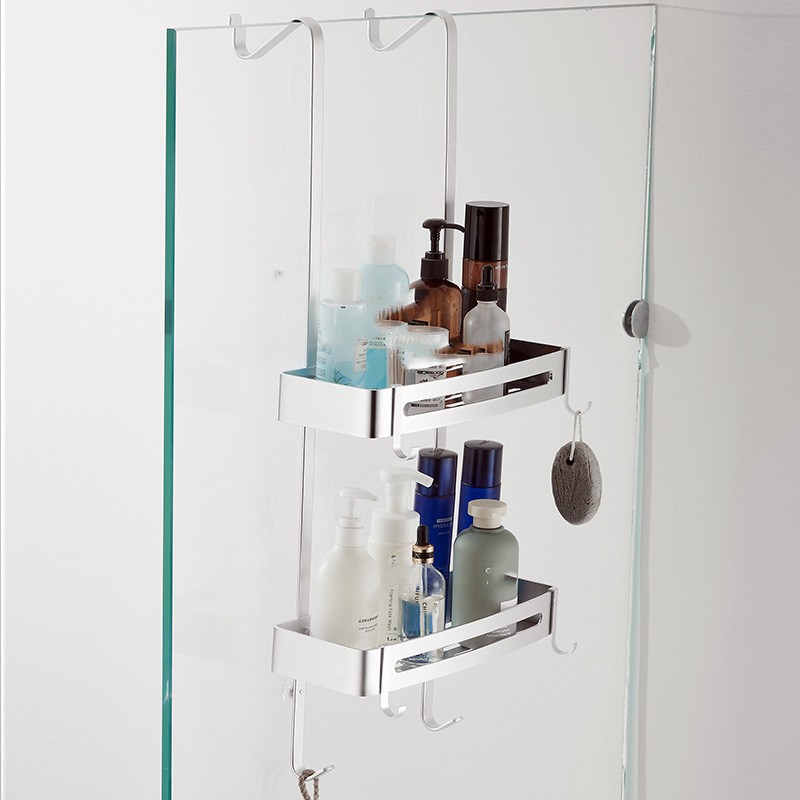
Aluminium Hanging Shower Caddy, Double Basket
Hangs rather than sits – the same load logic as a door rack, applied in a wet room.
$63.99
Compare on Amazon — this category usually has more brands, sizes and price points there.
Check current prices on Amazon →
As an Amazon Associate we earn from qualifying purchases. The price you pay is unchanged. Disclosure