A convenience store holds about 2,000 products in 80 square metres and still lets you find a lighter in four seconds. That is not merchandising magic; it is a set of measurements applied without exception – 40 cm shelves, 15 cm gaps, one facing per item, and everything within arm’s reach of the till. The same numbers work in a 4 square metre kitchen.
1. The 40 cm shelf, and why it repeats
Convenience store shelving is typically 40 cm deep and 90-120 cm wide, in tiers about 15 cm apart. The depth is set by the product: a drinks bottle is 8-10 cm, a bento box 20-25 cm, a magazine 30 cm. Everything fits one row, and one row is the point. A shelf you can see the back of is a shelf where stock does not disappear.
2. One facing per product
“Facing” means the number of units visible from the front. Convenience stores use one facing for slow sellers and two or three for fast ones, because stock behind stock is invisible stock. At home, the equivalent is the drawer where you keep three spatulas; two of them are invisible. The rule is one layer, edge-on, so every item is a facing.
3. The 15 cm tier gap
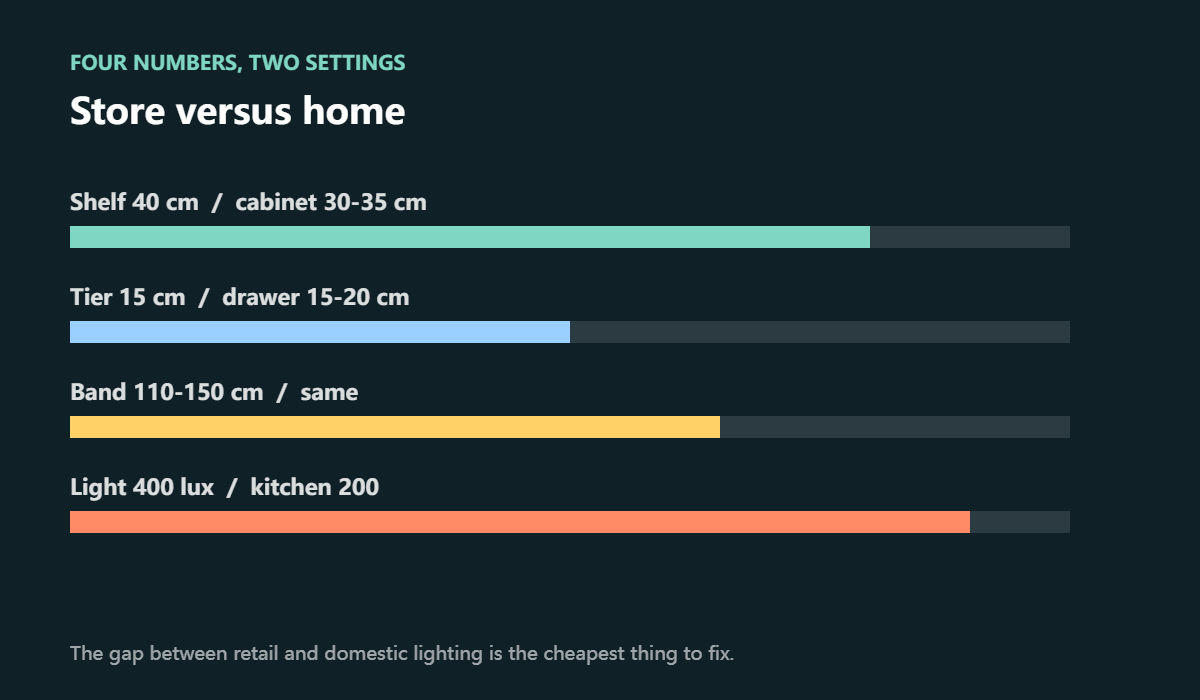
| Zone | Store measurement | Home equivalent | Why |
|---|---|---|---|
| Tier height | 12-18 cm | Drawer 15-20 cm | Fits a hand, blocks stacking |
| Shelf depth | 40 cm | Cabinet shelf 30-35 cm | One row, visible back |
| Eye band | 110-150 cm | Wall shelf band | Reached without bending |
| Gondola length | 1.2 m | Kitchen run 1-1.5 m | Short enough to scan |
| Checkout radius | 1.5 m | Daily items at the door | Highest-frequency items closest |
The 15 cm gap is the one worth copying first. It is tall enough to reach into and short enough that you cannot stack two layers, which is exactly what stops a drawer from becoming a rummage bin.
4. The checkout radius
Everything at a convenience store till is within 1.5 m of where you pay, because those are the highest-frequency purchases. At home the same logic applies to the door: keys, bag, umbrella, dog lead within arm’s reach of the handle. If your daily items live more than 1.5 m from where you enter, they will migrate to a chair.
5. What stores do that homes cannot
Stores can remove anything that does not sell within a set period. Homes cannot, because the decision-maker and the user are the same person with feelings about the object. The workaround is a box with a date on it: anything not opened in twelve months leaves. That is the closest domestic equivalent to a planogram review.
6. The 60-second scan test
Stand at the entrance to your kitchen and look at the counter for 60 seconds. Name every object you can identify without moving anything. A store passes this test by design; most kitchens fail it at about 60%. Anything you cannot name from the doorway is invisible storage, and invisible storage is where duplicates come from.
7. Lighting: 300-500 lux
Retail shelves are lit to roughly 300-500 lux at the product face, brighter than most kitchens at 150-250 lux. The difference is not cosmetic: you buy duplicates because you cannot see what you own. A single LED strip under one shelf, 4000 K, 2-3 W per 30 cm, is the cheapest fix in this article.
8. Category blocking
Stores group by category and never mix: drinks together, snacks together, hot food at the back. Homes mix categories constantly – batteries next to pasta – and then wonder why nothing is findable. Pick three blocks for your kitchen: cooking, eating, cleaning. Anything that does not fit a block goes in the box with the date on it.
9. The vertical limit
Above 170 cm, retail stock needs a step or a pole. Homes are the same: a shelf above 170 cm holds seasonal items, not daily ones. Convenience stores exploit this by putting slow movers high and fast movers at 110-150 cm. Copy the band, not the height.
10. What to buy, in order
First, a drawer insert that enforces one layer. Second, a shelf that keeps the 30-35 cm depth so the back stays visible. Third, a 2 W LED strip under one shelf. Fourth, a dated box for anything that fails the scan test. Nothing else in this article requires spending money.
11. The honest caveat
Stores optimise for a stranger finding a product in seconds; homes optimise for the same person finding it for years. That means two store practices do not transfer: aggressive seasonal resets and the assumption that stock can be thrown away. Keep the measurements, drop the churn.
12. The end-cap lesson
The end of a retail aisle – the end-cap – is the most profitable 60 cm in the store, because it is seen by everyone walking past and requires no decision to approach. Convenience stores put high-margin impulse items there and change it weekly, which is why you leave with a chocolate bar you did not plan to buy. At home the equivalent surface is the counter end nearest the door: whatever lives there gets used, and whatever lives there also gets bought again.
The lesson is not to avoid the end-cap but to control it. Put the two things you actually want to use daily there – the kettle, the fruit bowl – and move everything else 30 cm back. A surface that is 60 cm deep behaves very differently from one that is 90 cm deep, because the back 30 cm stops being decorative and starts being storage.
13. What to copy tomorrow, in fifteen minutes
Empty one drawer and count the layers: if there are two, you have found the problem. Measure its internal height, then buy or build a divider at 15-20 cm. Move the three highest-frequency items to within 1.5 m of the door and put everything else behind a closed door. Finally, stand at the kitchen entrance and name what you can see; anything you cannot name moves to the dated box.
That is the whole adaptation. No shelving system, no labels, no app. Four measurements – 40 cm depth, 15 cm tiers, 110-150 cm band, 300-500 lux – and one rule about visibility. The rest is retail theatre, and you are not selling anything to strangers.
Frequently asked questions
Why 40 cm shelves?
It is deep enough for one row of most packaged goods and shallow enough that the back is visible. Domestic cabinets at 60 cm deep typically have 50-55 cm of usable depth, which is why the back 10 cm becomes dead space.
What is a facing?
The number of units visible from the front. One facing per item is the rule at home: if you cannot see it, you will buy it again.
How tall should drawer compartments be?
15-20 cm internally. Tall enough to reach into, short enough to prevent a second layer forming.
Does lighting really change buying behaviour?
It changes whether you can see what you own. Retail faces run at 300-500 lux; typical kitchens run 150-250. A small LED strip closes most of that gap.
What is the checkout radius at home?
About 1.5 m from the door: keys, bag, umbrella and lead. Daily items further away migrate to whatever surface is nearest.
Honest disclosure: measurements are typical retail and domestic ranges, not standards for any specific store or kitchen.
Gear referenced in this guide
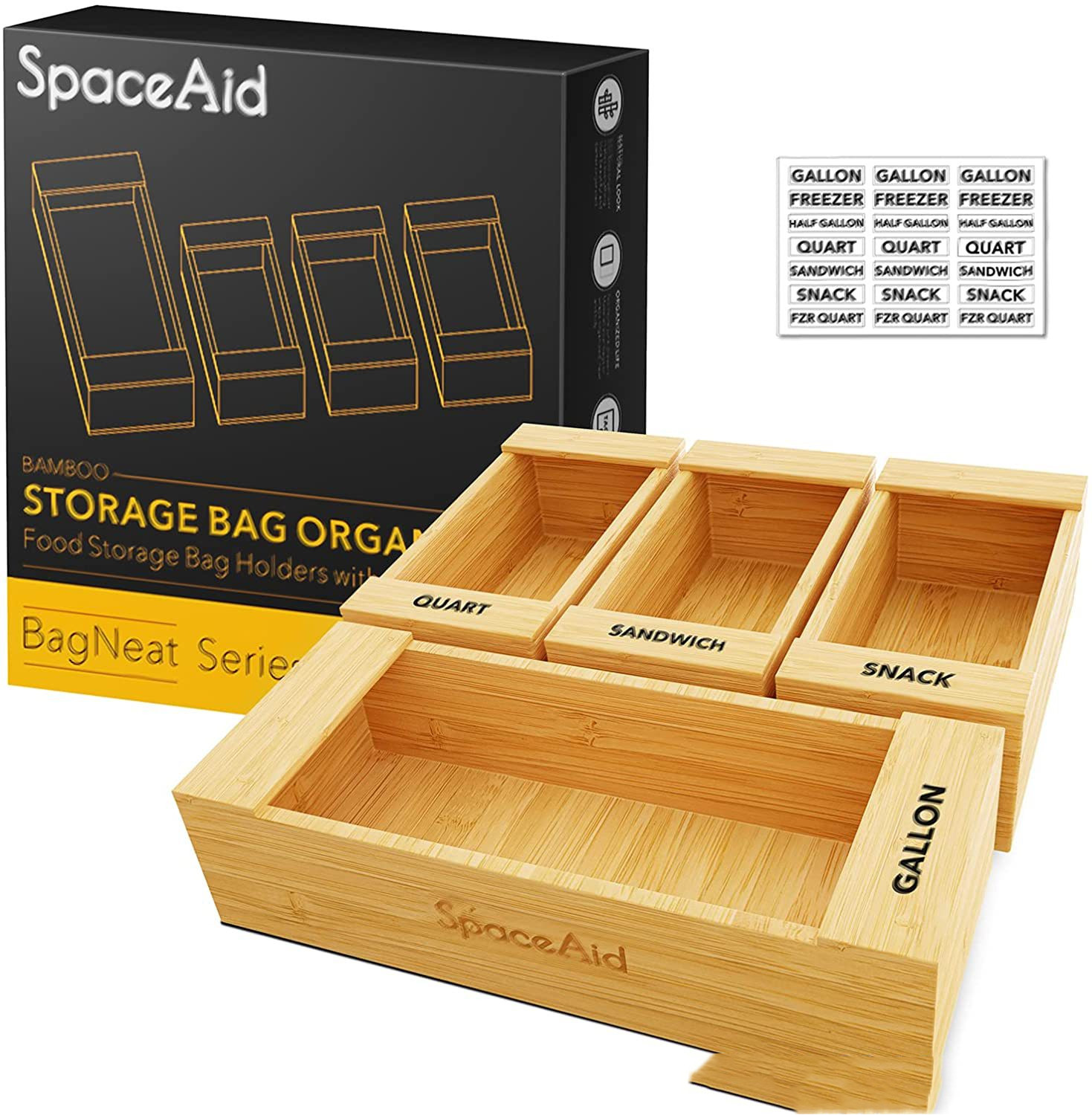
Bamboo Kitchen Drawer Organizer, Expandable
Compartments at the 15 cm depth that keep one layer visible, not two stacked.
$54.99
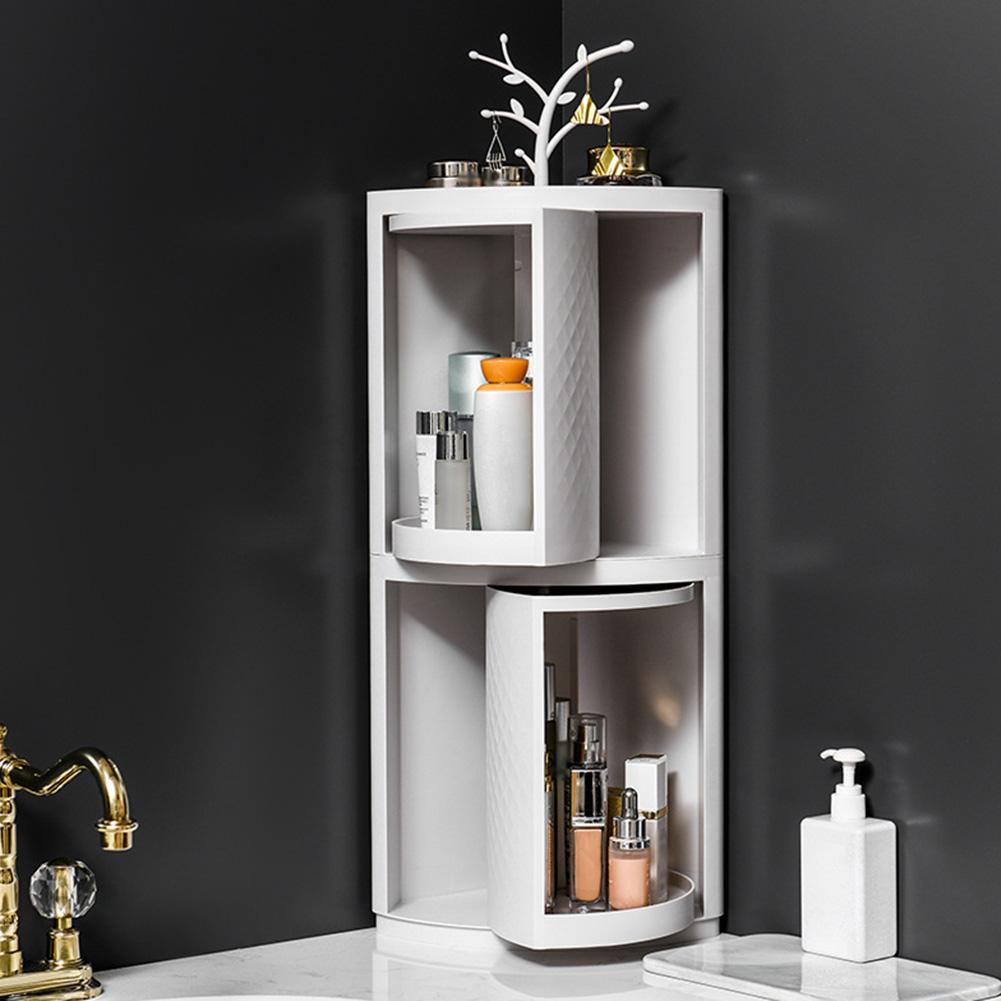
Rotatable Corner Bathroom Organizer, Wall-Mounted
For the corner that a 40 cm shelf cannot use: it swings out so the back stays reachable.
$54.99
Compare on Amazon — this category usually has more brands, sizes and price points there.
Check current prices on Amazon →
As an Amazon Associate we earn from qualifying purchases. The price you pay is unchanged. Disclosure