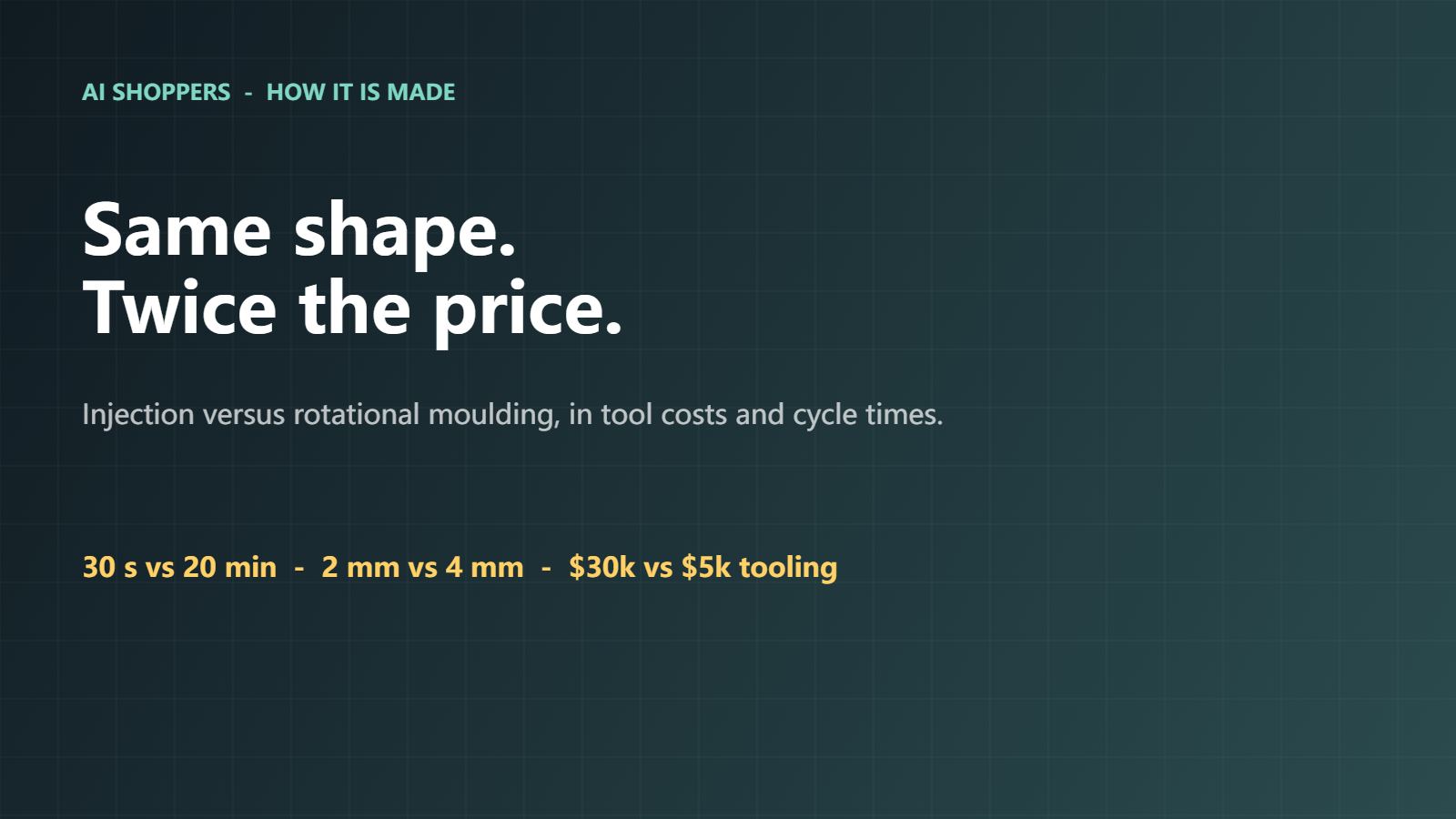
Two bins that look identical on a shelf can differ by a factor of two in price, and the reason is not the plastic – it is the tooling. A rotomoulded bin is made in an aluminium mould that costs a few thousand dollars and takes twenty minutes per cycle; an injection-moulded bin needs a steel tool costing tens of thousands and runs in thirty seconds. Understanding which process made the box in your hand explains its wall thickness, its weight, its price and the way it will fail.
1. The two processes, in one paragraph each
Injection moulding melts plastic pellets and forces the melt into a closed steel tool under high pressure. Cycle time is typically 20-60 seconds, wall thickness 1.5-3 mm, and the tool can survive hundreds of thousands of cycles. The cost sits in the tool: from roughly $5,000 for a small simple part to $50,000+ for a large multi-cavity one.
Rotational moulding puts powder in a hollow mould, heats it while rotating on two axes, and lets the plastic coat the inside. Cycle time is 15-30 minutes, walls are 3-6 mm, and the tool is cheap aluminium – often $2,000-8,000. The part is seamless, stress-free and strong at corners, which is why water tanks, kayaks and heavy-duty bins are rotomoulded.
2. The number that decides the price: tool cost per unit
| Factor | Injection moulding | Rotomoulding | What it changes |
|---|---|---|---|
| Tool cost | $5,000-50,000+ | $2,000-8,000 | Break-even volume |
| Cycle time | 20-60 s | 15-30 min | Labour per unit |
| Wall thickness | 1.5-3 mm | 3-6 mm | Weight and rigidity |
| Tool life | 100,000+ cycles | ~5,000-10,000 | Amortisation |
| Typical bin weight | 0.8-1.6 kg | 2-4 kg | Shipping cost |
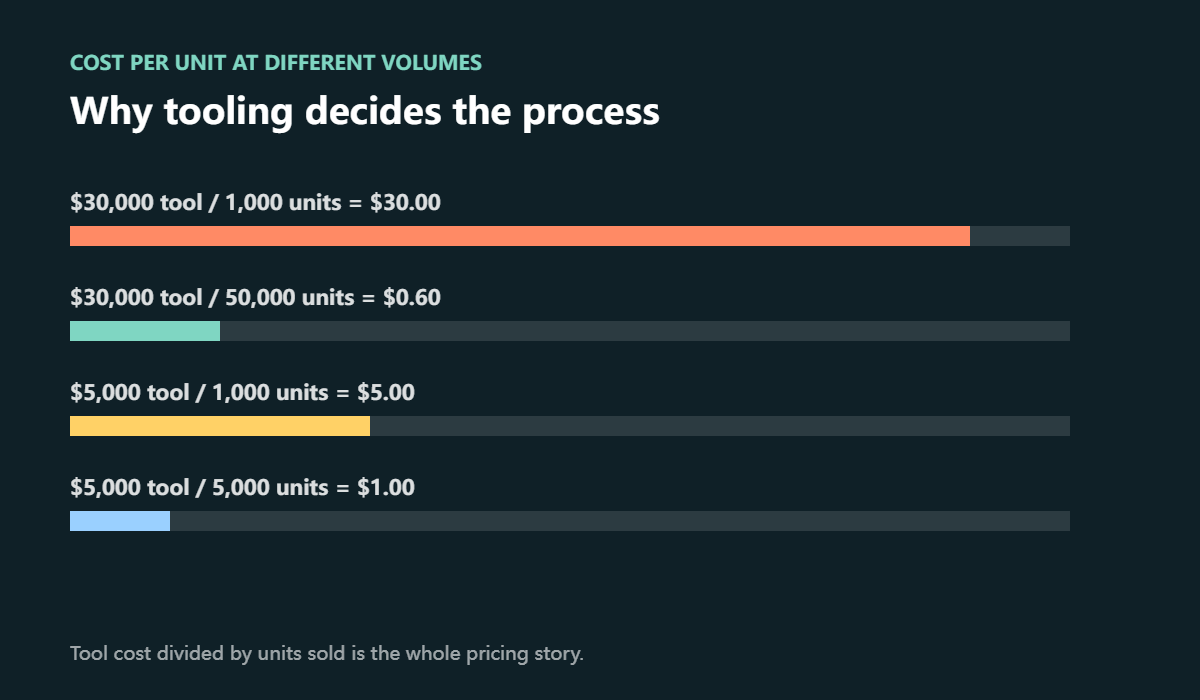
Tool cost divided by units sold is the whole story. At 50,000 units, a $30,000 injection tool adds 60 cents per bin; at 1,000 units it adds $30. That is why low-volume, large-format products are rotomoulded and high-volume small products are injected.
3. Why walls are thicker in rotomoulding
Rotomoulding builds wall thickness by depositing layer after layer of fused powder, so 3-6 mm is normal and 8 mm is possible. Thicker walls are not automatically better: they add weight, slow cooling and can warp if the cycle is rushed. But they do make the part rigid without ribs, which is why a rotomoulded bin feels solid and a thin injected one needs a lattice of ribs inside to stop it flexing.
4. Corners: where the two diverge
An injected part has uniform wall thickness and sharp internal corners are stress concentrators – designers add radii to compensate. A rotomoulded part is seamless and the corners are naturally thicker, so it survives being dropped on a corner in a way that a thin injected shell often does not. For storage that gets dragged across a floor, this matters more than the label on the box.
5. Tolerance: the reason mechanisms are injected
Injection moulding holds tolerances of roughly 0.1-0.5 mm on a well-run tool; rotomoulding holds 1-3 mm because the powder fuses unevenly and the part shrinks as it cools. Anything with a moving joint – a drawer runner, a hinge, a rotating bracket – has to be injected. Anything that only needs to hold volume can be rotomoulded.
6. Surface finish and colour
Injected parts take a moulded texture directly from the tool and hold colour consistently across millions of units. Rotomoulded parts have a slightly uneven surface, and colour is mixed into the powder, so batch-to-batch variation is more visible – which is why large rotomoulded items are often sold in one or two colours rather than twelve.
7. Weight and the shipping trap
Doubling wall thickness roughly doubles weight. A 0.8-1.6 kg injected bin versus a 2-4 kg rotomoulded one is a difference of 1-2 kg per unit, and at international parcel rates that can exceed the manufacturing cost difference. This is why a heavy, sturdy bin often costs more to ship than to make – and why flat-pack designs exist for both processes.
8. Which process made your box: a four-point check
- Look inside: a seam line or ejector-pin marks mean injection moulding.
- Check the wall: uniform 2 mm with internal ribs suggests injection.
- Weigh it against size: a 40-litre bin over 2.5 kg is probably rotomoulded.
- Look at corners: thick, rounded, seamless corners point to rotomoulding.
9. Where the price difference comes from
Take two 40-litre bins at retail. The injected one: tool amortised over 100,000 units, 30-second cycle, 1.2 kg of plastic, $3-5 ex-works. The rotomoulded one: tool amortised over 5,000 units, 20-minute cycle, 3 kg of plastic, $12-18 ex-works. Retail multiples are similar; the difference in cost is tooling amortisation, labour time and material weight – not brand markup.
10. Failure modes are different too
Injected bins fail at ribs, at thin corners and at the point where a handle meets the wall; rotomoulded bins fail at the base if dropped loaded, or develop a slow crack at a stress point after years of UV. Neither is better in the abstract – they fail in ways that match how they are used.
11. What this means when buying
If you need tight fit – a drawer insert, a stackable tray, anything with a mechanism – injection moulding is the only option, and a $20 price is reasonable. If you need a large volume container that survives being dragged, rotomoulding justifies its weight and price. Paying rotomoulded prices for a small item, or injection prices for a large heavy-duty one, usually means you are paying for the wrong property.
12. The honest summary
Same shape, twice the price, is rarely marketing. It is a tool that costs ten times more amortised over twenty times the volume, a cycle that is forty times faster, and a wall that is half as thick. Once you know which process made an object, the price stops being arbitrary and the failure mode stops being a surprise.
Frequently asked questions
Why is a rotomoulded bin more expensive?
Per-unit cost is higher because the cycle takes 15-30 minutes, the walls use 2-3 times more plastic, and the tool is amortised over far fewer units. The tool itself is cheaper, but the labour and material are not.
Which process is stronger?
Rotomoulded parts resist impact at corners better because the corners are naturally thicker and seamless. Injected parts are stiffer for their weight thanks to ribs. Different strengths, not a ranking.
How can I tell them apart?
Look inside for a seam or ejector-pin marks (injection), check for uniform thin walls with ribs (injection), or thick rounded seamless walls (rotomoulding), and weigh it against its size.
Can rotomoulded parts have moving parts?
Not reliably. Tolerance is 1-3 mm versus 0.1-0.5 mm for injection moulding, so hinges and runners have to be injected or assembled separately.
Does thicker always mean better?
No. Thicker walls add weight and shipping cost; for a drawer insert or a stacked tray, 2 mm with ribs outperforms 4 mm without.
Honest disclosure: tool costs, cycle times and tolerances are typical industry ranges, not quotes for any specific factory or product.
Gear referenced in this guide
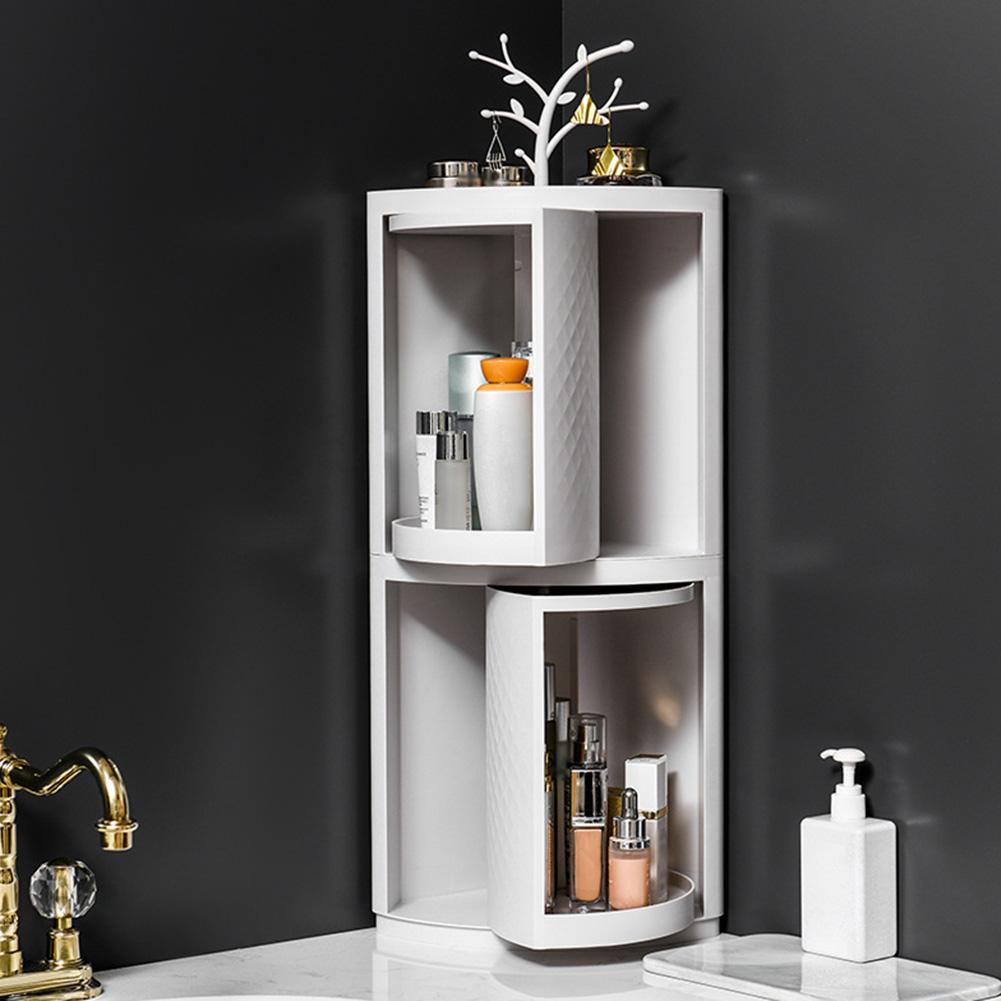
Rotatable Corner Bathroom Organizer, Wall-Mounted
Injection moulded to hold a 0.5 mm swing tolerance – the property rotomoulding cannot deliver.
$54.99
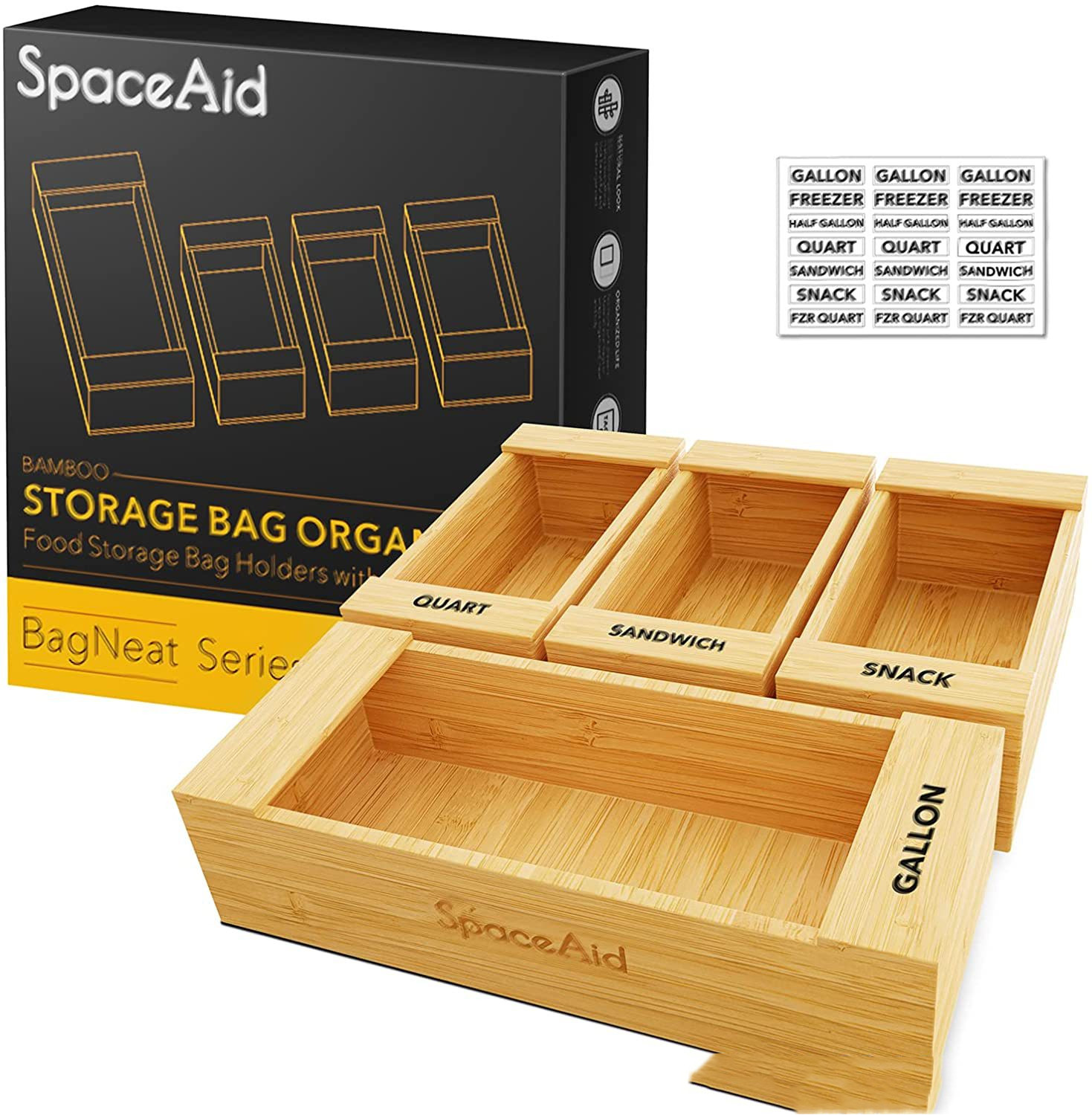
Bamboo Kitchen Drawer Organizer, Expandable
A different trade-off entirely: bamboo is milled, not moulded, and the cost sits in the material.
$54.99
Compare on Amazon — this category usually has more brands, sizes and price points there.
Check current prices on Amazon →
As an Amazon Associate we earn from qualifying purchases. The price you pay is unchanged. Disclosure