A bath mat is a sponge you stand on. After one shower it can hold roughly a litre of water — about five times its own weight — and the interesting engineering is not how fast it takes water in, but how slowly it gives it back. Two mats with identical pile and identical price can differ by twelve hours in drying time, entirely because of what is on the underside.
That difference decides whether the bathroom smells of damp by Thursday. It also explains why “quick-dry” on a product page is almost meaningless without a backing specification: drying is a function of airflow and humidity far more than of fabric.
1. Three layers, three jobs
A mat is a pile layer, a core, and a backing. The pile — usually cotton terry, microfibre or a cotton-polyester blend — provides surface area and capillary spaces. The core is either a dense tufted base or a foam layer. The backing is the layer that actually controls drying: PVC and latex are continuous sheets, TPR can be perforated, and some mats skip the backing entirely and rely on a spray-latex dot pattern.
Pile weight is quoted in grams per square metre, typically 900–1,400 g/m² for a bathroom mat. A 60 × 40 cm mat at 900 g/m² weighs about 216 g — a number worth remembering, because absorbency is usually expressed as a multiple of it.
2. The absorbency arithmetic
Cotton terry holds roughly 3.5 times its dry weight in water before it drips; microfibre can reach 4–5 times. On a 216 g mat that is 750–1,000 g. Add the film of water that sits on the surface and the number after a shower lands near 1.0–1.2 litres.
The useful part is the ratio, not the total: water held ≈ dry weight × absorbency factor. A heavier mat holds more, but it also has more mass to dry, so the drying time barely improves — and often gets worse, because a thick pile keeps the base layer wet longer.
3. Where the water actually goes
Evaporation takes energy: about 2,450 kJ per kilogram of water at room temperature. Drying 1.1 kg therefore requires roughly 2,700 kJ, or about 0.75 kWh of heat, taken from the room and from the mat itself. That is why a wet mat makes a bathroom feel cold, and why a heated floor dries a mat in hours instead of a day.
4. Why the backing decides everything
Water leaves a mat from its exposed surfaces. A continuous PVC backing removes the largest surface — the underside in contact with the floor — and creates a trapped film between mat and tile that cannot evaporate. The mat then dries from the top only, at roughly half the rate. Perforated TPR and dot-pattern latex leave channels, which is why the same pile dries in half the time.
The floor matters too. On tile with underfloor heating, the underside runs 5–10 °C warmer and dries fast; on cold stone in an unheated bathroom, the underside stays at 18–20 °C and becomes the last part to dry — usually the part that starts to smell.
5. The table
| Construction | Water held (60 × 40 cm) | Typical drying time at 50% RH | What fails first |
|---|---|---|---|
| Cotton terry, PVC backing | 0.9–1.2 L | 10–14 h | Trapped film, mildew at the edges |
| Microfibre, TPR perforated | 0.7–1.0 L | 5–8 h | Pile flattening after ~200 washes |
| Cotton, latex dot backing | 0.8–1.1 L | 6–9 h | Latex cracking after 2–3 years |
Read the table as a trade: PVC gives the best slip resistance and the worst drying. If the mat sits on tile in a windowless bathroom, perforated backing is worth more than extra pile weight.
6. The 70% line and mould
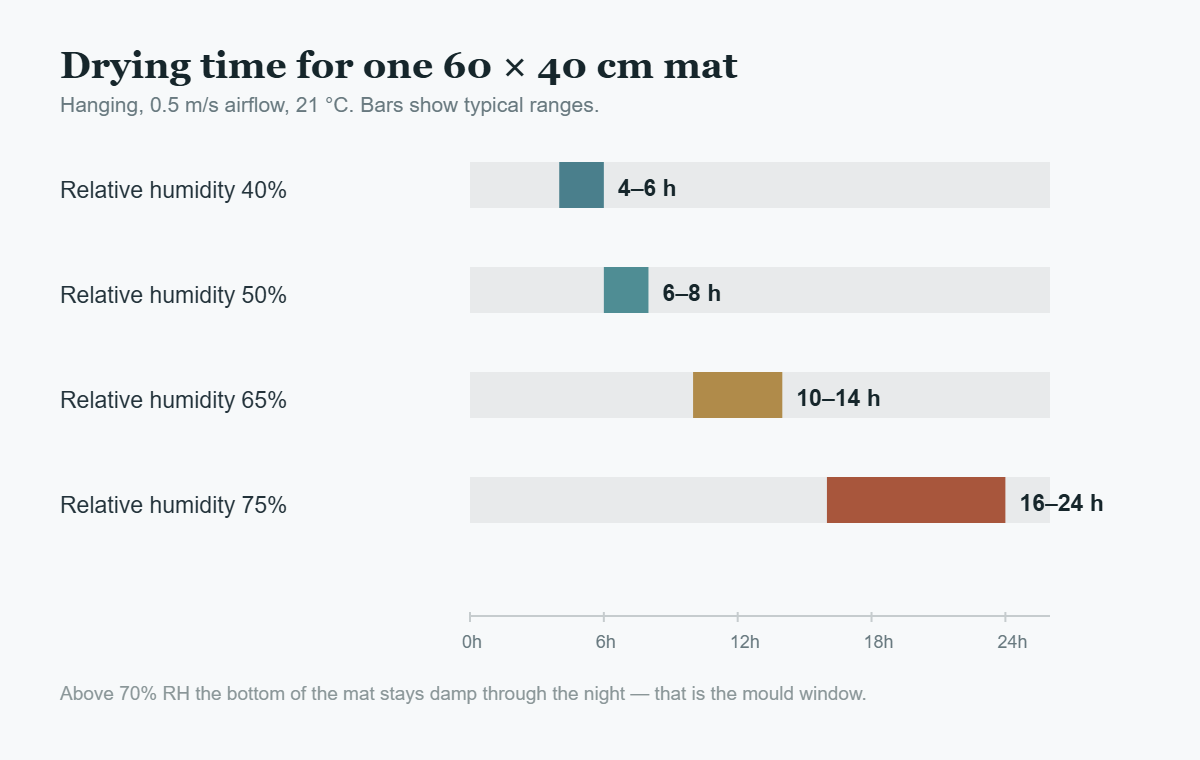
Surface mould needs sustained humidity above roughly 70–80% and a food source — skin cells, soap residue, cotton fibre. In a bathroom at 75% RH, the base of a PVC-backed mat can stay above that threshold for 16–24 hours, which is long enough for mildew to establish within a day or two. The fix is mechanical, not chemical: hang the mat over the bath edge or a rail after each use so both faces see air, and wash it at 40–60 °C monthly to remove the residue that feeds growth.
7. What to check before buying
One: the backing type, stated explicitly. “Non-slip” without a material name usually means PVC. Two: pile weight per square metre, not just “thick”. Three: whether the mat can be machine washed — latex-dot backings degrade in hot washes, TPR tolerates 40 °C. Four: size relative to the wet zone; a mat narrower than the shower opening just moves water onto the floor.
Care is simple and mostly about air: shake it out, hang it, never leave it folded on the floor, and rotate the ends so wear and damp are shared. A mat treated this way lasts years; the same mat left flat in a corner fails in months.
Related reading: why 60 percent humidity is the number that matters in a bathroom, and the four materials that actually stop things sliding.
8. Why thickness is the wrong metric
Pile height is the number sellers like because it photographs well. What matters in use is the gap between mat and floor: 3–5 mm of air under a perforated backing dries in hours, while a 12 mm pile pressed flat against tile behaves like a sealed container. If you want to test a mat before buying, press the backing against a wet tile and see whether a film of water forms — if it does, that is the surface that will stay damp.
The economics follow the drying. A mat washed weekly and hung to dry will survive 150–200 wash cycles before the pile flattens; the same mat left wet at the base develops mildew in months and gets thrown out long before the fibre wears. Paying more for perforated backing is, in practice, paying for the extra two years.
Frequently asked questions
Is microfibre better than cotton for a bath mat?
It absorbs more per gram and dries faster, but it flattens sooner under foot traffic. Cotton terry with a perforated backing is the better long-term compromise in a humid room.
Why does my mat smell even after washing?
Usually the backing or the core is still damp. A mat washed at 40 °C and left flat can stay wet inside for a day; hang it and dry both faces before putting it back.
Do heated floors damage mats?
They dry them faster, which is good, but continuous heat above about 35 °C surface temperature ages latex and PVC backings. Most underfloor systems run well below that.
How often should a bath mat be washed?
Weekly in a shared bathroom, every two weeks for one person — and always after any illness. The constraint is the backing: check the care label before going above 40 °C.
Can a mat be dried outside?
Yes, and it is the fastest option — full sun and moving air will dry a 1 litre mat in two to three hours. Avoid leaving latex-backed mats in direct sun for days; UV degrades the backing.
Honest disclosure: the absorbency and drying figures are typical ranges from textile data and standard evaporation physics, not lab tests of the products shown. Your bathroom’s airflow and humidity will move the numbers.
Gear referenced in this guide
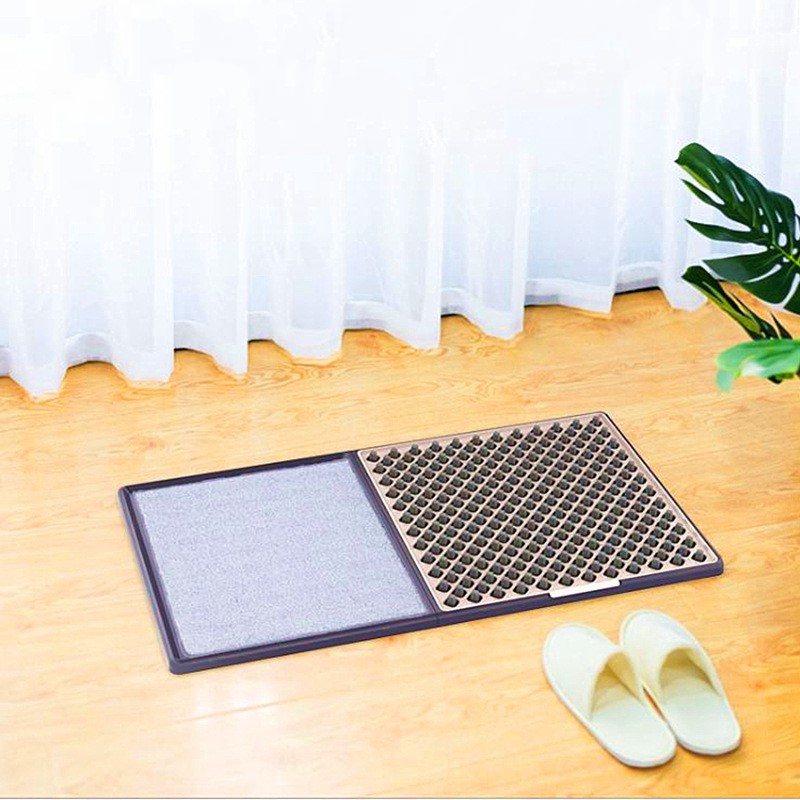
Non-Slip Bathroom Mat, Quick-Dry Absorbent Floor Mat
Quick-dry surface with a non-slip base — the construction this article is about.
$84.99
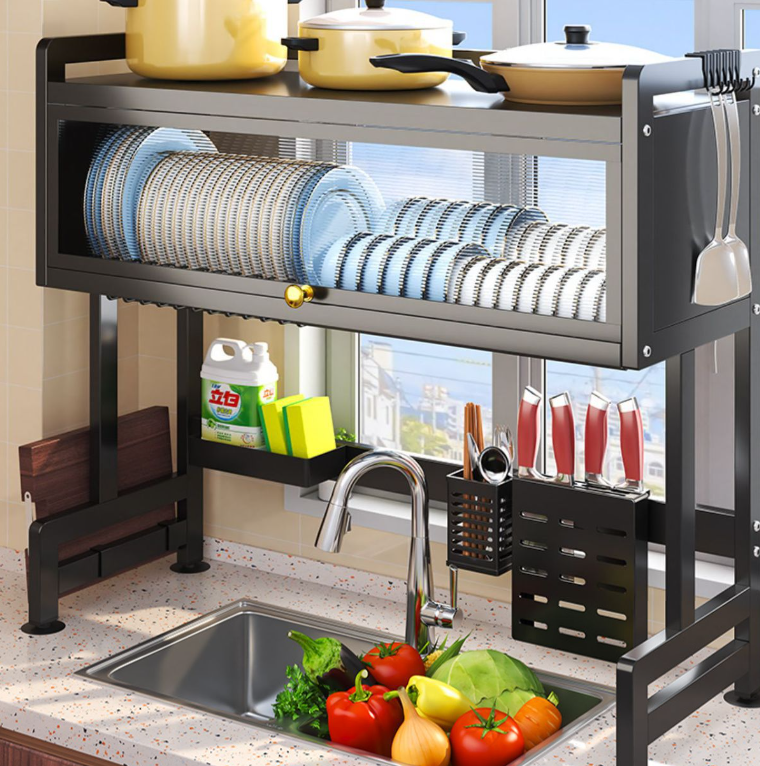
Kitchen Sink Storage Rack, Over-Basin Bowl and Sponge Drainer
Keeps the wet zone vertical: bowls and sponges drain instead of sitting in water.
$65.99
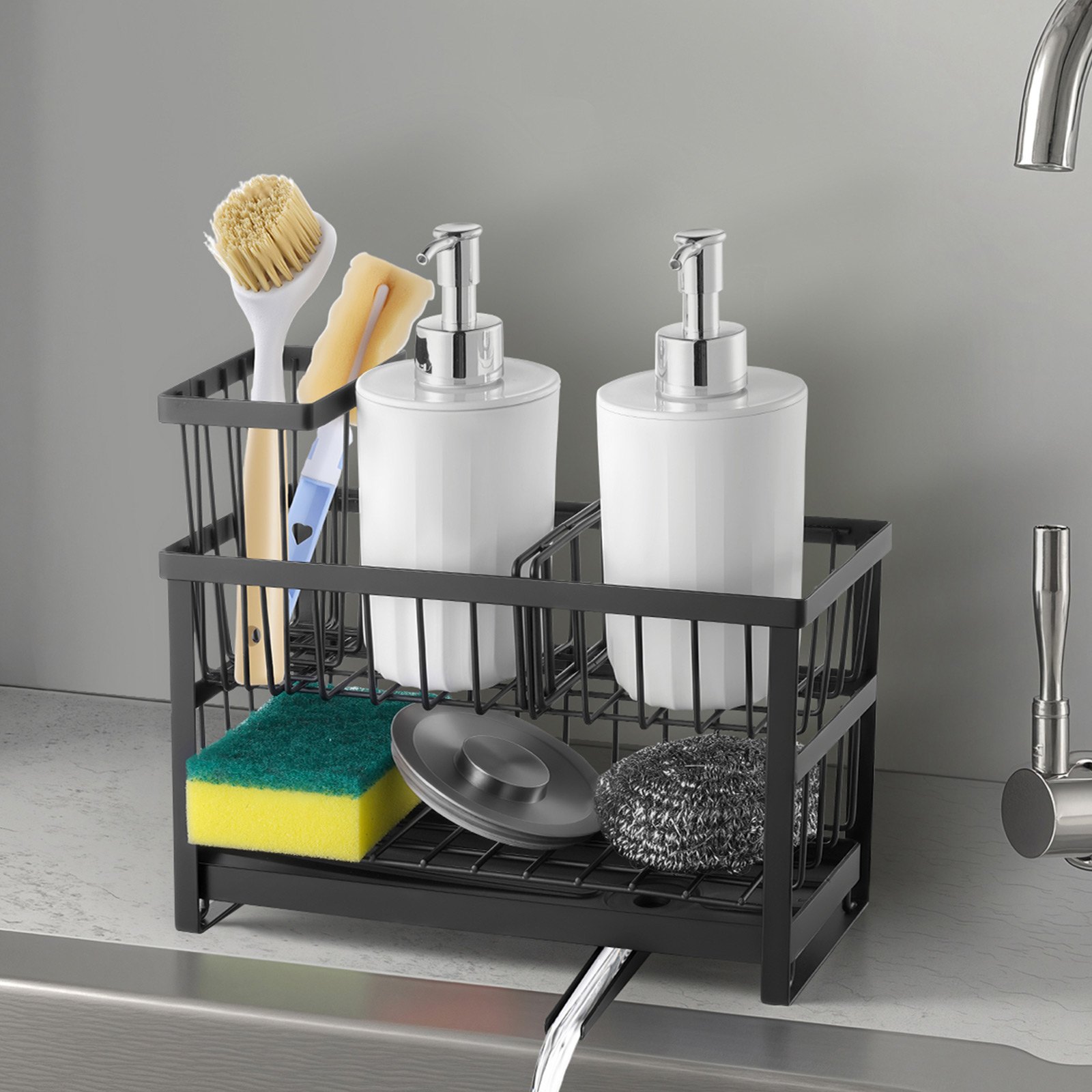
Kitchen Sink Caddy Organizer, Sponge and Brush Holder
Same principle at smaller scale — ventilation beats absorbency everywhere water sits.
$65.99
Compare on Amazon — this category usually has more brands, sizes and price points there.
Check current prices on Amazon →
As an Amazon Associate we earn from qualifying purchases. The price you pay is unchanged. Disclosure