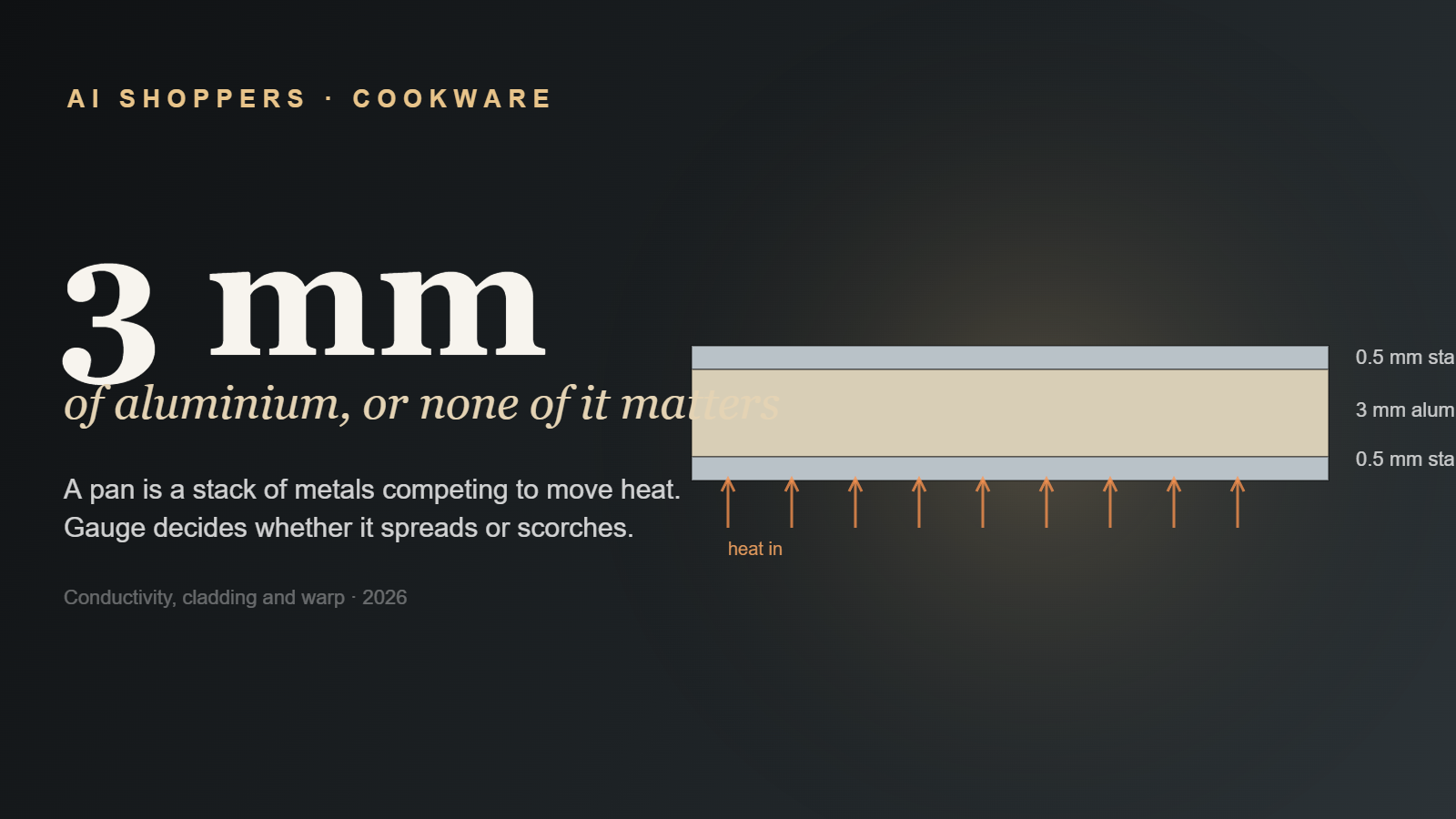
Two frying pans, same diameter, same colour, same non-stick claim. One weighs 850 g and costs $60; the other weighs 420 g and costs $18. The difference is almost entirely in a layer you cannot see: the aluminium core. It is either 3 mm thick, or it is 1.2 mm thick with a lot of marketing on top of it.
That thickness decides three things you will notice within a week — how evenly the pan heats, how quickly it recovers when food goes in, and whether the base stays flat after a hot sear. None of them appear on the package.
1. A pan is a stack of metals
Clad cookware is a sandwich. A typical three-ply is 0.5 mm stainless, 3 mm aluminium, 0.5 mm stainless, bonded under pressure. The stainless gives you a non-reactive, dishwasher-safe surface; the aluminium does the heat moving. Five-ply adds copper or more aluminium and costs accordingly.
Cheap pans skip the sandwich. They are stamped from a single sheet of 1.2–1.5 mm aluminium, coated, and sold. That is not automatically bad — a thin aluminium pan is light and heats fast — but it stores very little heat, so the moment cold food lands, the surface temperature drops and the pan has to catch up.
2. The numbers behind “heats evenly”
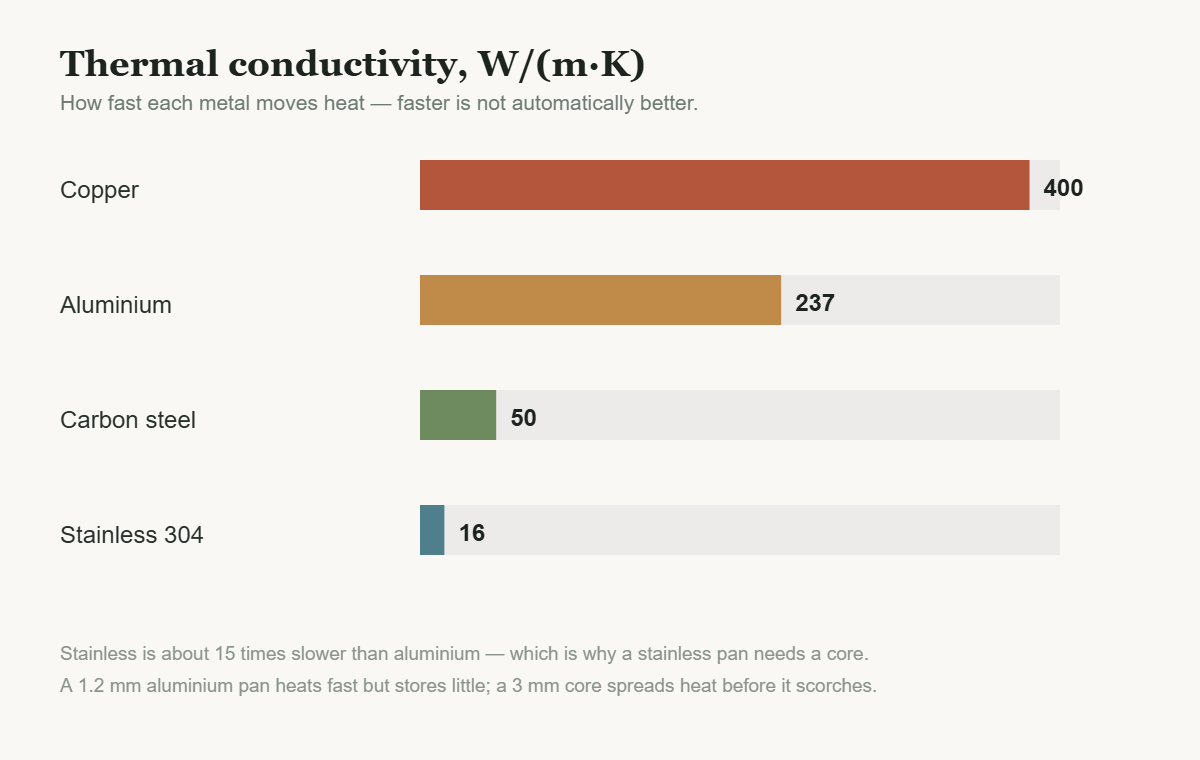
Thermal conductivity tells you how fast heat moves through a metal: copper about 400 W/(m·K), aluminium 237, carbon steel 50, stainless 304 around 16. Stainless is roughly fifteen times slower than aluminium, which is exactly why a stainless pan needs an aluminium or copper core — on its own it would scorch in the centre and stay cold at the rim.
Thickness matters as much as the material. Heat spreads sideways through a plate at a rate that grows with thickness; a 3 mm core moves heat outward fast enough that a 20 cm pan reads within a few degrees from centre to edge. A 1.2 mm base manages a hot ring and a cooler rim — the classic “hot spot” that browns one part of the pancake and leaves the rest pale.
3. Heat capacity: why a heavy pan forgives you
Thicker aluminium also stores more heat. Put a 200 g steak into a thin pan and the surface can drop 60–80 °C before the burner catches up; in a 3 mm pan the drop is smaller and recovers faster, which is why the steak sears instead of steaming. The trade is weight and warm-up time: a heavy pan takes two to three minutes longer to reach temperature.
| Construction | Base thickness | Heat spread | Recovery after cold food | Typical weight (20 cm) |
|---|---|---|---|---|
| Stamped aluminium, coated | 1.2–1.5 mm | Uneven, hot centre | Slow | 350–450 g |
| 3-ply clad (SS/Al/SS) | 3 mm core | Even | Good | 700–900 g |
| 5-ply with copper | 3–4 mm | Very even | Best | 900–1,200 g |
| Cast iron | 4–6 mm | Slow to spread, huge storage | Excellent | 1,400–2,000 g |
4. Warping and thermal shock
A thin base warps because the cooking surface and the flame side expand at different rates. Above roughly 250–300 °C, a 1.2 mm aluminium disc can take a permanent set — the pan starts spinning on the hob and never sits flat again. Thick clad bases resist this, but they can delaminate if quenched: pouring cold water into a 250 °C pan stresses the bond. Let it cool for two minutes first.
Induction adds a separate constraint. Induction heats only magnetic material, so an aluminium pan needs a steel disc bonded into the base. If the base is not magnetic, a magnet will not stick — a five-second test that saves a return.
5. Five checks before buying
One: weight relative to diameter. A 20 cm pan under 500 g is a thin stamp, whatever the listing says. Two: base thickness, stated in millimetres rather than “heavy duty”. Three: layer construction, e.g. “3-ply 18/10 + aluminium core”. Four: induction compatibility claimed explicitly, with a magnetic base. Five: handle fixing — rivets beat screws, and a riveted stainless handle survives oven use that a plastic one will not.
Care follows the construction: no quenching, no dishwasher for bare aluminium, medium heat for non-stick, and a flat-bottom check with a straight edge once a year. A clad pan treated this way lasts a decade; a thin one is a two-year consumable.
6. What the coating changes
Non-stick adds a fourth variable. PTFE coatings are typically 20–40 µm thick and are rated to about 260 °C; above that they degrade and release fumes that are harmful to pet birds and unpleasant for people. Ceramic (sol-gel) coatings tolerate higher heat — often 400 °C — but they lose their release properties faster, commonly within 12–24 months of daily use.
The practical consequence is that coating and core should be matched. A 3 mm clad pan with a good PTFE layer will outlast three thin pans with the same coating, because the thick base keeps the surface below the degradation temperature: a thin pan run at high heat spikes well past 260 °C at the hot spot even when the thermostat says medium.
Cast iron and carbon steel skip the coating entirely. They need seasoning, tolerate 300 °C and above, and are effectively repairable — which is why a $30 skillet can outlive a $90 non-stick pan.
7. The money question
Divide price by years of service and the ranking flips. An $18 thin pan replaced every two years costs $9 a year; a $60 clad pan lasting eight years costs $7.50, and it cooks better in year six than the cheap one did in month three. The same arithmetic applies to the 16-piece outdoor set: thin walls are correct there because weight is the constraint, not longevity.
Frequently asked questions
Is heavier cookware always better?
No. Cast iron is heavy and slow to respond; a 3 mm clad pan is heavy but responsive. What matters is mass in the base, not the total — a heavy handle tells you nothing.
Can I use aluminium pans on induction?
Only if a magnetic steel layer is bonded into the base. Pure aluminium is not magnetic, so induction cannot heat it directly.
Why does my pan spin on the hob?
The base has warped, usually from overheating or quenching. Set it on a flat surface and press one edge: any rocking means permanent deformation.
Does a copper core make a real difference?
It improves spread and response, but copper is roughly 1.7 times more conductive than aluminium and much heavier and costlier. At 3 mm, the difference is subtle for home cooking.
How thick should a stainless pan’s core be?
For a 20–24 cm pan, 2.5–3 mm of aluminium is the sensible minimum; below 2 mm the hot-spot problem returns even in clad construction.
Honest disclosure: the conductivity values are standard handbook figures for the pure metals and 304 stainless; real cookware uses alloys and composites, and thickness varies by product. Use the numbers to compare constructions, not to predict a specific pan’s exact behaviour.
Gear referenced in this guide
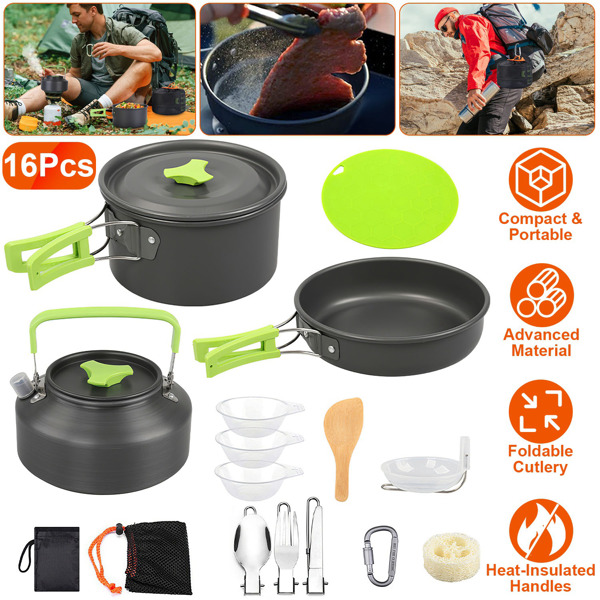
16 Piece Camping Cookware Set, Outdoor Cooking Kit
Thin-wall outdoor cookware: light by design, where fast heating matters more than heat storage.
$93.99
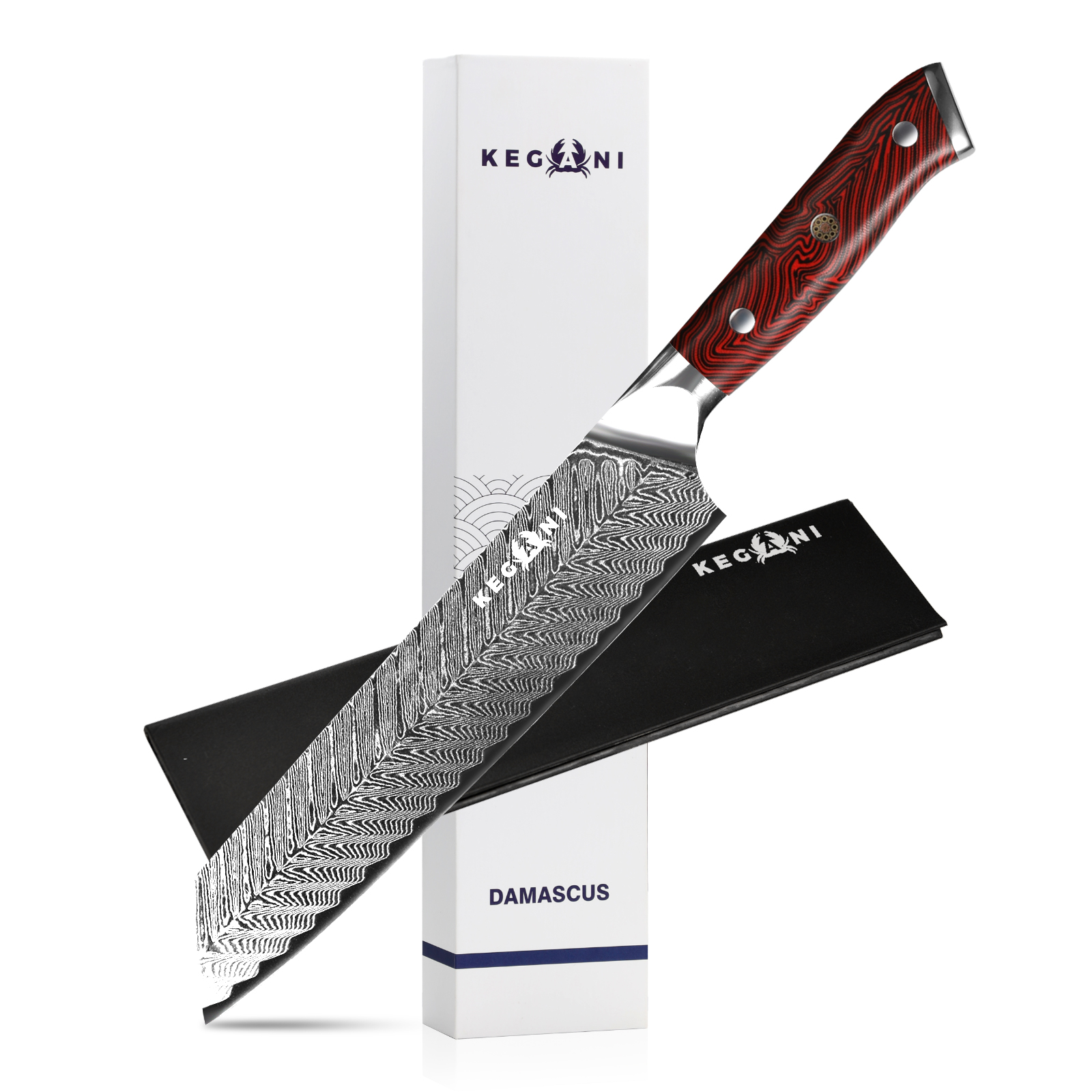
7 Inch Damascus Meat Cleaver, 73 Layers AUS-10 Steel
73 layers of AUS-10: a different sandwich, this one built for edge retention rather than heat.
$102.99
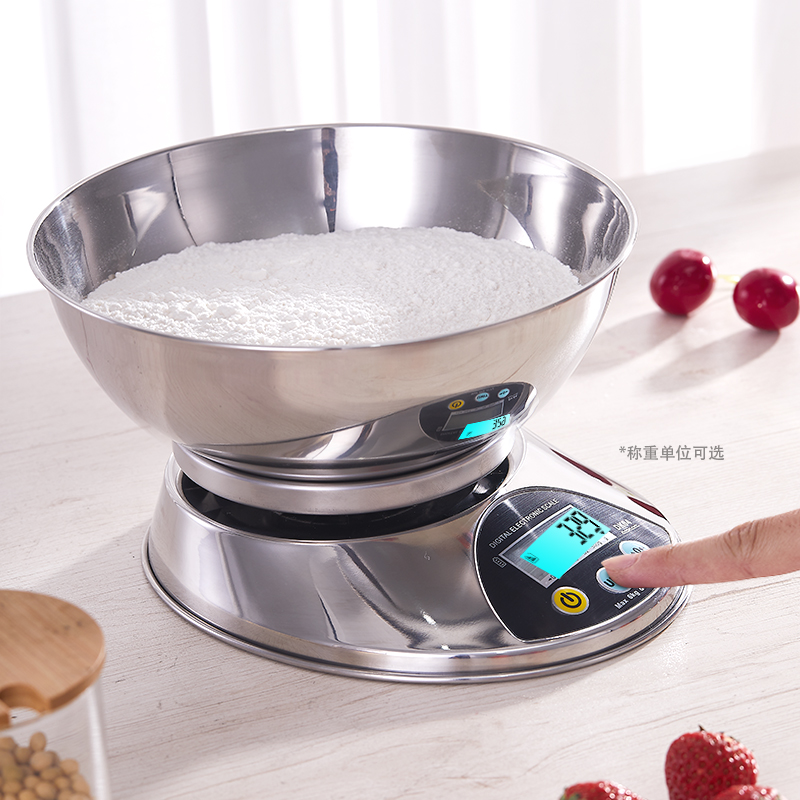
Stainless Steel Kitchen Scale with Tempered Glass Platform
Weigh a pan before you buy: grams per centimetre is the honest measure of base thickness.
$72.99
Compare on Amazon — this category usually has more brands, sizes and price points there.
Check current prices on Amazon →
As an Amazon Associate we earn from qualifying purchases. The price you pay is unchanged. Disclosure