Food sticks to stainless steel for one reason: the pan was not hot enough when the food went in. Almost everything else people try — more oil, a different spatula, seasoning the pan like cast iron — is a workaround for that single fact.
Why stainless behaves differently from cast iron
Cast iron and carbon steel are seasoned: oil polymerises onto the surface and forms a sacrificial layer that food releases from. Stainless steel does not hold a seasoning layer in the same way. You can polymerise oil onto it, and it will look darker, but that film is thin and comes off with detergent and heat cycling. So a stainless pan is not a non-stick pan with a damaged coating — it is bare metal, and release has to be created in the pan at the moment of cooking.
What is happening at the surface
Proteins bond to bare metal readily. At low temperature the bond forms before the food has a chance to firm up, so it welds to the surface; scraping then tears it. Raise the temperature and two things change: the surface moisture at the food’s base flashes to steam, and the food’s own proteins set quickly, forming a skin that is no longer in intimate contact with the metal. The steam layer is what the food is actually sitting on.
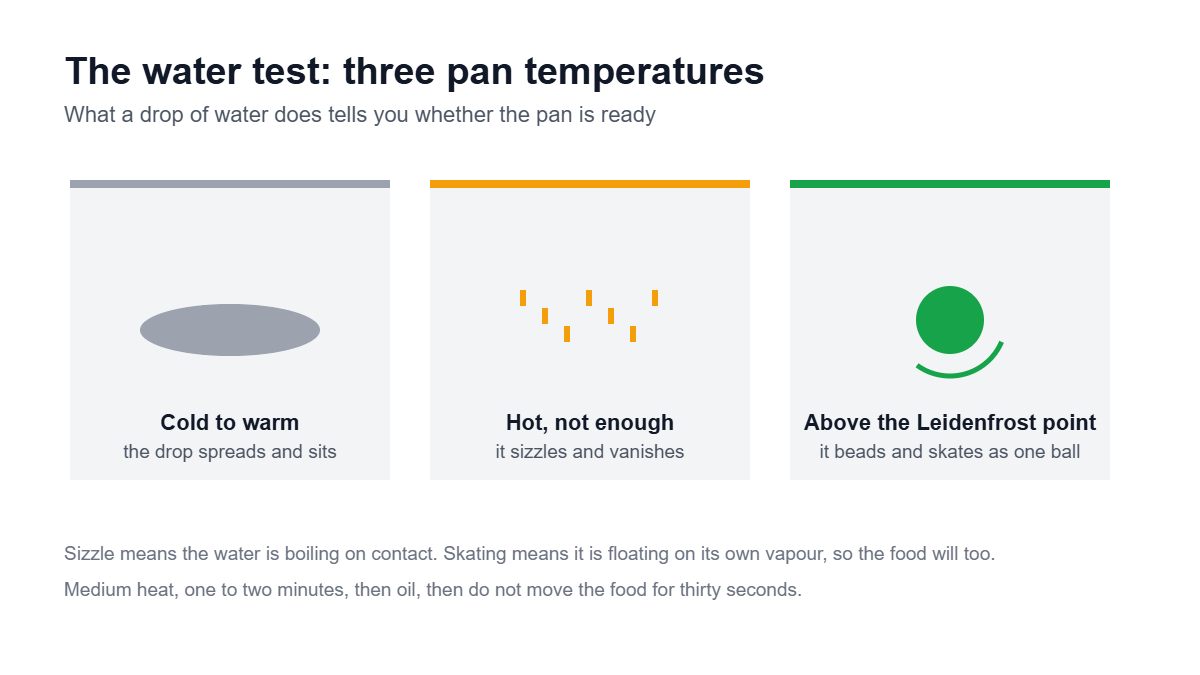
This is why the classic test works. Flick a few drops of water into a hot pan. If they sizzle and vanish, it is not hot enough. If they bead up and skate around the pan as a single ball, the surface is above the Leidenfrost point and the pan is ready. The water is behaving like a drop on a hot plate: it is floating on its own vapour.
The sequence that actually works
- Dry the pan, then heat it empty on medium for one to two minutes. Medium, not high: a clad pan heats unevenly if you attack it with a high flame on one spot.
- Test with water. Wait for the skating ball. If the water sizzles, keep going.
- Add oil, then wait ten seconds. The oil needs to come up to temperature and spread as a continuous film, not bead.
- Put the food in and leave it alone. Most sticking is caused by moving food before the skin has set. Give it thirty seconds, then check with a thin spatula.
- Turn the heat down once the food is in. The pan is already hot; you are now cooking, not heating.
What does not fix sticking
- More oil. Oil does not prevent the protein bond; temperature does. A flooded pan at low heat sticks worse than a lightly oiled hot one.
- Scrubbing the pan shiny first. Surface finish is not the variable. A mirror-polished pan and a brushed one behave the same at the same temperature.
- Seasoning like cast iron. The film will not survive normal washing, and building it takes time you could spend learning the heat cue.
- Non-stick sprays. Propellant and lecithin leave a varnish that is harder to remove than the food was.
What the pan itself contributes
| Pan property | Effect on sticking |
|---|---|
| Clad aluminium core | Even heat, fewer cool spots where food welds |
| Thin disc bottom | Hot ring over the burner, cool edges; sticking clusters at the transition |
| Heavy gauge base | Holds temperature when cold food goes in, so the pan recovers faster |
| Warped base | Contact patches create hotspots, and hotspots stick |
A pan that sticks only in one ring is telling you about its base, not about your technique.
FAQ
Does a stainless pan need seasoning?
No. It can be used bare. Seasoning is a carbon-steel practice; on stainless it is cosmetic and temporary.
Why does my pan stick only with eggs?
Eggs are high in protein and low in fat, and they go in cold. They are the most demanding test of pan temperature, which is why they are the standard test.
Can I use metal utensils?
Yes, on uncoated stainless. There is no coating to damage.
Is a scratched stainless pan still safe?
Yes. Scratches are cosmetic; deep pitting from salt is a different issue and is covered in the pitting article linked below.
The Leidenfrost test is a temperature cue, not a measurement. If you want the number, an infrared thermometer on the dry pan surface will show it.
Compare on Amazon — this category usually has more brands, sizes and price points there.
Check current prices on Amazon →
As an Amazon Associate we earn from qualifying purchases. The price you pay is unchanged. Disclosure