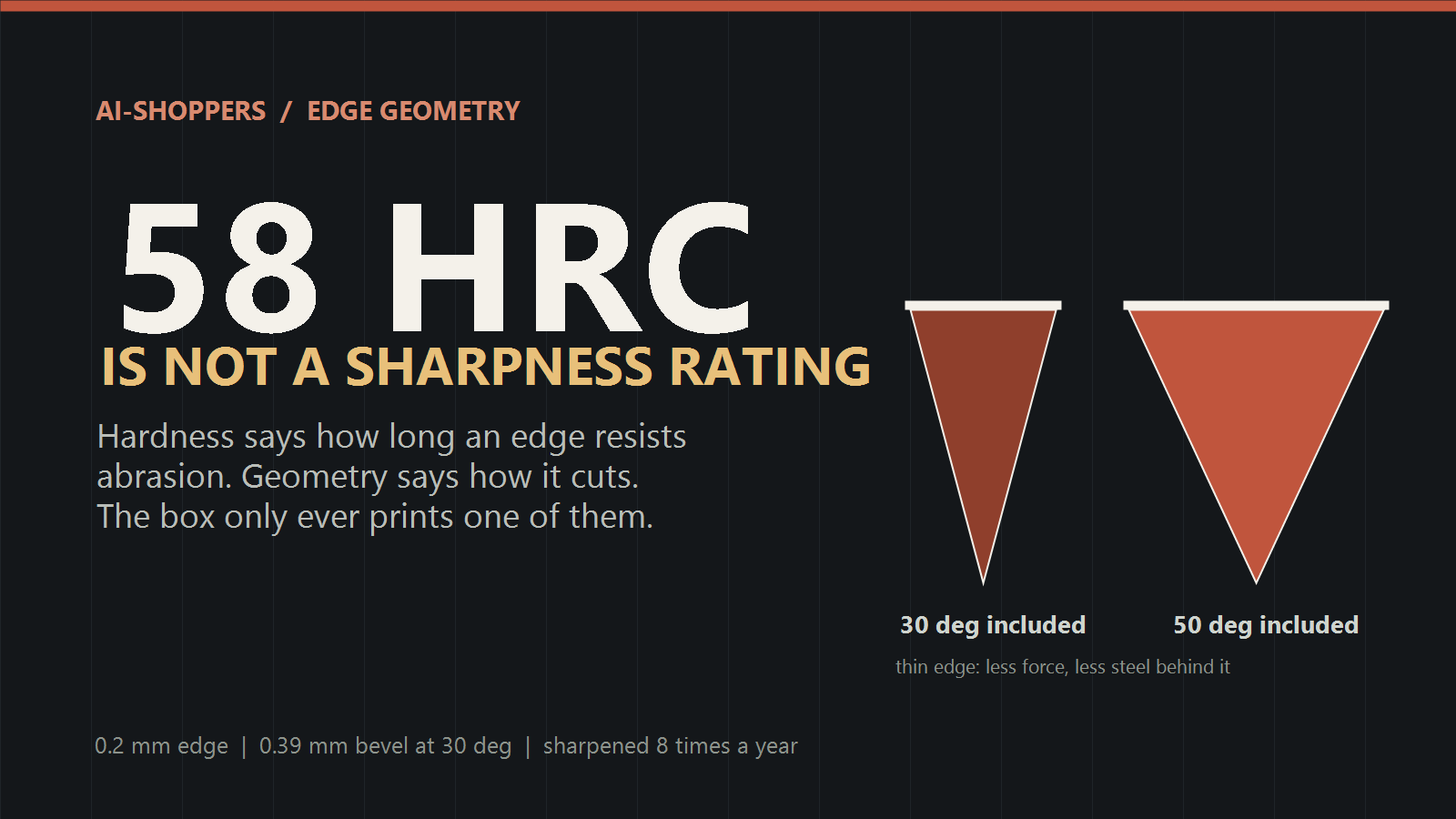
A 58 HRC number on a knife box is a hardness reading, and hardness is not sharpness. It is the resistance of steel to being scratched, which is a decent proxy for how long an edge lasts and a poor one for how well it cuts. Buy a knife on the hardness alone and you end up with a blade that holds its shape for months, then chips on a chicken bone because nobody told you the edge was ground to fifteen degrees a side.
1. Two numbers, one spec
Open ten knife listings and you will see the same handful of claims: HRC, layer count, steel name, “razor sharp”, “hand forged”. Only one of them is a quantitative measurement of the blade you are holding, and it is the HRC.
Layer counts are construction. A “73-layer Damascus” blade is a sandwich: a hard core, usually a single sheet of a known steel, clad on both sides with softer patterned layers that are folded and forged for looks and for corrosion resistance. The pattern does nothing for the edge. The core does everything. A 73-layer blade with a mediocre core is a mediocre knife with an expensive surface, and a 3-layer blade with a good core can be excellent.
The other issue is that HRC is measured on a sample of the core steel after heat treatment, not on the finished edge. Two blades from the same factory with the same HRC can behave completely differently depending on how the edge was ground, how thick the steel is behind the edge, and what the user cuts on.
2. What the HRC number actually measures
The Rockwell C test presses a diamond cone into the steel with a 150 kgf load and measures how deep it sinks. The scale is inverted and defined so that one HRC point equals two micrometres of penetration depth. A 58 HRC blade resists the cone about 10 µm more than a 53 HRC blade. That is the entire claim.
Two consequences follow, and both matter at the counter.
First, HRC is a bulk property. It says nothing about the edge, which is a shape. A 58 HRC knife ground at 25 degrees per side will outlast a 62 HRC knife ground at 12 degrees in any kitchen that involves bones, because the thin one fails by chipping, not by wear.
Second, the last few points cost a lot. Going from 56 to 58 HRC is routine. Going from 60 to 63 HRC on a production line multiplies the rejection rate, because the same steel becomes brittle enough that a bad tempering batch shows up as cracked blades. That is why the jump from a $40 knife to a $150 knife is often five HRC points and a better grind, not a different miracle steel.
3. Carbon makes hardness; chromium makes rust resistance
Hardness comes from carbon. Dissolved carbon distorts the iron lattice during quenching, and the more carbon you can keep in solution, the harder the martensite. Practical maximum hardness climbs with carbon up to roughly 0.6–0.8 percent; past that, extra carbon mostly forms chromium carbides, which buy wear resistance rather than matrix hardness.
Chromium does something else: at about 12 percent and above, it forms a passive oxide layer and the steel stops rusting in normal kitchen use. That is why kitchen stainless sits in a narrow band of chemistry, and why the cheap-versus-expensive question is usually about carbon content and carbide volume, not about the word “stainless”.
| Steel | Carbon | Chromium | Typical hardness | What it does well | What it does badly |
|---|---|---|---|---|---|
| 6Cr13 (shears, budget blades) | 0.6% | 13% | 52–56 HRC | Cheap, tough, easy to sharpen | Rolls an edge quickly on hard boards |
| X50CrMoV15 (German pattern) | 0.5% | 14.5% | 55–57 HRC | Forgiving, resists chipping, dishwasher-tolerant | Needs honing often; dulls on abrasives |
| 440C | 1.1% | 17% | 57–59 HRC | Good wear resistance, very corrosion resistant | Large carbides; can feel coarse on the stone |
| AUS-10 (cleaver core) | 1.0% | 15% | 58–60 HRC | Balanced: fine grain, decent edge retention | Less tough than the German pattern at equal angle |
| VG-10 | 1.0% | 15% | 60–61 HRC | Long edge life, takes a very fine apex | Chipping risk if ground thin and used hard |
Compositions above are typical published ranges for each grade, not a certificate for a specific batch. The practical read: anything at 0.5–0.6 percent carbon and 13–15 percent chromium is a tough working knife; anything at 1.0 percent carbon is a slicing knife that rewards a careful owner.
4. The trade nobody prints: hardness against toughness
Toughness is the ability to deform instead of breaking. It moves in the opposite direction to hardness, and the failure looks different at each end of the scale.
A soft blade (52–55 HRC) does not chip. It rolls: the apex bends to one side, you feel it catch on a tomato skin, and twenty strokes on a steel rod bring it back. A hard blade (60–62 HRC) does not roll. It chips, and a chip is permanent until you grind the whole edge back past it. On a 2 mm deep chip, that is a session on a coarse stone and a visibly shorter blade.
This is why the honest recommendation depends on the board and the cook, not on the price. If your knife gets used for frozen stock, garlic smashing and the occasional bone, you want 55–57 HRC at 20 degrees per side, and you want to stop reading about supersteels. If you slice proteins and vegetables on a wooden board and you are willing to hone weekly, 58–61 HRC at 15 degrees per side will outperform anything softer.
5. Geometry: the number that decides how it cuts
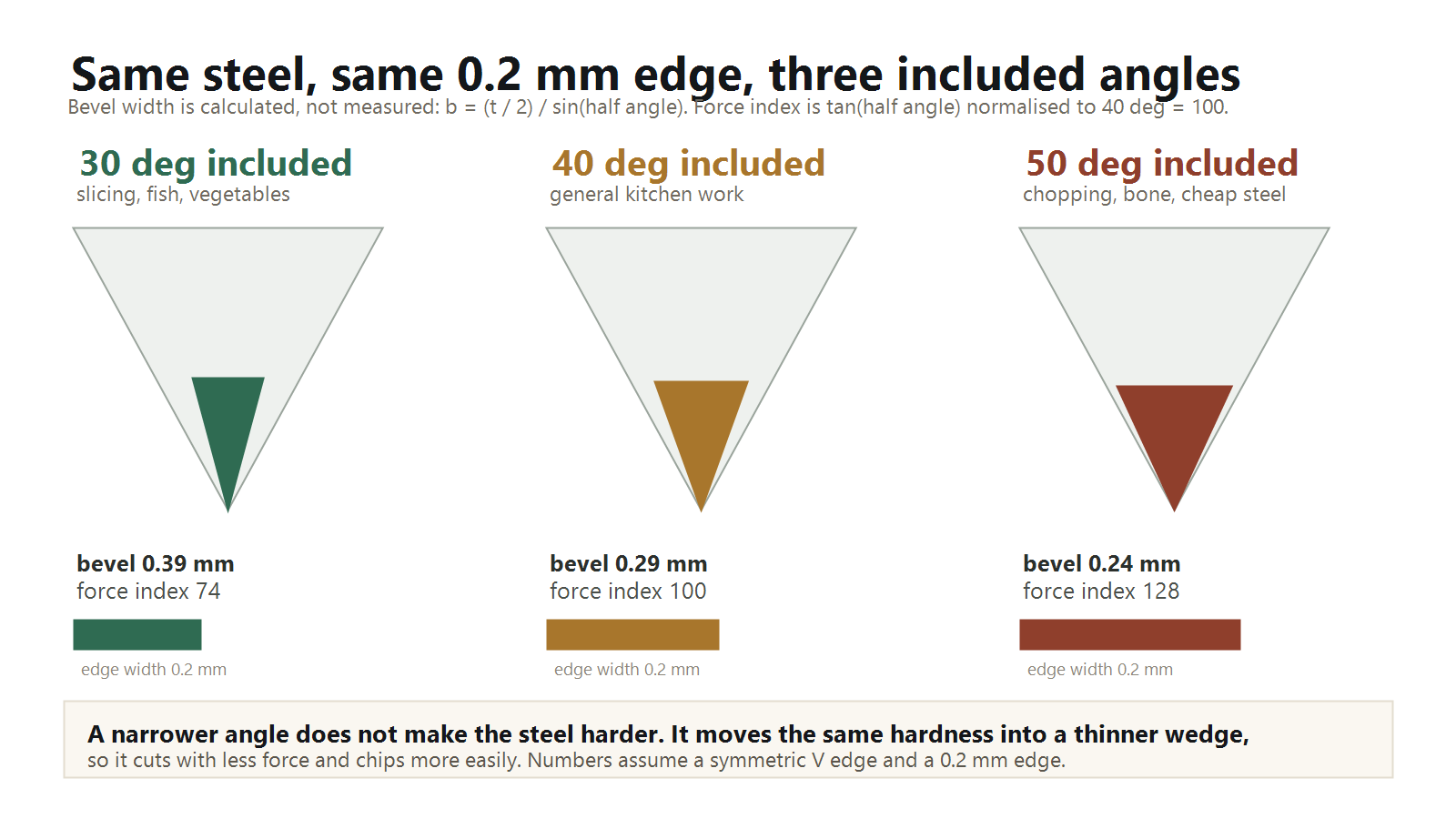
Here is the part that never appears in a listing. Take a blade with 0.2 mm of steel at the edge — a normal factory edge on a kitchen knife — and grind it to three different included angles. The bevel width is pure trigonometry:
b = (t / 2) / sin(θ/2), where t is edge thickness and θ is the included angle.
| Included angle | Bevel width (0.2 mm edge) | Force index (tan θ/2, 40° = 100) | Good for | Failure mode |
|---|---|---|---|---|
| 30° (15° per side) | 0.39 mm | 74 | Slicing fish, boneless protein, vegetables | Micro-chipping on bone, ice, seeds |
| 40° (20° per side) | 0.29 mm | 100 | General kitchen work | Slow dulling on abrasive boards |
| 50° (25° per side) | 0.24 mm | 128 | Chopping, cleavers, cheap steel | Wedges in dense food; poor slicing |
The force index comes from a simple wedge model: for a fixed depth of cut, the force needed to push a symmetric V edge scales roughly with tan(θ/2). Going from 40 to 30 degrees cuts that number by a quarter, which is exactly why a thin knife feels sharp even when it is dull. The catch is the bevel: at 30 degrees the bevel is 0.39 mm wide and the steel behind the edge is thinner, so the same sideways load that a 50-degree edge shrugs off will fold a 30-degree edge.
Two knives, one word. “Sharp” describes the apex, which you cannot see. “Thin” describes the geometry, which you can: look at the bevel width in a photo and at the angle in the spec sheet. A knife with a 0.4 mm bevel and a 25-degree edge is a different tool from one with a 0.24 mm bevel at 25 degrees, even if both say 58 HRC.
6. What you cut on is half the equation
Edge wear is abrasion, and the board does most of the abrading. The ranking below is consistent across wear tests and knife-maker advice; the exact multipliers vary by steel and technique.
| Board | Effect on the edge | Practical note |
|---|---|---|
| Glass, ceramic, stone | Roughly an order of magnitude more edge wear than end-grain wood | Use for serving, never for cutting |
| Bamboo | Moderate; contains silica in the fibre bundles | Hard, dense, cheap — but it is an abrasive |
| End-grain wood | Lowest wear; fibres part around the edge | Needs oiling, must not go in the dishwasher |
| Edge-grain wood | Low to moderate | The usual compromise; replace when deeply scored |
| HDPE plastic | Low wear, but raises a burr over time | Dishwasher-safe; replace when fuzzy |
There is an arithmetic that follows. If a glass board triples the rate of edge dulling, it turns an eight-sharpenings-a-year knife into one that needs attention every six weeks. The board is cheaper than the steel, and it is the part that decides how often you meet the stone.
7. The sharpening calendar, in millimetres and dollars
A full sharpening — raising a burr on both sides and resetting the apex — removes metal. On a kitchen knife that is about 0.07 mm of edge thickness per session, and the height lost follows the same geometry as before:
height lost ≈ δ / (2 × tan(θ/2)). At 40 degrees included and δ = 0.07 mm, that is about 0.1 mm per sharpening.
A 178 mm (7 inch) blade is typically 35–45 mm tall at the heel. At eight sharpenings a year, you lose roughly 0.8 mm a year, so five years of disciplined maintenance takes about a tenth off the blade height and leaves a noticeably thinner profile. That is normal, and it is also why a knife you sharpen twice a year outlives one you sharpen monthly on a pull-through.
Pull-through sharpeners deserve their own paragraph. The carbide version scrapes two grooves into the edge and removes far more steel than a stone, and it leaves a ragged apex that feels sharp for a week. The ceramic version is gentler but still fixes the angle for you, which is a problem if your knife is ground at 15 degrees and the gadget is set at 20.
Then the money. Professional sharpening runs about $5–$10 per knife in most US cities. At eight sessions a year, a $102.99 cleaver costs $40–$80 a year to keep sharp — between 40 and 80 percent of its purchase price, every year, forever. A $25 combination stone and twenty minutes of practice changes that number to nearly zero, which is the single best return in the kitchen.
8. Honing is not sharpening
A honing rod is a fine abrasive file, not a straightener. The old story that it “realigns the edge” is mostly wrong; what it does is abrade a few micrometres off the apex and knock off the weak, bent metal that makes a knife feel dull.
That is why the tool matters. A smooth steel is gentle and works on soft German-pattern blades at 55–57 HRC. A ceramic rod cuts faster and is closer to a 1000–3000 grit stone, which is appropriate for 58–61 HRC steel but will chew through a soft blade if used with pressure. Five to ten light strokes per side at the knife’s own angle, weekly, is the whole routine. Press hard and you round the edge instead of refreshing it.
9. Reading a Damascus label without being fooled
A 73-layer blade is made by folding and forging cladding around a core, then etching the surface so the layers show. It is a real process and it produces a genuinely beautiful knife. It is not a hardness specification, and it does not make the edge any better than the core allows.
Three questions turn the label into information. What is the core steel, by grade name? What hardness is the core taken to, in HRC? And what is the edge angle? A listing that answers all three is being honest. A listing that says “73 layers, razor sharp, highest quality” is selling the pattern.
Check the weight and the balance point too. Our 7 inch Damascus cleaver is a 178 mm blade with an AUS-10 core clad in 73 layers — a slicing and light-chopping tool at $102.99, not a bone cleaver, despite the name. The same logic runs through other edges. The 7 inch grooming shears in the card below are 6Cr13 at roughly 0.6 percent carbon, hardened into the mid-fifties: a softer steel on purpose, because shears cut hair, never touch a board, and a chipped shear is useless.
10. Storage: the twenty seconds that add a year
A knife dulls fastest where it is stored, not where it is used. Loose in a drawer, the edge hits other blades, a can opener, the handle of a pan. On a magnetic strip it is fine unless the strip is near steam. In a sink it is a chipped edge waiting to happen, plus a corrosion test.
Three workable answers: a magnetic strip mounted away from the hob, edge guards on each blade, or a lined drawer where the knives lie flat and cannot slide. If you go the drawer route, the knives need separation, which is what a simple bamboo insert does — the 30.5 × 10.2 × 7.6 cm drawer box in the card below is sized for cutlery and small tools, and it costs $53.99, which is less than one professional sharpening session for a full block.
The three-question test before you buy any knife. Does the listing name the core steel? Does it give an HRC figure for that core? Does it state an edge angle or at least show the bevel? Two out of three is normal. One out of three means you are buying a shape, and the shape will be whatever the factory felt like grinding that week.
Frequently asked questions
Is a higher HRC always better?
No. Above roughly 60 HRC, edge retention improves but toughness falls, so a thin edge chips instead of rolling. For a general kitchen knife used on a wooden board, 55–58 HRC is the sweet spot; 58–61 HRC is worth it only if you control the board and are willing to hone weekly.
Does 73 layers mean 73 times harder?
No. Layer count describes how many times the cladding was folded and forged. Hardness comes from the carbon content of the core steel and its heat treatment. The layers are a pattern on the surface and, at most, a modest corrosion barrier.
Can I sharpen a 58 HRC knife on a cheap stone?
Yes, but the stone matters more as hardness rises. A soft, coarse hardware-store stone will struggle to cut vanadium-rich steel and will dish quickly. A 1000/6000 combination water stone costs about $25–$40 and handles 55–61 HRC comfortably.
How often should a home cook sharpen?
Two to four times a year for a knife used daily and honed weekly, plus one full session whenever the edge reflects light along its whole length. Sharpening every month on a pull-through removes about 1 mm of blade height a year and shortens the knife’s life for no gain.
Why does my knife chip instead of going dull?
Because the edge angle is too thin for the load, or the steel is too hard for the job. A 15-degree edge at 60 HRC hitting a chicken bone, a frozen item or a glass board will chip. Either raise the angle to 20 degrees per side or keep the thin edge away from those jobs.
Do I need a cleaver for bone?
Yes, and it should be a different tool: heavy, thick behind the edge, 50 degrees included, and usually softer steel in the low-to-mid fifties. A 178 mm Damascus pattern blade is a slicing knife that will chip on bone — the name on the listing does not change the geometry.
Gear referenced in this guide
Three items from our own catalogue that follow the logic above: one blade whose core steel is named, one pair of shears that is deliberately softer, and one drawer insert that keeps edges from meeting each other. None of them is required to sharpen a knife.
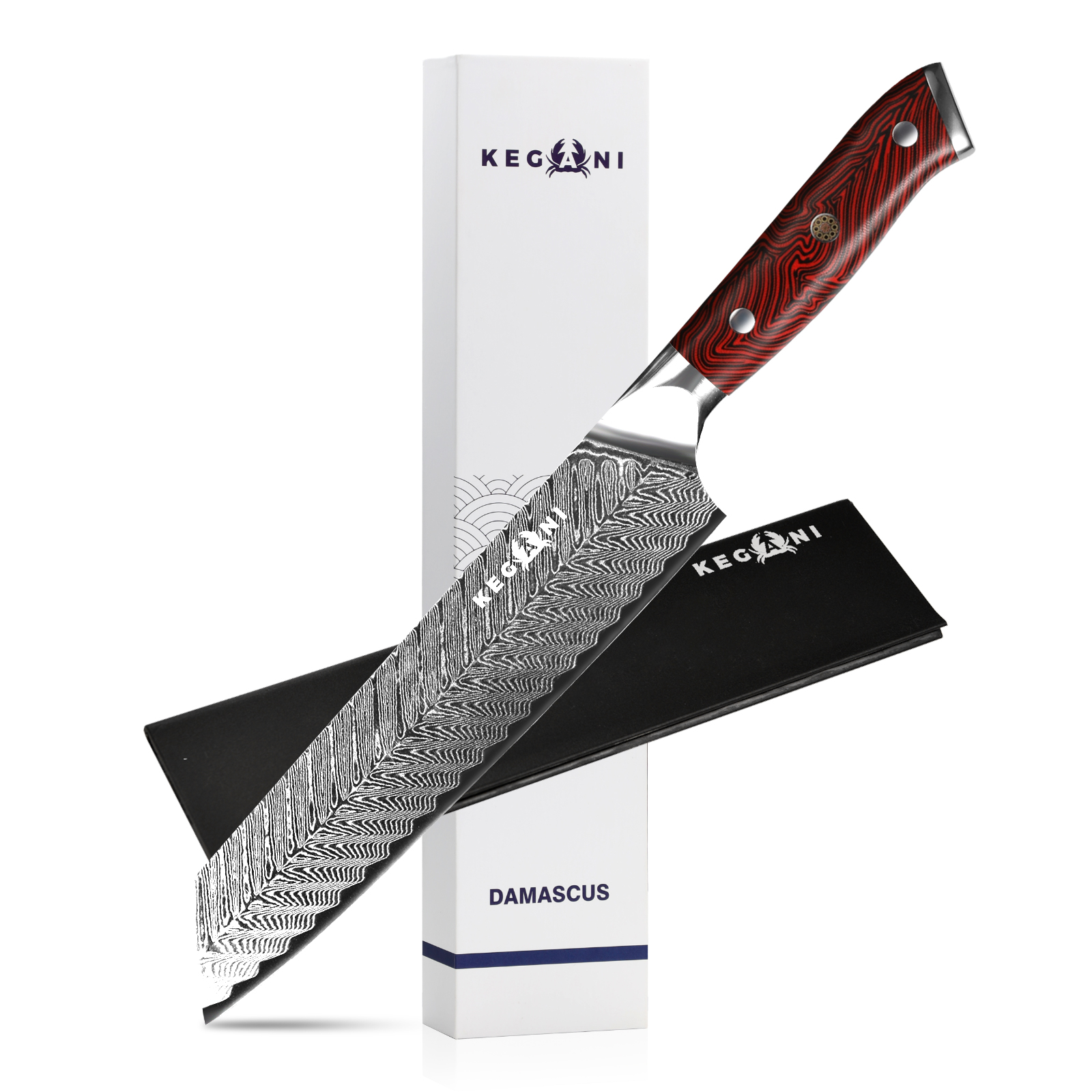 7 Inch Damascus Cleaver$102.99View details
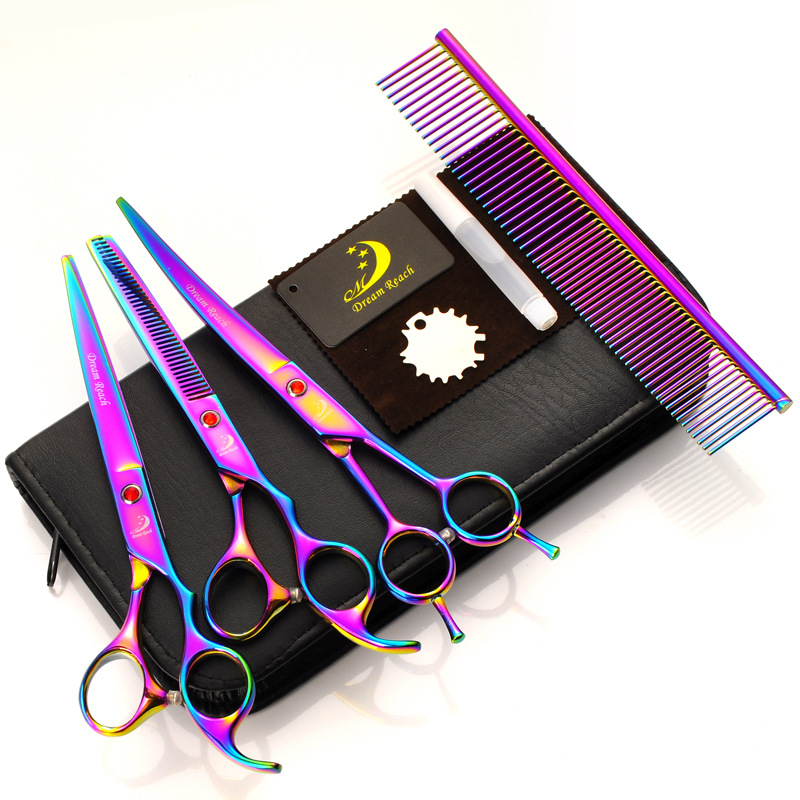 Grooming Shears, 7 Inch$68.99View details
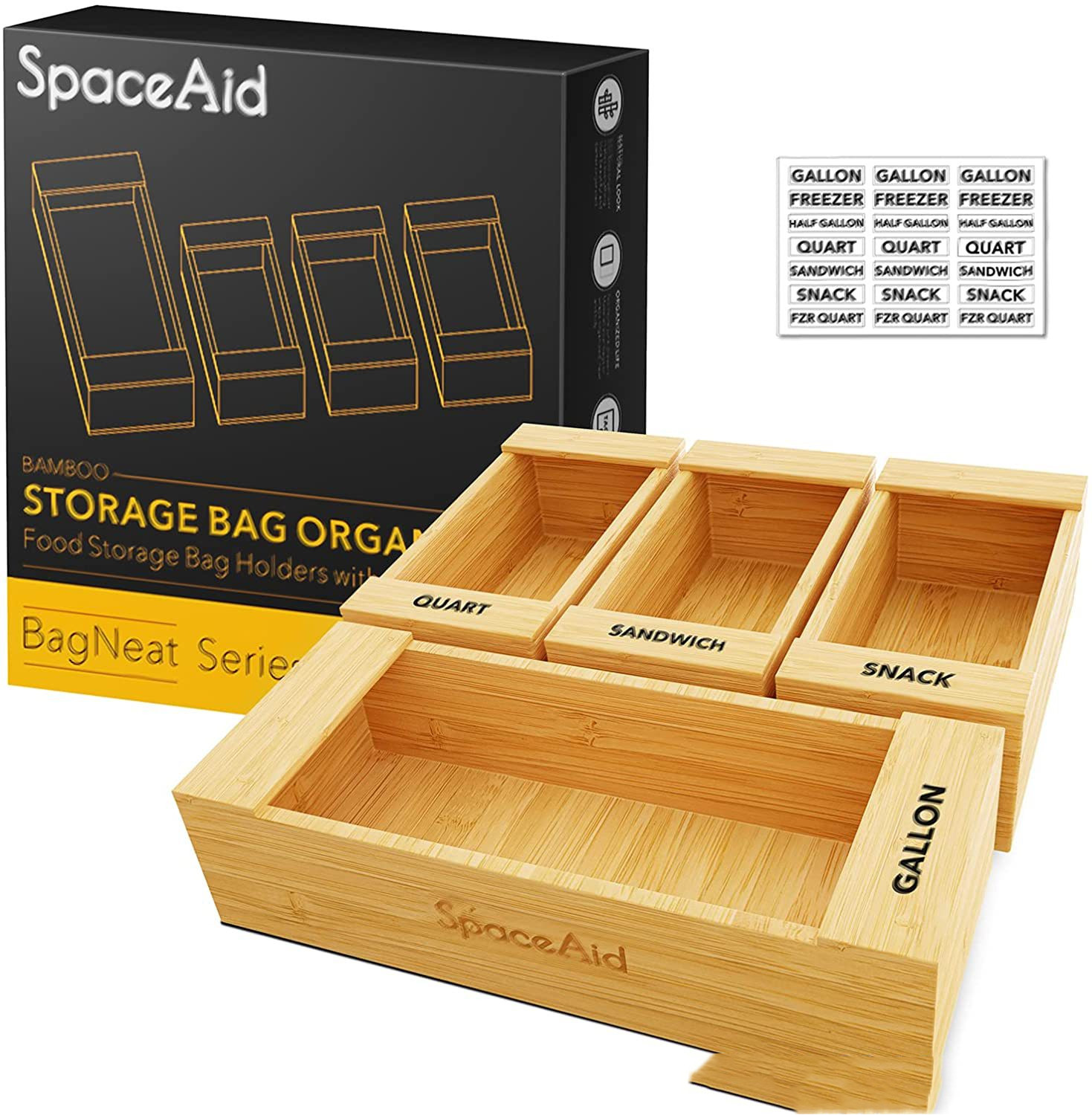 Bamboo Drawer Organizer$53.99View details
The short version: the HRC number tells you how the steel behaves over months, the angle tells you how it behaves in the next five minutes, and the board decides which of the two you notice first. Buy the geometry you can use, then keep it honest with a stone twice a year.
Compare on Amazon — this category usually has more brands, sizes and price points there.
Check current prices on Amazon →
As an Amazon Associate we earn from qualifying purchases. The price you pay is unchanged. Disclosure