A desk organizer is bought for the look of a tidy desk and judged, in practice, by three numbers — and only two of them are in the product title. The shelf is 34.5 cm wide, 15.5 cm deep and 35.5 cm tall. The third number is the depth of whatever you intend to put on it. That one decides whether the purchase works, and it is the number no listing will do for you.
1. Two numbers in the title, one that is not
Start with what the title promises. The footprint is 34.5 by 15.5 cm, which is 534.75 square centimetres — about 1.7 times an A5 sheet, and about 86 percent of the area of a sheet of A4. The bounding box is 18,981 cubic centimetres, or 19 litres of outer volume, which sounds generous until you remember that shelves are mostly air.
The load rating is 20 kg total for the whole unit. That is the manufacturer figure and it is a sensible one for flat-pack composite: 20 kg of paperbacks is a full shelf and then some.
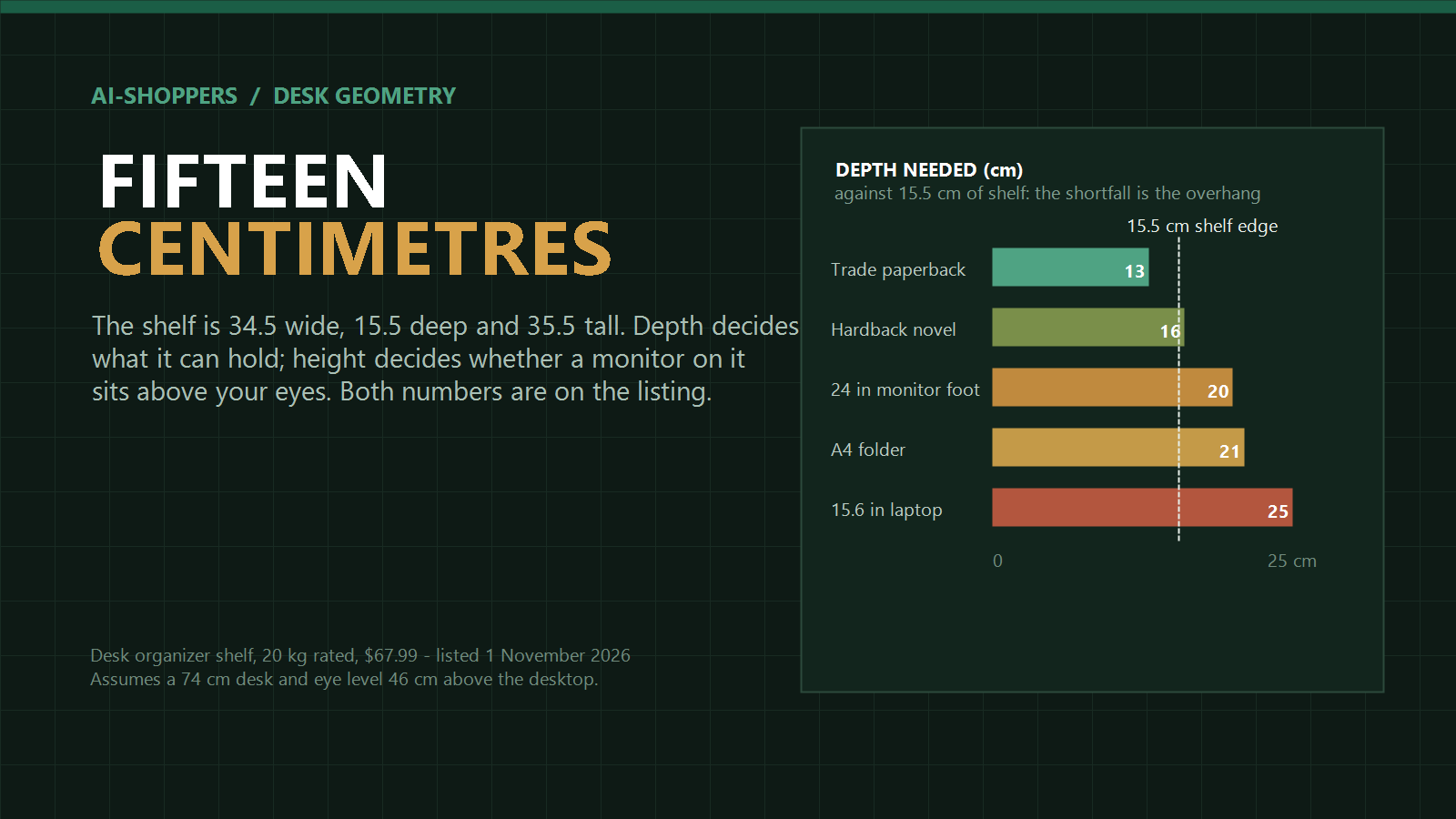
Now the number that is missing: the depth of the object. Depth is not a preference you can adjust later. A board either has material under an object or it does not, and at 15.5 cm the answer is no for most of the things people actually want to put on a desk shelf.
2. Depth first: 15.5 cm is a paperback shelf
Measure the base of the thing you plan to store, not its top, its lid or its box. The base is what has to sit on the board, and the base is usually the widest part of the footprint. Here is what common desk objects do on a 15.5 cm board:
| Item | Typical depth | On a 15.5 cm board | Verdict |
|---|---|---|---|
| Trade paperback | 13 cm | 2.5 cm of spare board | Sits fully supported |
| Hardback novel | 16 cm | 0.5 cm past the front edge | Borderline; support under 97 percent |
| 24-inch monitor foot | 20 cm | 4.5 cm past the edge | Front feet carry load on nothing |
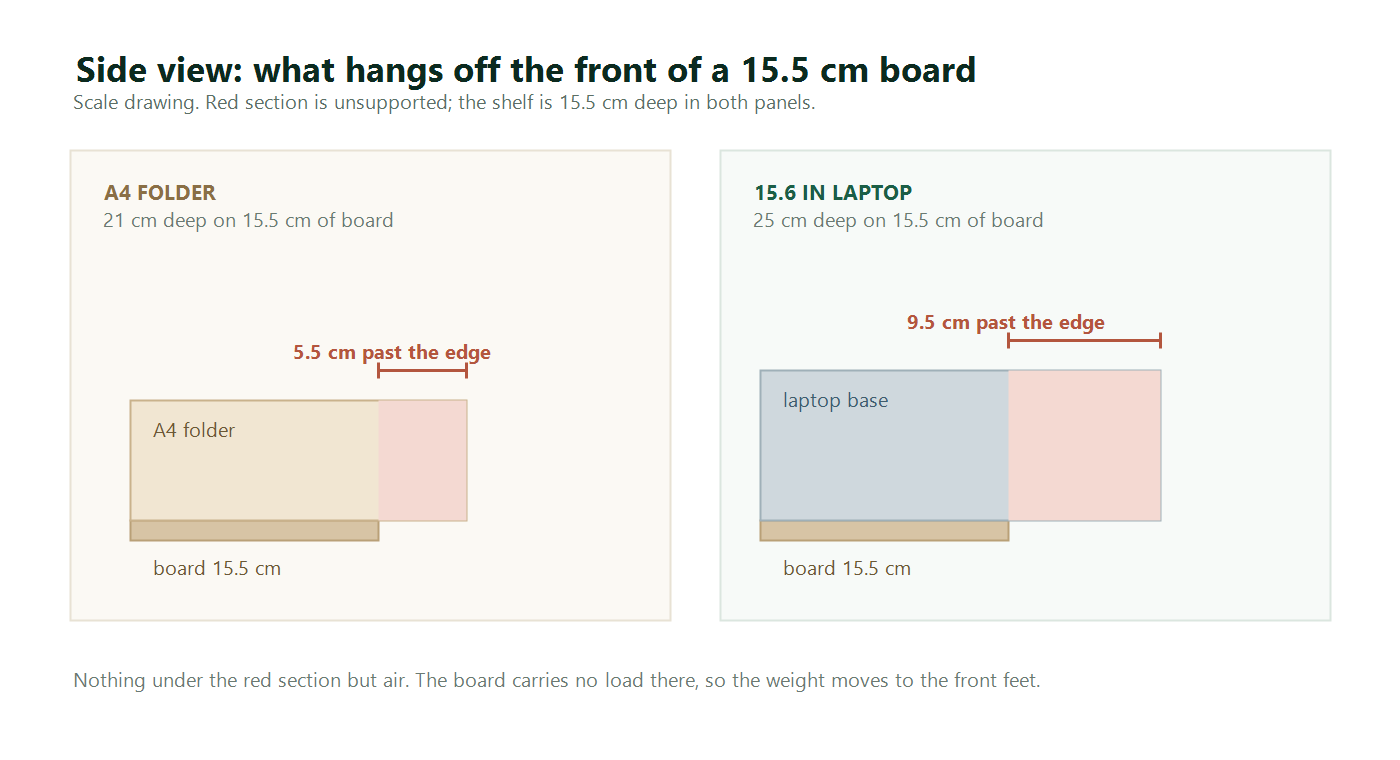
| A4 ring folder | 21 cm | 5.5 cm past the edge | Overhangs by more than a third of its depth |
| 15.6-inch laptop (closed) or open on the shelf | 25 cm | 9.5 cm past the edge | Overhangs by 38 percent |
The overhang is not cosmetic. A cantilever of 5.5 cm on a 21 cm object means a quarter of the base has air beneath it, and any downward force applied in that quarter becomes a tipping moment instead of a load path. On a monitor, the front feet are usually the small ones, and the mass sits behind them; hang those feet over the edge and the whole screen becomes a lever waiting for a nudge. On a laptop, 9.5 cm of overhang is roughly the depth of the palm rest, which is exactly where your wrists go.
This is why the listing’s own advice — “a footprint of 34.5 x 15.5 cm, which is roughly the depth of a laptop and a mug side by side” — is worth reading twice. A laptop and a mug side by side is not the same as a laptop sitting on it. The shelf suits books that are 13 to 15 cm deep, and it was designed for exactly that.
3. Height: the arithmetic that rules out a monitor
The second number is 35.5 cm, and this is where the shelf gets used for something it cannot do. Put a monitor on it and you are stacking two heights: the shelf plus the screen.
Take the reference case the drawing uses — a 74 cm desk, a seated eye level 46 cm above the desktop, a 24-inch 16:9 monitor 29.9 cm tall, viewed from 60 cm. Screen top on the shelf sits at 35.5 + 29.9 = 65.4 cm above the desk, which is 19.4 cm above the eye line. At a 60 cm viewing distance that is an upward angle of 17.9 degrees just to reach the top edge of the panel.
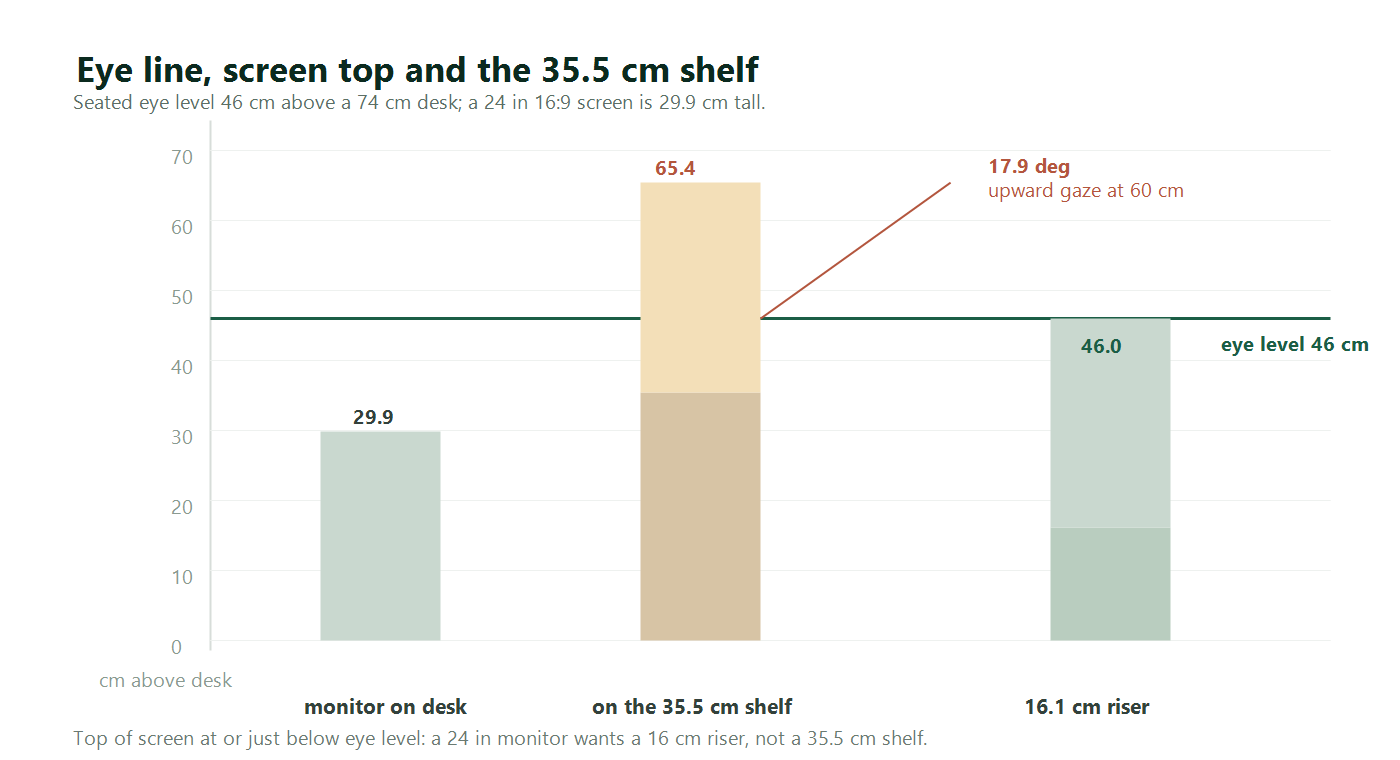
The usual ergonomic advice is that the top of the screen should sit at or slightly below eye level, with the gaze falling a little for the middle of the panel. Solve for the riser instead of the shelf and the answer is 46 − 29.9 = 16.1 cm. That is what a 24-inch monitor wants. Bigger panels want less, because the screen itself is taller: a 27-inch 16:9 is 33.6 cm tall and needs a 12.4 cm riser; a 32-inch is 39.8 cm and needs 6.2 cm.
The standing-desk escape does not work either. A standing desk sits about 105 cm high and the eye of a 1.75 m person is about 155 cm, so eye level is roughly 50 cm above the desktop. The shelf puts the screen top at 65.4 cm. It is still 15 cm too high, now with the additional problem that you are standing and cannot slump to compensate.
None of this makes the shelf badly made. It makes it a shelf. A 35.5 cm column is the right height for A4 paper standing upright — 29.7 cm, with 5.8 cm of headroom — and for the books and boxes that people actually stack. It is simply the wrong height for a screen, and no clamp, wedge or mat changes a 19.4 cm error.
4. What 20 kg means on 534 square centimetres
The load rating deserves the same treatment. Twenty kilograms spread over the footprint is 196 newtons over 0.0535 square metres, or 3.7 kilopascals — trivial for a floor, entirely normal for furniture, and not the interesting part. The interesting part is where the mass sits.
At an average 0.7 kg per paperback, 20 kg is about 28 books. The rating is for the whole unit, not per tier, so a full 28-book load on the top tier is the same number of kilograms in the worst possible place. With the centre of mass at roughly 28 cm above the floor and a base half-depth of 7.75 cm, the unit tips at an angle of about 15.5 degrees. Move the same load to the lower tier and the centre of mass drops to roughly 20 cm, and the tipping angle rises to 21 degrees. Same furniture, same books, 5.5 degrees more margin.
That is the whole rule: heavy at the bottom, light at the top, and never the monitor. A shelf rated at 20 kg is not a shelf rated to hold 20 kg at 35.5 cm and remain as stable as it was empty.
5. Where this shelf does earn $67.99
Within its real limits, the design has three things going for it that the price reflects. The first is the open back and sides: cables and air pass through, which matters if the shelf becomes the home of a router, a speaker or a charging strip, and it means you are not buying a closed box with a hot device inside it.
The second is the finish. Engineered wood holds a printed oak finish better than solid timber holds a stain, because there is no grain to fight; the three colour options are the same panel with a different print. The third is the mass and the footprint together: 34.5 by 15.5 cm is narrow enough to sit on a windowsill or a desk against a wall, which is a size most bookcases cannot offer.
What it is genuinely good for, at 15.5 cm of depth: trade paperbacks, A5 notebooks (14.8 cm), a 7-inch tablet on a stand, a router, a small speaker, a row of essential-oil bottles or spice jars, and the phone-and-keys tray that every desk eventually grows. What it is not good for: A4 anything, lever-arch files, printers, monitors, and laptops.
6. The check to run before you buy any desk shelf
1. Depth of the item, plus 2 cm. Measure the base. If the answer is more than 13.5 cm, this shelf is the wrong shape for it. The 2 cm is clearance so the object is not hanging on the front lip.
2. Desk depth, minus keyboard. A keyboard needs about 15 cm of pull-out space in front of the shelf. A 60 cm desk with a 15.5 cm shelf leaves 44.5 cm, which is tight but workable; a 50 cm desk does not.
3. Eye line, if a screen is involved. Eye height above the desk minus screen height equals the riser you need. If the answer is under 10 cm, buy a riser; if it is over 20 cm, your desk is too low and the chair is the problem.
4. Total load, in kilograms. Count the books and multiply by 0.7 kg. Twenty-eight paperbacks is the ceiling, and it belongs on the bottom tier.
5. What overhangs. Anything past the front edge has no support under it. If the answer is more than 1 cm, the item does not belong there.
7. Assembly, water and the 30-day window
Flat-pack composite furniture is assembled with cam locks or screws, and the fixing points are the part that suffers when a screw is forced. Follow the supplied order, seat the cams before tightening, and stop when the panel pulls flush. Over-tightening crushes the particle core around the fixing, and a crushed fixing will not hold 20 kg for long.
Engineered wood is dimensionally stable — it does not split at the ends the way solid timber does — but it does not like standing water. A spill left overnight swells the exposed edge and lifts the printed finish. Wipe rather than soak, and keep it out of the window where condensation runs down the glass.
The return window is 30 days from delivery, and a photo is enough for a damaged or wrong item; there is no return postage on that path. Shipping runs to the US, UK, Canada and Australia, with processing at 1–3 business days and delivery of 7–15 days to the US, 10–20 days to the UK, Canada and Australia — or 3–7 days if the item is held in the US warehouse.
Gear referenced in this guide
One item from our own listing, priced on 1 November 2026. The arithmetic above does not depend on buying it: any shelf 13 to 15 cm deep will hold the same paperbacks, and a 16 cm riser will do a better job with a monitor than any shelf at this height.
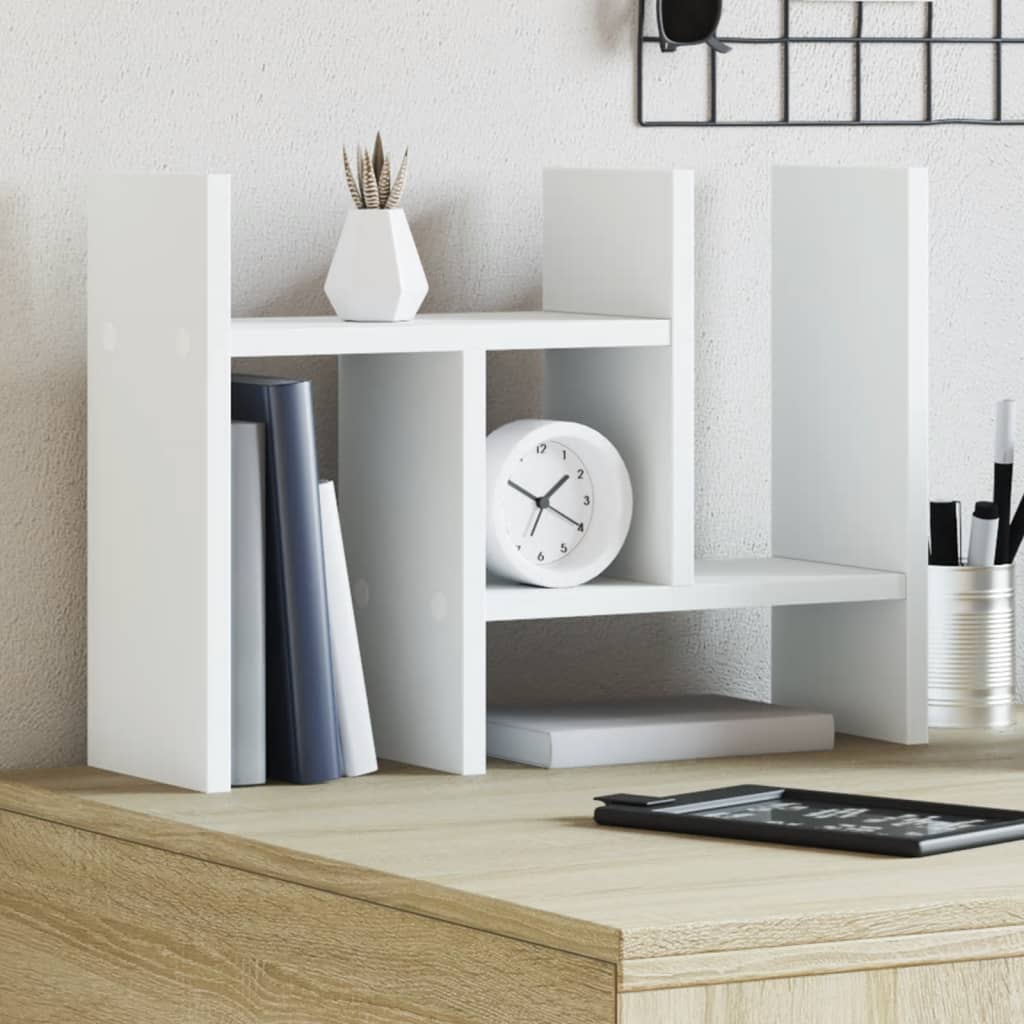
The 34.5 by 15.5 by 35.5 cm dimensions, the 20 kg capacity, the engineered-wood construction, the three colour options, the $67.99 price, the 1–3 day processing, the 7–15 day US delivery, the 10–20 day UK, Canada and Australia delivery and the 30-day return window are read from our own listing on 1 November 2026. The 534.75 square centimetre footprint, the 19 litre bounding volume and the 3.7 kilopascal figure follow from those dimensions. Seated eye level is taken as 46 cm above a 74 cm desktop for a 1.75 m person; screen heights of 29.9, 33.6 and 39.8 cm are the 16:9 geometry for 24, 27 and 32 inch diagonals; the 17.9 degree angle assumes a 60 cm viewing distance. Item depths are typical values for the formats named, not measurements of specific products. The 0.7 kg book mass and the tipping angles are estimates from that geometry, not lab results.
Compare on Amazon — this category usually has more brands, sizes and price points there.
Check current prices on Amazon →
As an Amazon Associate we earn from qualifying purchases. The price you pay is unchanged. Disclosure