Non-Slip: Why Things Slide and the Four Materials That Stop Them
Friction numbers, four materials and why thinner pads grip better than thick foam.
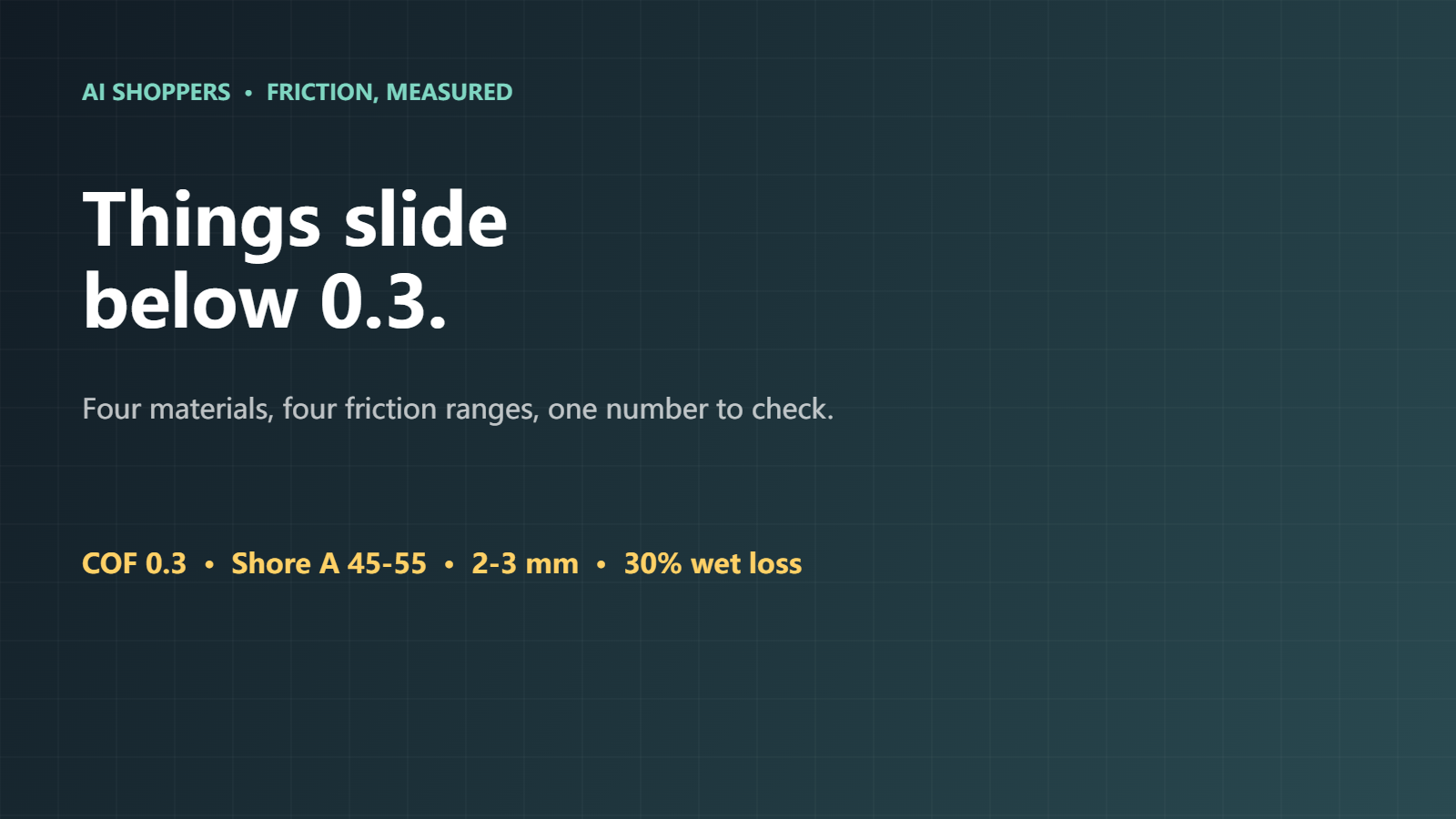
Things slide below a coefficient of friction of about 0.3.
Everything in a drawered, shelved, booted or bathed home eventually slides: the box in the boot, the tray in the drawer, the caddy on the tile. The reason is measurable – a coefficient of friction below about 0.4 against the surface it sits on – and the fix is one of four materials, each with a different grip, lifespan and price. This is the physics of not-sliding, with the numbers that let you choose.
1. Friction, in one number
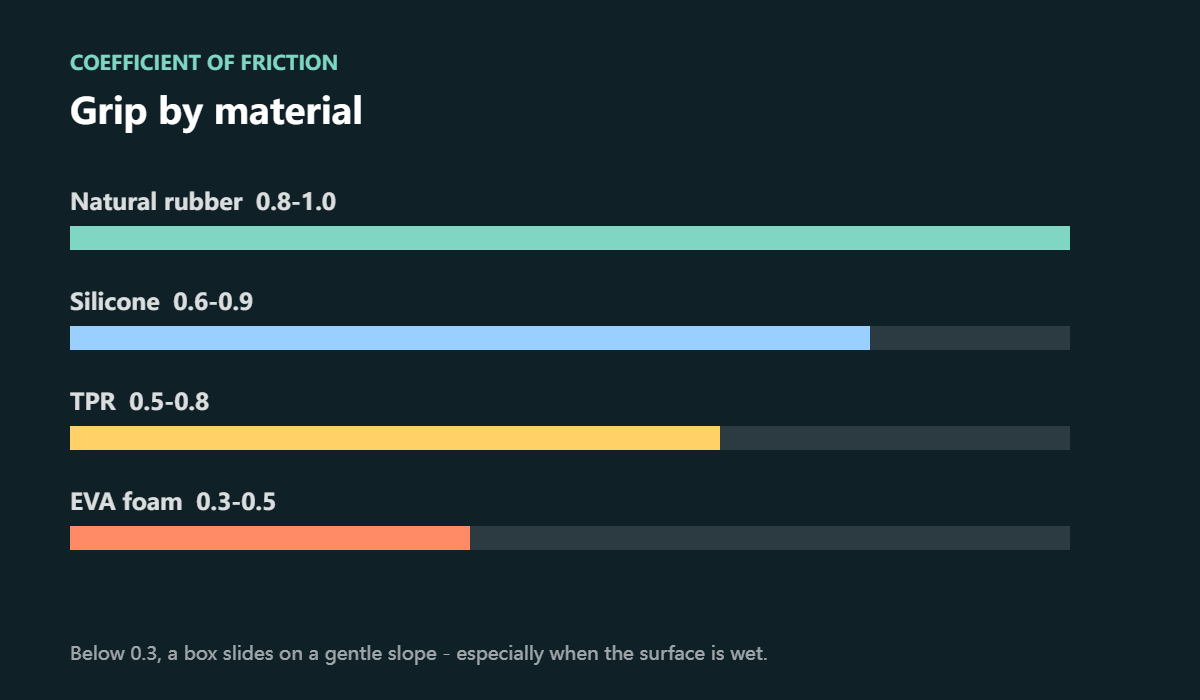
The coefficient of friction (COF) is the ratio between the force needed to start something sliding and the weight pressing it down. Below 0.3, a box slides on a gentle slope; 0.4-0.6 holds against normal vibration; above 0.7 it takes a deliberate push. Wet surfaces drop these numbers by 30-50%, which is why a mat that grips a dry boot floor fails in a rainy one.
2. The four materials
Natural rubber is the grippiest: 0.8-1.0 on dry, 0.5-0.7 wet. It does not age well in sunlight and smells faintly, but for a boot floor or a bath mat it is the best grip per pound.
Silicone sits at 0.6-0.9 and tolerates heat to 200-230 C, which is why it works under a hot pan but is overkill under a storage box. It picks up lint and dust, and a dusty silicone pad grips far less than a clean one.
TPR (thermoplastic rubber) is the middle option: 0.5-0.8, mouldable into complex shapes, cheaper than silicone, and it takes colour well. Most “non-slip” mats on sale are TPR with a textured top.
EVA foam is the weakest: 0.3-0.5 dry and much less when wet. It works as a cushion, not a gripper, which is why foam pads under appliances creep across the floor over months.
3. The comparison that matters
Material
COF dry
COF wet
Heat limit
Best use
Natural rubber
0.8-1.0
0.5-0.7
~70 C
Boot floor, bath mat
Silicone
0.6-0.9
0.4-0.6
200-230 C
Under hot items, sink mats
TPR
0.5-0.8
0.35-0.55
~90 C
General mats, drawer liners
EVA foam
0.3-0.5
0.2-0.3
~80 C
Cushioning, not grip
Grip by material: the four ranges that cover household use.
4. Thickness is not grip
A 2 mm rubber pad grips better than a 10 mm foam one, because grip comes from contact area and material softness, not depth. Thick pads compress and slide on their own base. For a boot floor or a drawer, 2-3 mm of rubber or TPR beats 10 mm of foam every time.
5. Shore A: the hardness number
Rubber and TPR hardness is measured on the Shore A scale. Grippy mats sit at 40-60 Shore A; a 70 Shore A material feels hard and slides more, while below 30 it deforms under load and creeps. If a listing quotes Shore hardness at all, 45-55 is the sweet spot for a non-slip pad.
6. Why wet surfaces break the promise
Water acts as a lubricant film: at 0.2-0.5 mm thickness it separates the pad from the surface and cuts friction by a third or more. That is why “non-slip” bath mats have suction cups rather than relying on friction, and why a boot mat needs drainage channels – to stop the film forming in the first place.
[…] Two companion pieces use the same measured approach: how humidity behaves in a bathroom and when a fan actually clears it (the eight-minute ventilation rule), and why wet floors fail long before the surface wears out (the four materials that stop slipping). […]
[…] Related reading: why 60 percent humidity is the number that matters in a bathroom, and the four materials that actually stop things sliding. […]
[…] Two companion pieces use the same measured approach: how humidity behaves in a bathroom and when a fan actually clears it (the eight-minute ventilation rule), and why wet floors fail long before the surface wears out (the four materials that stop slipping). […]